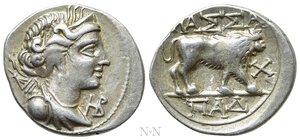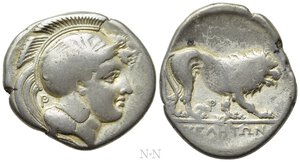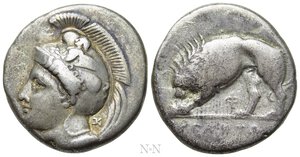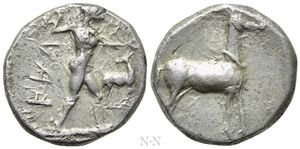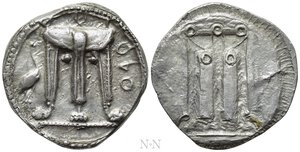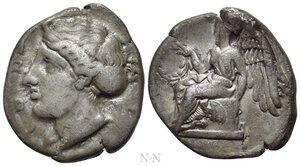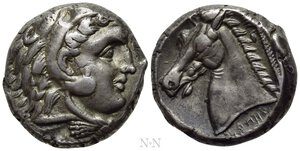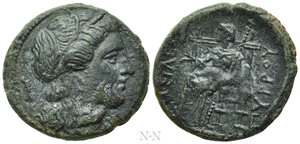
GAUL. Massalia. Drachm (Circa 125-90 BC) - GAUL. Massalia. Drachm (Circa 125-90 BC). Obv: Bust of Artemis right, bow and quiver over shoulder; HB monogram to right.Rev: MAΣΣA / ΠAΔ. Lion advancing right; X to right.Maurel (2019) 715; Depeyrot 55.43. Condition: Good very fine.Weight: 2.72 g. Diameter: 19 mm.
CALABRIA. Tarentum. Litra (Circa 450-430 BC) - CALABRIA. Tarentum. Litra (Circa 450-430 BC). Obv: Scallop shell.Rev: Head of Nymph left.Vlasto 1155ff.; HN Italy 840; HGC 1, 843. Condition: Very fine.Weight: 0.76 g. Diameter: 12 mm.
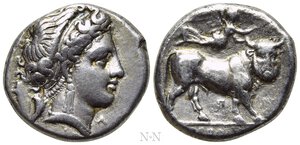
CALABRIA. Tarentum. Nomos (Circa 332-302 BC) - CALABRIA. Tarentum. Nomos (Circa 332-302 BC). Obv: Warrior, holding shield and two spears, and preparing to cast third spear, on horse rearing right; ΣIM below.Rev: TAPAΣ. Phalanthos, holding distaff, riding dolphin left; to left, eagle standing left; below, ΦI above waves.Vlasto 573-7; HN Italy 933; HGC 1, 800. Condition: Good very fine.Weight: 7.87 g. Diameter: 20 mm.
CALABRIA. Tarentum. Drachm (Circa 280-272 BC). Neumenios and Poly-, magistrates - CALABRIA. Tarentum. Drachm (Circa 280-272 BC). Neumenios and Poly-, magistrates. Obv: Head of Athena right, wearing helmet decorated with Skylla throwing stone.Rev: Owl standing right, head facing; NEYMHNIOΣ to left, ΠOΛY and olive branch to right.Vlasto 1058-61; HN Italy 1015; HGC 1, 906. Condition: Good very fine.Weight: 3.26 g. Diameter: 17 mm.
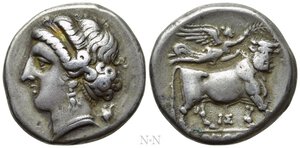
CALABRIA. Tarentum. Drachm (Circa 280-272 BC) - CALABRIA. Tarentum. Drachm (Circa 280-272 BC). Obv: Head of Athena left, wearing crested helmet decorated with Skylla.Rev: TAPANTINΩN. Owl standing right, head facing, on thunderbolt; ΣΩΣ to right.Vlasto 1077-82; HN Italy 1018; HGC 1, 907.Including pre 1950s ticket . Condition: Near very fine.Weight: 3.20 g. Diameter: 16 mm.
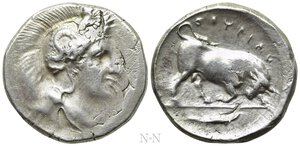
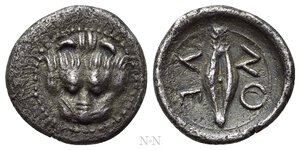
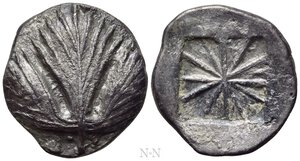
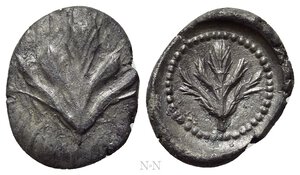
LUCANIA. Metapontion. Obol (Circa 540-510 BC) - LUCANIA. Metapontion. Obol (Circa 540-510 BC). Obv: Ear of barley with five grains.Rev: Incuse ear of barley with five grains.Noe Class III; HN Italy 1469. Condition: Very fine.Weight: 0.32 g. Diameter: 8 mm.
LUCANIA. Metapontion. Ae (Late 3rd century BC) - LUCANIA. Metapontion. Ae (Late 3rd century BC). Obv: Athena Alkidemos advancing left, brandishing spear and shield.Rev: META. Owl standing left on barley ear, head facing.Johnston Bronze 68c; HN Italy 1704; HGC 1, 1113. Condition: Good very fine.Weight: 3.45 g. Diameter: 16 mm.
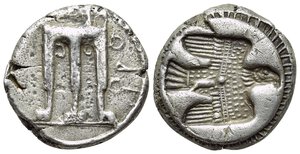
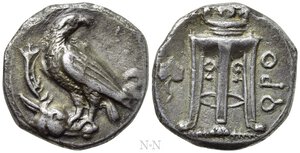
BRUTTIUM. Kroton. Nomos - Stater (Circa 425-350 BC) - BRUTTIUM. Kroton. Nomos - Stater (Circa 425-350 BC). Obv: Eagle standing left on head of stag, head right.Rev: ϘΡΟ. Tripod with legs terminating in lion’s feet; ivy leaf to left.HN Italy 2146; SNG ANS 350-2; HGC 1, 1458.Rare Condition: Very fine.Weight: 7.42 g. Diameter: 21 mm. Rare
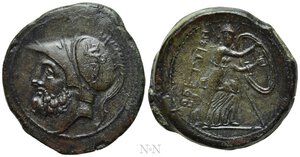
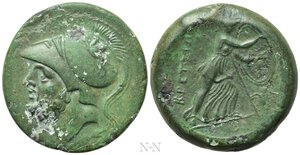
BRUTTIUM. The Brettii. Ae Double or Didrachm (Circa 208-203 BC) - BRUTTIUM. The Brettii. Ae Double or Didrachm (Circa 208-203 BC). Obv: Head of Ares left, wearing crested Corinthian helmet decorated with griffin; thunderbolt below.Rev: BPETTIΩN. Athena advancing right, holding shield and spear; to lower right, owl flying right, head facing.Scheu 40; HN Italy 1987; SNG ANS 97-9. Condition: Very fine.Weight: 17.93 g. Diameter: 28 mm.
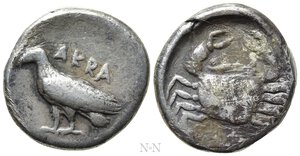
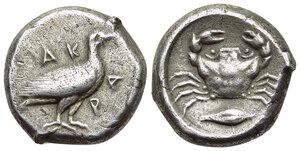
SICILY. Akragas. Didrachm (Circa 480/78-470 BC) - SICILY. Akragas. Didrachm (Circa 480/78-470 BC). Obv: AK / PA. Sea eagle standing right.Rev: Crab; grain ear below; all within incuse circle.Westermark, Coinage, Period I, Group IV, 269 (O89/R182); SNG ANS 956-7; HGC 2, 100.Ex Numismatic Fine Arts (24-25.05.1977), lot 54 Condition: Very fine.Weight: 8.52 g. Diameter: 19 mm.
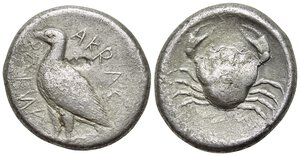
SICILY. Akragas. Tetradrachm (Circa 465/0–445/0 BC) - SICILY. Akragas. Tetradrachm (Circa 465/0–445/0 BC). Obv: AKPAΓANTOΣ. Eagle standing left.Rev: Crab.Westermark Period II, Group II, 343 (O9/R32); SNG ANS 964; HGC 2, 78.Historical sources give the date of Akragas' founding as the 50th Olympiad (585-580 BC), placing it among the last Greek colonies established in Sicily. The settlers probably came from Rhodes and Gela, under the command of the ecists Aristonoo and Pistilos, who located a site not far from the sea on the Akragas River, after which the city was named. During the tyranny of Phalaris (570-555 BC) the city built walls and began an expansionist campaign, later continued by Theron (488-473), who won an important battle victory over the Carthaginians at Himera, gaining a vast territory. From that time Akragas experienced enormous political, economic and cultural development, culminating in the period of democratic rule, which was established after the death of Theron. In 406 BC the city was besieged by the Carthaginians, who finally sacked and burned it several times, without however, favoring the establishment of a Punic colony. With Timoleon's victory over Carthage in 339, the city was rebuilt on the same site, then taken back by the Carthaginians and remained under their influence until 210, when it passed into Roman hands at the end of the Second Punic War. The eagle depicted on the obverse of this coin, and on most of the issues of Akragas, is surely to be related to Zeus, to whom the inhabitants dedicated the most important temple in the city. The crab, on the other hand, which appears on all the reverses, is associated with Poseidon, demonstrating the city's great connection with the sea from the time of its founding, which was important for its economy related to maritime trade. On some silver coins, such as this one, a human face appears on the carapace of the crab, most likely depicting the river god Akragas in an original way. Condition: Near very fine.Weight: 16.62 g. Diameter: 26 mm.
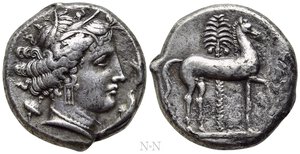
SICILY. Entella. Punic Issues. Tetradrachm (Circa 345/38-320/15 BC) - SICILY. Entella. Punic Issues. Tetradrachm (Circa 345/38-320/15 BC). Obv: Head of Kore right, wearing wreath of grain ears, triple-pendant earring, and pearl necklace; poppy behind neck, two dolphins to right.Rev: Horse walking right; palm tree in background.Jenkins, Punic, Series 2b, 101 (O35/R92); CNP 203a; HGC 2, 275.The foundation of Entella is traced back to Acestes, son of the river god Krimisos and a Trojan woman or, according to other sources to Prince Elymus, son of Anchises and brother of Aeneas. The city stood on a summit overlooking the Belice valley. Records are scarce until the arrival of the Campanian mercenaries, recruited in 410 BC by the Carthaginians and discharged after the 405 BC treaty, then passed into the pay of Dionysius I of Syracuse. After liberating Dionysius on the island of Ortigia from the Punic siege, the were discharged with rich gifts and settled in various cities on the island. In 404 a group of these mercenaries seized Entella, exterminating the entire male population, and began to mint their own coinage. From then on they implemented a generally pro-Carthaginian policy and, in 398 B.C., were able to stop Syracusan siege attempts with the help of the Punic. The strategic location of the fortress of Entella was coveted for its control of the valley below, and this led to several siege attempts: in 345 it was attacked by the Carthaginians led by General Annon, then in 342 the city was taken by the Syracusans commanded by Timoleon, but in 338 it fell back under Punic influence. During the First Punic War the city was destroyed by the Carthaginians. The “Decrees of Entella,” which were requests for help engraved on bronze slabs, from the inhabitants to neighboring cities, date from this period. In 263 Entella was conquered by the Romans and enjoyed a new period of prosperity until the second century BC when it was abandoned. Condition: Very fine.Weight: 16.25 g. Diameter: 24 mm.
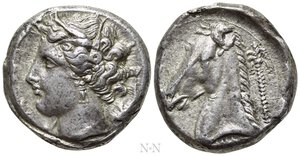
SICILY. Entella. Punic issues. Tetradrachm (Circa 300-289 BC) - SICILY. Entella. Punic issues. Tetradrachm (Circa 300-289 BC). Obv: Head of Herakles right, wearing lion skin.Rev: Head of horse left; palm tree to right; Punic legend below.CNP 272; HGC 2, 295.The foundation of Entella is traced back to Acestes, son of the river god Krimisos and a Trojan woman or, according to other sources to Prince Elymus, son of Anchises and brother of Aeneas. The city stood on a summit overlooking the Belice valley. Records are scarce until the arrival of the Campanian mercenaries, recruited in 410 BC by the Carthaginians and discharged after the 405 BC treaty, then passed into the pay of Dionysius I of Syracuse. After liberating Dionysius on the island of Ortigia from the Punic siege, the were discharged with rich gifts and settled in various cities on the island. In 404 a group of these mercenaries seized Entella, exterminating the entire male population, and began to mint their own coinage. From then on they implemented a generally pro-Carthaginian policy and, in 398 B.C., were able to stop Syracusan siege attempts with the help of the Punic. The strategic location of the fortress of Entella was coveted for its control of the valley below, and this led to several siege attempts: in 345 it was attacked by the Carthaginians led by General Annon, then in 342 the city was taken by the Syracusans commanded by Timoleon, but in 338 it fell back under Punic influence. During the First Punic War the city was destroyed by the Carthaginians. The “Decrees of Entella,” which were requests for help engraved on bronze slabs, from the inhabitants to neighboring cities, date from this period. In 263 Entella was conquered by the Romans and enjoyed a new period of prosperity until the second century BC when it was abandoned. Condition: Very fine.Weight: 17.38 g. Diameter: 23 mm.
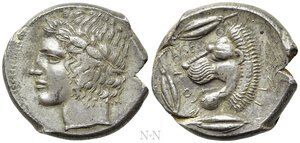
SICILY. Leontini. Tetradrachm (Circa 430-425 BC) - SICILY. Leontini. Tetradrachm (Circa 430-425 BC). Obv: Laureate head of Apollo left.Rev: LEONTINON. Lion head left with open jaws; three barleycorns and laurel leaf around.Boehringer 55 (same dies); SNG ANS 257 (same dies); HGC 2, 671. Condition: Good very fine.Weight: 17.49 g. Diameter: 26 mm.
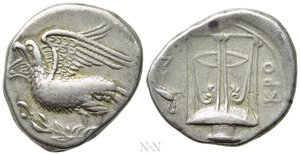
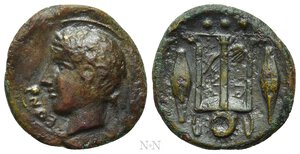
SICILY. Leontinoi. Ae Tetras (Circa 405-402 BC) - SICILY. Leontinoi. Ae Tetras (Circa 405-402 BC). Obv: ΛEON. Laureate head of Apollo left; ivy leaf and berry to left.Rev: Tripod; lyre behind central leg; barley grain to left and right; three pellets in exergue.CNS 1; SNG ANS -; SNG Copenhagen 361; HGC 2, 709. Condition: Very fine.Weight: 1.73 g. Diameter: 15 mm.
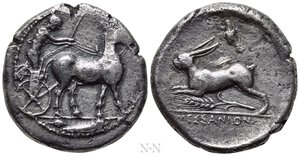
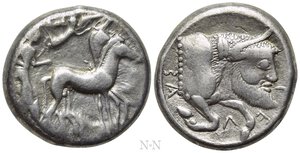
SICILY. Messana. Tetradrachm (Circa 412-408 BC) - SICILY. Messana. Tetradrachm (Circa 412-408 BC). Obv: The nymph Messana, holding kentron and reins, driving slow biga of mules right; laurel leaf in exergue.Rev: MEΣΣANION. Hare springing left; above, dove flying left; grain ear below.Cf. Caltabiano 617-8; HGC 2, 798 var. (hare right).Extremely rareFrom the A. Signorelli collection, ex Santamaria (25.10.1951), lot 316 Condition: Very fine.Weight: 16.56 g. Diameter: 26 mm. Extremely rare
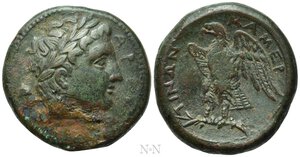
SICILY. Messana. The Mamertinoi. Ae Quadruple Unit (275-264 BC) - SICILY. Messana. The Mamertinoi. Ae Quadruple Unit (275-264 BC). Obv: APEOΣ. Laureate head of Ares right; helmet to left.Rev: MAMERTINΩN. Eagle standing left on thunderbolt, with wings spread.CNS 3; SNG ANS 402; HGC 2, 865.From the J.P. Righetti Collection, 9350; ex Classical Numismatic Group E-224 (2009), lot 27 Condition: Very fine.Weight: 17.37 g. Diameter: 27 mm.
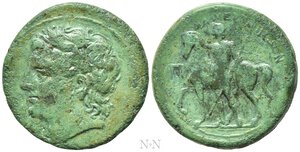
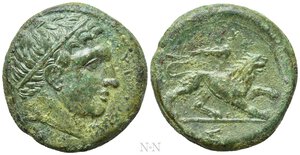
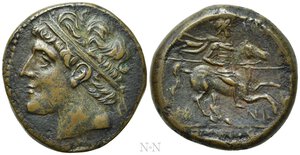
SICILY. Messana. The Mamertinoi. Ae Pentonkion (211-208 BC) - SICILY. Messana. The Mamertinoi. Ae Pentonkion (211-208 BC). Obv: Laureate head of Ares left.Rev: MAMEPTINΩN. Warrior standing left, holding spear and leading horse left; Π (mark of value) to left.CNS 25; SNG ANS 423-6; HGC 2, 849. Condition: Good fine.Weight: 11.57 g. Diameter: 27 mm.
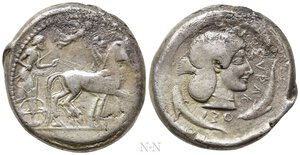
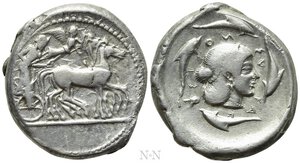
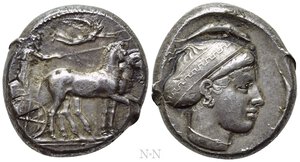
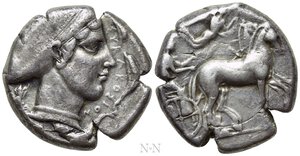
SICILY. Syracuse. Second Democracy (466-405 BC). Tetradrachm - SICILY. Syracuse. Second Democracy (466-405 BC). Tetradrachm. Obv: Charioteer driving quadriga right; above, Nike flying right, crowning horses.Rev: ΣVRAKOΣION. Diademed head of Arethousa right, hair in sakkos; four dolphins around.Boehringer Series 647 (V328/R444); SNG ANS 211; HGC 2, 1319. Condition: Near very fine.Weight: 17.10 g. Diameter: 24 mm.
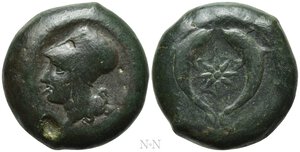
SICILY. Syracuse. Dionysios I (405-367 BC). Ae Drachm - SICILY. Syracuse. Dionysios I (405-367 BC). Ae Drachm. Obv: ΣYPA. Head of Athena left, wearing Corinthian helmet with bowl decorated with wreath.Rev: Sea-star between two dolphins.CNS 62; SNG ANS 454ff.; HGC 2, 1436. Condition: Good fine.Weight: 31.07 g. Diameter: 29 mm.
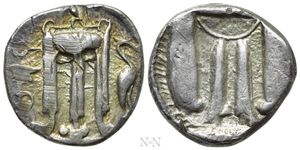
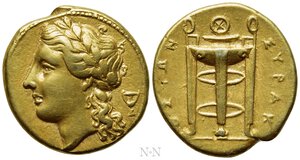
SICILY. Syracuse. Agathokles (317-289 BC). EL 25 Litrai or Hemistater - SICILY. Syracuse. Agathokles (317-289 BC). EL 25 Litrai or Hemistater. Obv: Laureate head of Apollo left; kantharos to right.Rev: ΣYPAKOΣIΩN. Tripod with legs terminating in lion’s feet.Jenkins, Electrum, Group B; BAR Issue 10; HGC 2, 1294.Ex Frank Sternberg XVII (1986), lot 71 Condition: Very fine.Weight: 3.57 g. Diameter: 16 mm.
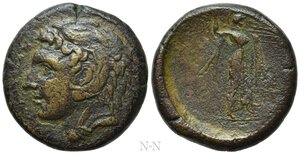
SICILY. Syracuse. Pyrrhos (Circa 278-276 BC). Ae Litra - SICILY. Syracuse. Pyrrhos (Circa 278-276 BC). Ae Litra. Obv: ΣΥΡΑΚΟΣΙΩΝ. Head of Herakles left, wearing lion skin.Rev: Athena advancing right, holding spear and shield; uncertain symbol to right.CNS 175; HGC 2, 1450.From the J.P. Righetti Collection, 10432; ex Classical Numismatic Group E-214 (2009), lot 57 Condition: Near very fine.Weight: 10.51 g. Diameter: 23 mm.
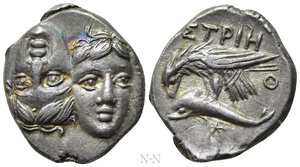
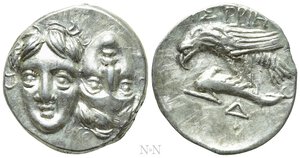
MOESIA. Istros. Drachm (4th century BC) - MOESIA. Istros. Drachm (4th century BC). Obv: Facing male heads, the left inverted.Rev: ΙΣΤΡΙΗ. Sea eagle left, grasping dolphin with talons; Θ above tail feathers, K below dolphin.SNG BM Black Sea 233 var. (no letter below dolphin); SNG Stancomb 142 var. (same); HGC 3.2, 1801; Numismatik Naumann 130, lot 82. Condition: Near extremely fine.Weight: 5.60 g. Diameter: 19 mm.