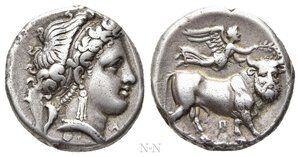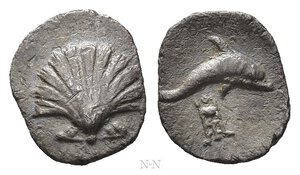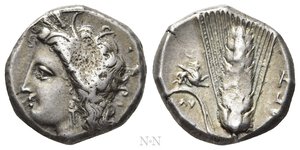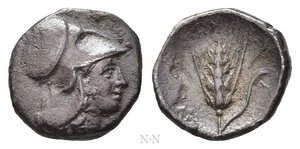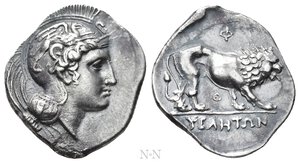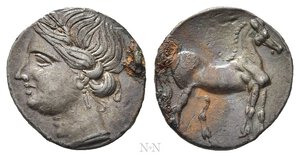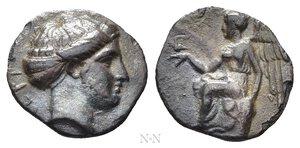
CAMPANIA. Neapolis. Nomos - Didrachm (Circa 300-275 BC) - CAMPANIA. Neapolis. Nomos - Didrachm (Circa 300-275 BC). Obv: Head of nymph right, wearing triple-pendant earring and pearl necklace; cornucopia behind, A below chin.Rev: NEAΠOΛITΩN. Man-headed bull standing right, head facing; above, crowning Nike flying right; Π below.Sambon 479; HN Italy 579; HGC 1, 453.Neapolis, the ‘new city’ founded by the Cumans, soon assumed a leading political and economic role in Campania. The city chose as its monetary emblem the head of Partenope, one of the sirens who killed herself with her sisters for failing to seduce Odysseus with her song. According to the myth, her body was found by the people of Neapolis, who honored her tomb and celebrated her every year with night races, in which athletes competed with evocative lit torches.
The reverse side features a bull with a human face, representing the river Achelous, father of the siren Partenope. These types remained on the coins of Neapolis for the entire duration of silver production, from the 5th to the 3rd century BC. Condition: Very fine.Weight: 7.16 g. Diameter: 20 mm.
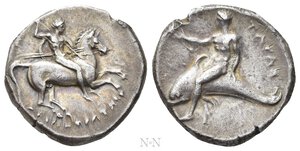
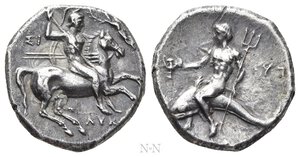
CALABRIA. Tarentum. Nomos (Circa 302-280 BC) - CALABRIA. Tarentum. Nomos (Circa 302-280 BC). Obv: Warrior, holding shield and two spears, and preparing to cast third spear, on horse rearing right; ΣΙ to left, ΔEINOKPATHΣ below.Rev: TAPAΣ. Phalanthos, holding small dolphin, riding dolphin left.Vlasto 692-3; HN Italy 967; HGC 1, 816.Ex Bertolami 67 (2019), lot 9 Condition: Extremely fine.Weight: 7.54 g. Diameter: 22 mm.
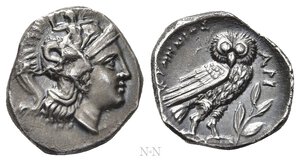
CALABRIA. Tarentum. Drachm (Circa 280-272 BC). Neumenios and Ari-, magistrates - CALABRIA. Tarentum. Drachm (Circa 280-272 BC). Neumenios and Ari-, magistrates. Obv: Helmeted head of Athena right; helmet decorated with Skylla.Rev: NEYMINIOΣ / API. Owl standing right on olive branch, head facing.Vlasto 1062; HN Italy 1015; HGC 1, 906.Ex Jean Elsen & ses Fils 141 (2019), lot 2 Condition: Extremely fine.Weight: 3.16 g. Diameter: 17 mm.
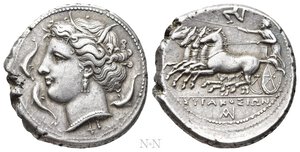
CALABRIA. Tarentum. Nomos (Circa 280-272 BC) - CALABRIA. Tarentum. Nomos (Circa 280-272 BC). Obv: Warrior on horseback right, holding shield and spears, preparing to cast spear downward; ΣΙ to left; to right, Nike flying left, crowning horse with wreath; ΛΥΚΩΝ below.Rev: TAPAΣ. Phalanthos astride dolphin left, holding kantharos and trident; retrograde ΓΥ to right.Vlasto 727-8; HN Italy 1004; HGC 1, 883.Ex Bertolami 67 (2019), lot 10 Condition: Good very fine.Weight: 6.43 g. Diameter: 20 mm.
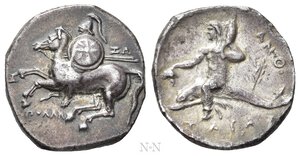
CALABRIA. Tarentum. Nomos (Circa 280-272 BC) - CALABRIA. Tarentum. Nomos (Circa 280-272 BC). Obv: Warrior on horseback left, holding shield decorated with star and two spears; ZΩ to upper right, AΠOΛΛΩ to lower left.Rev: TAPAΣ. Taras riding on dolphin left, holding grapes and distaff over shoulder; laurel branch and ANΘ to right.Vlasto 798; HN Italy 1013; HGC 1, 887.Ex Bertolami 67 (2019), lot 12 Condition: Good very fine.Weight: 6.29 g. Diameter: 21 mm.
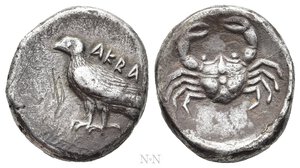
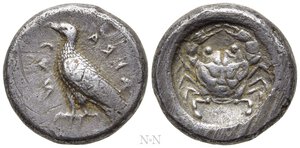
SICILY. Akragas. Didrachm (Circa 485-480/78 BC) - SICILY. Akragas. Didrachm (Circa 485-480/78 BC). Obv: AKRA - CAS. Sea eagle standing left.Rev: Crab, with carapace in the form of a human face, within incuse circle.Westermark 164 (O68/R111); SNG Copenhagen 28 (same dies); SNG Lockett 703 (same dies); HGC 2, 94.Historical sources give the date of Akragas' founding as the 50th Olympiad (585-580 BC), placing it among the last Greek colonies established in Sicily. The settlers probably came from Rhodes and Gela, under the command of the ecists Aristonoo and Pistilos, who located a site not far from the sea on the Akragas River, after which the city was named. During the tyranny of Phalaris (570-555 BC) the city built walls and began an expansionist campaign, later continued by Theron (488-473), who won an important battle victory over the Carthaginians at Himera, gaining a vast territory. From that time Akragas experienced enormous political, economic and cultural development, culminating in the period of democratic rule, which was established after the death of Theron. In 406 BC the city was besieged by the Carthaginians, who finally sacked and burned it several times, without however, favoring the establishment of a Punic colony. With Timoleon's victory over Carthage in 339, the city was rebuilt on the same site, then taken back by the Carthaginians and remained under their influence until 210, when it passed into Roman hands at the end of the Second Punic War. The eagle depicted on the obverse of this coin, and on most of the issues of Akragas, is surely to be related to Zeus, to whom the inhabitants dedicated the most important temple in the city. The crab, on the other hand, which appears on all the reverses, is associated with Poseidon, demonstrating the city's great connection with the sea from the time of its founding, which was important for its economy related to maritime trade. On some silver coins, such as this one, a human face appears on the carapace of the crab, most likely depicting the river god Akragas in an original way Condition: Very fine.Weight: 8.83 g. Diameter: 19 mm.
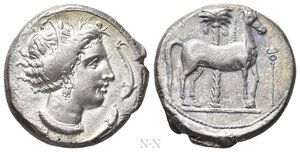
SICILY. Entella. Punic Issues. Tetradrachm (Circa 345/38-320/15 BC) - SICILY. Entella. Punic Issues. Tetradrachm (Circa 345/38-320/15 BC). Obv: Wreathed head of Arethusa right, wearing triple-pendant earring and necklace; three dolphins around; 'Tanit symbol' to left.Rev: Horse standing right; palm tree in background, kerykeion to right.Jenkins, Punic 89 (O31/R80); SNG Lloyd 1619–20 (same dies); SNG Lockett 1039 (same dies).The foundation of Entella is traced back to Acestes, son of the river god Krimisos and a Trojan woman or, according to other sources to Prince Elymus, son of Anchises and brother of Aeneas. The city stood on a summit overlooking the Belice valley. Records are scarce until the arrival of the Campanian mercenaries, recruited in 410 BC by the Carthaginians and discharged after the 405 BC treaty, then passed into the pay of Dionysius I of Syracuse. After liberating Dionysius on the island of Ortigia from the Punic siege, the were discharged with rich gifts and settled in various cities on the island. In 404 a group of these mercenaries seized Entella, exterminating the entire male population, and began to mint their own coinage. From then on they implemented a generally pro-Carthaginian policy and, in 398 B.C., were able to stop Syracusan siege attempts with the help of the Punic. The strategic location of the fortress of Entella was coveted for its control of the valley below, and this led to several siege attempts: in 345 it was attacked by the Carthaginians led by General Annon, then in 342 the city was taken by the Syracusans commanded by Timoleon, but in 338 it fell back under Punic influence. During the First Punic War the city was destroyed by the Carthaginians. The “Decrees of Entella,” which were requests for help engraved on bronze slabs, from the inhabitants to neighboring cities, date from this period. In 263 Entella was conquered by the Romans and enjoyed a new period of prosperity until the second century BC when it was abandoned. Condition: Very fine.Weight: 16.31 g. Diameter: 26 mm.
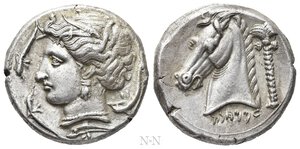
SICILY. Entella. Punic Issues. Tetradrachm (Circa 320/15-300 BC) - SICILY. Entella. Punic Issues. Tetradrachm (Circa 320/15-300 BC). Obv: Head of Arethousa left, wearing grain-ear wreath, earring and necklace; four dolphins around.Rev: Head of horse left; palm tree to right.Jenkins, Punic, 189 (O55/R166); CNP 267; HGC 2, 284.Ex Sotheby's - Numismatic Fine Arts (27-28 October 1993), lot 307.
The foundation of Entella is traced back to Acestes, son of the river god Krimisos and a Trojan woman or, according to other sources to Prince Elymus, son of Anchises and brother of Aeneas. The city stood on a summit overlooking the Belice valley. Records are scarce until the arrival of the Campanian mercenaries, recruited in 410 BC by the Carthaginians and discharged after the 405 BC treaty, then passed into the pay of Dionysius I of Syracuse. After liberating Dionysius on the island of Ortigia from the Punic siege, the were discharged with rich gifts and settled in various cities on the island. In 404 a group of these mercenaries seized Entella, exterminating the entire male population, and began to mint their own coinage. From then on they implemented a generally pro-Carthaginian policy and, in 398 B.C., were able to stop Syracusan siege attempts with the help of the Punic. The strategic location of the fortress of Entella was coveted for its control of the valley below, and this led to several siege attempts: in 345 it was attacked by the Carthaginians led by General Annon, then in 342 the city was taken by the Syracusans commanded by Timoleon, but in 338 it fell back under Punic influence. During the First Punic War the city was destroyed by the Carthaginians. The “Decrees of Entella,” which were requests for help engraved on bronze slabs, from the inhabitants to neighboring cities, date from this period. In 263 Entella was conquered by the Romans and enjoyed a new period of prosperity until the second century BC when it was abandoned. Condition: Near extremely fine.Weight: 17.11 g. Diameter: 26 mm.
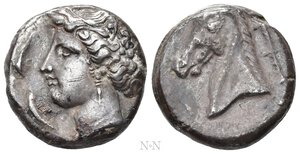
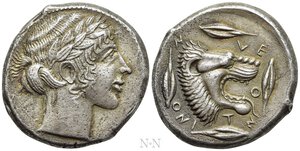
SICILY. Entella. Punic Issues. Tetradrachm (Circa 320/15-300 BC) - SICILY. Entella. Punic Issues. Tetradrachm (Circa 320/15-300 BC). Obv: Head of Arethousa left, wearing grain-ear wreath; three dolphins around.Rev: Head of horse left; palm tree to right.CNP 264-7; HGC 2, 284-9. Condition: Very fine.Weight: 16.28 g. Diameter: 23 mm.
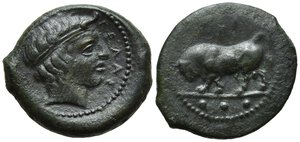
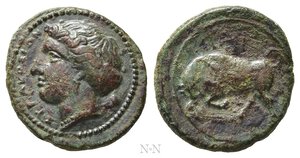
SICILY. Gela. Tetras (Circa 420-405 BC) - SICILY. Gela. Tetras (Circa 420-405 BC). Obv: Bull advancing left; three pellets in exergue.Rev: ΓΕΛΑΣ. Head of young river god right.CNS 15; HGC 2, 379. Condition: Good very fine.Weight: 3.90 g. Diameter: 19 mm.
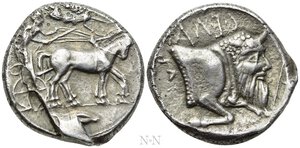
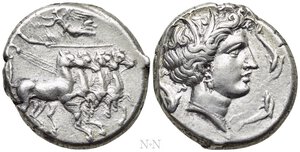
SICILY. Lilybaion (as ‘Cape of Melkart’). Tetradrachm (Circa 330-305 BC) - SICILY. Lilybaion (as ‘Cape of Melkart’). Tetradrachm (Circa 330-305 BC). Obv: Charioteer driving quadriga right, holding kentron and reins; Nike flying left above, crowning charioteer.Rev: Head of Arethusa right, wearing triple-pendant earring and necklace; surrounded by three dolphins.Jenkins, Punic 51; CNP 310; HGC 2, 741.Lilybaion was located at the site of today's Marsala on the western tip of Sicily. The name, literally 'facing Libya' is a direct reference to the geographical location. The city was founded in 397 BC by refugees who survived the destruction of Motya by Dionysius I, who created an important centre thanks to its strategic position and impregnable stronghold, which was later reinforced by the Carthaginians. The fortress was able to resist Pyrrhus in 276 BC and the almost ten-year siege by the Romans during the First Punic War.
Following the Roman victory against the Carthaginians and the Treaty of Eryx, the city passed to the Romans and took the name Lilybaeum, continuing to play an important military and commercial role in the Republican period. Its naval base was used by Scipio to finally destroy Carthage. It was also an important base for Julius Caesar during his civil war against Pompey.
The abundance, style and coin types minted by Lilybaion testify to the wealth and importance achieved by the city in the Punic period. Condition: Good very fine.Weight: 17.40 g. Diameter: 26 mm.
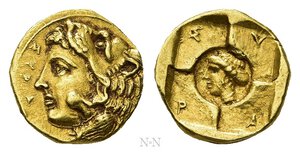
SICILY. Syracuse. Dionysios I (405-367 BC). GOLD 20 Litrai - SICILY. Syracuse. Dionysios I (405-367 BC). GOLD 20 Litrai. Obv: ΣYPA. Head of Herakles left, wearing lion's skin.Rev: Σ - Y - P - A. Quadripartite incuse square; head of Arethusa left in centre.Boehringer, Münzprägungen, pl. I, 6; Rizzo pl. XLVIII, 7-9; SNG ANS 351-4; HGC 2, 1289.Unlike in the East, in Greece and the Greek colonies in the West, silver was the metal commonly used for coinage. The first and rare examples of gold coinage date back to the first half of the 5th century and involve Cumae and Poseidonia. In Messana, during the same period, a rare gold diobol was issued, representing the first gold coinage in Sicily, if we exclude the Syracusan ‘demareteia’, an issue of which no examples have survived and which is mentioned by Diodorus Siculus.
It was during the tyranny of Dionysios I that gold began to be minted on a large scale in Syracuse, helpful in supporting his vast public building program and the war against the Punic invaders. Four series were produced, of 100, 50, 20, and 10 litrai, with a gold-to-silver ratio set at 1:15.
The start of the issue of these series can be dated to around 404 BC. The image of Herakles strangling the lion, which appears on the 100 litrai, symbolizes the conflict between Syracuse and Carthage, while the head of Herakles with the lion's skin (present here on the 20 litrai) alludes to the victory that had already been achieved. Condition: Good very fine.Weight: 1.16 g. Diameter: 10 mm.
SICILY. Syracuse. Agathokles (317-289 BC). Tetradrachm - SICILY. Syracuse. Agathokles (317-289 BC). Tetradrachm. Obv: Wreathed head of Arethusa left, wearing triple-pendant earring and pearl necklace; three dolphins around; ΦI below neck.Rev: ΣYPAKOΣION. Charioteer driving quadriga left; triskeles above, AI in exergue.SNG ANS 642; BAR Issue 2; HGC 2, 1348.The first period (317-310 BC) of Agathokles' coinage is distinguished by the presence of the triskeles on the reverse. This symbol, which appears for the first time in the city's coinage, symbolizes Syracusan supremacy and the tyrant's rule over all of Sicily.
The triskeles, commonly believed to be an allusion to the tricuspid shape of the island (Trinacria), is also an ancient symbol of the Sun and the cosmic sky, of rebirth and eternity.
This tetradrachm is also a clear Agathoklean reworking of the magnificent dekadrachms designed by the engraver Euainetos, which were also imitated by the Sicilian-Punic coinage of Panormos. Condition: Good very fine.Weight: 17.00 g. Diameter: 28 mm.
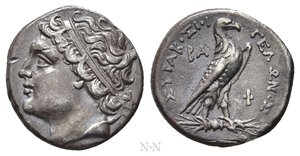
SICILY. Syracuse. Gelon, son of Hieron II (275-215 BC). AR 4 Litrai - Drachm - SICILY. Syracuse. Gelon, son of Hieron II (275-215 BC). AR 4 Litrai - Drachm. Obv: Diademed head left.Rev: ΣYPAKOΣIOI ΓEΛΩNOΣ. Eagle standing right on thunderbolt; BA to left, Φ to right.SNG ANS 902; HGC 2, 1563. Condition: Very fine.Weight: 3.34 g. Diameter: 16 mm.
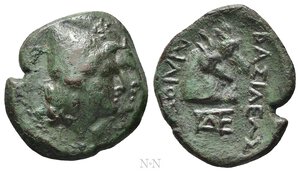
KINGS OF SKYTHIA. Ailis (2nd century BC). Ae - KINGS OF SKYTHIA. Ailis (2nd century BC). Ae. Obv: Jugate heads of the Dioskouroi right, each wearing laureate piloi.Rev: ΒΑΣΙΛΕΩΣ / ΑΙΛΙΟΣ. Jugate heads of horses right; monogram below.Draganov 627ff.; HGC 3.2, 2025. Condition: Very fine.Weight: 8.07 g. Diameter: 24 mm.
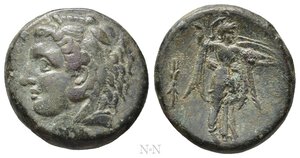
KINGS OF SKYTHIA. Sariakes (Circa 180-168/7 BC). Ae - KINGS OF SKYTHIA. Sariakes (Circa 180-168/7 BC). Ae. Obv: Laureate head of Apollo right.Rev: BAΣIΛE / ΣAPIAKOY. Grain ear and club; monogram to left.Draganov 850ff.; HGC 3.2, 2037. Condition: Good very fine.Weight: 2.53 g. Diameter: 17 mm.
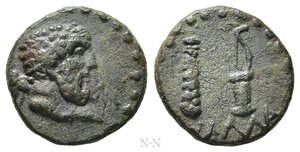
MOESIA. Kallatis. Ae (3rd-2nd centuries BC) - MOESIA. Kallatis. Ae (3rd-2nd centuries BC). Obv: Head of Herakles right, wearing tainia.Rev: ΚΑΛΛA[TI]. Club and bow in quiver.SNG Stancomb 862; HGC 3.2, -. Condition: Very fine.Weight: 3.83 g. Diameter: 17 mm.
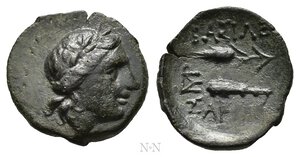
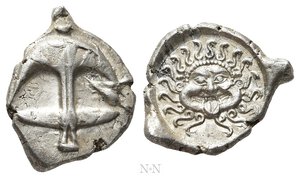
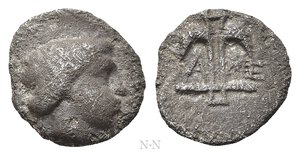
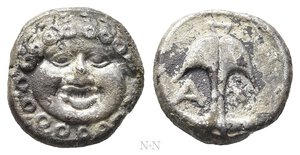
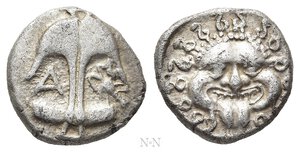
THRACE. Apollonia Pontika. Diobol (Circa 435-375 BC) - THRACE. Apollonia Pontika. Diobol (Circa 435-375 BC). Obv: Laureate head of Apollo right.Rev: Anchor; A to left, crayfish to right.SNG Bulgaria 288-9; SNG BM Black Sea 166.Very rare Condition: Near very fine.Weight: 1.09 g. Diameter: 11 mm.Very rare
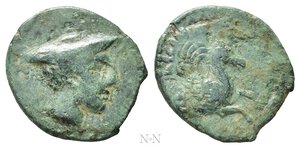
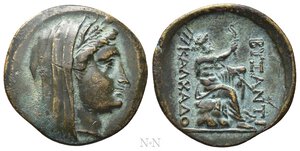
THRACE. Byzantion. Ae (3rd century BC). Alliance issue with Kalchedon - THRACE. Byzantion. Ae (3rd century BC). Alliance issue with Kalchedon. Obv: Veiled head of Demeter right, wearing grain wreath.Rev: BYZANTI / KAΛXAΔO. Poseidon seated right on rocks, holding aphlaston and trident.SNG BM Black Sea 82-3 var. (legend); HGC 3.2, 1428. Condition: Very fine.Weight: 7.50 g. Diameter: 26 mm.
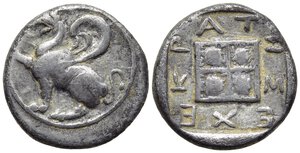
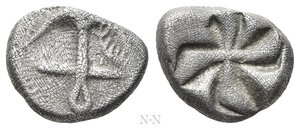
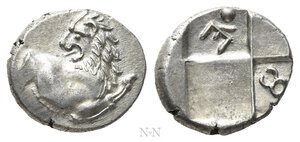
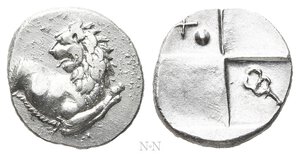
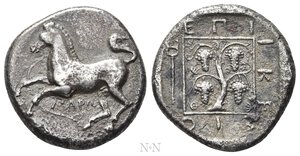
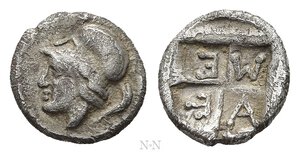
THRACE. Chersonesos. Hemidrachm (Circa 386-338 BC) - THRACE. Chersonesos. Hemidrachm (Circa 386-338 BC). Obv: Forepart of lion right, head left.Rev: Quadripartite incuse square with alternating raised and sunken quarters; monogram with pellet and kerykeion in sunken quarters.Weber 2421; CN online 53783; HGC 3.2, 1437. Condition: Good very fine.Weight: 2.39 g. Diameter: 13 mm.
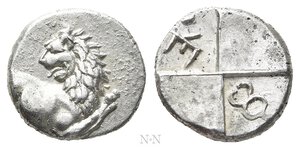
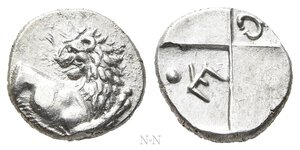
THRACE. Chersonesos. Hemidrachm (Circa 386-338 BC) - THRACE. Chersonesos. Hemidrachm (Circa 386-338 BC). Obv: Forepart of lion right, head left.Rev: Quadripartite incuse square with alternating raised and sunken quarters; monogram with pellet and kerykeion in sunken quarters.Weber 2421; CN online 53783; HGC 3.2, 1437. Condition: Near mint state.Weight: 2.38 g. Diameter: 13 mm.
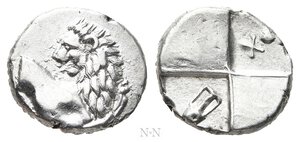
THRACE. Chersonesos. Hemidrachm (Circa 386-338 BC) - THRACE. Chersonesos. Hemidrachm (Circa 386-338 BC). Obv: Forepart of lion right, head left.Rev: Quadripartite incuse square with alternating raised and sunken quarters; pellet and X in one quarter, amphora in opposite quarter.McClean 4122; BMC 48; CN Online 52893; HGC 3.2, 1437. Condition: Near mint state.Weight: 2.36 g. Diameter: 14 mm.
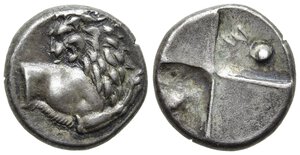
THRACE. Chersonesos. Hemidrachm (Circa 386-338 BC) - THRACE. Chersonesos. Hemidrachm (Circa 386-338 BC). Obv: Forepart of lion right, head left.Rev: Quadripartite incuse square with alternating raised and sunken quarters; pellet and monogram VE in one quarter, bee in opposite quarter.McClean 4114-6; SNG Copenhagen 830; HGC 3.2, 1437. Condition: Good very fine.Weight: 2.42 g. Diameter: 13 mm.
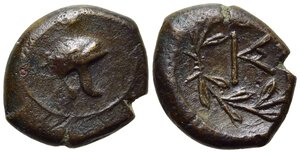
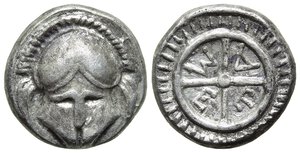
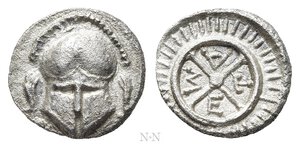
THRACE. Mesambria. Diobol (Circa 420-320 BC) - THRACE. Mesambria. Diobol (Circa 420-320 BC). Obv: Facing helmet.Rev: M - E - T - A. Four-spoked wheel.SNG BM Black Sea 268-9 & 271; HGC 3.2, 1560. Condition: Good very fine.Weight: 1.29 g. Diameter: 10 mm.
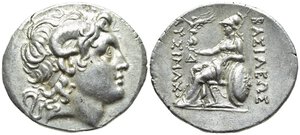
KINGS OF THRACE (Macedonian). Lysimachos (305-281 BC). Tetradrachm. Amphipolis - KINGS OF THRACE (Macedonian). Lysimachos (305-281 BC). Tetradrachm. Amphipolis. Obv: Diademed head of the deified Alexander right, wearing horn of Ammon.Rev: BAΣΙΛΕΩΣ / ΛYΣIMAXOY. Athena seated left on throne, holding crowning Nike and spear over shoulder, and resting elbow on shield. Control: ΔI monogram to inner left.Thompson 213 var. (monogram to outer right); Müller 212 var. (same); HGC 3.2, 1750l.Lysimachos was a Macedonian general and one of Alexander the Great's Diadochi. He was the son of Agathokles, from an important family in Pella. Took part in Alexander's expedition to Asia and distinguished himself during the campaign in India. As a reward for his valor, Alexander presented him with a golden crown in Susa.
When Alexander died in 323, during the division of the empire's satrapies in Babylon, Lysimachos obtained Thrace and worked to expand its borders to the mouth of the Danube. He formed an alliance with Seleukos, Kassander, and Ptolemy against Antigonos, who had revived the idea, already supported by Perdikkas and Eumenes, of reconstituting the unity of Alexander's empire under his command. Antigonos sought to use the Greeks' desire for freedom to his advantage, proclaiming that all Hellenic states should be independent and free from garrisons and tributes. This also had an effect in Thrace, where a revolt broke out against Lysimachos, who managed to defeat the rebels and the troops sent by Antigonos. The general peace that ended in 311 consolidated his rule in Thrace, where he founded the new capital, Lysimachia, in 309/8.
However, peace was brief and various Diadochi took the title of king, including Lysimachus (in 306-5), who once again allied himself with the previous league against Antigonos in Asia Minor. Antigonos was defeated at Ipsos in Phrygia, and in the resulting partition, Lysimachos gained control of Lydia and Caria. In honor of his first wife, who had died, he changed the name of the city of Antigoneia, founded by his rival, to Nicaea. To strengthen his alliance with Egypt, he remarried Arisonoe II, daughter of Ptolemy.
Later, when Demetrios Poliorketes, Antigonos' son, resumed his father's plans and proclaimed himself king of Macedonia, he fought against him with mixed fortunes. When Demetrios attempted to occupy Thrace, Lysimachos allied with Ptolemy, Seleukos, and Pyrrhus, king of Epirus. In 288 BC, the coalition invaded Macedonia, forcing Demetrios to flee. In the ensuing partition, Lysimachos took western Macedonia and Pyrrhus took eastern Macedonia.
The alliance with Pyrrhus soon broke down; defeated by Lysimachos, he was forced to retreat to Epirus, while in 285 Lysimachos became king of the all of Macedonia. His increased power aroused the suspicions of Seleukos and Ptolemy, intertwining with a family tragedy. His wife Arsinoe (perhaps with the intention of securing succession for her children) accused her stepson Agathokles of plotting against his father to seize the throne; Lysimachos had him imprisoned and poisoned (284 BC). His widow Lysandra (Arsinoe's half-sister), his brother Alexander, and other figures close to Agathokles fled and took refuge at the court of Seleukos, prompting him to wage war against Lysimachos. In the war that followed, Lysimachos was defeated, partly due to defections among his own forces, and died on the battlefield at Corupedium in Phrygia (282 BC). He was between 74 and 80 years old. The Asian territories of his kingdom came under the control of Seleukos, while Macedonia and Thrace, after various events, passed to Antigonos Gonatas, son of Demetrios. Condition: Near extremely fine.Weight: 17.10 g. Diameter: 31 mm.
Caricamento altri risultati...
Caricamento...
Notifiche web-push
Per abilitare le notifiche push su questo browser, premere il pulsante abilita.