Info & contatti
Le mie offerte
Lotti osservati
Condizioni di vendita
Prezzi di spedizione
Metodi di pagamento
Esito stampabile
Sessione Live 5/10/2025 17:00:00 CET
Celtic Coins (1-28)
Greek Coins (29-296)
Roman Provincial Coins (297-538)
Roman Republican Coins (539-643)
Roman Imperial Coins (644-1236)
Migration Period (1237-1240)
Byzantine Coins (1241-1324)
Medieval Coins (1325-1348)
World Coins (1349-1431)
Group Lots (1432-1594)

Risultati: 61
Romulus and Remus

Lotto n. 539
-
ANONYMOUS. Didrachm (Circa 265 BC). Rome. Obv: Diademed head of young Hercules right, with lion skin around neck; club on shoulder.Rev: ROMANO. She-wolf standing right, head left, suckling the twins Romulus and Remus.Crawford 20/1; HN Italy 287; RBW 23.The reverse of this Didrachm evokes one of the most widely attested legends about the foundation of Rome, faithfully reproduced from the famous sculpture preserved in the Capitoline Museums.
Rome's earliest bronze and silver coinage dates not earlier than the end of the 4th century BC. Produced initially in small quantities, they follow the pattern and weight values of Neapolitan coinage, so they are traditionally called 'Romano-Campananian' series. This occurred mainly after the stipulation of the 'foedum aequum', an agreement sanctioned between Rome and Neapolis in 326, at the time of the Second Samnite War, which marked the beginning of the Roman conquest of southern Italy. The period in which Rome began to produce coinage, between the second conflict with the Samnites until the end of the Punic Wars, coincides with the most intense phase of Roman expansion, implemented through the foundation of colonies and a widespread network of alliances. These issues responded to the need to meet the costs of military enterprises and subsequent public works in occupied territories.
The myth of the she-wolf suckling the twins is the result of several elaborations by various authors over the centuries, and it was only in the Augustan age that it took on the definitive form that has been handed down to us, mainly by Titus Livius. The historian tells of Aeneas who landed in Lazio and his descendants, up to Numitor, king of Alba, who was deposed by his brother Amulius. The latter had Numitor's sons killed and forced his only daughter, Rhea Silvia, to become a vestal, so that she would remain a virgin and not bear a son who might one day take revenge and reclaim the throne he had usurped. The vestal virgin was raped and gave birth to twins. In an attempt to save herself, she claimed that the father of her illegitimate offspring was Mars. However, Rhea Silvia was condemned and imprisoned, while the twins were placed in a basket and abandoned on the waters of the Tiber. According to Livius, divine will caused the river to overflow and forced the servants to leave the basket in a pool near the ficus Ruminalis (in the Velabrum). Here, a thirsty she-wolf, attracted by their cries, offered to suckle them and was noticed by the king's herdsman Faustulus, who took them to be raised by his wife. Condition: Near extremely fine.Weight: 7.01 g. Diameter: 22 mm.

Lotto n. 540
-
ANONYMOUS. Didrachm or Quadrigatus (Circa 225-214 BC). Rome. Obv: Laureate head of Janus.Rev: Jupiter, holding sceptre and thunderbolt, in quadriga driven by Victory right; ROMA incuse on tablet in exergue.Crawford 28/3; HN Italy 334; RBW 64.Rome's earliest bronze and silver coinage dates not earlier than the end of the 4th century BC. Produced initially in small quantities, they follow the pattern and weight values of Neapolitan coinage, so they are traditionally called 'Romano-Campananian' series. This occurred mainly after the stipulation of the 'foedum aequum', an agreement sanctioned between Rome and Neapolis in 326, at the time of the Second Samnite War, which marked the beginning of the Roman conquest of southern Italy. The period in which Rome began to produce coinage, between the second conflict with the Samnites until the end of the Punic Wars, coincides with the most intense phase of Roman expansion, implemented through the foundation of colonies and a widespread network of alliances. These issues responded to the need to meet the costs of military enterprises and subsequent public works in occupied territories. After the Campanian-influenced phase, Rome reorganized its monetary structure around the middle of the third century, introducing fixed images on silver series, with the introduction of the Quadrigatus. This silver coin on the obverse bears the youthful head of two-faced Janus and on the reverse a quadriga; it is flanked by the first gold issues, which, because of the depiction on the reverse, are called the 'oath' series. The precise dating of this restructuring of the monetary system is still a matter of debate; however the prow symbolizes an important naval victory, achieved at the time of the wars against the Carthaginians, when the Romans achieved their first significant victories on the sea. Quadrigate production is particularly impressive, probably spread over several mints besides Rome (as in Campania and Sicily). Its chronology, usually placed by scholars between 225 and 214 BC, may be broader to explain the abundance of issues. With the quadrigatus, which over time, like the silver coin series of Syracuse of the same years, is subject to a gradual decline in weight (from 6.60g to 4.50g), the first phase of Roman coinage comes to an end. Rome thus produced silver and bronze minted coinage related to the tradition of Greek cities and, at about the same time, heavy cast bronze series typical of Italic areas. Its colonies in non-Hellenic areas, where the use of metal by weight was rooted, also produced heavy bronze coinage, with the local value of the pound and its subdivisions. Condition: Near extremely fine.Weight: 6.72 g. Diameter: 23 mm.
Lotto n. 541
-
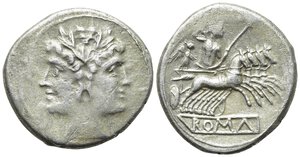
ANONYMOUS. Didrachm or Quadrigatus (Circa 225-214 BC). Rome. Obv: Laureate head of Janus.Rev: Jupiter, holding sceptre and thunderbolt, in quadriga driven by Victory right; ROMA in relief on tablet in exergue.Crawford 29/3; HN Italy 334; RBW 77. Condition: Very fine.Weight: 5.46 g. Diameter: 21 mm.
Lotto n. 542
-
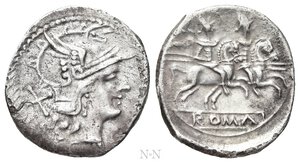
ANONYMOUS. Denarius (After 211 BC). Rome. Obv: Helmeted head of Roma right; X (mark of value) to left.Rev: ROMA. The Dioscuri on horses rearing right, each holding spear; two stars above; below, ROMA on tablet.Crawford 53/2. Condition: Near very fine.Weight: 3.57 g. Diameter: 21 mm.
Lotto n. 543
-
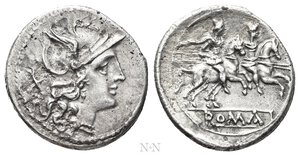
ANONYMOUS. Denarius (After 211 BC). Rome. Obv: Helmeted head of Roma right; X (mark of value) to left.Rev: ROMA. The Dioscuri on horses rearing right, each holding spear; two stars above; below, ROMA on tablet.Crawford 53/2. Condition: Extremely fine.Weight: 3.61 g. Diameter: 20 mm.
Choice for Type
Lotto n. 544
-
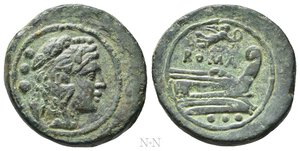
ANONYMOUS. Quadrans (211-208 BC). Central Italian mint. Victory series. Obv: Head of Hercules right, wearing lion skin headdress; three pellets (mark of value) behind.Rev: ROMA. Prow right; Victory flying right above; three pellets (mark of value) below.Crawford 61/5; RBW 257.Struck on a large and heavy flan. Condition: Very fine.Weight: 12.56 g. Diameter: 26 mm.
Lotto n. 545
-
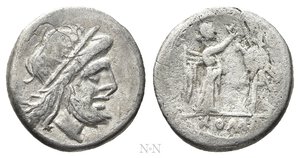
ANONYMOUS. Victoriatus (179-170 BC). Rome. Obv: Laureate head of Jupiter right.Rev: ROMA. Victory standing right, crowning trophy.Crawford 166/1; RBW -. Condition: Good fine.Weight: 2.44 g. Diameter: 16 mm.
Lotto n. 546
-
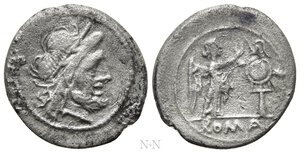
ANONYMOUS. Victoriatus (179-170 BC). Rome. Obv: Laureate head of Jupiter right.Rev: ROMA. Victory standing right, crowning trophy.Crawford 166/11; RBW -. Condition: Near very fine.Weight: 2.27 g. Diameter: 18 mm.
Lotto n. 547
-
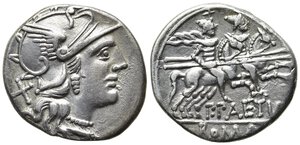
P. AELIUS PAETUS. Denarius (138 BC). Rome. Obv: Helmeted head of Roma right; X (mark of value) behind.Rev: P PAETVS / ROMA. The Dioscuri galloping right, each holding spear and wearing pileus surmounted by star.Crawford 233/1; RBW 968. Condition: Good very fine.Weight: 3.81 g. Diameter: 20 mm.
Lotto n. 548
-
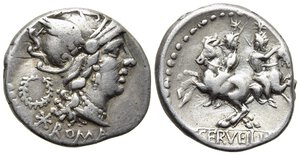
C. SERVILIUS M. F. Denarius (136 BC). Rome. Obv: ROMA. Helmeted head of Roma right; to left, wreath above mark of value.Rev: C SERVEILI M F. Dioscuri, each holding spear, on horses riding in opposite directions.Crawford 239/1; RBW 984. Condition: Near very fine.Weight: 3.76 g. Diameter: 20 mm.
Lotto n. 549
-
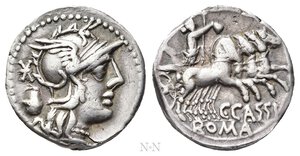
C. CASSIUS. Denarius (Circa 126 BC). Rome. Obv: Helmeted head of Roma right; behind, star (mark of value) above voting urn.Rev: C CASSI / ROMA. Libertas driving quadriga right, holding rod and pileus.Crawford 266/1; RBW 1075.Privately purchased in Prague 1948 (with collector's ticket) Condition: Very fine.Weight: 3.70 g. Diameter: 18 mm.
Lotto n. 550
-
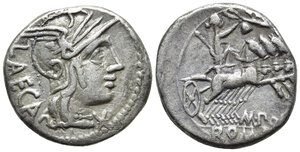
M. PORCIUS LAECA. Denarius (125 BC). Rome. Obv: LAECA. Helmeted head of Roma right; mark of value to lower right.Rev: M PORC / ROMA. Libertas, holding vindicta, reins and pileus, driving quadriga right; above, crowning Victory flying left.Crawford 270/1; RBW 1088. Condition: Very fine.Weight: 3.89 g. Diameter: 18 mm.
Lotto n. 551
-
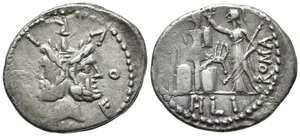
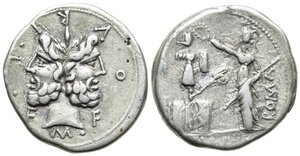
M. FURIUS L.F. PHILUS. Denarius (120 BC). Rome. Obv: M FOVRI L F. Laureate head of Janus.Rev: ROMA / PHILI. Roma standing left, holding sceptre and crowning trophy of Gallic arms and carnyces to left.Crawford 281/1; RBW 1105. Condition: Very fine.Weight: 3.74 g. Diameter: 21 mm.
Lotto n. 552
-
M. FURIUS L.F. PHILUS. Denarius (120 BC). Rome. Obv: M FOVRI L F. Laureate head of Janus.Rev: ROMA / PHILI. Roma standing left, holding sceptre and crowning trophy of Gallic arms and carnyces to left.Crawford 281/1; RBW 1105. Condition: Very fine.Weight: 4.04 g. Diameter: 20 mm.
Lotto n. 553
-
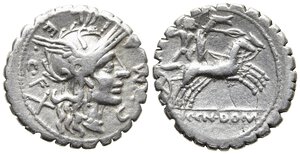
C. MALLEOLUS C.f. Serrate Denarius (118 BC). Narbo. Obv: MALLE C F. Helmeted head of Roma right; X (mark of value) behind.Rev: L LIC C N DOM. Gallic warrior (Bituitus?), hurling spear and holding shield and carnyx, driving biga right.Crawford 282/3; RBW 1108. Condition: Very fine.Weight: 3.83 g. Diameter: 20 mm.
Lotto n. 554
-
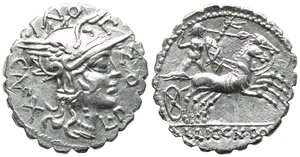
L. POMPONIUS CN. F., L. LICINIUS AND CN. DOMITIUS. Serrate Denarius (118 BC). Rome. Obv: L POMPONI CNF. Helmeted head of Roma right; mark of value to left.Rev: L LIC CN DOM. Gallic warrior (Bituitus?) driving biga right, holding shield, carnyx and spear.Crawford 282/4; RBW -. Condition: Extremely fine.Weight: 2.91 g. Diameter: 20 mm.
Lotto n. 555
-
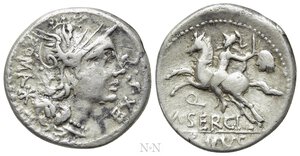
M. SERGIUS SILUS. Denarius (116-115 BC). Rome. Obv: ROMA EX S C. Helmeted head of Roma right; X (mark of value) behind.Rev: M SERGI SILVS. Horseman riding left, holding sword, shield and severed head; Q below horse.Crawford 286/1; RBW 1115. Condition: Near very fine.Weight: 3.83 g. Diameter: 19 mm.
Lotto n. 556
-
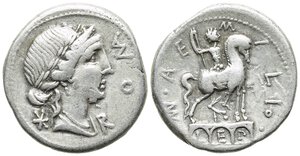
MN. AEMILIUS LEPIDUS. Denarius (114-113 BC). Rome. Obv: ROMA. Laureate, diademed, and draped bust of Roma right; mark of value to left.Rev: MAN AEMILIO / LEP. Equestrian statue right on triumphal arch.Crawford 291/1; RBW 1124. Condition: Near very fine.Weight: 3.85 g. Diameter: 19 mm.
Lotto n. 557
-
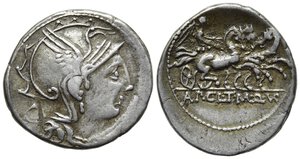
APPIUS CLAUDIUS PULCHER, T. MANLIUS MANCIUS and Q. URBINIUS. Denarius (111-110 BC). Rome. Obv: Helmeted head of Roma right; quadrangular device to left.Rev: AP CL T MAL Q VR. Victory, holding reins, driving triga right.Crawford 299/1a; RBW 1141. Condition: Very fine.Weight: 3.78 g. Diameter: 19 mm.
Lotto n. 558
-
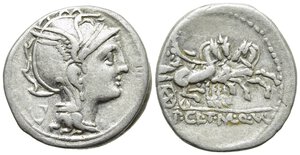
APPIUS CLAUDIUS PULCHER, T. MANLIUS MANCIUS and Q. URBINIUS. Denarius (111-110 BC). Rome. Obv: Helmeted head of Roma right; quadrangular device to left.Rev: AP CL T MAL Q VR. Victory, holding reins, driving triga right.Crawford 299/1a; RBW 1141. Condition: Very fine.Weight: 3.78 g. Diameter: 18 mm.
Lotto n. 559
-
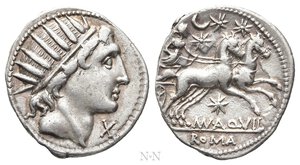
MAN. AQUILIUS. Denarius (109-108 BC). Rome. Obv: Radiate head of Sol right; X (mark of value) to lower right.Rev: MAN AQVIL / ROMA. Luna driving biga right; crescent and three stars above, one star below.Crawford 303/1; RBW -. Condition: Good very fine.Weight: 3.92 g. Diameter: 20 mm.
Lotto n. 560
-
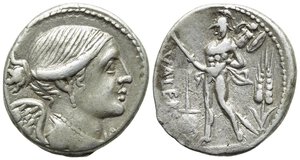
L. VALERIUS FLACCUS. Denarius (108-107 BC). Rome. Obv: Winged and draped bust of Victory right; mark of value to lower right.Rev: L VALERI FLACCI. Mars standing left, holding spear and trophy; apex to left, grain ear to right.Crawford 306/1; RBW 1147. Condition: Very fine.Weight: 3.88 g. Diameter: 19 mm.
Lotto n. 561
-
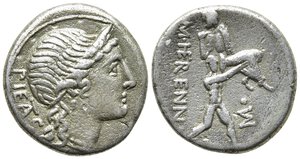
M. HERENNIUS. Denarius (108-107 BC). Rome. Obv: PIETAS. Diademed head of Pietas right.Rev: M HERENNI. One of the Catanaean brothers, Amphinomous or Anapias, running right and carrying his father on his shoulder; •/Σ to right.Crawford 308/1b; RBW 1149 var. (control letter). Condition: Very fine.Weight: 3.81 g. Diameter: 17 mm.
Lotto n. 562
-
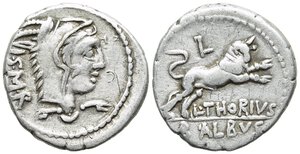
L. THORIUS BALBUS. Denarius (105 BC). Rome. Obv: I S M R. Head of Juno Sospita right, wearing goat skin.Rev: L THORIVS / BALBVS. Bull charging right; L above.Crawford 316/1; RBW 1168 var. (letter on rev.). Condition: Near very fine.Weight: 3.82 g. Diameter: 19 mm.
Lotto n. 563
-
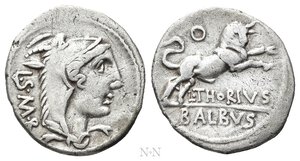
L. THORIUS BALBUS. Denarius (105 BC). Rome. Obv: I S M R. Head of Juno Sospita right, wearing goat skin.Rev: L THORIVS / BALBVS. Bull charging right; O above.Crawford 316/1; RBW 1168 var. (letter on rev.). Condition: Near very fine.Weight: 3.75 g. Diameter: 20 mm.
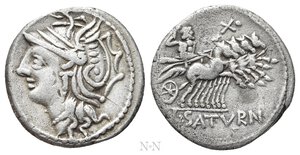
Lotto n. 564
-
L. APPULEIUS SATURNINUS. Denarius (104 BC). Rome. Obv: Helmeted head of Roma left.Rev: L SATVRN. Saturn driving quadriga right, holding harpa and reins; control-mark X• above.Crawford 317/3a; RBW -. Condition: Very fine.Weight: 3.71 g. Diameter: 19 mm.
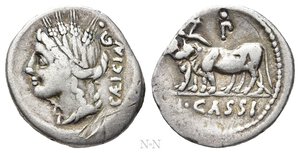
Lotto n. 565
-
L. CASSIUS CAECIANUS. Denarius (102 BC). Rome. Obv: CÆICIAN. Head of Ceres left, wearing grain wreath; •G to upper right.Rev: L CASSI. Two yoked oxen pulling plow left; •P above.Crawford 321/1; RBW 1176 var.. Condition: Near very fine.Weight: 3.61 g. Diameter: 19 mm.
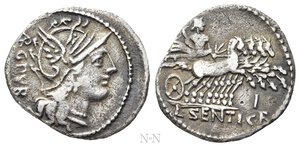
Lotto n. 566
-
L. SENTIUS C.F. Denarius (101 BC). Rome. Obv: ARG PVB. Helmeted head of Roma right.Rev: L SENTI C F. Jupiter, holding sceptre, reins and thunderbolt, driving quadriga right; I below horses.Crawford 325/1b; RBW 1182 var. (control). Condition: Near very fine.Weight: 3.60 g. Diameter: 21 mm.
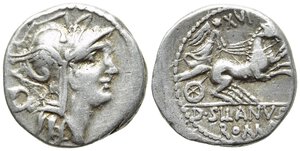
Lotto n. 567
-
D. SILANUS L.F. Denarius (91 BC). Rome. Obv: Helmeted head of Roma right; D to left.Rev: D SILANVS L F / ROMA. Victory driving galloping biga right; XVI above.Crawford 337/3; RBW 1233 var. (controls). Condition: Very fine.Weight: 3.61 g. Diameter: 18 mm.
Lotto n. 568
-
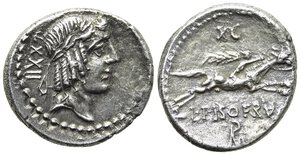
L. CALPURNIUS PISO FRUGI. Denarius (90 BC). Rome. Obv: Laureate head of Apollo right; control-number to left.Rev: L PISO FRVGI. Warrior riding horse right, holding reins and palm frond; control-numer XC above, Roma monogram below.Crawford 340/1. Condition: Extremely fine.Weight: 3.89 g. Diameter: 19 mm.
Lotto n. 569
-
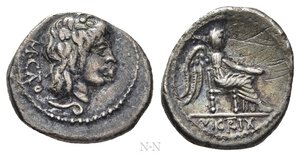
M. PORCIUS CATO. Quinarius (89 BC). Rome. Obv: M CATO. Head of Liber right, wearing ivy wreath; below, lituus.Rev: VICTRIX. Victory seated right on throne, holding palm frond and patera.Crawford 343/2b; RBW 1298-9 var. (control-mark). Condition: Very fine.Weight: 1.98 g. Diameter: 15 mm.
Lotto n. 570
-
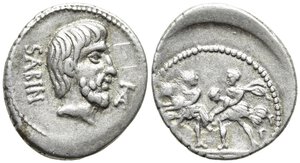
L. TITURIUS L.F. SABINUS. Denarius (89 BC). Rome. Obv: SABIN. Bareheaded and bearded head of King Tatius right; monogram to right.Rev: L TITVRI. Two soldiers, facing each other, each carrying off a Sabine woman in his arms.Crawford 344/1a; RBW -. Condition: Very fine.Weight: 3.61 g. Diameter: 20 mm.
Lotto n. 571
-
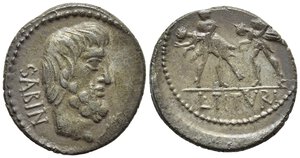
L. TITURIUS L.F. SABINUS. Denarius (89 BC). Rome. Obv: SABIN. Bareheaded and bearded head of King Tatius right; palm frond to lower right.Rev: L TITVRI. Two soldiers, facing each other, each carrying off a Sabine woman in his arms.Crawford 344/1b; RBW -. Condition: Very fine.Weight: 3.47 g. Diameter: 19 mm.
Lotto n. 572
-
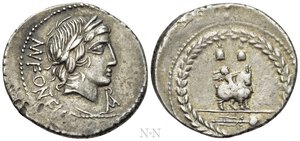
MN. FONTEIUS C.F. Denarius (85 BC). Rome. Obv: MN FONTEI C F. Laureate head of Apollo-Vejovis right; thunderbolt below, monogram to lower right.Rev: Cupid riding goat right; pilei of the Dioscuri above; below, filleted thyrsus right; all within wreath.Crawford 353/1a. Condition: Near very fine.Weight: 3.99 g. Diameter: 21 mm.
Lotto n. 573
-
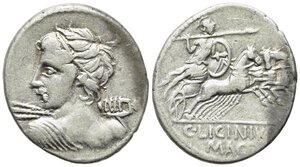
C. LICINIUS L.F. MACER. Denarius (84 BC). Rome. Obv: Bust of Apollo Vejovis left, seen from behind and with drapery on left shoulder, preparing to hurl thunderbolt.Rev: C LICINIVS L F / MACER. Minerva driving quadriga right, holding spear, shield and reins.Crawford 354/1; RBW 1355. Condition: Very fine.Weight: 3.63 g. Diameter: 21 mm.
Lotto n. 574
-
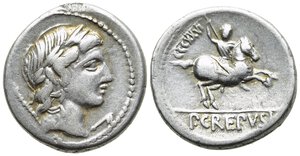
P. CREPUSIUS. Denarius (82 BC). Rome. Obv: Laureate head of Apollo right; behind, sceptre and [letter]; symbol below chin.Rev: P CREPVSI. Horseman advancing right; behind, control-number CCCXXVI.Crawford 361/1c. Condition: Very fine.Weight: 3.89 g. Diameter: 18 mm.
Lotto n. 575
-
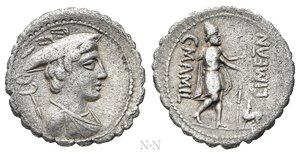
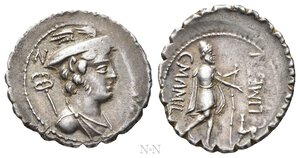
C. MAMILIUS LIMETANUS. Serrate Denarius (82 BC). Rome. Obv: Draped bust of Mercury right, wearing petasus; to left, control letter I above caduceus.Rev: C MAMIL / LIMETAN. Ulysses advancing right, holding staff and extending hand to his dog Argus.Crawford 362/1; RBW 1370 var. (control-mark). Condition: Very fine.Weight: 3.41 g. Diameter: 19 mm.
Ulysses Arriving in Ithaka
Lotto n. 576
-
C. MAMILIUS LIMETANUS. Serrate Denarius (82 BC). Rome. Obv: Draped bust of Mercury right, wearing petasus; to left, control letter N above caduceus.Rev: C MAMIL / LIMETAN. Ulysses advancing right, holding staff and extending hand to his dog Argus.Crawford 362/1; RBW 1370 var. (control-mark).In book XVII of the Odyssey, Odysseus returns to Ithaka disguised as a beggar and is recognized only by his faithful dog Argos, now old. Once a superb hunting dog, Argos raises his head and wags his tail at the sight of Odysseus, but dies immediately after recognizing him, demonstrating his loyalty and love, preventing him from inadvertently revealing his master's identity and allowing Odysseus to plan his revenge. Condition: Good very fine.Weight: 3.69 g. Diameter: 21 mm.
Lotto n. 577
-
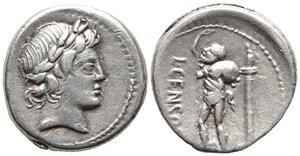
L. CENSORINUS. Denarius (82 BC). Rome. Obv: Laureate head of Apollo right.Rev: L CENSOR. Marsyas standing left, raising hand and holding wineskin over shoulder; to right, column bearing statue of Victory.Crawford 363/1d; RBW 1372. Condition: Very fine.Weight: 3.77 g. Diameter: 17 mm.
Lotto n. 578
-
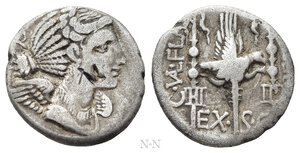
L. VALERIUS FLACCUS. Denarius (82 BC). Massalia. Obv: Winged bust of Victory right; Q behind.Rev: C VAL FLA IMPERAT / EX - S.C. Aquila between two signa inscribed H (Hastati) and P (Principes).Crawford 365/1b; RBW -. Condition: Very fine.Weight: 3.43 g. Diameter: 17 mm.
Lotto n. 579
-
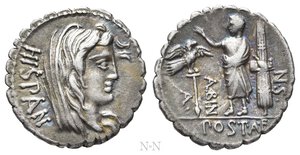
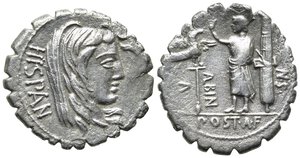
A. POSTUMIUS A.F. SP.N. ALBINUS. Serrate Denarius (81 BC). Rome. Obv: HISPAN. Veiled head of Hispania right.Rev: POST A F / S N / ALBIN / A. Togate figure standing left, raising hand; aquila to left, fasces to right.Crawford 372/2; RBW 1393. Condition: Good very fine.Weight: 3.92 g. Diameter: 19 mm.
Lotto n. 580
-
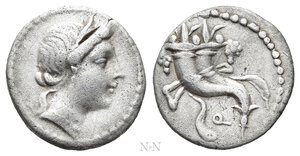
A. POSTUMIUS A.F. SP.N. ALBINUS. Serrate Denarius (81 BC). Rome. Obv: HISPAN. Veiled head of Hispania right.Rev: POST A F / S N / ALBIN / A. Togate figure standing left, raising hand; aquila to left, fasces to right.Crawford 372/2; RBW 1393. Condition: Extremely fine.Weight: 3.62 g. Diameter: 21 mm.
Lotto n. 581
-
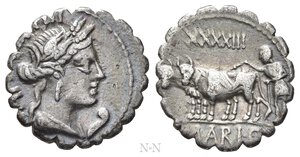
L. SULLA. Denarius (81 BC). Uncertain mint. Obv: Diademed head of Venus right.Rev: Double cornucopia with fillet, filled with fruit; Q below.Crawford 375/2; RBW 1398. Condition: Very fine.Weight: 3.64 g. Diameter: 17 mm.
Lotto n. 582
-
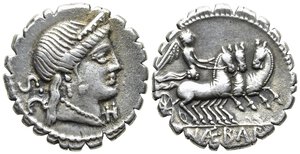
C. MARIUS C. F. CAPITO. Serrate Denarius (81 BC). Rome. Obv: CAPIT XXXXIIII. Draped bust of Ceres, wearing grain wreath; prow-stern to lower right.Rev: C MARI C F / S C. Founder plowing left with yoke of oxen; XXXXIIII above.Crawford 378/1c. Condition: Near very fine.Weight: 3.69 g. Diameter: 18 mm.
Lotto n. 583
-
C. NAEVIUS BALBUS. Serrate Denarius (79 BC). Rome. Obv: Diademed head of Venus right; S C to left; H to lower right.Rev: C NAE BALB. Victory driving triga right, holding reins.Crawford 382/1a; RBW 1409 var. (control letter). Condition: Very fine.Weight: 3.95 g. Diameter: 18 mm.
Lotto n. 584
-
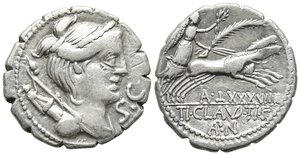
TI. CLAUDIUS NERO. Serrate Denarius (79 BC). Rome. Obv: S C. Draped bust of Diana right, with bow and quiver over shoulder.Rev: TI CLAVD TI F / AP N. Victory driving biga right, holding palm frond and reins; A•LXXXVIII below.Crawford 383/1; RBW 1411 var. (control). Condition: Very fine.Weight: 3.58 g. Diameter: 19 mm.
Lotto n. 585
-
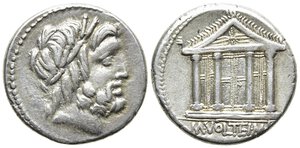
M. VOLTEIUS M.F. Denarius (75 BC). Rome. Obv: Laureate head of Jupiter right.Rev: M VOLTEI M F. Tetrastyle temple of Jupiter Capitolinus, with winged thunderbolt in pediment.Crawford 385/1; RBW 1414.Ex Heidelberger Münzhandlung 71 (2017), lot 1592 Condition: Good very fine.Weight: 3.77 g. Diameter: 17 mm.
Lotto n. 586
-
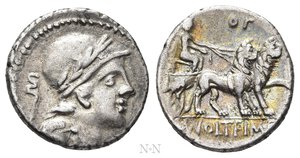
M. VOLTEIUS M.F. Denarius (78 BC). Rome. Obv: Helmeted, laureate and draped bust right; in left field, control-symbol.Rev: M VOLTEI M F. Cybele driving biga of lions right; control-mark OΓ.Crawford 385/4 (control-symbol pl. LXX, 58). Condition: Very fine.Weight: 3.72 g. Diameter: 17 mm.
Lotto n. 587
-
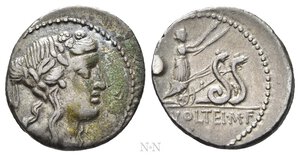
M. VOLTEIUS M.F. Denarius (78 BC). Rome. Obv: Wreathed head of Bacchus (or Liber) right.Rev: M VOLTEI M F. Ceres, holding two torches, driving biga of serpents right; symbolt to left.Crawford 385/3. Condition: Very fine.Weight: 3.95 g. Diameter: 19 mm.
Lotto n. 588
-
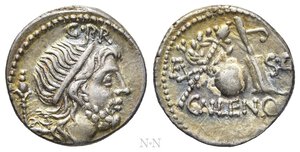
CN. LENTULUS. Denarius (76-75 BC). Spain. Obv: C P R. Diademed and draped bust of Genius Populi Romani right, with sceptre over shoulder.Rev: C N LEN Q. Sceptre with wreath, terrestrial globe and rudder.Crawford 393/1a; RBW 1432. Condition: Near mint state.Weight: 3.96 g. Diameter: 18 mm.
Lotto n. 589
-
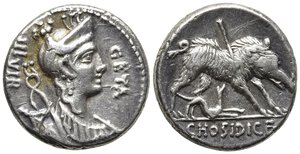
C. HOSIDIUS C.F. GETA. Denarius (64 BC). Rome. Obv: III VIR / GETA. Diademed and draped bust of Diana right, with bow and quiver over shoulder.Rev: C HOSIDI C F. Calydonian Boar standing right, pierced by spear and harried by hound below.Crawford 407/2; RBW 1456. Condition: Good very fine.Weight: 3.94 g. Diameter: 17 mm.
Lotto n. 590
-
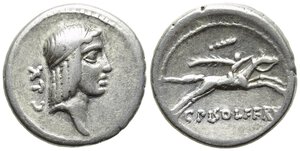
C. PISO L.F. FRUGI. Denarius (61 BC). Rome. Obv: Head of Apollo left, wearing taenia; CLX to left.Rev: C PISO L F FRV. Warrior riding horse right, holding palm frond and reins; above, club right.Crawford 408/1b (O33/R32); Hersh, Piso 318 (O262/R2075). Condition: Good fine.Weight: 3.90 g. Diameter: 18 mm.
Calliope the Muse of Epic Poetry
Lotto n. 591
-
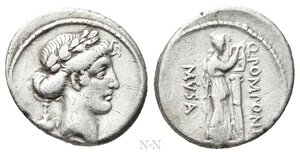
Q. POMPONIUS MUSA. Denarius (56 BC). Rome. Obv: Laureate head of Apollo right; lyre key to left.Rev: Q POMPONI / MVSA. Calliope standing right, playing lyre set on column.Crawford 410/2b; RBW -.Calliope, ‘beautiful-voiced’, was one of the nine Muses, the inspiration for epic poetry. Her love with Apollo resulted in the birth of Linus, Orpheus, and the Sirens.
The Muses are minor deities of the Greek pantheon who, through their song, preserve the memory of past events. They are the daughters of Zeus and Mnemosyne, goddess of memory. She gave birth to them after the King of Olympus' victory over the Titans, a victory immortalized by the song of his daughters. Condition: Very fine.Weight: 3.79 g. Diameter: 18 mm.
Lotto n. 592
-
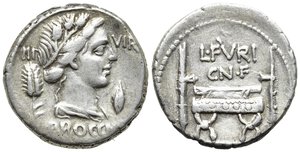
L. FURIUS CN.F. BROCCHUS. Denarius (63 BC). Rome. Obv: III - VIR / BROCCHI. Head of Ceres right, wearing grain wreath; grain ear to left, single grain to right.Rev: L FVRI / CN F. Curule chair between fasces.Crawford 414/1; RBW 1495. Condition: Very fine.Weight: 3.93 g. Diameter: 18 mm.
Lotto n. 593
-
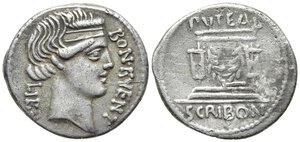
L. SCRIBONIUS LIBO. Denarius (62 BC). Rome. Obv: BON EVENT / LIBO. Diademed head of Bonus Eventus right.Rev: PVTEAL / SCRIBON. Puteal Scribonianum (Scribonian wellhead) decorated with garland and two lyres; hammer at base.Crawford 416/1a; RBW 1500. Condition: Very fine.Weight: 3.73 g. Diameter: 19 mm.
Lotto n. 594
-
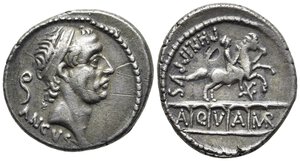
L. MARCIUS PHILIPPUS. Denarius (57 BC). Rome. Obv: ANCVS. Diademed head of Ancus Marcius right; lituus to left.Rev: PHILIPPVS / AQVAM R. Equestrian statue on aqueduct right; flower below statue.Crawford 425/1; RBW 1524.This denarius was issued in 56 BC by L. Marcius Philippus in honor of his ancestor Q. Marcius Rex. On the obverse, the coin depicts the head of the fourth king of Rome, Ancus Marcius, identified by the legend, from whom the Marcia gens claimed to descend and who, according to a legend (reported by Pliny the Elder), was the first to provide an aqueduct to the city. The reverse depicts an equestrian statue (Marcius Rex) placed on an arched structure, clearly identified as an aqueduct by the legend. The aqueduct depicted here was built in 144 BC by Marcius Rex (to whom the statue refers), and supplied water to many areas of Rome. It was over 90 km long and mostly underground.
As was common in the Republican period, the designs on both sides are purely propagandistic, aimed at celebrating the gens to which the monetary magistrate belonged, with references to mythical and historical ancestors, legitimizing his personal ambitions. Condition: Very fine.Weight: 3.91 g. Diameter: 19 mm.
Lotto n. 595
-
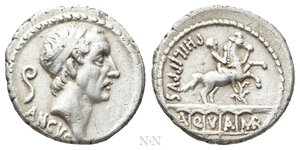
L. MARCIUS PHILIPPUS. Denarius (57 BC). Rome. Obv: ANCVS. Diademed head of Ancus Marcius right; lituus to left.Rev: PHILIPPVS / AQVAM R. Equestrian statue on aqueduct right; flower below statue.Crawford 425/1; RBW 1524.This denarius was issued in 56 BC by L. Marcius Philippus in honor of his ancestor Q. Marcius Rex. On the obverse, the coin depicts the head of the fourth king of Rome, Ancus Marcius, identified by the legend, from whom the Marcia gens claimed to descend and who, according to a legend (reported by Pliny the Elder), was the first to provide an aqueduct to the city. The reverse depicts an equestrian statue (Marcius Rex) placed on an arched structure, clearly identified as an aqueduct by the legend. The aqueduct depicted here was built in 144 BC by Marcius Rex (to whom the statue refers), and supplied water to many areas of Rome. It was over 90 km long and mostly underground.
As was common in the Republican period, the designs on both sides are purely propagandistic, aimed at celebrating the gens to which the monetary magistrate belonged, with references to mythical and historical ancestors, legitimizing his personal ambitions. Condition: Very fine.Weight: 4.00 g. Diameter: 19 mm.
Lotto n. 596
-
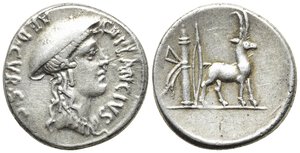
CN. PLANCIUS. Denarius (55 BC). Rome. Obv: CN PLANCIVS / AED CVR SC. Head of Diana Planciana right, wearing petasus.Rev: Cretan goat standing right; bow and quiver to left.Crawford 432/1; RBW 1541. Condition: Good very fine.Weight: 3.81 g. Diameter: 17 mm.
Lotto n. 597
-
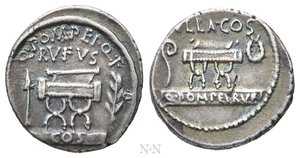
Q. POMPEIUS RUFUS. Denarius (54 BC). Rome. Obv: Q POMPEI Q F RVFVS / COS. Curule chair; arrow to left, branch to right.Rev: SVLLA COS / Q POMPEI RVF. Curule chair; lituus to left, wreath to right.Crawford 434/2; RBW 1545. Condition: Good very fine.Weight: 3.94 g. Diameter: 18 mm.
Lotto n. 598
-
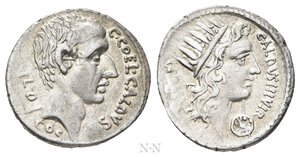
C. COELIUS CALDUS. Denarius (51 BC). Rome. Obv: C COELIVS CALDVS COS. Bare head of C. Coelius Caldus right; tablet inscribed LD to left.Rev: CALDVS III VIR. Radiate head of Sol right; to left, S above oval shield decorated with thunderbolt; round shield below chin.Crawford 437/1b; RBW 1550. Condition: Good very fine.Weight: 3.66 g. Diameter: 19 mm.
Caricamento altri risultati...