Banner Naumann 168
Watch:
Starting price: € 144
Current bid: € 144
B.P.: 18.90%
Closing on: 2026-06-07 16:00:00 Roma time
Watch:
Starting price: € 40
B.P.: 18.90%
Closing on: 2026-06-07 16:00:00 Roma time
Watch:
Starting price: € 160
Current bid: € 160
B.P.: 18.90%
Closing on: 2026-06-07 16:00:00 Roma time
Watch:
Starting price: € 100
Current bid: € 100
B.P.: 18.90%
Closing on: 2026-06-07 16:00:00 Roma time
Watch:
Starting price: € 40
B.P.: 18.90%
Closing on: 2026-06-07 16:00:00 Roma time
Watch:
Starting price: € 120
B.P.: 18.90%
Closing on: 2026-06-07 16:00:00 Roma time
Watch:
Starting price: € 80
B.P.: 18.90%
Closing on: 2026-06-07 16:00:00 Roma time
Watch:
Starting price: € 80
B.P.: 18.90%
Closing on: 2026-06-07 16:00:00 Roma time
Watch:
Starting price: € 40
B.P.: 18.90%
Closing on: 2026-06-07 16:00:00 Roma time
Watch:
Starting price: € 400
B.P.: 18.90%
Closing on: 2026-06-07 16:00:00 Roma time
Watch:
Starting price: € 80
B.P.: 18.90%
Closing on: 2026-06-07 16:00:00 Roma time
Watch:
Starting price: € 40
Current bid: € 40
B.P.: 18.90%
Closing on: 2026-06-07 16:00:00 Roma time
Watch:
Starting price: € 80
Current bid: € 90
B.P.: 18.90%
Closing on: 2026-06-07 16:00:00 Roma time
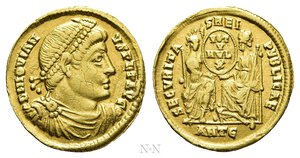
Lot # 794 - JOVIAN (363-364). GOLD Solidus. Antioch. Obv: D N IOVIANVS PEP AVG. Pearl-diademed, draped and cuirassed bust right.Rev: SECVRITAS REI PVBLICAE / ANTЄ. Roma and Constantinopolis, with foot on prow, seated facing one another on double throne, holding sceptres and between them a shield inscribed VOT / V / MVL / X in four lines.RIC 223; Depeyrot 18/2.Jovian was the son of Varronianus, born in Singidunum in 331, and served as 'protector domesticus' first under Constantius II and then under Julian II. Upon Julian’s death, he was proclaimed Augustus. He was immediately forced to negotiate with the Persians because the army was exhausted and starving from the long war and eager to return home. Shapur II, realizing the Romans’ difficult situation, took advantage of it to secure the territories conquered by Diocletian beyond the Tigris River. Jovian accepted the unfair terms of peace and signed an unfavorable treaty, forced to abandon important territories and the Christian fortress of Nisibis. After that, Jovian reaffirmed the supremacy of Christianity over paganism, perhaps even prohibiting certain sacrifices and ordering the closure of temples. His ambitious goal was the religious reunification of the empire. But during his return journey to Rome, he died under mysterious circumstances, likely from intoxication or poisoning. He was buried in the Church of the Holy Apostles of Constantinople and was granted the 'consecratio'. Condition: Very fine.Weight: 4.36 g. Diameter: 21 mm.Estimate: € 1000
Watch:
Starting price: € 800
Current bid: € 800
B.P.: 18.90%
Closing on: 2026-06-07 16:00:00 Roma time
Watch:
Starting price: € 80
B.P.: 18.90%
Closing on: 2026-06-07 16:00:00 Roma time
Watch:
Starting price: € 40
B.P.: 18.90%
Closing on: 2026-06-07 16:00:00 Roma time
Watch:
Starting price: € 400
B.P.: 18.90%
Closing on: 2026-06-07 16:00:00 Roma time
Watch:
Starting price: € 40
B.P.: 18.90%
Closing on: 2026-06-07 16:00:00 Roma time
Watch:
Starting price: € 400
Current bid: € 400
B.P.: 18.90%
Closing on: 2026-06-07 16:00:00 Roma time
Watch:
Starting price: € 40
Current bid: € 40
B.P.: 18.90%
Closing on: 2026-06-07 16:00:00 Roma time
Watch:
Starting price: € 40
B.P.: 18.90%
Closing on: 2026-06-07 16:00:00 Roma time
Watch:
Starting price: € 80
Current bid: € 80
B.P.: 18.90%
Closing on: 2026-06-07 16:00:00 Roma time
Ex Savoca 2017
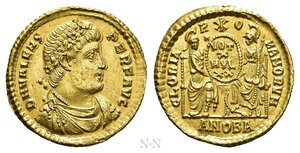
Lot # 803 - VALENS (364-378). GOLD Solidus. Antioch. Obv: D N VALENS PER F AVG. Rosette-diademed, draped and cuirassed bust right.Rev: GLORIA ROMANORVM / ANOBA. Roma and Constantinopolis, with right foot on prow and holding sceptre in left hand, enthroned facing, holding between them a shield inscribed VOT/X/MVL/XX in four lines; Christogram above.RIC 16d.1; Depeyrot 38/3.Ex Savoca Numismatik 2nd premium auction (2017), lot 86. Flavius Julius Valens was the younger brother of Valentinian I. After serving as protector domesticus (personal guard) of Julian II and Jovian, he immediately became emperor of the East in 364 thanks to his brother who was already Augustus of the West, although the two differed in faith. Valens in fact was an Arian, while Valentinian was a Nicene Christian. The first problem was presented by the usurper Procopius, comes of Antioch, who proclaimed himself Augustus of the East in 365. Valens defeated him, sentenced him to death and struck with damnatio memoriae. He later faced the Visigoths and a second conspiracy, hatched by Theodore of Antioch. In 374 Valens celebrated the decennalia and became Maximus Augustus in 375 on the death of his brother, after which he organized an expedition against the Persians that proved unsuccessful, forcing him to sign an unfavorable peace. Another problem was the confluence of Ostrogoths and Visigoths into Roman territory across the Danube because of the advance of the Huns. The Romans were forced to accept them, but this integration was not easy; the Visigoths felt oppressed and exploited as a labor-power, resulting in an insurrection. Valens, considered a general of little ability by his contemporaries, was thus induced to recruit Goth mercenaries, with the risk that they would end up allied with his enemies. In fact, a large contingent of Visigoths, Ostrogoths, Huns, and Alamanni joined forces to fight the Romans and achieved a decisive victory at Hadrianopolis (Thrace) in 378. The tremendous defeat was caused by Gratian, who was meanwhile on the Western throne and did not arrive in time with his troops. Valens died in the battle but the Goths failed to conquer Constantinople. According to Ambrose, bishop of Mediolanum, the defeat at Hadrianopolis heralded the fall of the empire and the end of the world. Condition: Extremely fine.Weight: 4.47 g. Diameter: 21 mm.Estimate: € 500
Watch:
Starting price: € 400
Current bid: € 675
B.P.: 18.90%
Closing on: 2026-06-07 16:00:00 Roma time
Watch:
Starting price: € 80
B.P.: 18.90%
Closing on: 2026-06-07 16:00:00 Roma time
Watch:
Starting price: € 40
B.P.: 18.90%
Closing on: 2026-06-07 16:00:00 Roma time
Watch:
Starting price: € 80
B.P.: 18.90%
Closing on: 2026-06-07 16:00:00 Roma time
Watch:
Starting price: € 400
Current bid: € 525
B.P.: 18.90%
Closing on: 2026-06-07 16:00:00 Roma time
Watch:
Starting price: € 40
B.P.: 18.90%
Closing on: 2026-06-07 16:00:00 Roma time
Ex CNG 2006
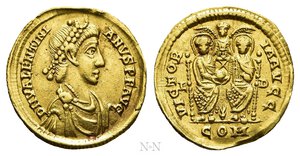
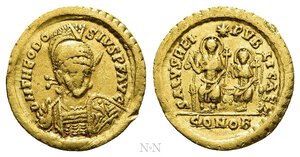
Lot # 809 - VALENTINIAN II (375-392). GOLD Solidus. Lugdunum. Obv: D N VALENTINIANVS P F AVG. Pearl-diademed, draped and cuirassed bust right.Rev: VICTORIA AVGG / L - D / COM. Two emperors seated facing on double throne, holding globus between them; behind and between, Victory standing front with outspread wings, palm frond below.RIC 38a; Depeyrot 17/1.From the Marc Poncin Collection, ex Classical Numismatic Group E-146 (2006), lot 286; ex V. Gadoury Monaco (2018), lot 273. Flavius Valentinianus, of Augusta Treverorum (Treveri), son of Justina, ascended the throne when he was only four years old. He was elected augustus in 375 by the soldiers, because they refused to let the sole legions of Germania, who had nominated Valentinian's elder half-brother Gratian, choose the emperor. However young, Valentinian faced complicated situations with his mother and Gratian, such as the usurpation of Magnus Maximus in Britain, which was remedied by Theodosius I, who managed to prevent Valentinian from being attacked by the insurgent's legions. More complicated was the matter of the removal of the Altar of Victory from the Senate of Rome, which represented the city's glorious pagan tradition. Its removal was supported by Gratian, on the advice of charismatic figures such as Mediolanum bishop Ambrose, which led him to confront a group headed by senator Quintus Aurelius Simmachus. As much as Justina and her son were of the Arian faith and close to Simmachus, the altar was nevertheless removed to the great scandal of the court of Rome. When his mother and brother faced such situations, because of his young age Valentinian often remained in the background; moreover, he fell under the spell of a dangerous character: the Frank leader and able warrior Arbogastes, his magister equitum. Soon, however, their relationship became conflictual, partly because of the Altar of Victory, which Arbogaste wanted to see restored. Valentinian was found hanged from a tree in 392 at Vienne in Gaul. Sources disagree on the cause of death, some mentioning suicide, others leaning toward murder by Arbogaste. The emperor was probably the victim of a palace conspiracy, as Arbogaste had led to the elevation of Flavius Eugenius to augustus. The damnatio memoriae documented by some eroded inscriptions may support this hypothesis. His funeral was held in Mediolanum, at the behest of Theodosius I, by Bishop Ambrose, who also wrote a consolatory piece on the young emperor's death for the occasion. Condition: Very fine; ex jewelry.Weight: 4.44 g. Diameter: 20 mm.Estimate: € 500
Watch:
Starting price: € 400
Current bid: € 425
B.P.: 18.90%
Closing on: 2026-06-07 16:00:00 Roma time
Watch:
Starting price: € 80
Current bid: € 80
B.P.: 18.90%
Closing on: 2026-06-07 16:00:00 Roma time
Watch:
Starting price: € 400
Current bid: € 400
B.P.: 18.90%
Closing on: 2026-06-07 16:00:00 Roma time
Watch:
Starting price: € 80
B.P.: 18.90%
Closing on: 2026-06-07 16:00:00 Roma time
Watch:
Starting price: € 40
B.P.: 18.90%
Closing on: 2026-06-07 16:00:00 Roma time
Watch:
Starting price: € 600
Current bid: € 600
B.P.: 18.90%
Closing on: 2026-06-07 16:00:00 Roma time
Watch:
Starting price: € 40
B.P.: 18.90%
Closing on: 2026-06-07 16:00:00 Roma time
Watch:
Starting price: € 80
B.P.: 18.90%
Closing on: 2026-06-07 16:00:00 Roma time
Watch:
Starting price: € 40
B.P.: 18.90%
Closing on: 2026-06-07 16:00:00 Roma time
Watch:
Starting price: € 80
B.P.: 18.90%
Closing on: 2026-06-07 16:00:00 Roma time
Watch:
Starting price: € 40
B.P.: 18.90%
Closing on: 2026-06-07 16:00:00 Roma time
Ex Rauch 2013
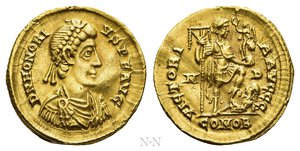
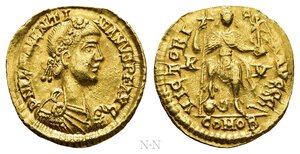
Lot # 820 - HONORIUS (393-423). GOLD Solidus. Mediolanum. Obv: D N HONORIVS P F AVG. Pearl-diademed, draped and cuirassed bust right.Rev: VICTORIA AVGGG / M - D / COMOB. Honorius standing right, with foot set on captive, holding vexillum and victoriola.RIC 1206; Depeyrot 16/2.Ex Auktionshaus H. D. Rauch 14 (2013), lot 496 Honorius became Augustus of the West at the age of ten at the behest of his father Theodosius I, who was intent on establishing the succession before his death. Given his young age, however, he was assisted by the valiant general Stilicho, who was half Vandal in origin and unlikely to have been aiming for the throne. The East, on the other hand, was entrusted to Honorius's brother Arcadius, and this was home to unrest because the two brothers did not like each other and were both assisted by cunning and manipulative advisers. By now there was no longer talk of a western and eastern part of the empire, but of two separate empires. Theodosius' project of a united empire in solidarity with the barbarian peoples, integrated into the Roman army, had failed. According to some historians Arcadius was the first Byzantine emperor. Stilicho faced great difficulties on the eastern front, mainly due to Alaric's Goths and other tribes crossing into Gaul. The situation precipitated and the Senate refused to pay a large sum of money to Alaric, further accusing Stilicho of conspiring with the enemy and condemning him to death in 408. It was the beginning of the end for the West, because the most valuable politician and general was lost. Honorius resided in Ravenna, where he treacherously attempted to murder Alaric, who was there to renew the 'foedus' with the emperor. This caused him to break off all negotiations and led to the famous 'sack of Rome' in 410, which marked the end of the city as capital. The news of Rome's fall represented a trauma for the empire and the collapse of the certainty of its invincibility. Honorius also did not recognize the marriage between his half-sister Galla Placidia and Ataulf, Alaric's successor. This marriage was strongly desired by the Goths and may have been a response to the crisis in the empire, as Ataulf intended to settle permanently in Roman territories by offering protection to the emperor instead of fighting him. In 413 General Flavius Constantius defeated four usurpers in the western provinces, succeeded in signing a peace treaty with Ataulf, and became associate emperor under the name Constantius III (421) but, unrecognized by the eastern empire, died shortly thereafter. In 423 Honorius also died, marking the final surrender, the birth of the Romano-Barbarian kingdoms and the first steps of medieval history. Condition: Good very fine.Weight: 4.41 g. Diameter: 21 mm.Estimate: € 500
Watch:
Starting price: € 400
B.P.: 18.90%
Closing on: 2026-06-07 16:00:00 Roma time
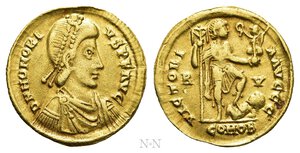
Lot # 821 - HONORIUS (393-423). GOLD Solidus. Ravenna. Obv: D N HONORIVS P F AVG. Pearl-diademed, draped and cuirassed bust right.Rev: VICTORIA AVGGG / R - V / COMOB. Honorius standing right, with foot upon captive, holding labarum and victoriola.RIC 1323; Ranieri 13; Depeyrot 7/1.Honorius became Augustus of the West at the age of ten at the behest of his father Theodosius I, who was intent on establishing the succession before his death. Given his young age, however, he was assisted by the valiant general Stilicho, who was half Vandal in origin and unlikely to have been aiming for the throne. The East, on the other hand, was entrusted to Honorius's brother Arcadius, and this was home to unrest because the two brothers did not like each other and were both assisted by cunning and manipulative advisers. By now there was no longer talk of a western and eastern part of the empire, but of two separate empires. Theodosius' project of a united empire in solidarity with the barbarian peoples, integrated into the Roman army, had failed. According to some historians Arcadius was the first Byzantine emperor. Stilicho faced great difficulties on the eastern front, mainly due to Alaric's Goths and other tribes crossing into Gaul. The situation precipitated and the Senate refused to pay a large sum of money to Alaric, further accusing Stilicho of conspiring with the enemy and condemning him to death in 408. It was the beginning of the end for the West, because the most valuable politician and general was lost. Honorius resided in Ravenna, where he treacherously attempted to murder Alaric, who was there to renew the 'foedus' with the emperor. This caused him to break off all negotiations and led to the famous 'sack of Rome' in 410, which marked the end of the city as capital. The news of Rome's fall represented a trauma for the empire and the collapse of the certainty of its invincibility. Honorius also did not recognize the marriage between his half-sister Galla Placidia and Ataulf, Alaric's successor. This marriage was strongly desired by the Goths and may have been a response to the crisis in the empire, as Ataulf intended to settle permanently in Roman territories by offering protection to the emperor instead of fighting him. In 413 General Flavius Constantius defeated four usurpers in the western provinces, succeeded in signing a peace treaty with Ataulf, and became associate emperor under the name Constantius III (421) but, unrecognized by the eastern empire, died shortly thereafter. In 423 Honorius also died, marking the final surrender, the birth of the Romano-Barbarian kingdoms and the first steps of medieval history. Condition: Very fine.Weight: 4.44 g. Diameter: 20 mm.Estimate: € 500
Watch:
Starting price: € 400
B.P.: 18.90%
Closing on: 2026-06-07 16:00:00 Roma time
Watch:
Starting price: € 400
Current bid: € 400
B.P.: 18.90%
Closing on: 2026-06-07 16:00:00 Roma time
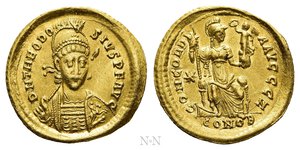
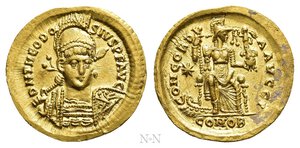
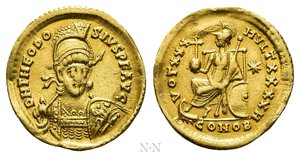
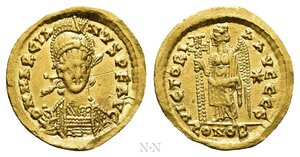
Lot # 823 - THEODOSIUS II (402-450). GOLD Solidus. Constantinople. Obv: D N THEODOSIVS P F AVG. Helmeted and cuirassed bust facing slightly right, holding spear and shield decorated with horseman motif.Rev: CONCORDIA AVGG I / CONOB. Constantinopolis seated facing on throne, head right, with foot set upon prow and holding sceptre and globus surmounted by crowning Victory; star to left.RIC 202; Depeyrot 73/2.Theodosius II was proclaimed Augustus at the age of one, but became the ruler of the East only when his father Arcadius died in 408. In fact, however, his mother Aelia Eudoxia was the real ruler, together with the praetorian prefect Anthemius, who had already reigned for Arcadius and distinguished himself for his wisdom and good judgment. The beginning of his reign was marked by peace: relations with the court of Ravenna and with the Persians were good, and important reconstruction works were begun, especially those concerning the new city walls of Constantinople. In 414, however, Anthemius disappeared from court and was replaced by Theodosius II's young sister, Pulcheria, a devout Christian, who began to rule effectively in the East until her brother came of age. She was responsible for the aggressive approach towards the Huns, who represented a new threat to the empire. She also chose to marry her brother to Aelia Eudocia, the daughter of a pagan philosopher from Athens, who was committed to writing religious and secular hymns. Theodosius also enjoyed writing scientific, historical, and theological works, and the court was imbued with a fervent Christian faith. Again on Pulcheria's suggestion, Theodosius attempted to place his cousin Valentinian III on the Western throne and began to reclaim provinces and territories, arguing that the empire should be united. But the Roman Senate, the court of Ravenna with John I, and the army reorganized to protect the West against the claims of Constantinople, enacting laws and launching a campaign in Africa against Bonifatius, loyal to Theodosius II, guilty of having attracted the Vandals of Genseric there. A compromise was reached in Africa, and Theodosius entrusted Valentinian III's mother, Galla Placidia, a woman of undisputed political experience and diplomatic skill, with taking control of the West. This led to the capture of John I in Ravenna and Valentinian III was acclaimed emperor of the West, while Galla Placidia began to establish good relations with both Christians and pagans in an attempt to create a broad consense around her son. Theodosius died in 450 after falling from his horse, before he could implement a series of important initiatives. His reign was marked by a cultural renaissance, during which the famous 'Codex Theodosianus' was compiled to reaffirm the unity of the Roman Empire and lay the foundations for Justinian's future code. Condition: Extremely fine.Weight: 4.37 g. Diameter: 22 mm.Estimate: € 500
Watch:
Starting price: € 400
B.P.: 18.90%
Closing on: 2026-06-07 16:00:00 Roma time
Watch:
Starting price: € 240
Current bid: € 240
B.P.: 18.90%
Closing on: 2026-06-07 16:00:00 Roma time
Watch:
Starting price: € 400
B.P.: 18.90%
Closing on: 2026-06-07 16:00:00 Roma time
Ex Frühwald 2011
Lot # 826 - VALENTINIAN III (425-455). GOLD Solidus. Ravenna. Obv: D N PLA VALENTINIANVS P F AVG. Rosette-diademed, draped and cuirassed bust right.Rev: VICTORIA AVGGG / R - V / COMOB. Valentinian standing facing, with foot set upon serpentine human head, holding long cross and crowning Victory on globus.RIC 2019; Ranieri 98; Depeyrot 17/1.Ex Auktionen Frühwald 94 (2011), lot 355; ex Auktionshaus Felzmann 144 (2013), lot 178 Flavius Placidius Valentinianus was born in 419 to Constantius III and Galla Placidia, placed very young on the throne after the death of Honorius, who had left no heir, while the court of Ravenna had chosen Johannes as augustus in an attempt to free itself from the control of the Eastern Empire. Appointed caesar in 424, he was crowned augustus of the West in Rome the following year, but his mother Galla ruled in his stead for more than a decade. Despite her diplomatic prowess Galla Placidia was in trouble when she faced the valiant general Flavius Aetius, who had sided with Johannes and for him gained the support of the Huns. After the defeat of the usurper Galla could not put the general to death, but she put him back to work in the Gauls, where he displayed great military experience and earned the title of 'magister militum'. Flavius Aetius, in fact, found himself in charge of a power greater even than that of the young emperor and his mother, and did his best to contain barbarian pressure on the Rhine and Danube fronts, while he could do nothing against Genseric's Vandals who conquered Carthage. Another serious threat was posed by the Huns who, having renounced tribute from the Eastern Empire under Marcian control, turned to the West: the sister of Valentinian III, Justa Grata Honoria, unwilling to marry the man for whom her family had destined her, sent a plea for help to Attila, in some ways legitimizing his coming to the West. This started a war in Gaul. Aetius prevailed in the battle near the Catalaunian Fields (451) but Attila, although defeated, managed to sack Mediolanum. Here occurred the famous and mysterious meeting with pope Leo I the Great, who succeeded in getting him to desist from an invasion of Italy (453). Attila died shortly afterward, however. The end of Valentinian III's reign came, however, at the hands of his most trusted advisers. Jealous of the power Aetius was gaining, the eunuch Heraclius and the prefect of the praetorium in Rome, Petronius Maximus, persuaded the emperor to get rid of him (454). Without Aetius Valentinian had deprived himself of his own power and was murdered the following year by two assassins sent by Maximus. Condition: Good very fine.Weight: 4.40 g. Diameter: 21 mm.Estimate: € 500
Watch:
Starting price: € 400
Current bid: € 450
B.P.: 18.90%
Closing on: 2026-06-07 16:00:00 Roma time
Watch:
Starting price: € 400
B.P.: 18.90%
Closing on: 2026-06-07 16:00:00 Roma time
Watch:
Starting price: € 400
Current bid: € 400
B.P.: 18.90%
Closing on: 2026-06-07 16:00:00 Roma time
Watch:
Starting price: € 400
B.P.: 18.90%
Closing on: 2026-06-07 16:00:00 Roma time
Watch:
Starting price: € 200
B.P.: 18.90%
Closing on: 2026-06-07 16:00:00 Roma time
Watch:
Starting price: € 80
B.P.: 18.90%
Closing on: 2026-06-07 16:00:00 Roma time
Watch:
Starting price: € 80
B.P.: 18.90%
Closing on: 2026-06-07 16:00:00 Roma time
Watch:
Starting price: € 160
B.P.: 18.90%
Closing on: 2026-06-07 16:00:00 Roma time
Watch:
Starting price: € 80
B.P.: 18.90%
Closing on: 2026-06-07 16:00:00 Roma time
Watch:
Starting price: € 400
B.P.: 18.90%
Closing on: 2026-06-07 16:00:00 Roma time
Watch:
Starting price: € 160
Current bid: € 160
B.P.: 18.90%
Closing on: 2026-06-07 16:00:00 Roma time
Watch:
Starting price: € 560
B.P.: 18.90%
Closing on: 2026-06-07 16:00:00 Roma time
Watch:
Starting price: € 320
B.P.: 18.90%
Closing on: 2026-06-07 16:00:00 Roma time
Watch:
Starting price: € 80
B.P.: 18.90%
Closing on: 2026-06-07 16:00:00 Roma time
Watch:
Starting price: € 40
B.P.: 18.90%
Closing on: 2026-06-07 16:00:00 Roma time