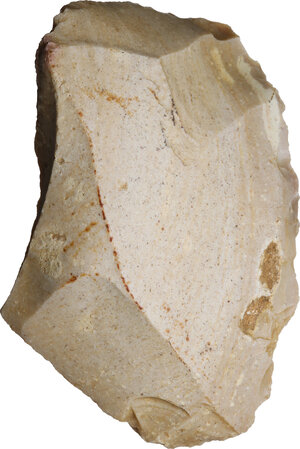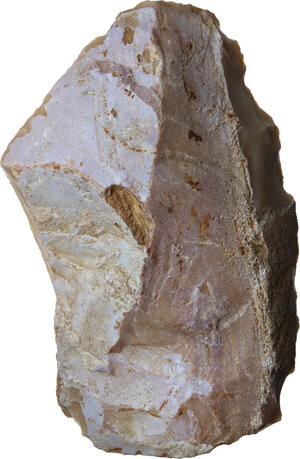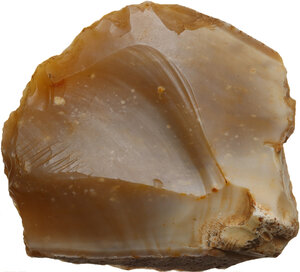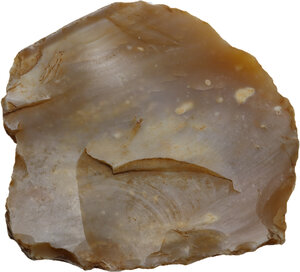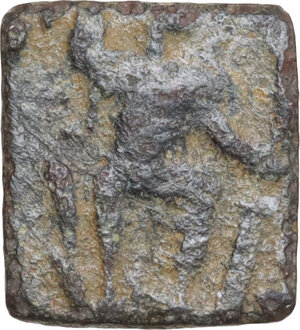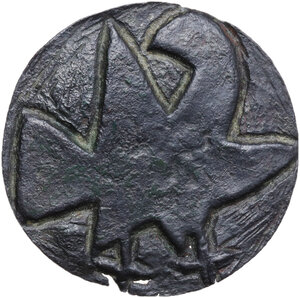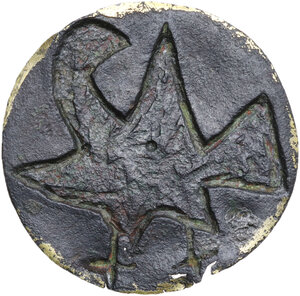
PREHISTORIC FLINT SCRAPER Upper Paleolithic to Neolithic, c. 35000-5000 BC. Scraper made of flint with a notched crescent side. Dimensions: 57x51 mm - PREHISTORIC FLINT SCRAPER Upper Paleolithic to Neolithic, c. 35000-5000 BC. Scraper made of flint with a notched crescent side. Dimensions: 57x51 mm. Intact and fascinating item. One can clearly see the retouches made to give this flint a clean and precise shape, so that it could be used for scraping purposes.
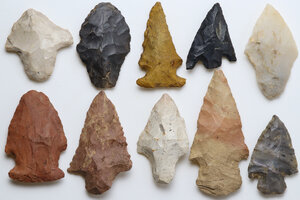
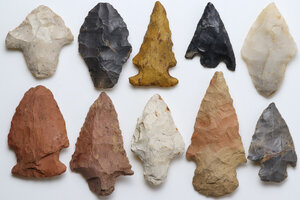
AMERICAN INDIANS ARROWHEADS American prehistory, c. 13500-1000 BC. Lot of ten (10) flint american indians arrowheads. Various shapes. Dimensions: from 72 to 38 mm - AMERICAN INDIANS ARROWHEADS American prehistory, c. 13500-1000 BC. Lot of ten (10) flint american indians arrowheads. Various shapes. Dimensions: from 72 to 38 mm. Minor damages.
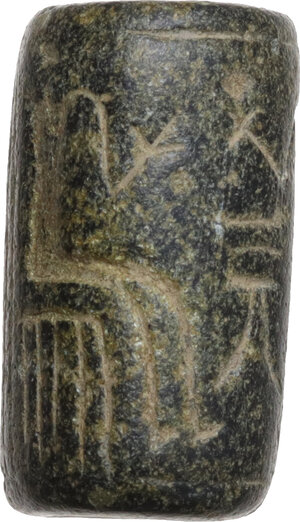
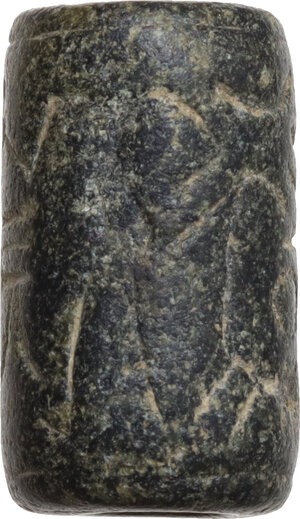
MESOPOTAMIAN CYLINDER SEAL Late Near Eastern culture, late 2nd - early 1st millennium BC. Green serpentine cylinder seal with large through hole. It features a complex engraving apparatus, with a figure seated on a throne and animals, as well as letters in the cuneiform alphabet from the late period. Dimensions: 20 x 12 mm - MESOPOTAMIAN CYLINDER SEAL Late Near Eastern culture, late 2nd - early 1st millennium BC. Green serpentine cylinder seal with large through hole. It features a complex engraving apparatus, with a figure seated on a throne and animals, as well as letters in the cuneiform alphabet from the late period. Dimensions: 20 x 12 mm. Very rare and interesting study item. Intact and complete. The seals with crude designs are typical of the dark age of the late second-early first millennium BC. Bibl: Catalogue of ancient Near Eastern seals in the Ashmolean Museum, Volume I, Cylinder seals, pp. 205-207.
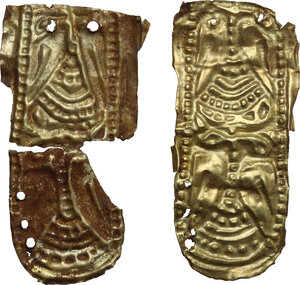
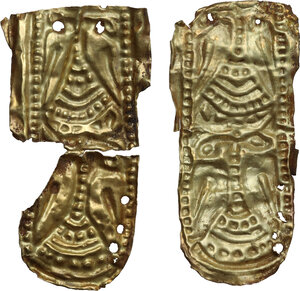
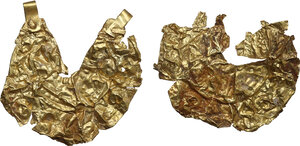
SCYTHIAN GOLD SHEETS Scythian culture, 1st millennium BC. Pair of gold foils decorated with embossed ornithomorphic and geometric motifs, probably pertaining to the decoration of a parade object. Dimensions: 61x28 mm. Weight: 8.25 g - SCYTHIAN GOLD SHEETS Scythian culture, 1st millennium BC. Pair of gold foils decorated with embossed ornithomorphic and geometric motifs, probably pertaining to the decoration of a parade object. Dimensions: 61x28 mm. Weight: 8.25 g. Rare and fascinating item. One intact and complete, the other damaged, with missing. Presence of ancient holes for mounting.
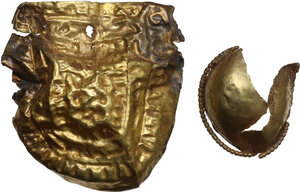
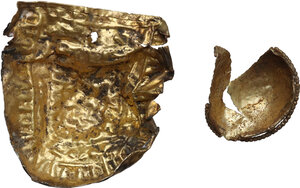
SCYTHIAN GOLD SHEET AND BULLA Scythian culture, 1st millennium BC. Gold sheet with embossed geometri motifs, probably pertaining to the decoration of a parade object and a bulla. Dimensions: 30x29 and 18 mm. Weight: 2.15 and 0.68 g - SCYTHIAN GOLD SHEET AND BULLA Scythian culture, 1st millennium BC. Gold sheet with embossed geometri motifs, probably pertaining to the decoration of a parade object and a bulla. Dimensions: 30x29 and 18 mm. Weight: 2.15 and 0.68 g. Rare and fascinating items. Damaged, with missings.
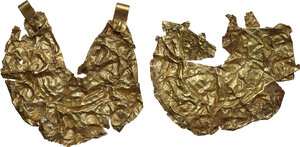
SCYTHIAN GOLD APPLIQUES Scythian culture, 1st millennium BC. Lot of two gold foil appiques of half-moon shape, one retains the two suspension rings. Dimensions: 41x39 and 41x33 mm. Weight: 1.32 and 0,73 g - SCYTHIAN GOLD APPLIQUES Scythian culture, 1st millennium BC. Lot of two gold foil appiques of half-moon shape; one retains the two suspension rings. Dimensions: 41x39 and 41x33 mm. Weight: 1.32 and 0,73 g. Rare and fascinating items. Bent and damaged.
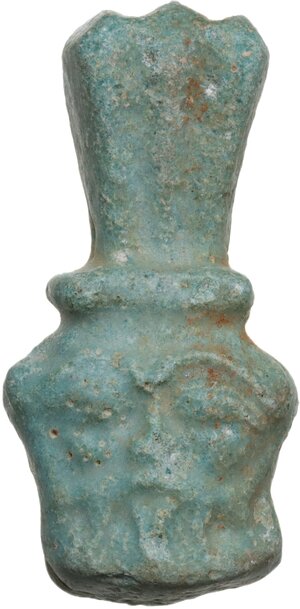
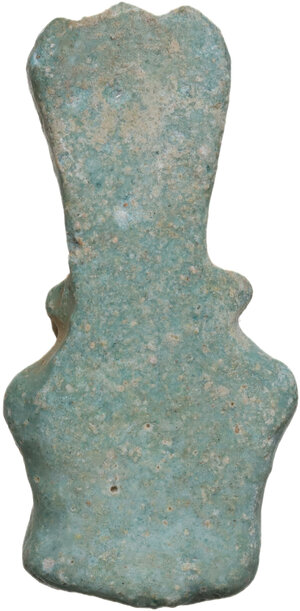
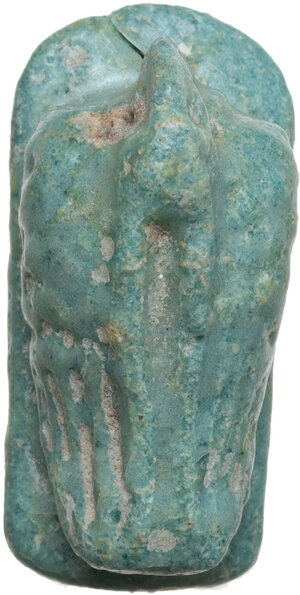
EGYPTIAN BES FAIENCE AMULET Egyptian Late Period (716-30 BC.) Egyptian light blue faience amulet depicting the head of the god Bes in his classical representation with a crown of feathers on his head, a broad bearded face with large eyes and a flattened nose. Through-hole at the base of the feather crown. Height: 33 mm - EGYPTIAN BES FAIENCE AMULET Egyptian Late Period (716-30 BC.) Egyptian light blue faience amulet depicting the head of the god Bes in his classical representation with a crown of feathers on his head, a broad bearded face with large eyes and a flattened nose. Through-hole at the base of the feather crown. Height: 33 mm. Intact, minor wears on the surface. The god Bes, depicted as a fat, bearded, feral dwarf, was considered by the ancient Egyptians to be the protector of the home, of sleep and of women in labour.
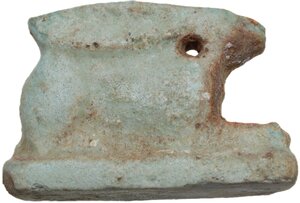
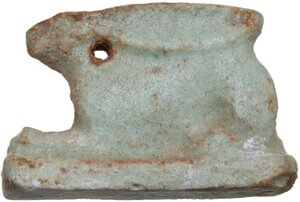
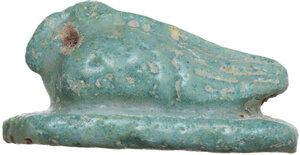
EGYPTIAN HARE FAIENCE AMULET Egyptian Late Period (716-30 BC.) Egyptian pale blue faience amulet depicting a hare crouched on a rectangular base. Through-hole at the base of the ears. Lenght: 24 mm - EGYPTIAN HARE FAIENCE AMULET Egyptian Late Period (716-30 BC.) Egyptian pale blue faience amulet depicting a hare crouched on a rectangular base. Through-hole at the base of the ears. Lenght: 24 mm. Intact, with nice earthy encrustations.
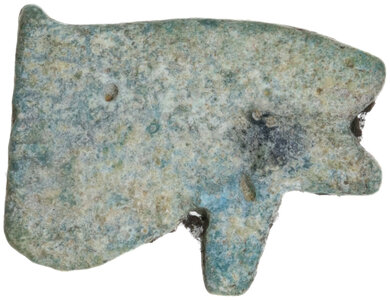
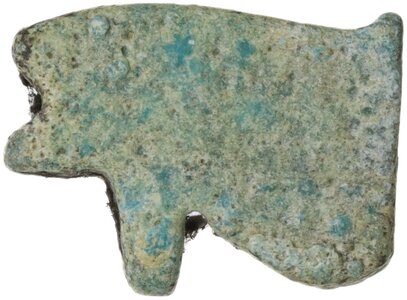
EGYPTIAN HORUS EYE FAIENCE AMULET Egyptian Late Period (716-30 BC.) Egyptian light blue faience amulet depicting the eye of Horus. Through-hole for suspension. Lenght: 15 mm - EGYPTIAN HORUS EYE FAIENCE AMULET Egyptian Late Period (716-30 BC.) Egyptian light blue faience amulet depicting the eye of Horus. Through-hole for suspension. Lenght: 15 mm. Intact, nicely wear. The Eye of Horus was in the Egyptian religion the symbol of protection, prosperity, royal power and good health.
EGYPTIAN BIRD FAIENCE AMULET Egyptian Late Period (716-30 BC.) Egyptian light blue faience amulet depicting a bird crouched on a rectangular base. Through-hole at the base of the neck. Lenght: 25 mm - EGYPTIAN BIRD FAIENCE AMULET Egyptian Late Period (716-30 BC.) Egyptian light blue faience amulet depicting a bird crouched on a rectangular base. Through-hole at the base of the neck. Lenght: 25 mm. Small chip repaired.
RARE LURISTAN BRONZE Iran, c. 7th century BC. Rare bronze from the Luristan culture, tubular in shape with moldings in the external parts and robes in relief in the central part. Dimensions: 175x26 mm - RARE LURISTAN BRONZE Iran, c. 7th century BC. Rare bronze from the Luristan culture, tubular in shape with moldings in the external parts and robes in relief in the central part. Dimensions: 175x26 mm. Object with encrustations removed. Leather patina with minor reddish deposits.
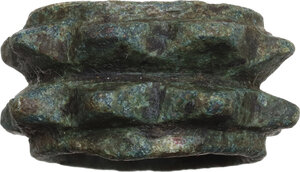
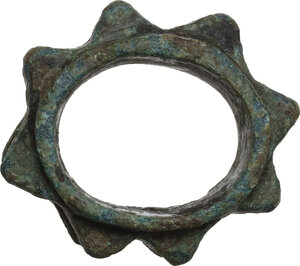
BRONZE "PASSAREDINI" OR MACE HEAD Italic culture, c. 6th to 4th century BC. Masculine ring forged from leaded bronze. The circular accessory features a relatively smooth interior surface as well as columns of two spikes surrounding the exterior. Diameter: 34.5 mm. Inner size: 21 mm. Height: 16 mm - BRONZE 'PASSAREDINI' OR MACE HEAD Italic culture, c. 6th to 4th century BC. Masculine ring forged from leaded bronze. The circular accessory features a relatively smooth interior surface as well as columns of two spikes surrounding the exterior. Diameter: 34.5 mm. Inner size: 21 mm. Height: 16 mm. AE. Intact and complete. Generally referred to as 'passaredini' and thus related to the equestrian sphere, this type of bronze object apparently has no certain function. Another hypothesis of use sees these objects as belonging to the military or domestic sphere.
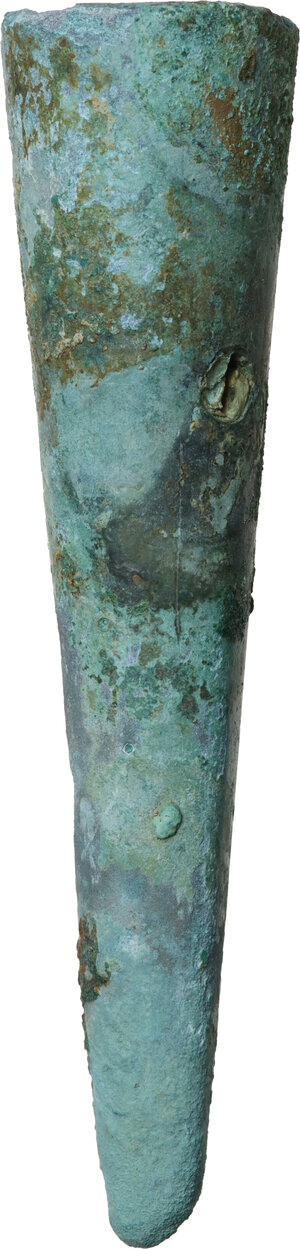
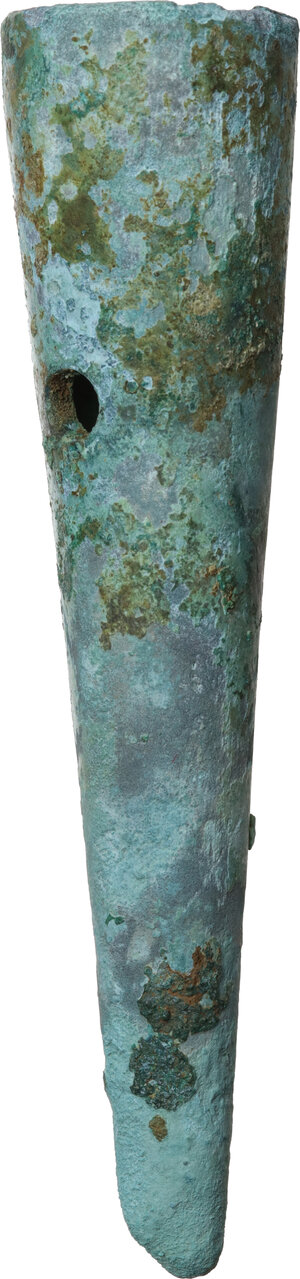
BRONZE SPEAR TERMINAL Italic culture, c. 5th century BC Terminal part of a bronze spear, conical in shape, with two holes. Lenght: 88 mm - BRONZE SPEAR TERMINAL Italic culture, c. 5th century BC Terminal part of a bronze spear, conical in shape, with two holes. Lenght: 88 mm.
BRONZE VASE HANDLE Italic (?) culture, c. 5th century BC. Bronze vase handle, possibly of Italic manufacture, in the shape of an omega with the terminals shaped like phytomorphic elements. Dimensions: 64x57 mm - BRONZE VASE HANDLE Italic (?) culture, c. 5th century BC. Bronze vase handle, possibly of Italic manufacture, in the shape of an omega with the terminals shaped like phytomorphic elements. Dimensions: 64x57 mm.
ITALIC HALF WALNUT LEAD Italic cultures, Central Italy, 4th century BC. Lead configured in half-nut. Lenght: 29 mm, Weight: 28.48 g - ITALIC HALF WALNUT LEAD Italic cultures, Central Italy, 4th century BC. Lead configured in half-nut. Lenght: 29 mm; Weight: 28.48 g. 28.48 g. 29.00 mm. Rare and interesting item.
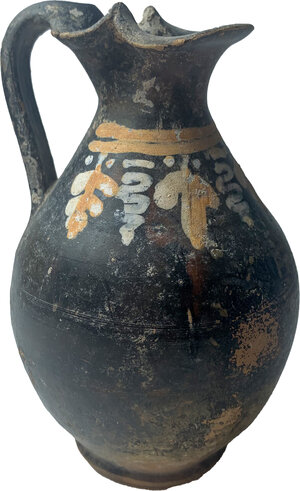
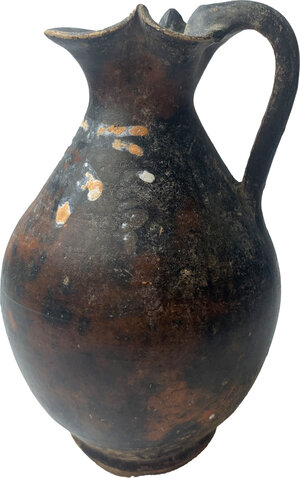
GNATHIAN STYLE SMALL OINOCHOE Apulian culture, c. 4th century BC. Small oinochoe in the style of Gnathia, with three-lobed mouth, receding shoulder, ovoid body, low foot. Slightly overlapping rod handle. Decoration overpainted in white and beige, with phytomorphic and geometric motifs. Height: 109 mm., Width: 67 mm - GNATHIAN STYLE SMALL OINOCHOE Apulian culture, c. 4th century BC. Small oinochoe in the style of Gnathia, with three-lobed mouth, receding shoulder, ovoid body, low foot. Slightly overlapping rod handle. Decoration overpainted in white and beige, with phytomorphic and geometric motifs. Height: 109 mm.; Width: 67 mm. Intact and complete.
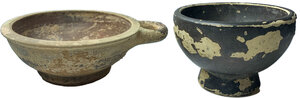
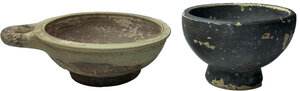
LOT OF TWO APULIAN VASES Apulian culture, 4th-3rd century BC. Lot of two Apulian vessels, a light clay single-handled cup with brown glaze decoration in full field in the bowl and banded on the outside and a black glazed cup. Dimensions: 91x37 and 78x53 mm - LOT OF TWO APULIAN VASES Apulian culture, 4th-3rd century BC. Lot of two Apulian vessels; a light clay single-handled cup with brown glaze decoration in full field in the bowl and banded on the outside and a black glazed cup. Dimensions: 91x37 and 78x53 mm. Intact and complete. Encrustations and damages to the paint. Interesting symbol engraved under the foot of the cup in black paint.
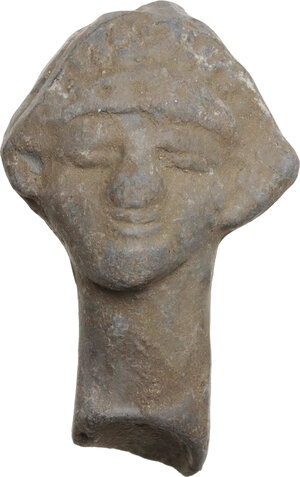
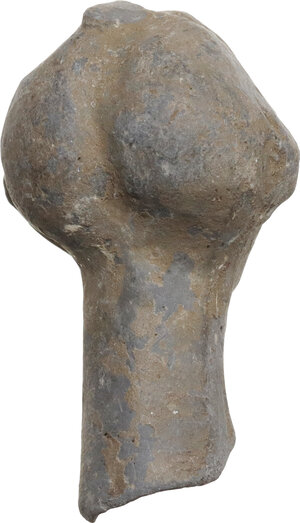
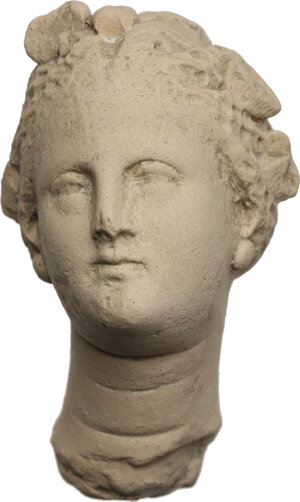
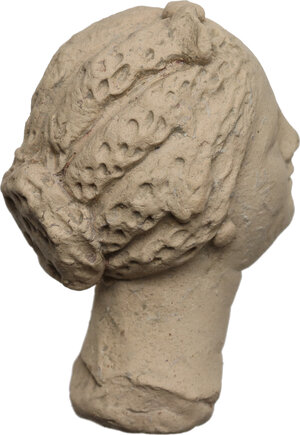
FEMALE TERRACOTTA HEAD South Italian, c. 4th-3rd century BC. Female head in terracotta, resting slightly on one side and with hair gathered in a chignon at the back. Height: 61 mm - FEMALE TERRACOTTA HEAD South Italian, c. 4th-3rd century BC. Female head in terracotta, resting slightly on one side and with hair gathered in a chignon at the back. Height: 61 mm. Fascinating, of high manufacturing technique. Decoration of the braids made with dot impressions. Part of a medium-sized statuette.
MAGNA GRECIAN TERRACOTTA APPLIQUE Magna Graecia, c. 4th-2nd century BC. Terracotta applique made from matrix, depicting a female head with a long neck and complex hair. Dimensions: 33.5 x 21 mm - MAGNA GRECIAN TERRACOTTA APPLIQUE Magna Graecia, c. 4th-2nd century BC. Terracotta applique made from matrix, depicting a female head with a long neck and complex hair. Dimensions: 33.5 x 21 mm.
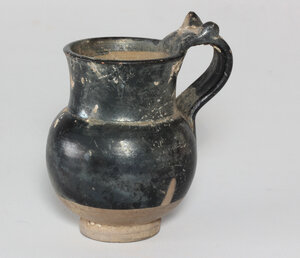
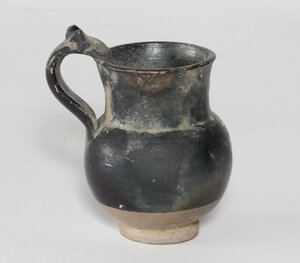
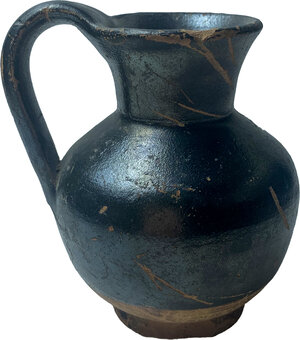
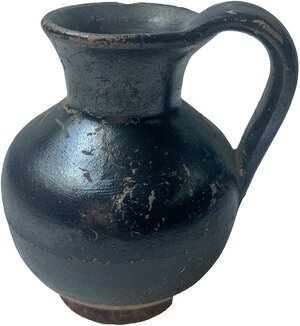
BLACK-GLAZED JUG Southern Italy, c. 4th-2nd century BC. Small black-glazed jug with circular mouth, high flared lip, ovoid body and disc-shaped foot, slightly overlapping rod-shaped handle with two peaks on the top. Full black paint with the lower part of the body and the foot spared. Dimensions: 100x69 mm - BLACK-GLAZED JUG Southern Italy, c. 4th-2nd century BC. Small black-glazed jug with circular mouth, high flared lip, ovoid body and disc-shaped foot, slightly overlapping rod-shaped handle with two peaks on the top. Full black paint with the lower part of the body and the foot spared. Dimensions: 100x69 mm.
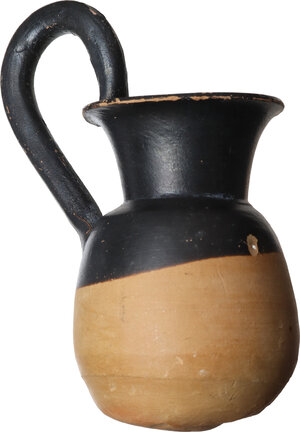
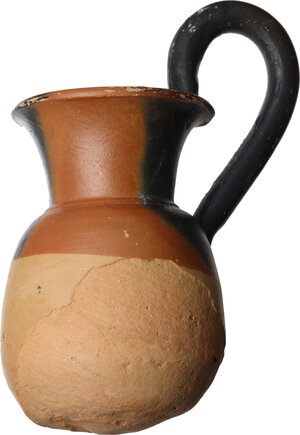
BLACK GLAZED OLPE Southern Italy, c. 4th-2nd century BC. Small black glazed olpe in beige clay with short everted lip, funnel-shaped neck, ovoid body and rod-shaped handle on top. Paint present in the upper part of the vase. Dimensions: 112x74 mm - BLACK GLAZED OLPE Southern Italy, c. 4th-2nd century BC. Small black glazed olpe in beige clay with short everted lip, funnel-shaped neck, ovoid body and rod-shaped handle on top. Paint present in the upper part of the vase. Dimensions: 112x74 mm. Rare pottery shape. Damages on the surface.
BLACK GLAZED JUG Southern Italy, c. 4th-2nd century BC. Black glazed jug with round mouth, funnel-shaped neck, slightly compressed ovoid body, slightly concave disc-shaped foot. Foot and external bottom spared from paint. Slightly overlapping ribbon handle. Dimensions: 77x62 mm - BLACK GLAZED JUG Southern Italy, c. 4th-2nd century BC. Black glazed jug with round mouth, funnel-shaped neck, slightly compressed ovoid body, slightly concave disc-shaped foot. Foot and external bottom spared from paint. Slightly overlapping ribbon handle. Dimensions: 77x62 mm. Intact and complete, minor damages.
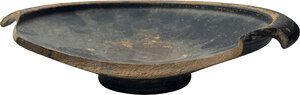
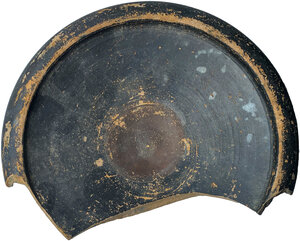
BLACK GLAZED BOWL Southern Italy, c. 4th-2nd century BC. Black glazed bowl of Italic production with hanging lip and tub with a truncated cone section. Low truncated cone foot. Dimensions: 200 x 51 mm - BLACK GLAZED BOWL Southern Italy, c. 4th-2nd century BC. Black glazed bowl of Italic production with hanging lip and tub with a truncated cone section. Low truncated cone foot. Dimensions: 200 x 51 mm. Broken, with missings. The presence of a less baked circle inside the bowl of black glaze plates and bowls is very common. This is, in fact, the mark left by the spacer disc that was placed between one plate and another in the pile of ceramics to be fired inside the kiln.
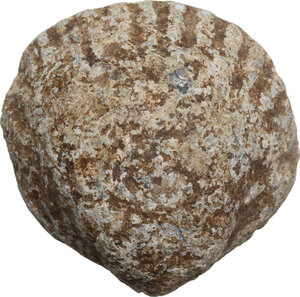
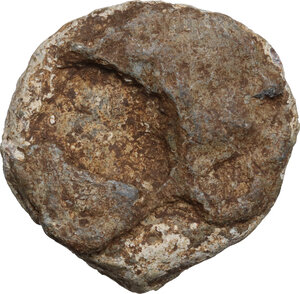
LEAD SCALLOP SHELL Greek world, Southern Italy, c. 4th - 2nd century BC. Lead scallop shell, obtained by casting. Natural rendering of details - LEAD SCALLOP SHELL Greek world, Southern Italy, c. 4th - 2nd century BC. Lead scallop shell, obtained by casting. Natural rendering of details. 55.83 g. 30.50 mm.
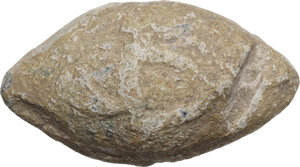
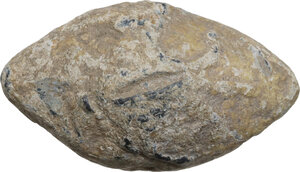
THUNDERBOLT SLINGSHOT Greek, Hellenistic Period, c. 3rd century BC. Lead slingshot bullet with thunderbolt and D (?). Dimensions: 37 x 21 mm - THUNDERBOLT SLINGSHOT Greek, Hellenistic Period, c. 3rd century BC. Lead slingshot bullet with thunderbolt and D (?). Dimensions: 37 x 21 mm. The representation of the thunderbolt on this slingshot is very similar of the representations on some Magna Graecia and Roman cast coins.
OFFERER HAND WITH PATERA Italic culture, c. 3rd-2nd century BC. Hand of bronze statuette holding a patera or a phiale mesomphalos. Dimensions: 17x13 mm - OFFERER HAND WITH PATERA Italic culture, c. 3rd-2nd century BC. Hand of bronze statuette holding a patera or a phiale mesomphalos. Dimensions: 17x13 mm. Rare and interesting item.
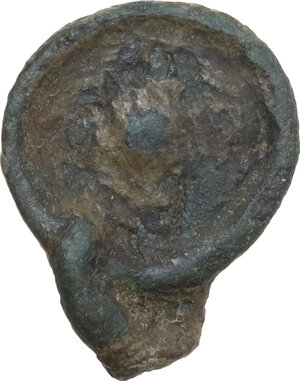
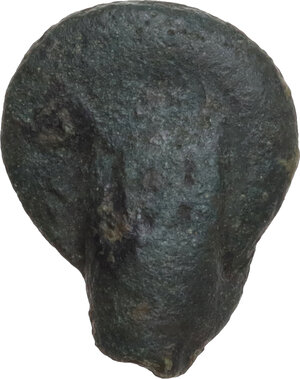
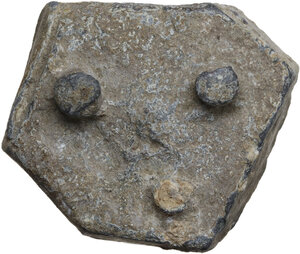
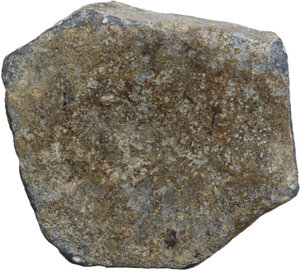
POLIGONAL LEAD WEIGHT Probably Roman Republic, c. 5th-1st century BC. Roman weight of irregular six-sided polygonal shape with three knobs on the surface, one of which may have been truncated in antiquity - POLIGONAL LEAD WEIGHT Probably Roman Republic, c. 5th-1st century BC. Roman weight of irregular six-sided polygonal shape with three knobs on the surface, one of which may have been truncated in antiquity. 128.00 g. 42.00 mm. Complete and intact. Object with a very unusual shape. The weight of 128 grams corresponds exactly to two and a half ounces on the foot of the Roman pound. The fact that the object has three knobs on its surface, one of which is apparently deliberately truncated, might suggest that these served to indicate its weight.
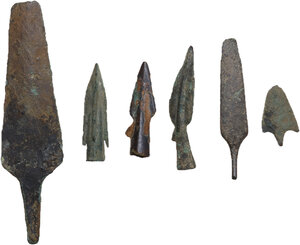
SIX ANCIENT WEAPONS 1st millennium BC - 2nd century AD. Lot of six ancient bronze weapons, including five arrowheads and a small blade (?). Lenghts: from 18 to 72 mm - SIX ANCIENT WEAPONS 1st millennium BC - 2nd century AD. Lot of six ancient bronze weapons, including five arrowheads and a small blade (?). Lenghts: from 18 to 72 mm. Minor damages.
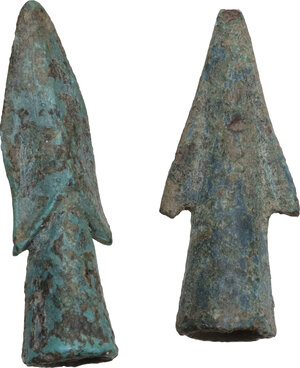
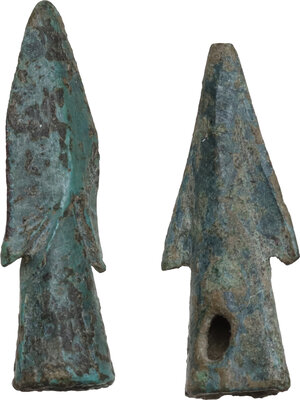
TWO PARTHIAN ARROWHEADS Ancient Iran, c. 3rd century BC. - 2nd century AD. Lot of two Parthian arrowheads, one with a triangular section, the other lanceolate. Lenght: 28 and 25.5 mm - TWO PARTHIAN ARROWHEADS Ancient Iran, c. 3rd century BC. - 2nd century AD. Lot of two Parthian arrowheads, one with a triangular section, the other lanceolate. Lenght: 28 and 25.5 mm. Intact and complete, with lovely green patina and minor earthy encrustations.
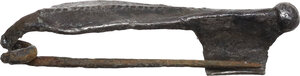
ANCIENT SILVER FIBULA Celtic (?) culture, c. 2nd century BC-1st century AD. Silver fibula, probably of Celtic production, with flat arch decorated with central dotted rib, tail ending in button. Dimensions: 41x8 mm - ANCIENT SILVER FIBULA Celtic (?) culture, c. 2nd century BC-1st century AD. Silver fibula, probably of Celtic production, with flat arch decorated with central dotted rib, tail ending in button. Dimensions: 41x8 mm. Repaired but complete.
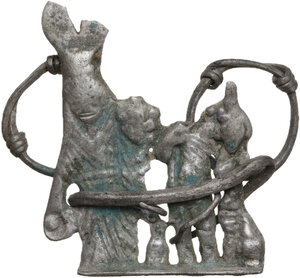
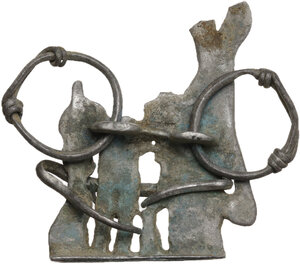
SILVER ISIS AND HARPOKRATES Roman period, c. 1st century BC-1st century AD. Silver amulet depicting Isis and her son Harpokrates. Wire fastening was mounted significantly later. Dimensions: 28x35 mm - SILVER ISIS AND HARPOKRATES Roman period, c. 1st century BC-1st century AD. Silver amulet depicting Isis and her son Harpokrates. Wire fastening was mounted significantly later. Dimensions: 28x35 mm. Interesting and fascinating item. Amulet probably linked to the Greco-Roman mysteries, in which numerous cult figures from antiquity were revived and partly given new meaning.
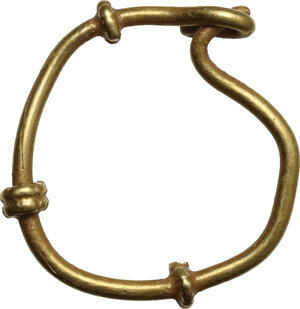
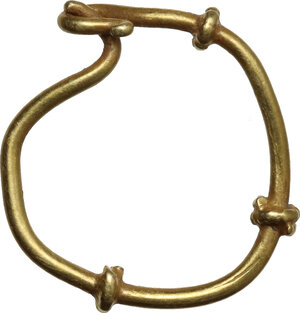
ANCIENT GOLD EARRING Ancient world, c. 5th century BC - 3rd century AD. Gold earring, made with a wire on which small rings are set. Dimensions: 19x17 mm. Weight: 1.33 g - ANCIENT GOLD EARRING Ancient world, c. 5th century BC - 3rd century AD. Gold earring, made with a wire on which small rings are set. Dimensions: 19x17 mm. Weight: 1.33 g.
ROMAN BONE GODDESS Roman period, c. 1st-3rd century AD. Roman statuette of a female deity in bone. Accurately rendered drapery and hair details. Height: 82 mm - ROMAN BONE GODDESS Roman period, c. 1st-3rd century AD. Roman statuette of a female deity in bone. Accurately rendered drapery and hair details. Height: 82 mm. Interesting and rare item.
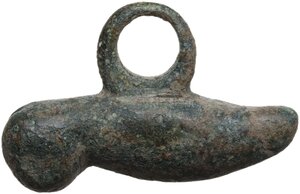
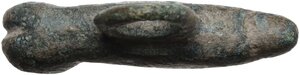
ROMAN PHALLIC AMULET Roman period, c. 1st-3rd century AD. Cast bronze pendant in the form of male genitals with realistic rendered details, surmounted by a suspension loop. Lenght: 32.50 mm - ROMAN PHALLIC AMULET Roman period, c. 1st-3rd century AD. Cast bronze pendant in the form of male genitals with realistic rendered details, surmounted by a suspension loop. Lenght: 32.50 mm. 13.20 g.
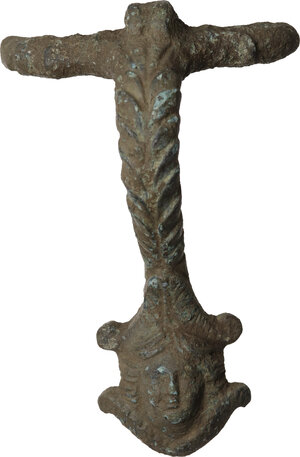
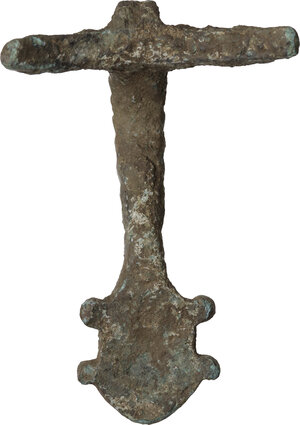
ROMAN BRONZE VASE HANDLE Roman period, c. 1st-3rd century AD. Roman bronze vase handle with phytomorphic decoration on the arched part and frontal female head on the end plate. Dimensions: 81 x 52 mm - ROMAN BRONZE VASE HANDLE Roman period, c. 1st-3rd century AD. Roman bronze vase handle with phytomorphic decoration on the arched part and frontal female head on the end plate. Dimensions: 81 x 52 mm. Intact and complete, of good craftmanship, with delicate green patina and earthy deposits.
ROMAN SURGICAL SPATULA Roman period, c. 1st-3rd century AD. Bronze surgical spatula with long handle and small concave head. Lenght: 101 mm - ROMAN SURGICAL SPATULA Roman period, c. 1st-3rd century AD. Bronze surgical spatula with long handle and small concave head. Lenght: 101 mm. Intact and complete. Lovely dark patina with minor earthy deposits. The spatula was one of the essential tools in the Roman surgeon's kit, together with the scalpel, tweezers and other tools for extracting bone fragments.
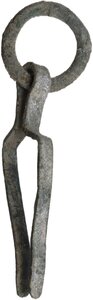
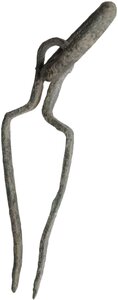
ROMAN BRONZE TWEEZERS Roman period, c. 1st-3rd century AD Roman bronze tweezers with suspension ring. Tweezers lenght: 52 mm., Ring width: 21 mm - ROMAN BRONZE TWEEZERS Roman period, c. 1st-3rd century AD Roman bronze tweezers with suspension ring. Tweezers lenght: 52 mm.; Ring width: 21 mm. Intact, still as flexible as in antiquity and without corrosion spots. Lovely everyday item, indispensable in daily body care operations. The suspension ring suggests that it was hung in the bathroom, perhaps in association with other objects.
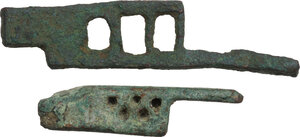
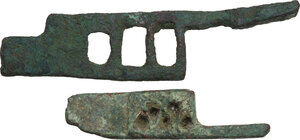
TWO ROMAN PADLOCKS Roman period, c. 1st to 3rd century AD. Lot of two roman bronze lock patches. Lenghts: 70 and 47 mm - TWO ROMAN PADLOCKS Roman period, c. 1st to 3rd century AD. Lot of two roman bronze lock patches. Lenghts: 70 and 47 mm. Intact and complete.
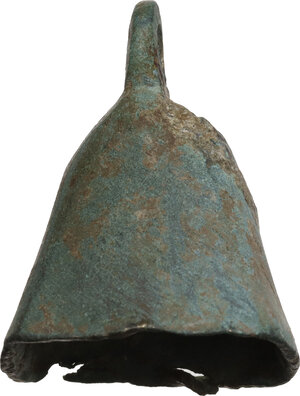
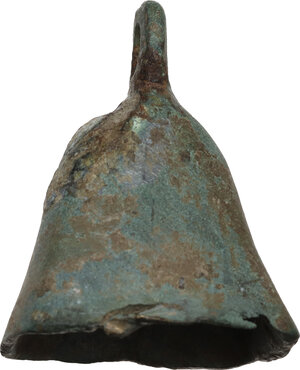
ROMAN BRONZE BELL Roman period, c. 1st - 3rd century AD. Rectangular cross-section bell, with suspension ring. Height: 40 mm. Base: 31 x 27 mm. Weight: 25.50 g - ROMAN BRONZE BELL Roman period, c. 1st - 3rd century AD. Rectangular cross-section bell, with suspension ring. Height: 40 mm. Base: 31 x 27 mm. Weight: 25.50 g. The iron clapper is missing, remaining traces inside.
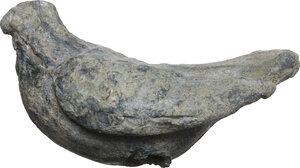
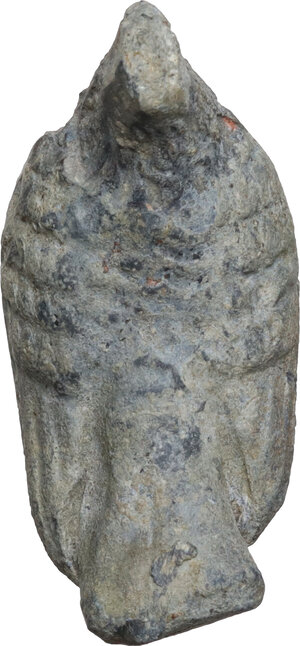
ROMAN LEAD BIRD FIGURINE Roman period, c. 1st-3rd century AD. Roman lead figurine configured as a bird (eagle?) in flight. There are two circular holes in the underlying art, perhaps to allow mounting on a stand. Dimensions: 42x27 mm. Weight: 59.60 g - ROMAN LEAD BIRD FIGURINE Roman period, c. 1st-3rd century AD. Roman lead figurine configured as a bird (eagle?) in flight. There are two circular holes in the underlying art, perhaps to allow mounting on a stand. Dimensions: 42x27 mm. Weight: 59.60 g.
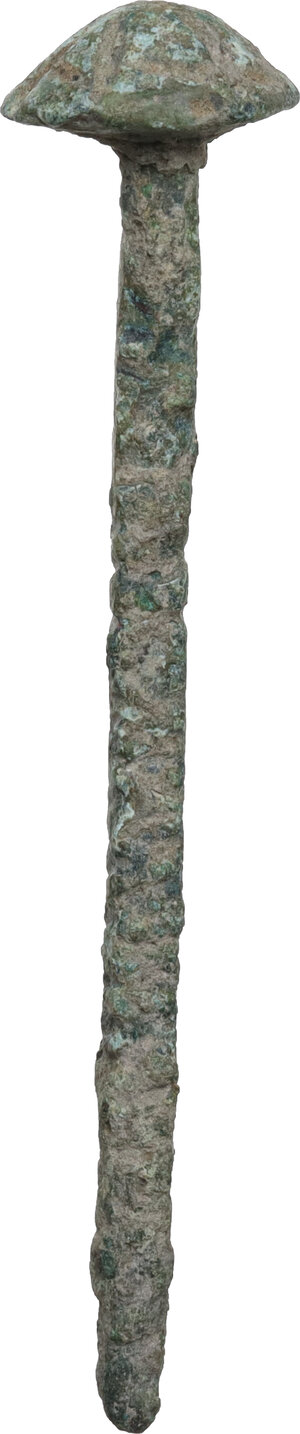
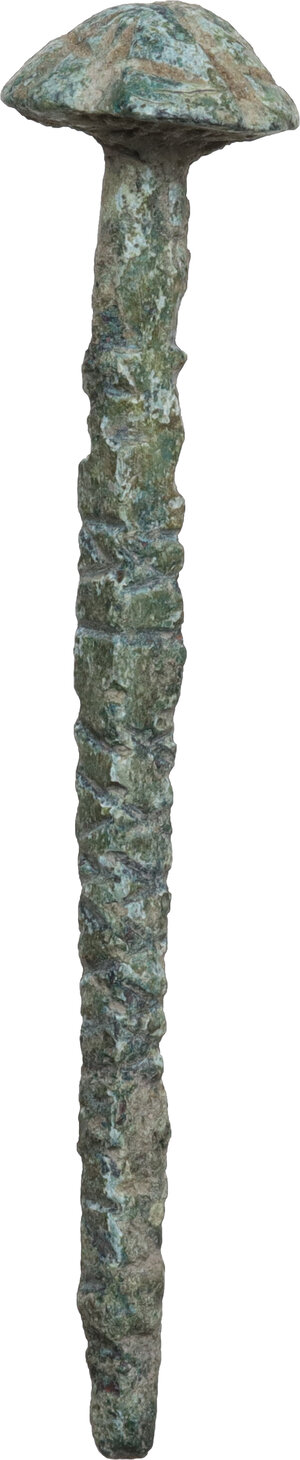
ROMAN "MAGIC" NAIL Roman period, c. 2nd-3rd century AD. Bronze nail decorated with engraved geometrical pattern. Lenght: 73 mm - ROMAN 'MAGIC' NAIL Roman period, c. 2nd-3rd century AD. Bronze nail decorated with engraved geometrical pattern. Lenght: 73 mm. Intact and complete.
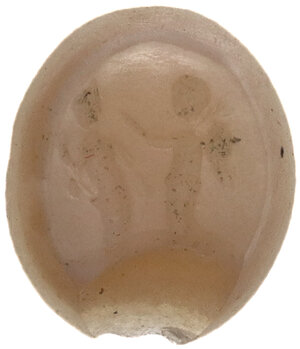
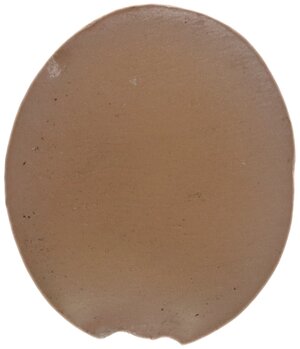
MULTILAYER PINK GEMSTONE Roman period, c. 2nd-3rd century AD. Oval multilayer pink gem of truncated cone shape, depicting two figures, probably a cupid or a victoriola and a female figure possibly with a cornucopia. Dimensions: 10.5 x 9 mm - MULTILAYER PINK GEMSTONE Roman period, c. 2nd-3rd century AD. Oval multilayer pink gem of truncated cone shape, depicting two figures; probably a cupid or a victoriola and a female figure possibly with a cornucopia. Dimensions: 10.5 x 9 mm. Chipped.
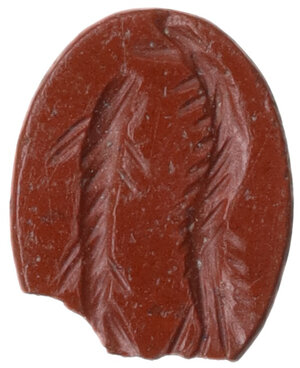
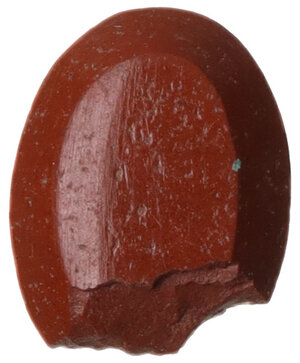
RED JASPER GEMSTONE Roman period, c. 2nd-3rd century AD. Gem in red jasper depicting a marine scene, with a shrimp and a fish engraved on the flat side. Dimensions: 9 x 7 mm - RED JASPER GEMSTONE Roman period, c. 2nd-3rd century AD. Gem in red jasper depicting a marine scene, with a shrimp and a fish engraved on the flat side. Dimensions: 9 x 7 mm. Nicely rendered scene. Chipped.
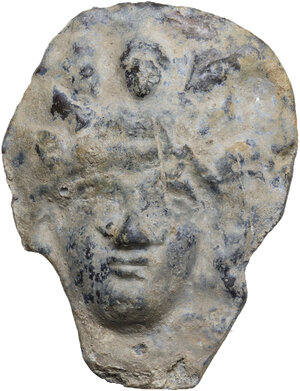
GODDES LEAD PLAQUE Roman period, c. 3rd-4th century AD. Lead plaque depicting the head of a god or goddess with a Victoriola above. Dimensions: 61x49 mm - GODDES LEAD PLAQUE Roman period, c. 3rd-4th century AD. Lead plaque depicting the head of a god or goddess with a Victoriola above. Dimensions: 61x49 mm. PB. Portrait of great impact.
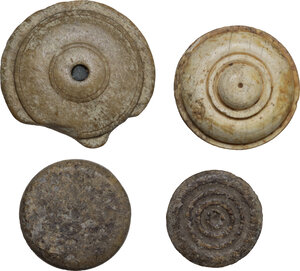
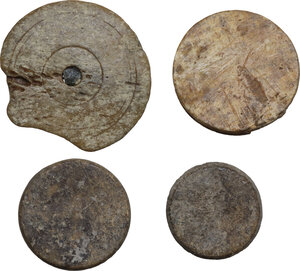
FOUR ANCIENT GAME PIECES Greek to Roman period, c. 4th century BC. - 4th century AD. Lot of four ancient bone game pieces. Various shapes and decorations. Dimensions: from 29 to 18 mm - FOUR ANCIENT GAME PIECES Greek to Roman period, c. 4th century BC. - 4th century AD. Lot of four ancient bone game pieces. Various shapes and decorations. Dimensions: from 29 to 18 mm. Minor damages.
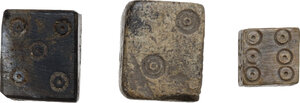
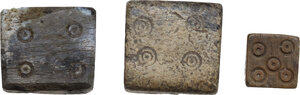
THREE ROMAN DICES Roman period, c. 2nd century BC - 4th century AD. Lot of three bone roman dices of various sizes. Dimensions: from 15 to 8 mm - THREE ROMAN DICES Roman period, c. 2nd century BC - 4th century AD. Lot of three bone roman dices of various sizes. Dimensions: from 15 to 8 mm. Minor damages.
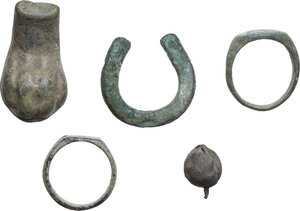
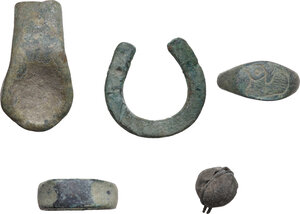
FIVE ROMAN ITEMS Roman period, c. 1st-5th century AD. Lot of five roman bronze items, comprehending a miniaturistic horseshoe, a bell, a lion's paw and two rings, one with a dove engraved. Dimensions: from 38 to 17 mm - FIVE ROMAN ITEMS Roman period, c. 1st-5th century AD. Lot of five roman bronze items, comprehending a miniaturistic horseshoe, a bell, a lion's paw and two rings, one with a dove engraved. Dimensions: from 38 to 17 mm.
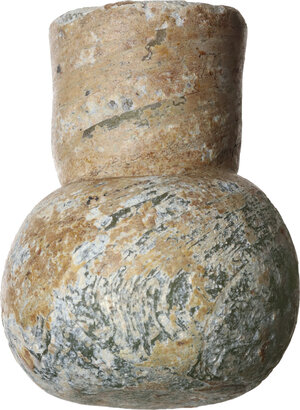
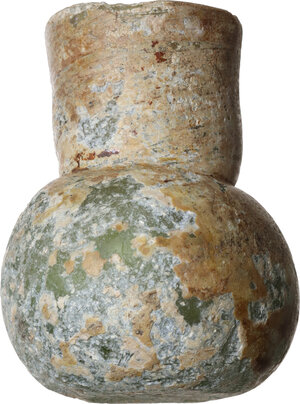
LATE ROMAN UNGUENTARIUM Roman period, 2nd-5th century AD. Late roman transparent glass unguentarium, with circular mouth, cylindrical neck, flattened ovoid body, slight concavity on the bottom. Dimensions: 58x45 mm. Weight: 70g - LATE ROMAN UNGUENTARIUM Roman period, 2nd-5th century AD. Late roman transparent glass unguentarium, with circular mouth, cylindrical neck, flattened ovoid body, slight concavity on the bottom. Dimensions: 58x45 mm. Weight: 70g. Intact and complete. Fascinating earthy encrustations.
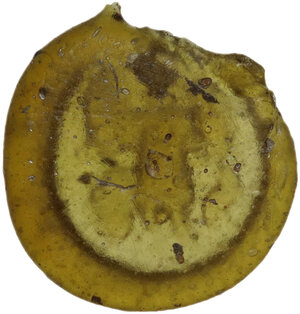
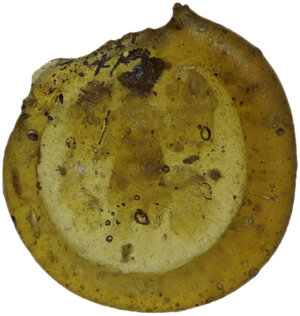
ROMAN GLASS SEAL Late Roman period, c. 4th-5th century AD. Roman yellow glass seal depicting a flying Victory (?) with two hounds around, one each side. Dimensions: 20 mm - ROMAN GLASS SEAL Late Roman period, c. 4th-5th century AD. Roman yellow glass seal depicting a flying Victory (?) with two hounds around, one each side. Dimensions: 20 mm. Interesting and complete.
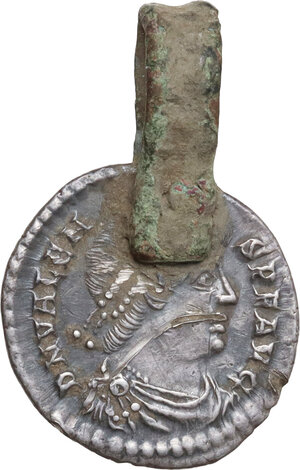
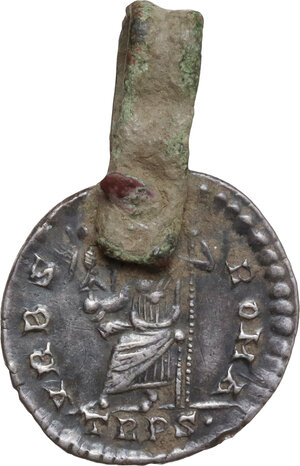
ROMAN LATE ANTIQUE PENDANT Roman period, late 4th-early 5th century AD. Pendant made with a holed siliqua and composed of a bronze hook with riveted nail. The coin: Valens (364-378). AR Siliqua, Treveri mint - ROMAN LATE ANTIQUE PENDANT Roman period, late 4th-early 5th century AD. Pendant made with a holed siliqua and composed of a bronze hook with riveted nail. The coin: Valens (364-378). AR Siliqua, Treveri mint. D/ DN VALENS PF AVG. Pearl-diademed, draped and cuirassed bust right. R/ VRBS ROMA. Roma seated left on throne, holding Victory on globe and reversed spear; in exergue, TRPS•. RIC IX 27e. AR. 3.09 g. 28.00 mm. Scratch on obverse.
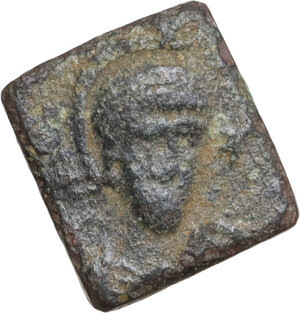
LATE ANTIQUE BRONZE TESSERA Roman period, 5th century AD. Game tessera obtained by cutting a bronze coin minted by Arcadius Dimensions: 11x10 mm. Weight: 1.11 g - LATE ANTIQUE BRONZE TESSERA Roman period, 5th century AD. Game tessera obtained by cutting a bronze coin minted by Arcadius Dimensions: 11x10 mm. Weight: 1.11 g. Intriguing and rare rework.
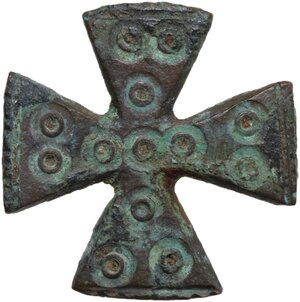
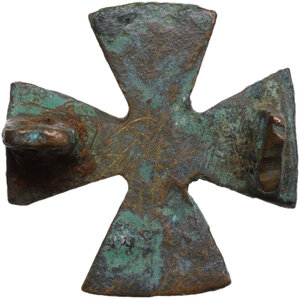
LOMBARD CROSS FIBULA Lombard Italy, c. 7th AD. Bronze fibula in the shape of a greek cross. Decoration rendered with engraved dots and circles. Width: 26 mm - LOMBARD CROSS FIBULA Lombard Italy, c. 7th AD. Bronze fibula in the shape of a greek cross. Decoration rendered with engraved dots and circles. Width: 26 mm. Needle missing. Lovely dark patina with green deposits. Fascinating item.
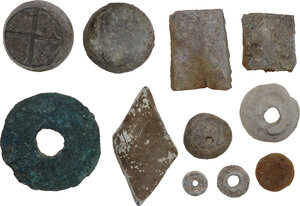
ELEVEN ANCIENT WEIGHTS Central Europe, 1st millennium BC - 1st millennium AD. Lot of eleven ancient weights, of different shapes and weights, one in bronze and ten made of lead. Weights: from 145 to 5 g - ELEVEN ANCIENT WEIGHTS Central Europe, 1st millennium BC - 1st millennium AD. Lot of eleven ancient weights, of different shapes and weights, one in bronze and ten made of lead. Weights: from 145 to 5 g. Interesting study lot.
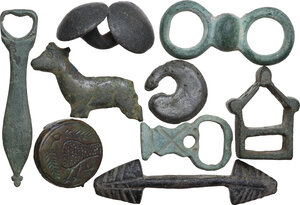
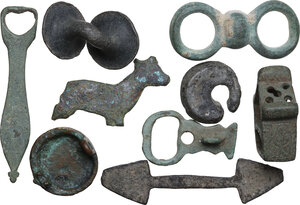
LOT OF NINE ANCIENT ITEMS Roman to early Medieval period, c. 1st-10th century AD. Variegated lot of nine ancient bronze items, from the Roman to the Medieval period, comprehending parts of fibulae, a double button and other objects to identify. Dimensions: from 59 to 20 mm - LOT OF NINE ANCIENT ITEMS Roman to early Medieval period, c. 1st-10th century AD. Variegated lot of nine ancient bronze items, from the Roman to the Medieval period, comprehending parts of fibulae, a double button and other objects to identify. Dimensions: from 59 to 20 mm. Interesting study lot.
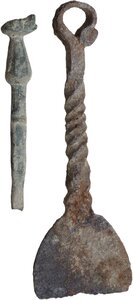
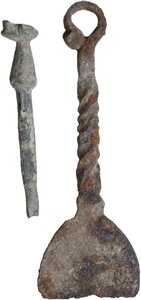
IRON PADDLE AND BRONZE TOOL Roman to early Medieval period, c. 1st-10th century AD. Lot of two items, an iron paddle with a decorated handle and suspension ring and a bronze tool with a duck-shaped end (?). Paddle lenght: 97 mm., Tool height: 65 mm - IRON PADDLE AND BRONZE TOOL Roman to early Medieval period, c. 1st-10th century AD. Lot of two items; an iron paddle with a decorated handle and suspension ring and a bronze tool with a duck-shaped end (?). Paddle lenght: 97 mm.; Tool height: 65 mm.
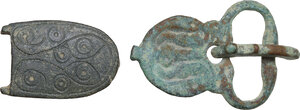
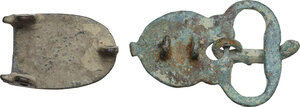
TWO ANCIENT FIBULAE Byzantine to Medieval period, c. 7th-12th century AD. Lot of two ancient bronze fibulae, one Byzantine, the other from the Medieval period. One with engraved decoration, the other in negative relief. Dimensions: 50x32 and 34x21 mm - TWO ANCIENT FIBULAE Byzantine to Medieval period, c. 7th-12th century AD. Lot of two ancient bronze fibulae, one Byzantine, the other from the Medieval period. One with engraved decoration, the other in negative relief. Dimensions: 50x32 and 34x21 mm. Minor missings.
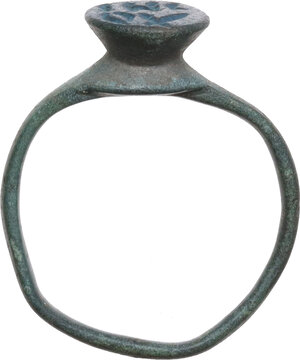
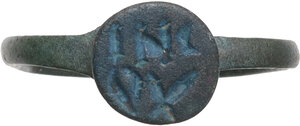
BYZANTINE ENGRAVED RING Byzantine period, c. 7th-12th century AD. Byzantine bronze ring with engraved "INI/VX" on the bezel. Dimensions: 26x22 mm. Inner diameter: 18 mm - BYZANTINE ENGRAVED RING Byzantine period, c. 7th-12th century AD. Byzantine bronze ring with engraved 'INI/VX' on the bezel. Dimensions: 26x22 mm. Inner diameter: 18 mm. Intact and complete.
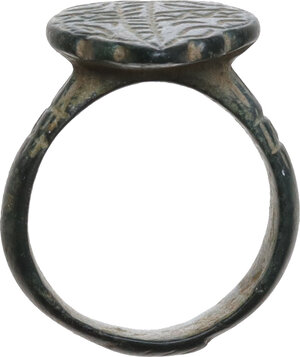
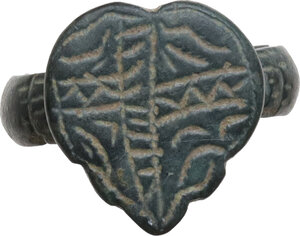
ANCIENT BRONZE RING Early Medieval period, c. 7th-12th century AD. Ancient bronze ring with heart-shaped bezel and engraved cross-shaped decoration with geometric patterns. Dimensions: 24.5x21 mm. Inner size: 17 mm - ANCIENT BRONZE RING Early Medieval period, c. 7th-12th century AD. Ancient bronze ring with heart-shaped bezel and engraved cross-shaped decoration with geometric patterns. Dimensions: 24.5x21 mm. Inner size: 17 mm. Intact and complete. Lovely green earthy patina.
Caricamento altri risultati...
Loading…
Web-push notifications
To enable push notifications on this browser, press the enable button.