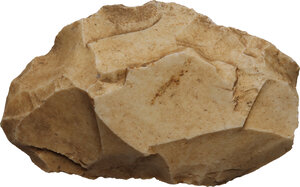
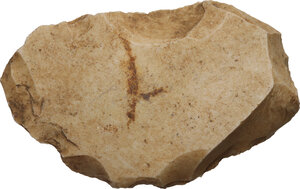
929 - STONE SCRAPER Middle Paleolithic to Musterian, c. 300.000-30.000 BC. Medium size stone scraper. Dimesions: 9 x 5.5 cm.
Info & contatti
Le mie offerte
Lotti osservati
Conferimento
Condizioni di vendita
Prezzi di spedizione
Metodi di pagamento
Tabella rilanci
Esito stampabile
Sessione Live 30/11/2024 15:00:00 CET
Greek Coins (1-183)
The Roman Republic (184-383)
The Roman Empire (384-500)
Sessione Live 1/12/2024 15:00:00 CET
The Roman Empire (501-677)
The Byzantine Empire (678-727)
Islam (728-732)
Leads from the Ancient World (733-746)
World Coins (747-888)
Large Lots (889-928)
Antiquities (929-1000)

Risultati: 61
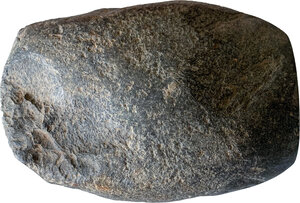
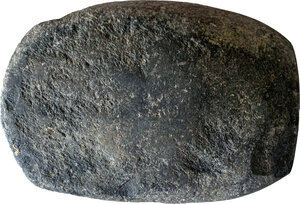
930 - STONE GRINDER Probably Neolithic period, c. 40.000 - 10.000 years ago. Quadrangular stone grinder, with one side worn from use. Dimensions: 112 x 75 x 40 mm.
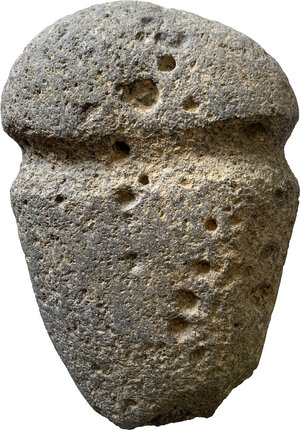
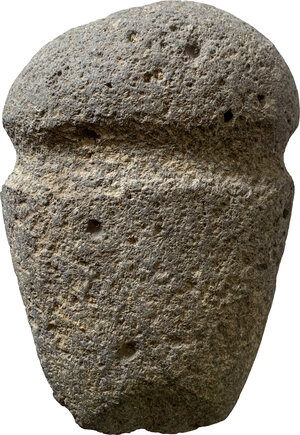
931 - NATIVE AMERICAN STONE AXE American Archaic period, c. 9000-2700 years ago. Large stone axe with groove around the midsection. Dimensions: 175 x 119 x 57 mm. Intact and complete. Large lithic tool, typical of Native American cultures of North America, used for cutting trees and trunks.
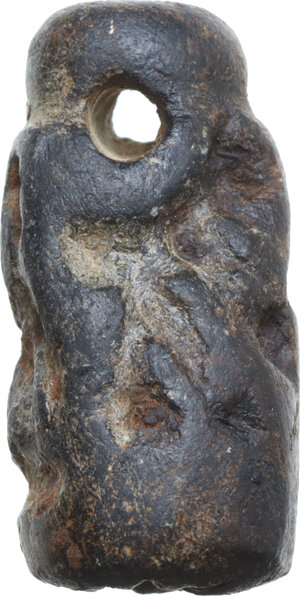
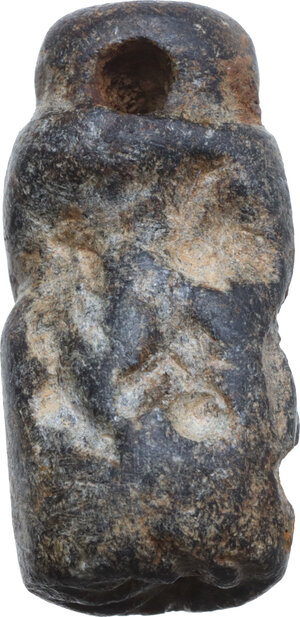
932 - GANDHARA CYLINDER SEAL Gandhara culture, c. 2nd Millennium BC. Large dark stone seal with interesting engravings. Stylized animals and an anthropomorphic figure are represented. With suspension loop. Dimensions: 34 x 17 mm. Very rare and intact.
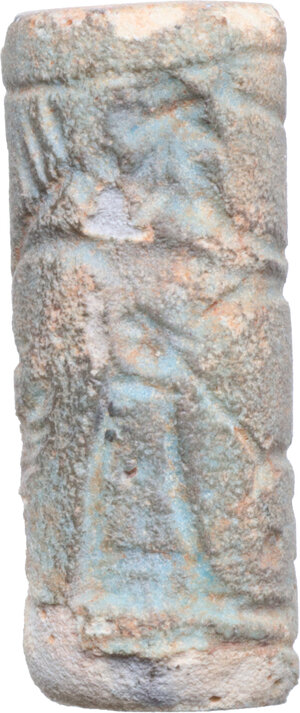
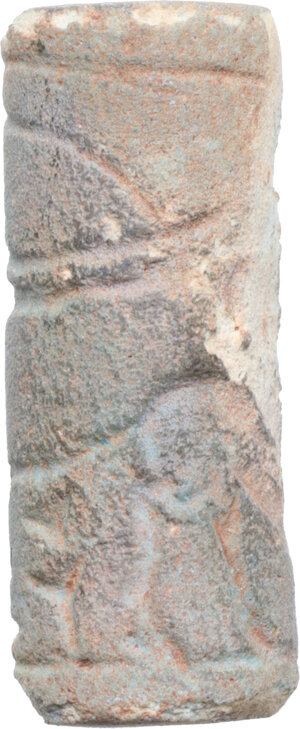
933 - NEO ASSYRIAN CYLINDER SEAL Neo Assyrian period, c. late 2nd - early 1st millennium BC. Large green steatite seal with interesting engraved scene. Archer facing right shoots an arrow at a lion (?) facing right. Dimensions: 32.5 x 12 mm. Very fascinating item. Corroded.
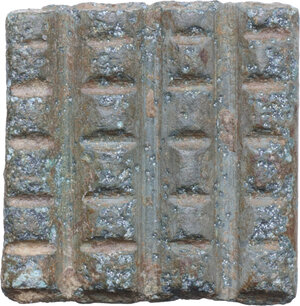
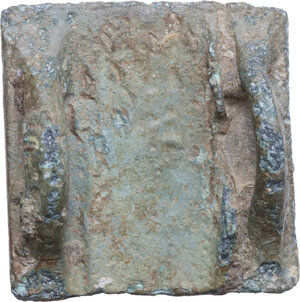
934 - SQUARED BRONZE SEAL Ancient Near East, c. 2nd Millennium BC. Bronze seal of quadrangular shape decorated with linear motifs. On the back are two suspension rings. Dimensions: 28 x 27 x 11 mm. Fascinating item, intact and complete.
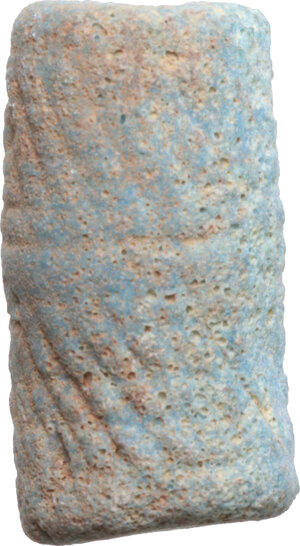
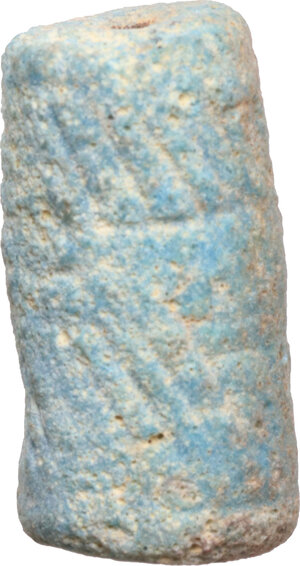
935 - GEOMETRIC FAIENCE SEAL Ancient Near East, c. 2nd millennium BC. Faience seal with complex geometric decoration of oblique and horizontal lines. Height: 24 mm. Interesting and rare. Worn.
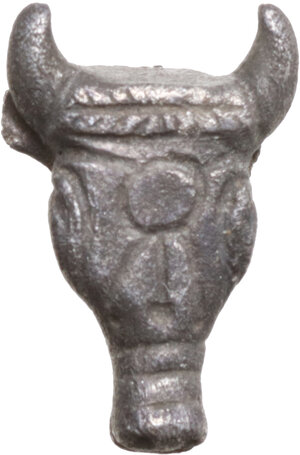
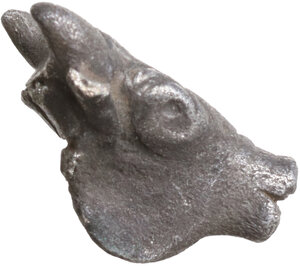
936 - SILVER BULL'S HEAD PENDANT Egypt or Ancient Near East, c. 1st millennium BC. Silver pendant depicting a bull with stylized anatomical details and a symbol (probably a sun) engraved on its forehead. Height: 20 mm. Fascinating item. Missing loop.
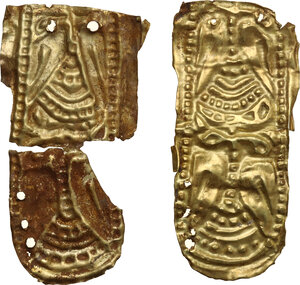
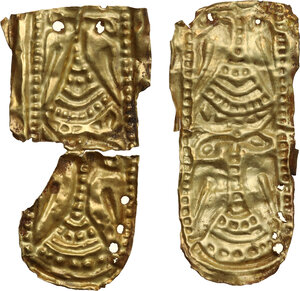
937 - SCYTHIAN GOLD SHEETS Scythian culture, 1st millennium BC. Pair of gold foils decorated with embossed ornithomorphic and geometric motifs, probably pertaining to the decoration of a parade object. Dimensions: 61x28 mm. Weight: 8.25 g. Rare and fascinating item. One intact and complete, the other damaged, with missing. Presence of ancient holes for mounting.
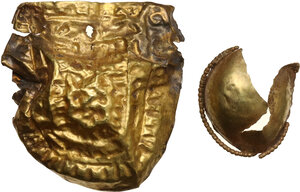
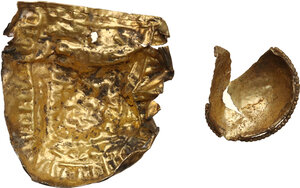
938 - SCYTHIAN GOLD SHEET AND BULLA Scythian culture, 1st millennium BC. Gold sheet with embossed geometri motifs, probably pertaining to the decoration of a parade object and a bulla. Dimensions: 30x29 and 18 mm. Weight: 2.15 and 0.68 g. Rare and fascinating items. Damaged, with missings.
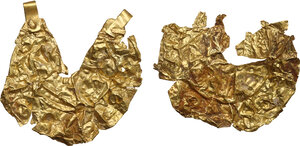
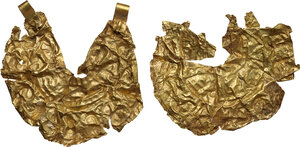
939 - SCYTHIAN GOLD APPLIQUES Scythian culture, 1st millennium BC. Lot of two gold foil appiques of half-moon shape; one retains the two suspension rings. Dimensions: 41x39 and 41x33 mm. Weight: 1.32 and 0,73 g. Rare and fascinating items. Bent and damaged.
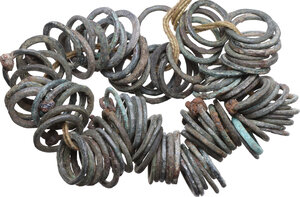
940 - BRONZE RING NECKLACE Celtic World, 1st millennium BC. Ring necklace made of of 94 bronze rings. Lenght: c. 180 mm. Weight: 107 g. Rare and interesting item.
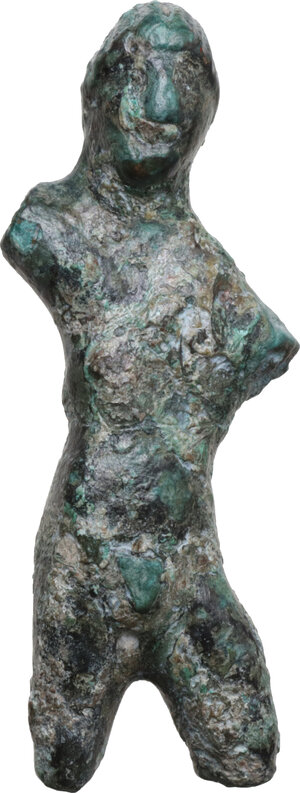
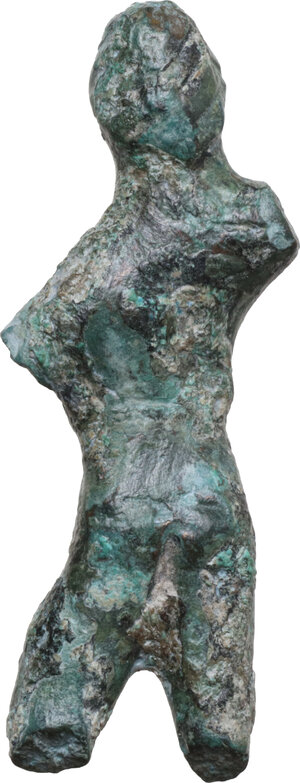
941 - HERAKLES STATUETTE Greek world, c. 5th century BC. Bronze statuette of Herakles in attack position, right arm raised. Dimensions: 49 x 19 mm. Missings.
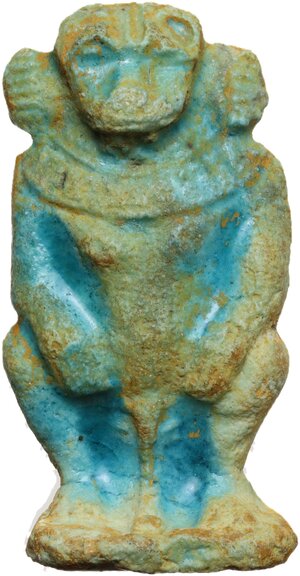
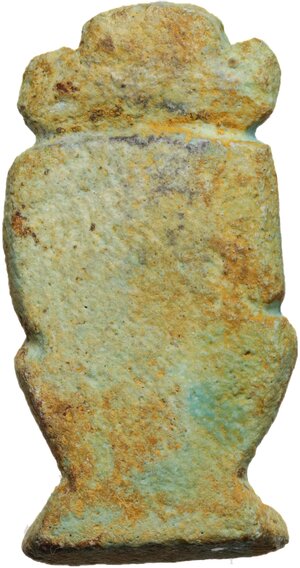
942 - THOT-BABOON FAIENCE AMULET Egyptian Kingdom, Late Period, second half on 1st millennium BC. Large amulet in blue faience, depicting Thoth in the form of a baboon with a large pectoral. Dimensions: 64 x 33 mm. Baboon amulets probably were offerings to shrines honoring Thoth, but could also have been placed with the deceased as a representative of the deity who recorded Osiris' judgment.
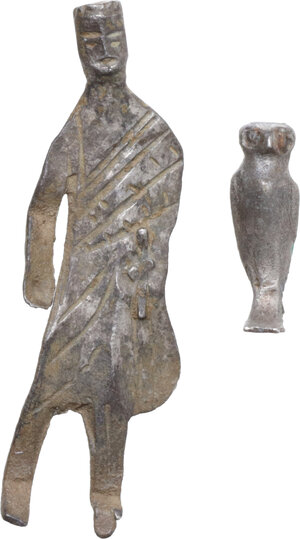
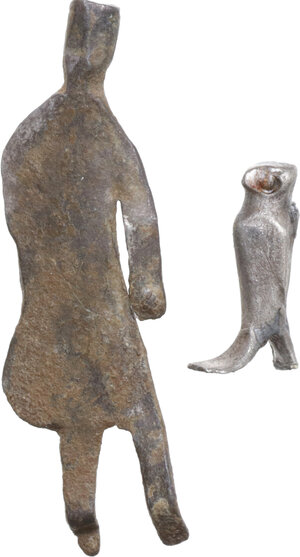
943 - SILVER VOTIVE FIGURINES Ancient Mediterranean, c. 5th - 3rd century BC. Two silver figurines; one in the shape of a stylized man, the other in the shape of an eagle. Heights: 40 and 15 mm. Fascinating lot.
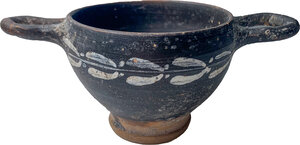
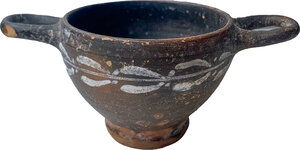
944 - GNATHIAN STYLE SKYPHOS Apulian culture, c. 4th century BC. Small skyphos in the style of Gnathia, with receding lip, downward tapering body, ring foot, and horizontal rod handles. Black paint decoration with overpainting in white in the form of an olive branch. Dimensions: 133 x 57 mm. One handle professionally restored, otherwise intact.
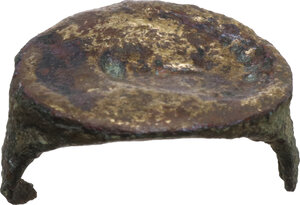
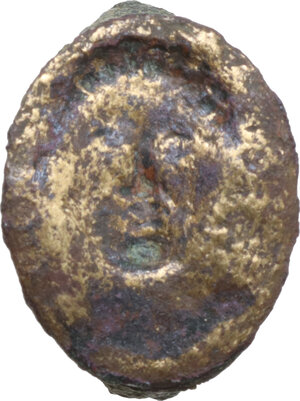
945 - HELLENISTIC RING Greek World, c. 4th - 3rd century BC. Gilded bronze ring with large oval bezel engraved ith the portrait of a facing figure. Bezel dimensions: 21 x 17 mm. Rare and fascinating item. Missings. The interesting and unusual depiction of a person in frontal view can perhaps be traced back to the affective sphere of the owner.
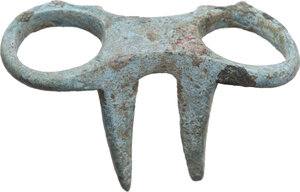
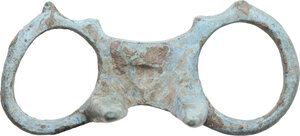
946 - ROMAN BRONZE BOW RING Roman Republican period, c. 5th century BC - 1st century BC. Tricuspid geminous ring in bronze, formed by two cylindrical annular elements, connected by a median body surmounted by three cusps: a wider one, with a triangular base, and two thinner ones placed side by side, with a pyramidal shape. The rings have faint thickenings on the front. 37.95 g. 61.5 mm. One missing cuspid. In the past these objects have been interpreted in various ways: as female ornaments, tools for horse taming or bridle clips, as thrusters and bow turnbuckles. Among them, the most reliable hypothesis, based on experiences of experimental practice, is that they are bow turnbuckles, having as their main function the protection of the fingers during the release of the arrow. The tricuspid gemini rings are very widespread especially in the Emilian area, in particular in the Parma, Reggio Emilia and Modena areas, but they are also known in northern Italy in the Lombard and Piedmont areas. Their chronological classification is difficult in the absence of stratigraphic associations, given that they appear both in contexts of the second Iron Age and in the late Republican age, above all due to a tendency towards formal conservatism inherent in the instrument.
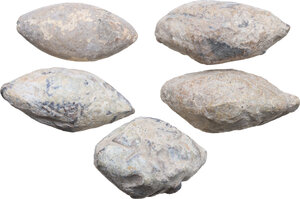
947 - FIVE LEAD SLINGSHOTS Ancient world, c. 6th century BC - 3rd century AD. Lot of five lead anepigraphic slingshots. Lead slingshots are among the most common weapons of antiquity; they are found on every battlefield and are difficult to attribute to a specific period on the basis of measurements.
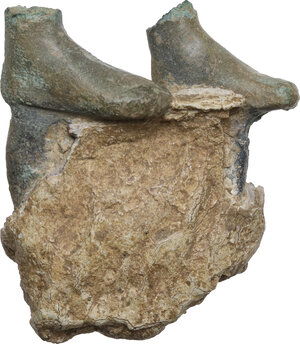
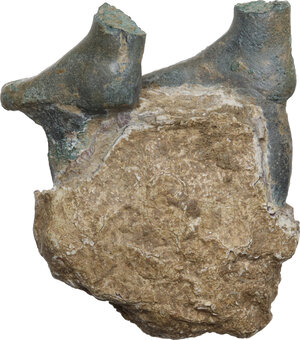
948 - STATUETTE BASE Greek to Roman period, c. 4th century BC - 3rd century AD. Base of statuette in lead, with the latter's bronze feet still attached. Dimensions: 37.2 x 33.0 mm. 64 g. Rare and interesting object.
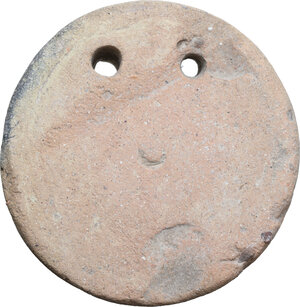
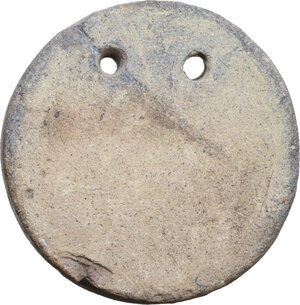
949 - LARGE FRAME WEIGHT Ancient world, c. 5th century BC - 5th century AD. Large round pottery frame weight with two suspension holes. Diameter: 75 mm. Weight: 156.86 g. Intact and complete. Unusually heavy.
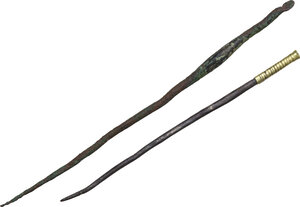
950 - TWO ANCIENT PINS Ancient world, c. 5th century BC - 5th century AD. Lot of two ancient pins; one in bronze with a sort of small spatula and the other made of silver, with a gold sheet bent on one side. Lenghts: 120 and 80 mm. Intact and complete.
Maenivs Agrippa
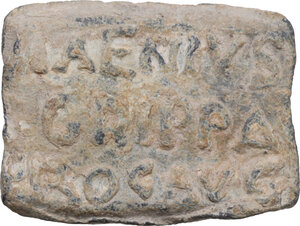
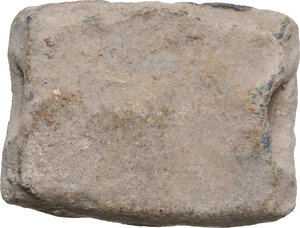
951 - IMPORTANT LEAD SEAL Roman Empire, after 122 AD. Large and rare seal of rectangular shape, with hole intended to hold a lanyard. The front bears the inscription: MAENIVS AGRIPPA PROC AVG Dimensions: 26.5 x 20 x 4.5 mm Weight: 16.65. PB. Of the highest rarity, intact and complete. M. Maenius Agrippa L. Tusidius Campester was a Roman of noble born who probably accompanied Hadrian to the Britain campaign in 122 AD. After commanding the Maryport garrison, Maenius Agrippa deftly climbed the imperial career ladder, ultimately becoming Procurator of Britain. He's also known for an inscription on an altar found in Camerinum (Marche, Italy), dedicated to him. This seal was probably affixed to secure goods intended for the imperial garrison.
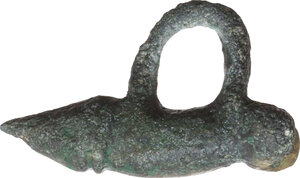
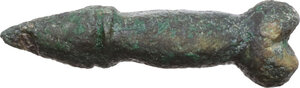
952 - ROMAN PHALLIC AMULET Roman period, c. 1st - 2nd century AD. Cast bronze pendant in the form of male genitals with realistic rendered details, surmounted by a suspension loop. Lenght: 35 mm. Intact and complete. Item of good craftmanship.
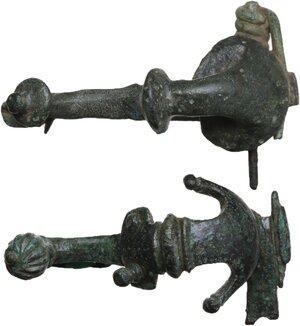
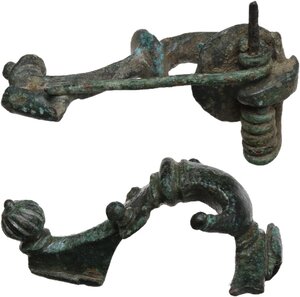
953 - TWO ROMAN TRUMPET FIBULAE Roman period, mid 1st - 2nd century AD. Lot of two roman trumpet shaped fibulae, decorated with knobs. Lenghts: 44 and 42 mm. Nice and solid green patina. Damages and missings.
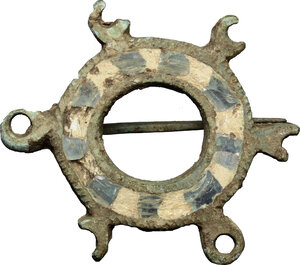
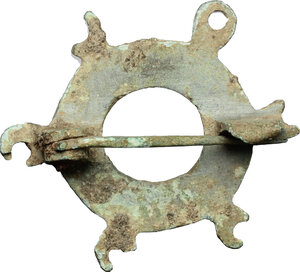
954 - ROMAN ENAMELLED DISC FIBULA Roman period, c. 2nd century AD. Roman bronze fibula in the shape of a disc. Decoration in blue glass paste and bone (?). Dimensions: 34 mm. Minor missings.
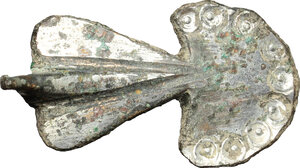
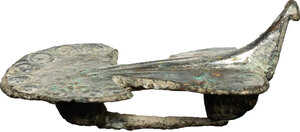
955 - PEACOCK SILVERED FIBULA Roman period, c. 1st - 3rd century AD. Fully silvered bronze fibula in the shape of peacock. Dimensions: 34 x 19 mm. Rare, intact and complete.
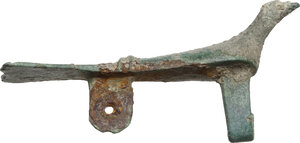
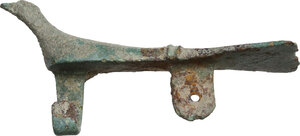
956 - DOVE BRONZE FIBULA Roman period, c. 1st - 3rd century AD. Bronze fibula in the shape of a dove. Lenght: 40 mm. Missing needle.
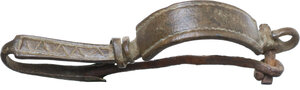
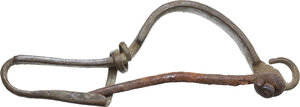
957 - ROMAN BRONZE FIBULA Roman period, c. 1st - 3rd century AD. Bronze fibula with engraved decoration. Lenght: 69 mm. Solid brown patina. Slightly bent, damaged needle.
Bellerophon on Pegasus
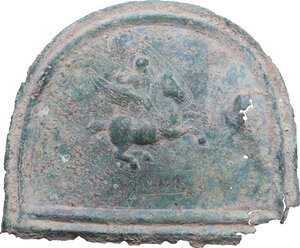
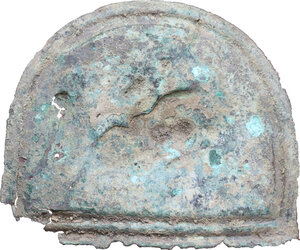
958 - ROMAN BRONZE PLAQUE Roman period, c. 1st - 3rd century AD. Laminated Roman bronze plaque of half-moon shape. In the central part is an embossed depiction of a male figure (Bellerophon) holding a spear with his right arm raised, placed above a winged horse in flight (Pegasus) to right. Below the winged horse is an engraved rectangular decoration. Dimensions: 104 x 85 mm. Weight: 39.44 g. Lovely green patina. Cracks and flaws.
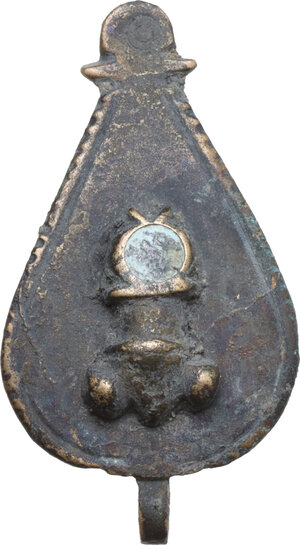
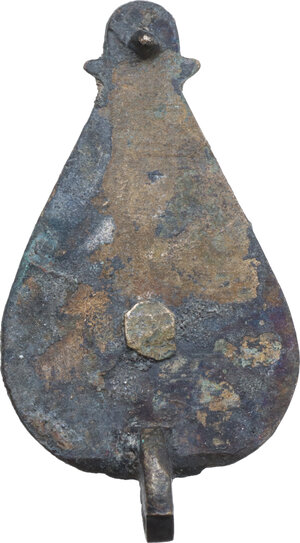
959 - SMALL PENDANT-BOX LID Roman period, c. 1st - 3rd century AD Lid of a small bronze container pendant, with a raised phallus. Dimensions: 35 x 19 mm. 5.69 g. Extremely rare item. Intact. A similar item can be seen in the Archaeological Museum of Iuvanum.
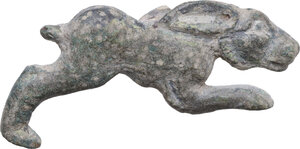
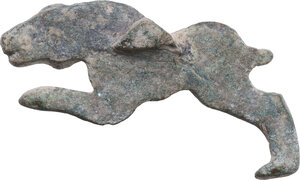
960 - BIG HARE FIGURINE Roman period, c. 1st - 3rd century AD. Roman bronze figurine in the shape of a big leaping hare, with realistic engraved details. Dimensions: 57 x 22 mm. Probably part of a decorated forniture.
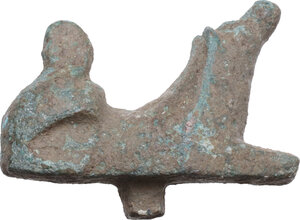
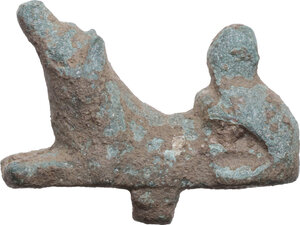
961 - DOG STATUETTE Roman period, c. 1st - 3rd century AD. Bronze statuette in the form of a dog crouched and with head raised. Dimensions: 37 x 29 mm. With peduncle at base, perhaps for placement on a stand.
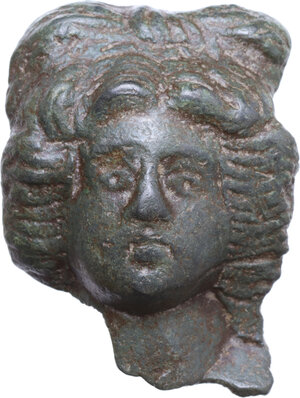
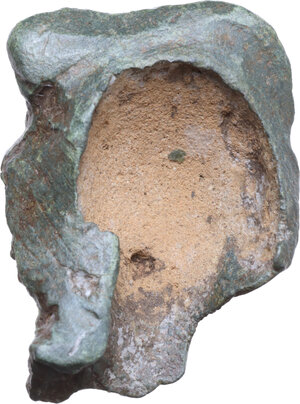
962 - FEMALE BRONZE HEAD Roman period, c. 1st - 3rd century AD (?). Bronze female frontal head with complex hair. Niche in the back. Dimensions: 41 x 31 mm. Interesting item, of difficult attribution.
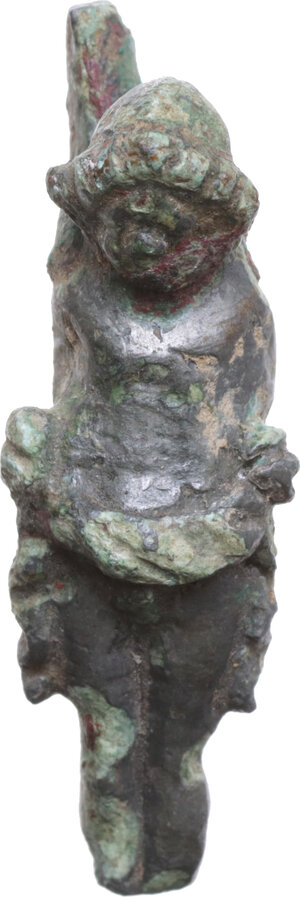
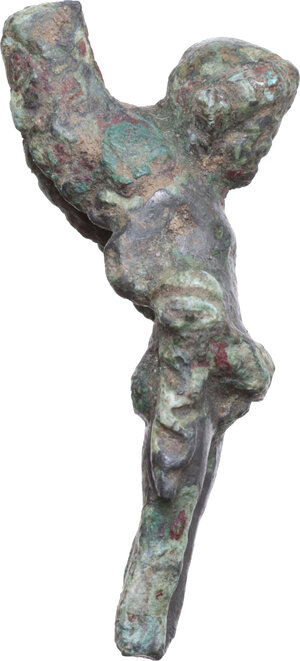
963 - ROMAN BRONZE STATUETTE Roman period, c. 1st - 3rd century AD. Statuette of naked Eros or Priapos, part of a bronze handle. Height: 41 mm. Fascinating item, of good craftmanship. Missings.
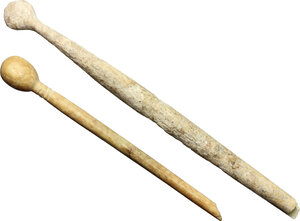
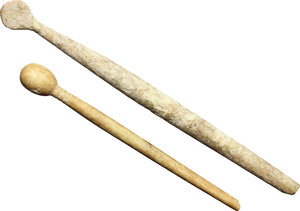
964 - ROMAN UTENSILS Roman period, c. 1st - 3rd century AD. Lot of 2 bone utensils; a medical spoon and a pin. Lenghts: 108 and 82 mm.
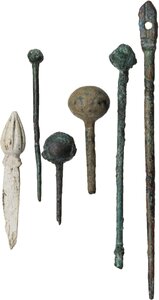
965 - ROMAN PINS GROUP Roman period, c. 1st - 3rd century AD. Lot of six roman pins, five made of bronze and one of bone. Dimensions: 81 to 25 mm. One completely intact. Damages and missings.
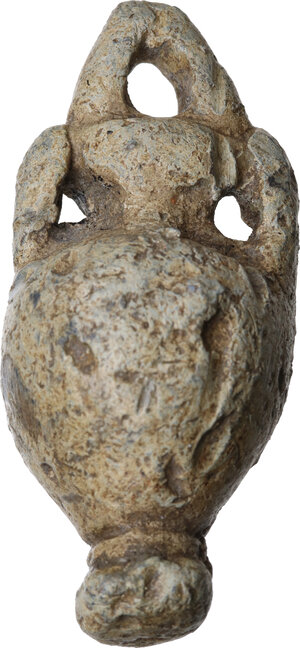
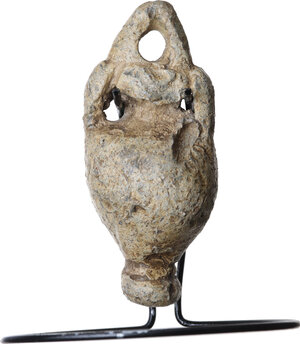
966 - LARGE ROMAN LEAD AMPHORA Roman period, c. 1st - 3rd century AD. Large, heavy and unusual Roman solid lead amphora with a large bulbous main body tapering to a short narrow neck with two loop handles on opposing shoulders. On top: hole for suspension. Dimensions: 78 x 34.5 mm. Weight: 310.4 g. Intact and complete.


967 - ROMAN 'MAGIC' NAIL Roman period, c. 2nd-3rd century AD. Bronze nail decorated with engraved geometrical pattern and corn-ears. Lenght: 85.50 mm. Slightly bended, green patina. Intact.
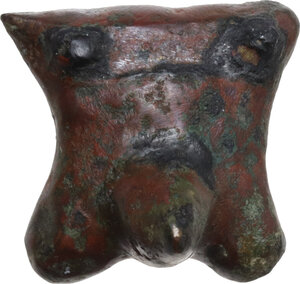
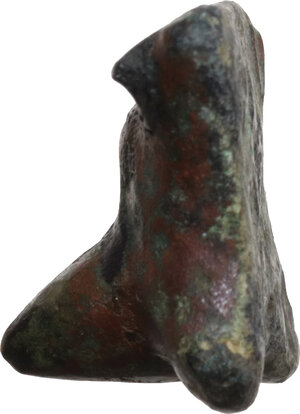
968 - ROMAN PHALLIC APPLIQUE Roman period, c. 1st - 4th century AD. Bronze square shaped phallic applique. Dimensions: 20 x 19 mm. Intact and complete, with enchanting red and green patina.
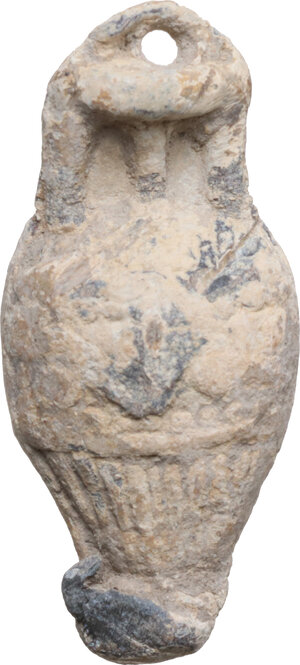
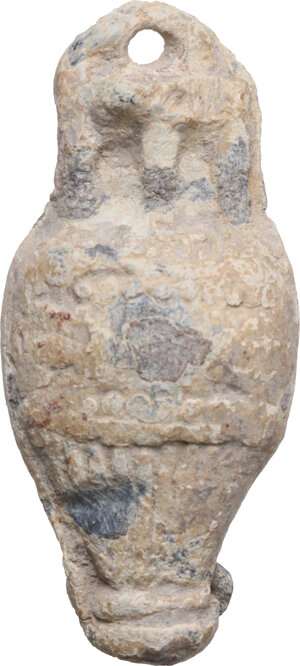
969 - 'GROMA' AMPHORA WEIGHT Roman period, 1st - 4th century AD. Decorated weight in the shape of amphora with suspension loop. Height: 39 mm Weight: 28.27 g. PB. Minor damages.
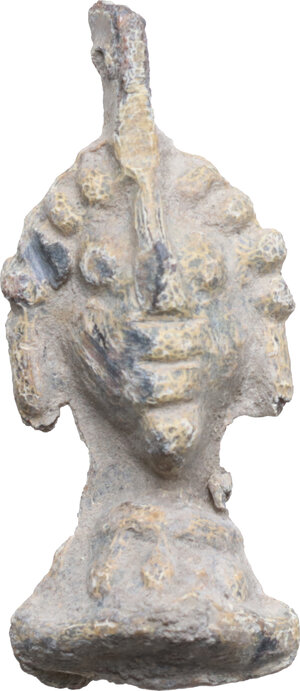
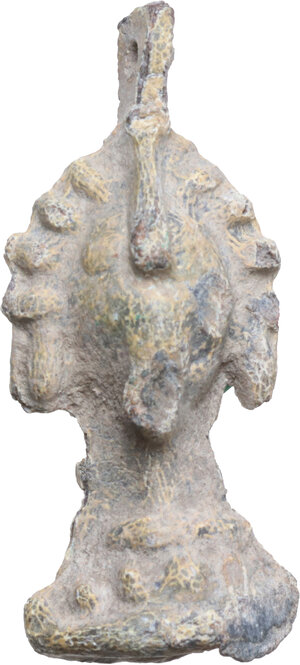
970 - 'GROMA' HEAD WEIGHT Roman period, 1st - 4th century AD. Weight in the shape of a janiform head with suspension loop. Dimensions: 36 x 15 mm. Weight: 18.05 g. Intact and complete.
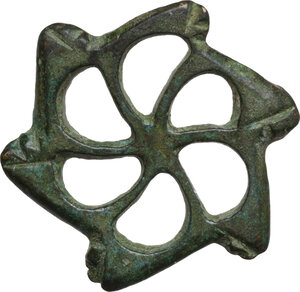
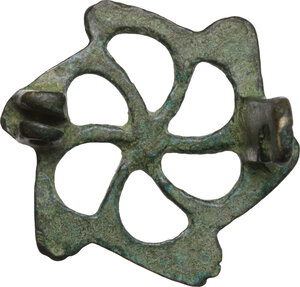
971 - BRONZE OPENWORK FIBULA Roman period, c. 2nd - 4th century AD. Roman bronze fibula configured in a openwork hexahedron. Diameter: 29 mm. Rare and fascinating. Missing pin.
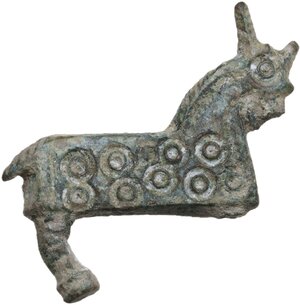
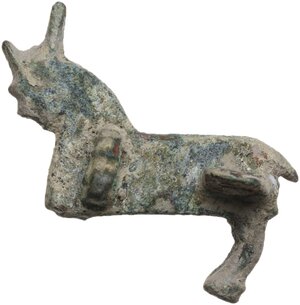
972 - ROMAN BRONZE BROOCH Roman period, Balkans, c. 3rd-4th century AD. Roman bronze fibula in the form of a quadruped (horse?), hooped decoration. Lenght: 31 mm. Pin and one leg missing. Lovely green patina and nice decoration.
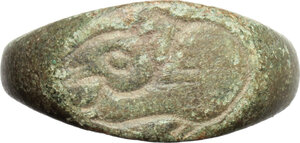
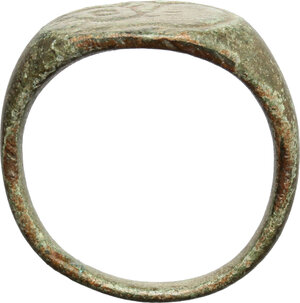
973 - HARE RING Roman period, c. 2nd - 4th century AD. Bronze ring, the bezel decorated with engraved hare. Diameter: 22 mm.
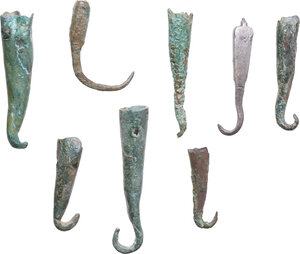
974 - ROMAN SPINDLE-HOOKS Roman period, c. 1st - 5th century AD. Lot of eight (8) roman bronze spindle-hooks. Dimensions: from 35 to 20 mm. Damages.
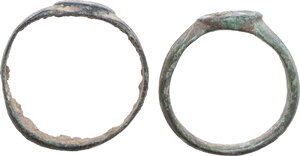
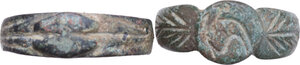
975 - TWO BRONZE RINGS Late Roman period, c. 4th-5th century AD. Lot of two late roman bronze rings with zoomorphic and geometric decorations.
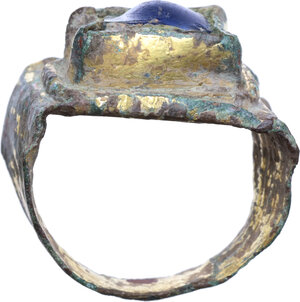
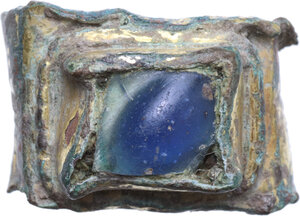
976 - GILDED BRONZE RING Early Middle Age, c. 5th - 10th century AD. Gilded bronze ring with blue glass paste bezel. Size: 16.5 mm.
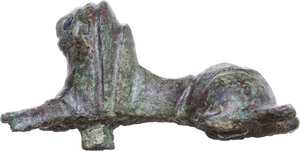
977 - LION STATUETTE Barbaric to Medieval period, c. 6th to 12th century AD. Bronze statuette in the shape of a supine lion, with eyes made of glass paste. Dimensions: 53 x 29 x 26 mm. Probably part of a decorated forniture.
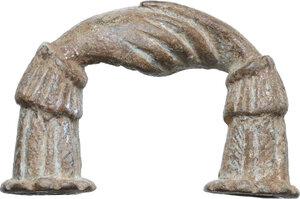
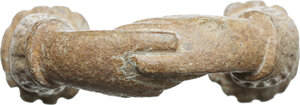
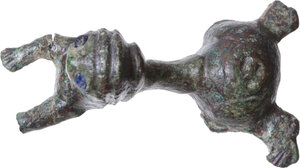
978 - IMPORTANT BRONZE HANDLE Uncertain period, Roman or Medieval (?). Large bronze handle, probably pertaining to a piece of furniture, conformed into two joined hands. Dimensions: 81 x 54 x 27 mm. Weight: 195.07 g. Of very good craftmanship. Intact and complete.
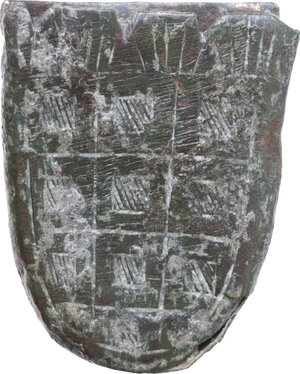
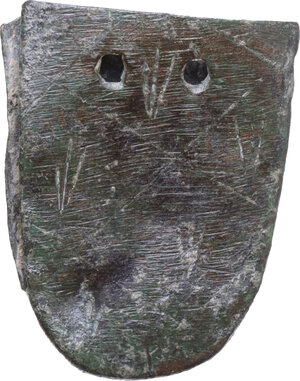
979 - BRONZE BELT TERMINAL Medieval period, c. 7th to 14th century AD. Bronze belt terminal, decorated with square and panel engravings. The two holes on the back were used to fasten the leather or fabric strip. Dimensions: 44 x 36 mm. 12.52 g.
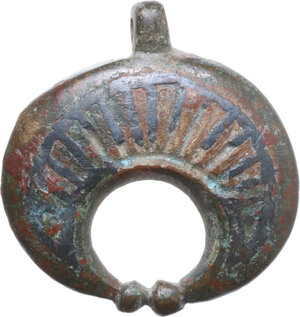
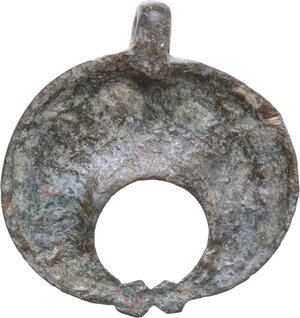
980 - EARLY ISLAMIC PENDANT Arab world, c. 8th - 14th century AD. Bronze pendant in the shape of a crescent with engraved details. Dimensions: 29 x 27.5 mm.
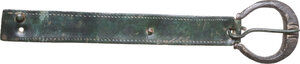
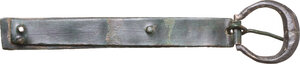
981 - LONG MEDIEVAL BUCKLE Medieval period, c. 10th-14th century AD. Long bronze buckle with body composed of two sheets folded one over the other and joined by two rivets. Decoration with engraved teeth on the long sides. Dimensions: 83 x 18 mm. 6.4 g. 82.5 mm. Rare, intact and complete.
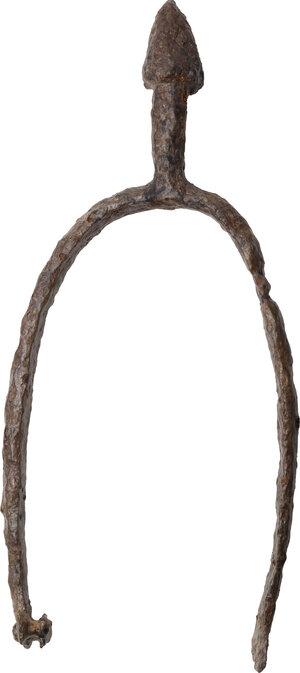
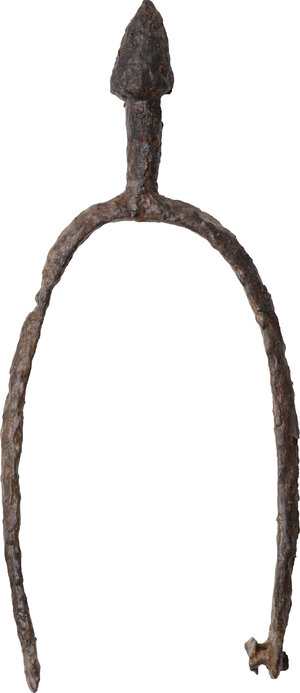
982 - MEDIEVAL IRON SPUR Medieval period, c. 10th-14th century AD. Medieval iron spur with a straight profile and cone-shaped rear part. Dimensions: 154x66 mm. Intact and complete, minor corrosions.
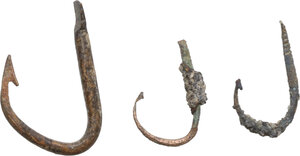
983 - THREE FISHING HOOKS Ancient world. c. 1st century - 15th century AD. Lot of three bronze fishing hooks. Dimensions: from 15 to 12 mm. Minor missings.
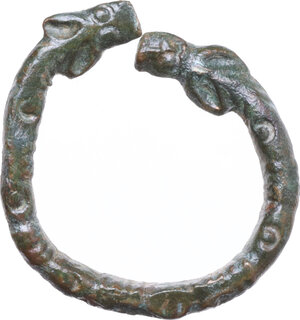
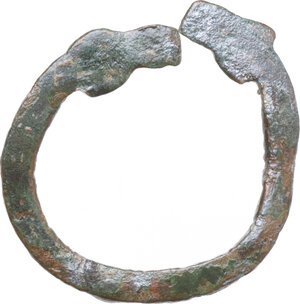
984 - BRONZE APPLIQUE Medieval period, c. 7th - 15th century AD (?) Bronze applique in the shape of a double headed serpent or dragon. The bottom is flat. Width: 32 mm. 6.38 g. 29 mm.
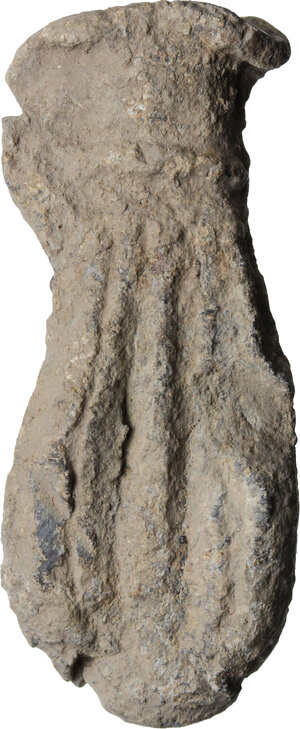
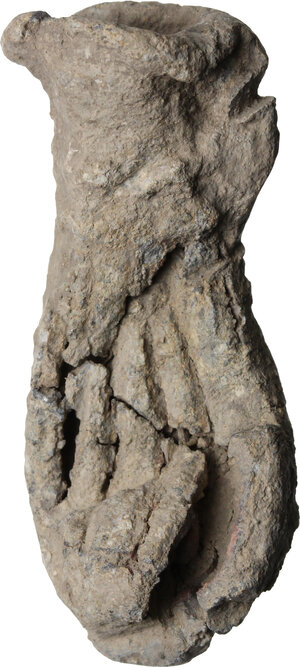
985 - PILGRIM'S FLASK Medieval period, c. 12th - 15th century AD. Lead Holy Water pilgrim's flask. Dimensions: 48 x 20 mm. PB. Damages.
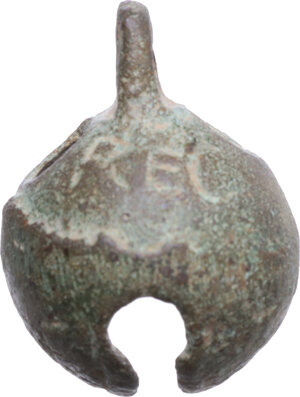
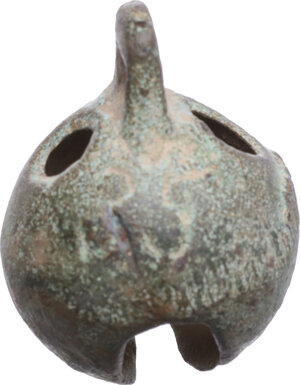
986 - MEDIEVAL CROTAL BELL Medieval period, c. 12th-15th century AD. Bronze crotal bell with interesting letters engraved on both sides: REC and RS. Weight: 11.72 g. Dimensions: 31 x 24 mm. Intact. Rattle missing.
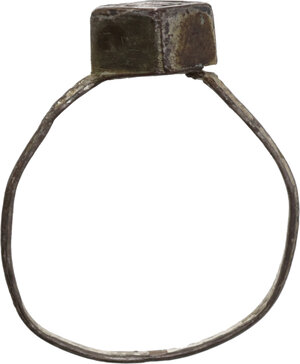
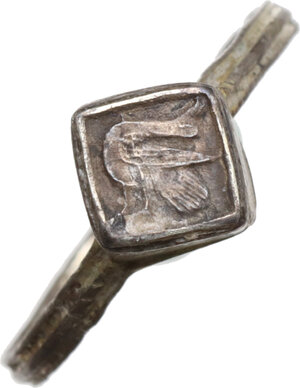
987 - SILVERED DOVE RING Medieval period, c. 13th - 15th century AD. Silvered ring with square bezel with a dove engraved on the top. Inner size: 18 mm.
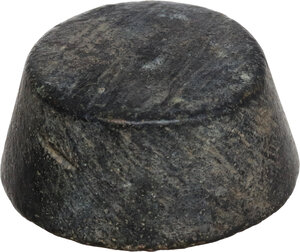
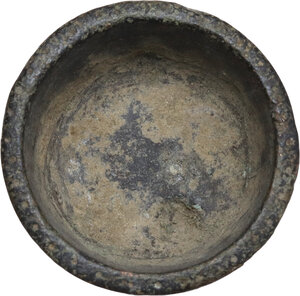
988 - BRONZE CUP WEIGHT Medieval Age, England, c. 15th century AD. Weight in the shape of a bronze cup, with ‘punched-dot’ decoration around rim. Dimensions: 28x13 mm. Weight: 27.15 g.
Caricamento altri risultati...