Info & contatti
Le mie offerte
Lotti osservati
Condizioni di vendita
Prezzi di spedizione
Metodi di pagamento
Esito stampabile
Sessione Live 5/4/2026 17:00:00 CET
Celtic Coins (1-7)
Greek Coins (8-221)
Roman Provincial Coins (222-353)
Roman Republican Coins (354-425)
Roman Imperial Coins (426-853)
Migration Period (854-855)
Byzantine Coins (856-890)
Medieval Coins (891-927)
World Coins (928-955)
Medals & Tokens (956-958)
Group Lots (959-1105)

TRAJAN (98-117). Sestertius. Rome
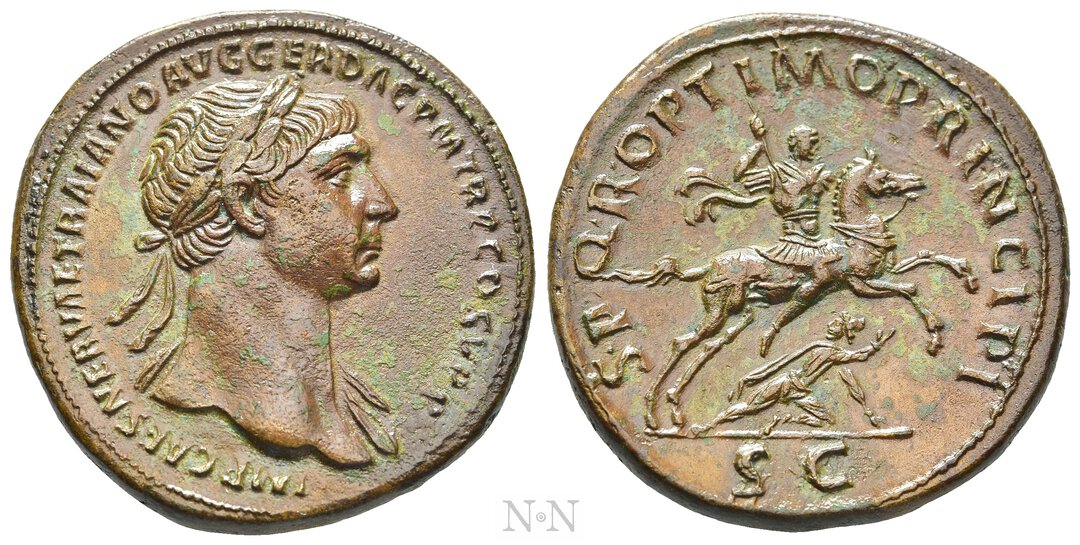

TRAJAN (98-117). Sestertius. Rome.
Obv: IMP CAES NERVAE TRAIANO AVG GER DAC P M TR P COS V P P.
Laureate bust right, slight drapery.
Rev: S P Q R OPTIMO PRINCIPI / S C.
Trajan, thrusting spear at fallen Dacian below, on horse rearing right.
Woytek 317b; RIC 543.
The reverse side of this sestertius refers to Trajan's conquest of Dacia. Despite the lack of money in the imperial treasury, Trajan managed to arm and supply an army to avenge the defeats suffered by Domitian. The aim was to conquer a territory rich in gold and silver mines to meet Rome's financial needs and limit the growing power of Decebalus along the imperial borders. Trajan had 150,000 soldiers at his disposal, including legionaries and auxiliaries, and led them across the Danube in 101, winning a crushing victory at the Battle of Tapae and forcing Decebalus to accept a restrictive peace treaty in 102. The second war (105-106) was triggered when Decebalus violated the agreements, pushing Trajan to attempt total conquest. The Romans built the famous Apollodorus Bridge over the Danube, captured the capital Sarmizegetusa Regia, and Decebalus committed suicide to avoid capture. Dacia became a Roman province and Trajan celebrated his victory by erecting the famous Trajan's Column. The reverse side of this sestertius commemorates Trajan as “Optimus Princeps,” meaning the best emperor Rome has ever known.
Condition: Extremely fine.
Weight: 27.56 g.
Diameter: 34 mm.
Obv: IMP CAES NERVAE TRAIANO AVG GER DAC P M TR P COS V P P.
Laureate bust right, slight drapery.
Rev: S P Q R OPTIMO PRINCIPI / S C.
Trajan, thrusting spear at fallen Dacian below, on horse rearing right.
Woytek 317b; RIC 543.
The reverse side of this sestertius refers to Trajan's conquest of Dacia. Despite the lack of money in the imperial treasury, Trajan managed to arm and supply an army to avenge the defeats suffered by Domitian. The aim was to conquer a territory rich in gold and silver mines to meet Rome's financial needs and limit the growing power of Decebalus along the imperial borders. Trajan had 150,000 soldiers at his disposal, including legionaries and auxiliaries, and led them across the Danube in 101, winning a crushing victory at the Battle of Tapae and forcing Decebalus to accept a restrictive peace treaty in 102. The second war (105-106) was triggered when Decebalus violated the agreements, pushing Trajan to attempt total conquest. The Romans built the famous Apollodorus Bridge over the Danube, captured the capital Sarmizegetusa Regia, and Decebalus committed suicide to avoid capture. Dacia became a Roman province and Trajan celebrated his victory by erecting the famous Trajan's Column. The reverse side of this sestertius commemorates Trajan as “Optimus Princeps,” meaning the best emperor Rome has ever known.
Condition: Extremely fine.
Weight: 27.56 g.
Diameter: 34 mm.