Info & contatti
Le mie offerte
Lotti osservati
Condizioni di vendita
Prezzi di spedizione
Metodi di pagamento
Esito stampabile
Sessione Live 5/4/2026 17:00:00 CET
Celtic Coins (1-7)
Greek Coins (8-221)
Roman Provincial Coins (222-353)
Roman Republican Coins (354-425)
Roman Imperial Coins (426-853)
Migration Period (854-855)
Byzantine Coins (856-890)
Medieval Coins (891-927)
World Coins (928-955)
Medals & Tokens (956-958)
Group Lots (959-1105)

TRAJANUS DECIUS (249-251). Double Sestertius. Rome
Ex CNG 2014
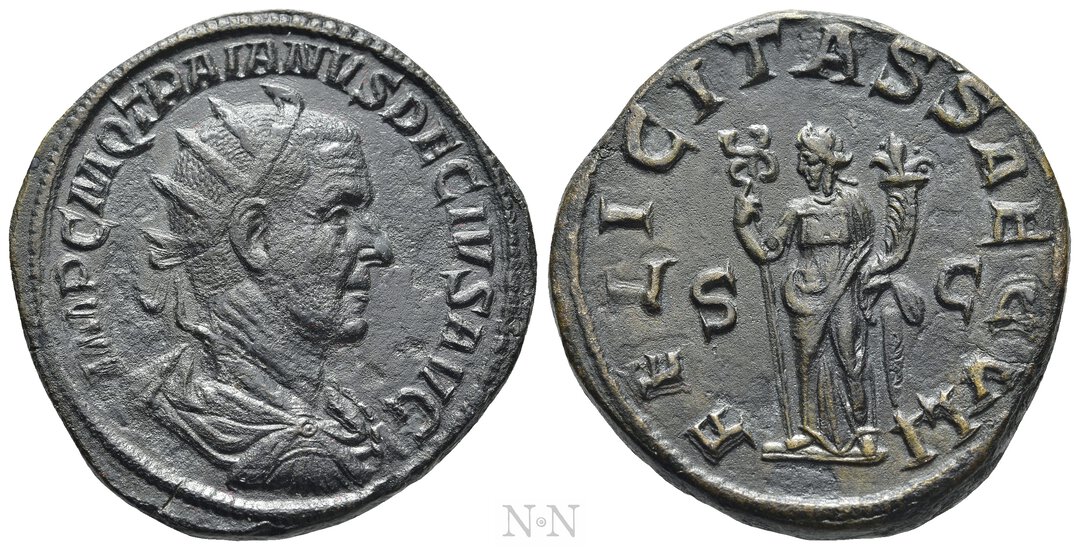

TRAJANUS DECIUS (249-251). Double Sestertius. Rome.
Obv: IMP C M Q TRAIANVS DECIVS AVG.
Radiate, draped and cuirassed bust right.
Rev: FELICITAS SAECVLI / S - C.
Felicitas standing left, holding caduceus and cornucopia.
RIC 115c.
Rare
Ex Classical Numismatic Group 97 (2014), lot 712. The Double Sestertius, a large coin made of orichalcum, was first struck by Decius in response to the inflation of the time, which had devalued the purchasing power of the Sestertius. Decius was born in Pannonia near Sirmium, his mother descended from an ancient and noble Italic family. He had an excellent military career, becoming prefect of Rome and commander in Moesia and Pannonia, where he obtained an important victory against the Goths who threatened the Danube border. The soldiers acclaimed him emperor in 249, triggering the reaction of Philip I, who was defeated near Verona. The Senate welcomed him with great honors and gave him the name ‘Trajan’, perhaps in the hope that the emperor would be friendly and respectful towards Roman institutions. Decius did not betray the Senate's expectations and committed himself to safeguarding the traditions of the empire and strengthening it. He launched a heavy persecution of Christians, driven in part by the empire's difficult financial situation, with the aim of seizing their considerable assets. Decius' primary goal of reviving the ancient glories of Rome also led him to undertake important public works, such as repairing roads and defending the territories conquered by the first emperor Trajan. However, his plan to rebuild and restore the empire was stopped by a new attack from the Goths in 251, who had regrouped and were once again threatening the empire. The decisive battle took place near Abritus, close to the Black Sea, where Decius and his son Herennius, who had recently been named Caesar and Princeps Iuventutis, died. Despite the brevity of his reign, Trajan Decius minted a considerable amount of coins. Although he continued to strike the Sestertius in abundance and reintroduced the Semis, he continued the policy of significantly reducing the weight of all denominations. During his reign, the denarius was no longer minted, while the Antoninianus was now the most widely circulated coin but no longer had the characteristics of a silver coin of good quality. Roman coinage increasingly consolidated its fiduciary character, no longer linked to the value of the metal it contained.
Condition: Near extremely fine.
Weight: 45.47 g.
Diameter: 37 mm.
Obv: IMP C M Q TRAIANVS DECIVS AVG.
Radiate, draped and cuirassed bust right.
Rev: FELICITAS SAECVLI / S - C.
Felicitas standing left, holding caduceus and cornucopia.
RIC 115c.
Rare
Ex Classical Numismatic Group 97 (2014), lot 712. The Double Sestertius, a large coin made of orichalcum, was first struck by Decius in response to the inflation of the time, which had devalued the purchasing power of the Sestertius. Decius was born in Pannonia near Sirmium, his mother descended from an ancient and noble Italic family. He had an excellent military career, becoming prefect of Rome and commander in Moesia and Pannonia, where he obtained an important victory against the Goths who threatened the Danube border. The soldiers acclaimed him emperor in 249, triggering the reaction of Philip I, who was defeated near Verona. The Senate welcomed him with great honors and gave him the name ‘Trajan’, perhaps in the hope that the emperor would be friendly and respectful towards Roman institutions. Decius did not betray the Senate's expectations and committed himself to safeguarding the traditions of the empire and strengthening it. He launched a heavy persecution of Christians, driven in part by the empire's difficult financial situation, with the aim of seizing their considerable assets. Decius' primary goal of reviving the ancient glories of Rome also led him to undertake important public works, such as repairing roads and defending the territories conquered by the first emperor Trajan. However, his plan to rebuild and restore the empire was stopped by a new attack from the Goths in 251, who had regrouped and were once again threatening the empire. The decisive battle took place near Abritus, close to the Black Sea, where Decius and his son Herennius, who had recently been named Caesar and Princeps Iuventutis, died. Despite the brevity of his reign, Trajan Decius minted a considerable amount of coins. Although he continued to strike the Sestertius in abundance and reintroduced the Semis, he continued the policy of significantly reducing the weight of all denominations. During his reign, the denarius was no longer minted, while the Antoninianus was now the most widely circulated coin but no longer had the characteristics of a silver coin of good quality. Roman coinage increasingly consolidated its fiduciary character, no longer linked to the value of the metal it contained.
Condition: Near extremely fine.
Weight: 45.47 g.
Diameter: 37 mm.