Info & contatti
Le mie offerte
Lotti osservati
Condizioni di vendita
Prezzi di spedizione
Metodi di pagamento
Esito stampabile
Sessione Live 5/4/2026 17:00:00 CET
Celtic Coins (1-7)
Greek Coins (8-221)
Roman Provincial Coins (222-353)
Roman Republican Coins (354-425)
Roman Imperial Coins (426-853)
Migration Period (854-855)
Byzantine Coins (856-890)
Medieval Coins (891-927)
World Coins (928-955)
Medals & Tokens (956-958)
Group Lots (959-1105)

ANASTASIUS I (491-518). GOLD Solidus. Constantinople
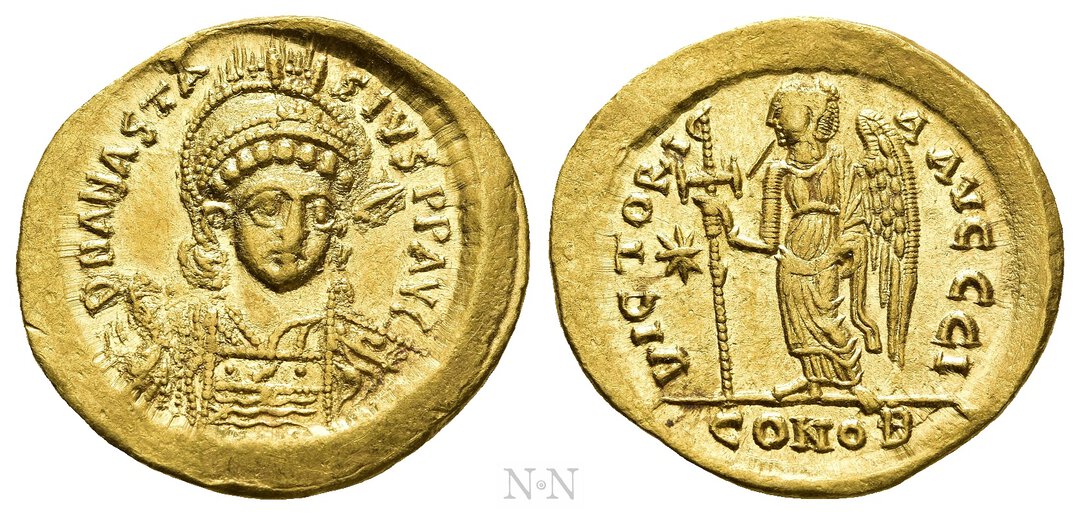

ANASTASIUS I (491-518). GOLD Solidus. Constantinople.
Obv: D N ANASTASIVS P P AVG.
Helmeted and cuirassed bust facing slightly right, holding spear and shield decorated with horseman motif.
Rev: VICTORIA AVGGG I / CONOB.
Victory standing left, holding long staff surmounted by reversed staurogram; star to left.
MIBE 7; DOC 7j; Sear 5.
Anastasius was nicknamed ‘dikoros’ (=two pupils) because of the different color of his eyes. When Zeno died, since he had no living heirs, his widow Ariadne had the difficult choice of appointing a successor to the people, who demanded an orthodox emperor. Ariadne eventually chose Anastasius, about whom we only know that he was a palace official, responsible for maintaining silence during important sacred ceremonies. After Zeno's funeral, Anastasius received the crown from the patriarch, was acclaimed augustus by the crowd in 491, and married Ariadne to legitimize the succession. His main task was to restore Constantinople's finances, which had been severely affected during his predecessor's reign. He managed to balance the budget despite a policy of tax relief, making the people pay less tax, but in cash rather than in kind. This favored the cities but was to the detriment of the people living in the countryside, and in fact many revolts broke out in rural areas. He also revolutionized the tax collection system by introducing the ‘vindices’ and encouraged the return of copper folles, which began to circulate again with a precise value ratio to the gold solidus. Anastasius demonstrated wisdom and competence, and the Byzantine Empire flourished once again. A great amount of money flowed into the state treasury, which favored the work of his successors, particularly Justinian I. With regard to foreign policy, Anastasius reached an agreement with Theodoric, king of the Roman-Barbarian kingdom in Italy, promoting trade that benefited both kingdoms. Despite his undeniable qualities as an administrator, Anastasius was constantly threatened by intrigues and uprisings. He was also engaged in a long war against the Persians (502-506), which ended with a peace treaty and the construction of the Anastasian Wall to defend Constantinople along the Propontis and the Black Sea. However, the internal situation was more delicate. The emperor was not orthodox, as the people had asked Ariadne, but a convinced Monophysite, and he attracted much dissent, partly because he contributed to distancing the Eastern Church from that of Rome by interfering in the nomination of the new pope. The discontent led to a civil war (513-515) with the insurrection of Vitalian at the head of the Isaurians, who was eventually defeated by the general Marinus of Syria. Anastasius died in 518 at the age of almost ninety, but left no children to succeed him to the throne.
Condition: Extremely fine.
Weight: 4.47 g.
Diameter: 21 mm.
Obv: D N ANASTASIVS P P AVG.
Helmeted and cuirassed bust facing slightly right, holding spear and shield decorated with horseman motif.
Rev: VICTORIA AVGGG I / CONOB.
Victory standing left, holding long staff surmounted by reversed staurogram; star to left.
MIBE 7; DOC 7j; Sear 5.
Anastasius was nicknamed ‘dikoros’ (=two pupils) because of the different color of his eyes. When Zeno died, since he had no living heirs, his widow Ariadne had the difficult choice of appointing a successor to the people, who demanded an orthodox emperor. Ariadne eventually chose Anastasius, about whom we only know that he was a palace official, responsible for maintaining silence during important sacred ceremonies. After Zeno's funeral, Anastasius received the crown from the patriarch, was acclaimed augustus by the crowd in 491, and married Ariadne to legitimize the succession. His main task was to restore Constantinople's finances, which had been severely affected during his predecessor's reign. He managed to balance the budget despite a policy of tax relief, making the people pay less tax, but in cash rather than in kind. This favored the cities but was to the detriment of the people living in the countryside, and in fact many revolts broke out in rural areas. He also revolutionized the tax collection system by introducing the ‘vindices’ and encouraged the return of copper folles, which began to circulate again with a precise value ratio to the gold solidus. Anastasius demonstrated wisdom and competence, and the Byzantine Empire flourished once again. A great amount of money flowed into the state treasury, which favored the work of his successors, particularly Justinian I. With regard to foreign policy, Anastasius reached an agreement with Theodoric, king of the Roman-Barbarian kingdom in Italy, promoting trade that benefited both kingdoms. Despite his undeniable qualities as an administrator, Anastasius was constantly threatened by intrigues and uprisings. He was also engaged in a long war against the Persians (502-506), which ended with a peace treaty and the construction of the Anastasian Wall to defend Constantinople along the Propontis and the Black Sea. However, the internal situation was more delicate. The emperor was not orthodox, as the people had asked Ariadne, but a convinced Monophysite, and he attracted much dissent, partly because he contributed to distancing the Eastern Church from that of Rome by interfering in the nomination of the new pope. The discontent led to a civil war (513-515) with the insurrection of Vitalian at the head of the Isaurians, who was eventually defeated by the general Marinus of Syria. Anastasius died in 518 at the age of almost ninety, but left no children to succeed him to the throne.
Condition: Extremely fine.
Weight: 4.47 g.
Diameter: 21 mm.