Info & contatti
Le mie offerte
Lotti osservati
Condizioni di vendita
Prezzi di spedizione
Metodi di pagamento
Esito stampabile
Sessione Live 7/6/2026 17:00:00 CET
Celtic Coins (1-7)
Greek Coins (8-164)
Roman Provincial Coins (165-261)
Roman Republican Coins (262-309)
Roman Imperial Coins (310-829)
Migration Period (830-835)
Byzantine Coins (836-860)
Medieval Coins (861-889)
World Coins (890-941)
Medals & Tokens (942-942)
Group Lots (943-1108)

EGYPT. Alexandria. Uncertain Emperor (1st century AD). Ae Dichalkon. Dated RY 2 of an uncertain reign
Apis - the Sacred Bull
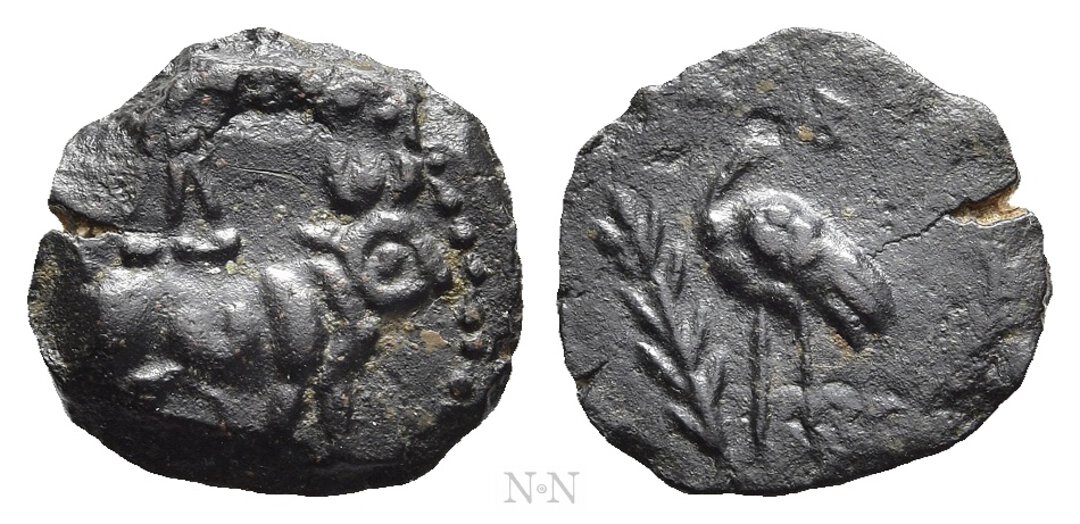

EGYPT. Alexandria. Uncertain Emperor (1st century AD). Ae Dichalkon. Dated RY 2 of an uncertain reign.
Obv: Ibis standing left; to left, palm branch.
Rev: L B (date).
Apis bull standing right wearing solar disk.
RPC I 5112; Dattari (Savio) 112; Emmett 4257.2.
Apis bull is one of the most recognizable deities of ancient Egypt. Its ancient cult reached its peak between the New Kingdom and the Ptolemaic period, when it became a focal point where religion, politics, and royal ideology converged. In Memphis, the sacred city and ancient capital, Apis was venerated as the living manifestation of the god Ptah, and upon his death he united with Osiris to become OsirApis, a symbol of rebirth and continuity. The sacred bull was chosen based on very specific distinguishing marks (a black coat, white spots in symbolic shapes, and a scarab under its tongue) and once recognized, it lived like a king: public appearances, oracles, rituals, and a stable considered a sanctuary. Upon its death, its body was mummified and laid to rest in the Serapeum at Saqqara. The cult endured for thousands of years, surviving even the arrival of the Greeks and Romans, who reinterpreted it through the syncretic figure of Serapis. It is therefore not surprising that Apis also appears on ancient coins: the bull, often depicted with a sun disk between its horns, became a powerful symbol of Egyptian identity and the legitimization of power. On Ptolemaic coins, his image served to show respect for local traditions, while in the Roman era, especially on Alexandrian issues such as this one, Apis was used as a symbol of cultural continuity. Emperors like Hadrian, who visited Egypt in 130 AD, included him on their coin reverses to emphasize a direct connection with the country’s religion and history.
Condition: Good very fine.
Weight: 1.68 g.
Diameter: 13 mm.
Estimate: € 50
Obv: Ibis standing left; to left, palm branch.
Rev: L B (date).
Apis bull standing right wearing solar disk.
RPC I 5112; Dattari (Savio) 112; Emmett 4257.2.
Apis bull is one of the most recognizable deities of ancient Egypt. Its ancient cult reached its peak between the New Kingdom and the Ptolemaic period, when it became a focal point where religion, politics, and royal ideology converged. In Memphis, the sacred city and ancient capital, Apis was venerated as the living manifestation of the god Ptah, and upon his death he united with Osiris to become OsirApis, a symbol of rebirth and continuity. The sacred bull was chosen based on very specific distinguishing marks (a black coat, white spots in symbolic shapes, and a scarab under its tongue) and once recognized, it lived like a king: public appearances, oracles, rituals, and a stable considered a sanctuary. Upon its death, its body was mummified and laid to rest in the Serapeum at Saqqara. The cult endured for thousands of years, surviving even the arrival of the Greeks and Romans, who reinterpreted it through the syncretic figure of Serapis. It is therefore not surprising that Apis also appears on ancient coins: the bull, often depicted with a sun disk between its horns, became a powerful symbol of Egyptian identity and the legitimization of power. On Ptolemaic coins, his image served to show respect for local traditions, while in the Roman era, especially on Alexandrian issues such as this one, Apis was used as a symbol of cultural continuity. Emperors like Hadrian, who visited Egypt in 130 AD, included him on their coin reverses to emphasize a direct connection with the country’s religion and history.
Condition: Good very fine.
Weight: 1.68 g.
Diameter: 13 mm.
Estimate: € 50