Info & contatti
Le mie offerte
Lotti osservati
Condizioni di vendita
Prezzi di spedizione
Metodi di pagamento
Esito stampabile
Sessione Live 7/6/2026 17:00:00 CET
Celtic Coins (1-7)
Greek Coins (8-164)
Roman Provincial Coins (165-261)
Roman Republican Coins (262-309)
Roman Imperial Coins (310-829)
Migration Period (830-835)
Byzantine Coins (836-860)
Medieval Coins (861-889)
World Coins (890-941)
Medals & Tokens (942-942)
Group Lots (943-1108)

CONSTANTINE II (337-340). GOLD Solidus. Antioch
Ex Prof. Bachmann Coll. 2001
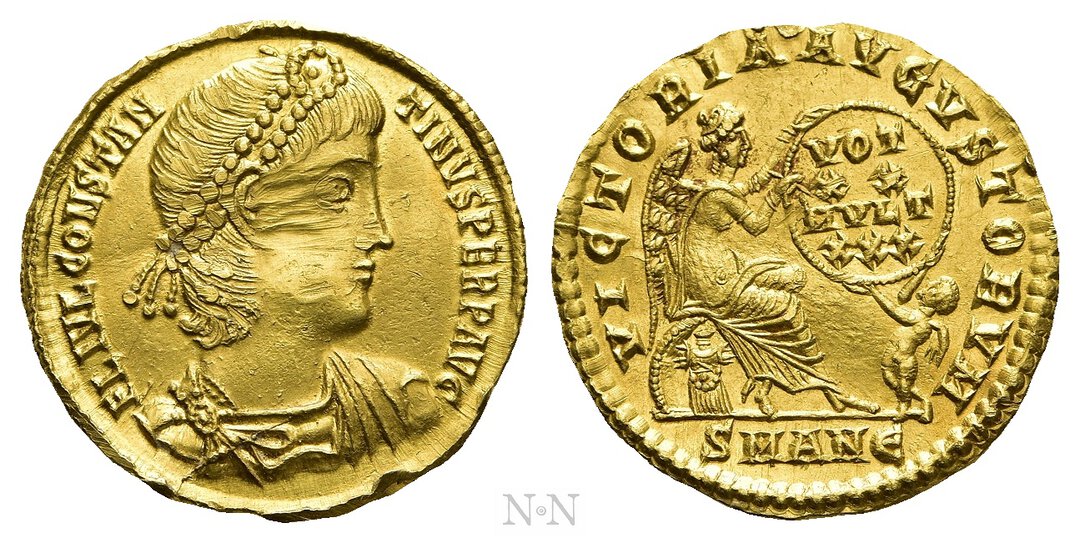

CONSTANTINE II (337-340). GOLD Solidus. Antioch.
Obv: FL IVL CONSTANTINVS PERP AVG.
Pearl-diademed, draped and cuirassed bust right.
Rev: VICTORIA AVGVSTORVM / SMANЄ.
Victory seated right on cuirass, shield to left, inscribing VOT/ XX/ MVLT/ XXX in four lines on shield set on knee; to right, small winged Genius standing left, supporting shield.
RIC 23; Depeyrot 5/1.
Rare
From the Prof. Bachmann collection (acquired 2001), ex Dr. Busso Peus 424 (2019), lot 266. Flavius Claudius Constantinus, son of Constantine I and Fausta, was born in Arelate in 316 and was educated by Lactantius, who taught him Latin literature and politics. Following an agreement between his father and Licinius, the Augusti of the West and the East, Constantine II was named Caesar—along with his half-brother Crispus and Licinius’s son, Licinianus—before he had even turned one year old. This move strongly reaffirmed the hereditary nature of imperial power, marking the failure of the Tetrarchy. Upon Crispus’s death in 326, Constantine II became the sole Caesar of the West and began to nourish the desire to reunite the entire Empire under his rule. He served as a loyal general to his father, fighting alongside him against Alaric, king of the Visigoths, and in 332 he established himself in Trier to oversee the Rhine Limes. A few years later, Constantine I divided the empire among his sons and grandsons, which led to disorders upon his death. His grandsons Delmatius and Hanniballianus were killed by soldiers who clearly favored the emperor’s sons. The involvement of the military in the elimination and coronation of emperors became a common occurrence in the third century. Rivalry, however, was also simmering among the sons of the late emperor, a situation further exacerbated by the religious division between the two empires. In the West, the Nicene creed prevailed, while in the East, Arianism was favored. Consequently, a conference was organized at Viminacium in 338 to discuss the division of power and territories. Constantine II received Gaul and the care of his younger brother Constans, to whom Italy, Africa, and Macedonia belonged. Constantius, on the other hand, received the East and Thrace. However, the harmony did not last long. According to sources, Constantine II sought to take control of other territories and marched into Italy with an army, but he was killed in the Battle of Aquileia and his body was thrown into the Alsa River in 340. Constans became the sole ruler in the West.
Condition: Extremely fine; some underlaying luster.
Weight: 4.51 g.
Diameter: 20 mm.
Estimate: € 500
Obv: FL IVL CONSTANTINVS PERP AVG.
Pearl-diademed, draped and cuirassed bust right.
Rev: VICTORIA AVGVSTORVM / SMANЄ.
Victory seated right on cuirass, shield to left, inscribing VOT/ XX/ MVLT/ XXX in four lines on shield set on knee; to right, small winged Genius standing left, supporting shield.
RIC 23; Depeyrot 5/1.
Rare
From the Prof. Bachmann collection (acquired 2001), ex Dr. Busso Peus 424 (2019), lot 266. Flavius Claudius Constantinus, son of Constantine I and Fausta, was born in Arelate in 316 and was educated by Lactantius, who taught him Latin literature and politics. Following an agreement between his father and Licinius, the Augusti of the West and the East, Constantine II was named Caesar—along with his half-brother Crispus and Licinius’s son, Licinianus—before he had even turned one year old. This move strongly reaffirmed the hereditary nature of imperial power, marking the failure of the Tetrarchy. Upon Crispus’s death in 326, Constantine II became the sole Caesar of the West and began to nourish the desire to reunite the entire Empire under his rule. He served as a loyal general to his father, fighting alongside him against Alaric, king of the Visigoths, and in 332 he established himself in Trier to oversee the Rhine Limes. A few years later, Constantine I divided the empire among his sons and grandsons, which led to disorders upon his death. His grandsons Delmatius and Hanniballianus were killed by soldiers who clearly favored the emperor’s sons. The involvement of the military in the elimination and coronation of emperors became a common occurrence in the third century. Rivalry, however, was also simmering among the sons of the late emperor, a situation further exacerbated by the religious division between the two empires. In the West, the Nicene creed prevailed, while in the East, Arianism was favored. Consequently, a conference was organized at Viminacium in 338 to discuss the division of power and territories. Constantine II received Gaul and the care of his younger brother Constans, to whom Italy, Africa, and Macedonia belonged. Constantius, on the other hand, received the East and Thrace. However, the harmony did not last long. According to sources, Constantine II sought to take control of other territories and marched into Italy with an army, but he was killed in the Battle of Aquileia and his body was thrown into the Alsa River in 340. Constans became the sole ruler in the West.
Condition: Extremely fine; some underlaying luster.
Weight: 4.51 g.
Diameter: 20 mm.
Estimate: € 500