Info & contatti
Le mie offerte
Lotti osservati
Condizioni di vendita
Prezzi di spedizione
Metodi di pagamento
Esito stampabile
Sessione Live 14/6/2026 17:00:00 CET
Celtic Coins (1-3)
Greek Coins (4-22)
Roman Provincial Coins (23-26)
Roman Republican Coins (27-28)
Roman Imperial Coins (29-263)
Migration Period (264-264)

KYRENAICA. Kyrene. Time of Magas (Ptolemaic governor, first reign, circa 300-282/75 BC). Didrachm
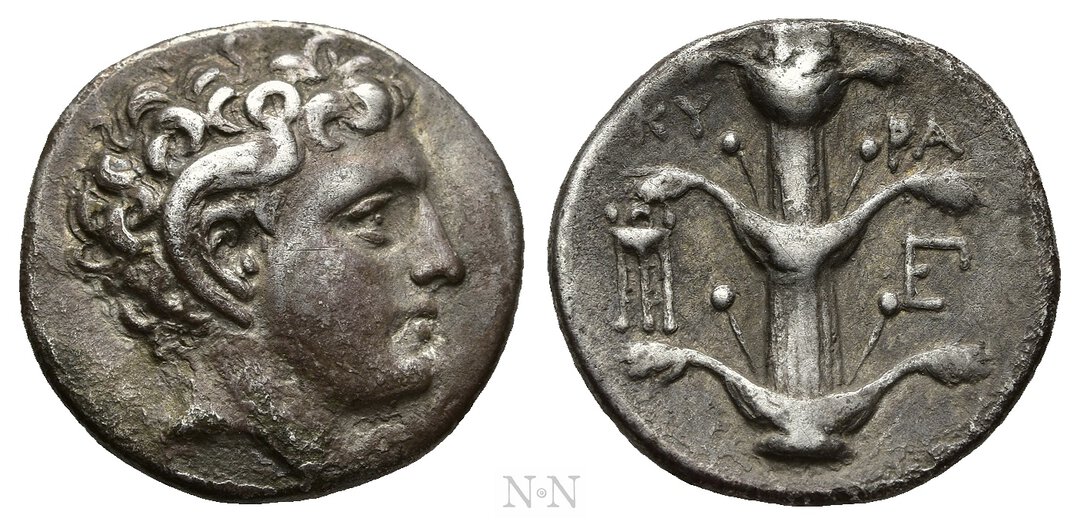

KYRENAICA. Kyrene. Time of Magas (Ptolemaic governor, first reign, circa 300-282/75 BC). Didrachm.
Obv: Head of Zeus Karneios right.
Rev: KY - PA.
Silphion plant; tripod to left, monogram to right.
SNG Copenhagen -; BMC 252.
Founded in 631 B.C. by settlers from the island of Thera, Cyrene was soon one of the richest and most important Greek cities. The period from the end of the Battiadian dynasty to the rise of Alexander the Great was the city's golden age. It earned the nickname 'Athens of Africa', hosting important philosophers such as Aristippos, the poet Callimachos and the astronomer Eratosthenes. Silphium was a plant widely used in antiquity as a medicine, condiment and for perfumes. It is mentioned by Herodotus but also by naturalists such as Theophrastus and Pliny the Elder and was considered as valuable as gold and silver. Despite its popularity, however, silphium disappeared completely back in antiquity, probably due to the overcrowding and climatic changes North Africa underwent, combined with the very small habitat in which it grew, a narrow strip of land in Cyrenaica. When the plant began to become scarce, the Greeks and Romans tried to cultivate it, without success. Its collection in the wild was strictly regulated, and a thriving black market was dedicated to its trade. Nowadays no one knows what silphium looks like; the only records of this plant are offered by literature and coins like this one.
Condition: Very fine.
Weight: 7.48 g.
Diameter: 22 mm.
Estimate: € 1250
Obv: Head of Zeus Karneios right.
Rev: KY - PA.
Silphion plant; tripod to left, monogram to right.
SNG Copenhagen -; BMC 252.
Founded in 631 B.C. by settlers from the island of Thera, Cyrene was soon one of the richest and most important Greek cities. The period from the end of the Battiadian dynasty to the rise of Alexander the Great was the city's golden age. It earned the nickname 'Athens of Africa', hosting important philosophers such as Aristippos, the poet Callimachos and the astronomer Eratosthenes. Silphium was a plant widely used in antiquity as a medicine, condiment and for perfumes. It is mentioned by Herodotus but also by naturalists such as Theophrastus and Pliny the Elder and was considered as valuable as gold and silver. Despite its popularity, however, silphium disappeared completely back in antiquity, probably due to the overcrowding and climatic changes North Africa underwent, combined with the very small habitat in which it grew, a narrow strip of land in Cyrenaica. When the plant began to become scarce, the Greeks and Romans tried to cultivate it, without success. Its collection in the wild was strictly regulated, and a thriving black market was dedicated to its trade. Nowadays no one knows what silphium looks like; the only records of this plant are offered by literature and coins like this one.
Condition: Very fine.
Weight: 7.48 g.
Diameter: 22 mm.
Estimate: € 1250