Info & contatti
Le mie offerte
Lotti osservati
Condizioni di vendita
Prezzi di spedizione
Metodi di pagamento
Esito stampabile
Sessione Live 4/10/2026 17:00:00 CET
Celtic Coins (1-13)
Greek Coins (14-181)
Roman Provincial Coins (182-296)
Roman Republican Coins (297-425)
Roman Imperial Coins (426-1087)
Migration Period (1088-1097)
Byzantine Coins (1098-1119)
Medieval Coins (1120-1163)
World Coins (1164-1368)
Medals & Tokens (1369-1377)
Group Lots (1378-1594)

FLAVIUS VICTOR (387-388). Siliqua. Mediolanum
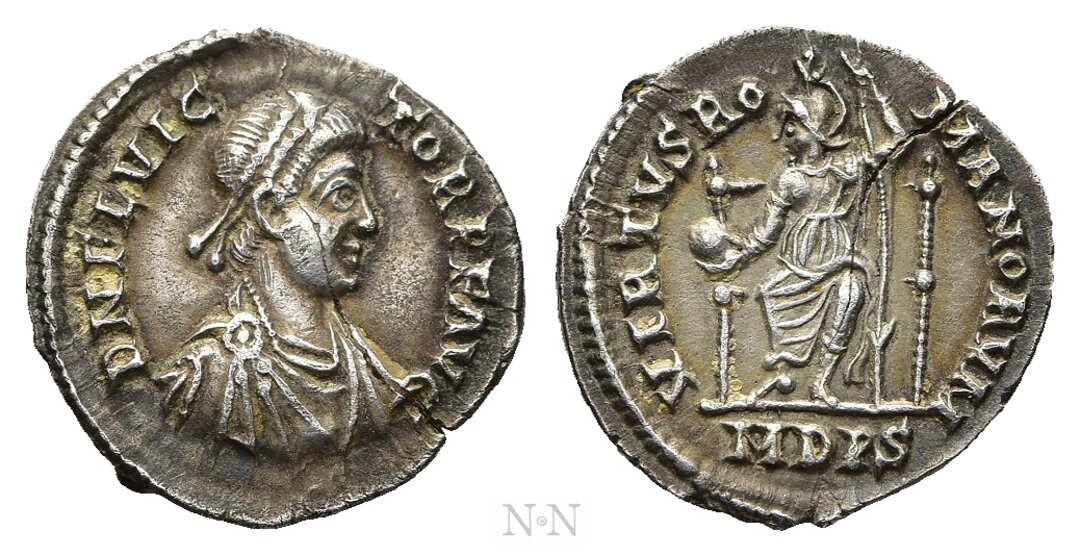

FLAVIUS VICTOR (387-388). Siliqua. Mediolanum.
Obv: D N FL VICTOR P F AVG.
Pearl-diademed, draped and cuirassed bust right.
Rev: VIRTVS ROMANORVM / MDPS.
Roma seated facing on throne, head left, holding globus and spear.
RIC 19b.
Flavius Victor was the son of the Hispano-Roman general Magnus Maximus, who was proclaimed emperor by the troops stationed in Britain in 383, who were unhappy with Gratian. Maximus, an ambitious and capable figure, quickly succeeded in consolidating his power in Gaul, Britain and Hispania. He pursued Gratian as he fled to Italy, defeated and killed him, and even secured formal recognition from the Eastern Emperor Theodosius I, who temporarily accepted him as the legitimate ruler of the West. In 384, Magnus Maximus decided to place his son on the throne, proclaiming him Augustus. In the same year, Theodosius officially recognised both Maximus and the young Augustus, thereby establishing a truce between the two halves of the Empire. Although he was only a child, Victor formally held the role of co-emperor of the West, based in Treveri, the administrative capital of Gaul. There he remained under the guardianship of the generals Quintinus and Nanninus, whilst his father led military operations. In 387, Maximus decided to invade Italy to depose Valentinian II, provoking Theodosius’s response. The Eastern Emperor marched westwards in 388, defeated Maximus in Pannonia and captured him at Aquileia, where he was executed on 28 August 388. His son’s fate was also sealed: Theodosius sent the Frankish general Arbogast to Treveri, who had him killed shortly afterwards, thereby eliminating any potential dynastic rival.
Condition: Good very fine.
Weight: 1.66 g.
Diameter: 17 mm.
Estimate: € 750
Obv: D N FL VICTOR P F AVG.
Pearl-diademed, draped and cuirassed bust right.
Rev: VIRTVS ROMANORVM / MDPS.
Roma seated facing on throne, head left, holding globus and spear.
RIC 19b.
Flavius Victor was the son of the Hispano-Roman general Magnus Maximus, who was proclaimed emperor by the troops stationed in Britain in 383, who were unhappy with Gratian. Maximus, an ambitious and capable figure, quickly succeeded in consolidating his power in Gaul, Britain and Hispania. He pursued Gratian as he fled to Italy, defeated and killed him, and even secured formal recognition from the Eastern Emperor Theodosius I, who temporarily accepted him as the legitimate ruler of the West. In 384, Magnus Maximus decided to place his son on the throne, proclaiming him Augustus. In the same year, Theodosius officially recognised both Maximus and the young Augustus, thereby establishing a truce between the two halves of the Empire. Although he was only a child, Victor formally held the role of co-emperor of the West, based in Treveri, the administrative capital of Gaul. There he remained under the guardianship of the generals Quintinus and Nanninus, whilst his father led military operations. In 387, Maximus decided to invade Italy to depose Valentinian II, provoking Theodosius’s response. The Eastern Emperor marched westwards in 388, defeated Maximus in Pannonia and captured him at Aquileia, where he was executed on 28 August 388. His son’s fate was also sealed: Theodosius sent the Frankish general Arbogast to Treveri, who had him killed shortly afterwards, thereby eliminating any potential dynastic rival.
Condition: Good very fine.
Weight: 1.66 g.
Diameter: 17 mm.
Estimate: € 750