Info & contatti
Le mie offerte
Lotti osservati
Condizioni di vendita
Prezzi di spedizione
Metodi di pagamento
Esito stampabile
Sessione Live 4/10/2026 17:00:00 CET
Celtic Coins (1-13)
Greek Coins (14-181)
Roman Provincial Coins (182-296)
Roman Republican Coins (297-425)
Roman Imperial Coins (426-1087)
Migration Period (1088-1097)
Byzantine Coins (1098-1119)
Medieval Coins (1120-1163)
World Coins (1164-1368)
Medals & Tokens (1369-1377)
Group Lots (1378-1594)

JUDAEA. Legionary Countermarks. Legio X Fretensis. Ae (Circa 81/2-132/5). Sebaste or Caesarea Maritima
Legio X Fretensis
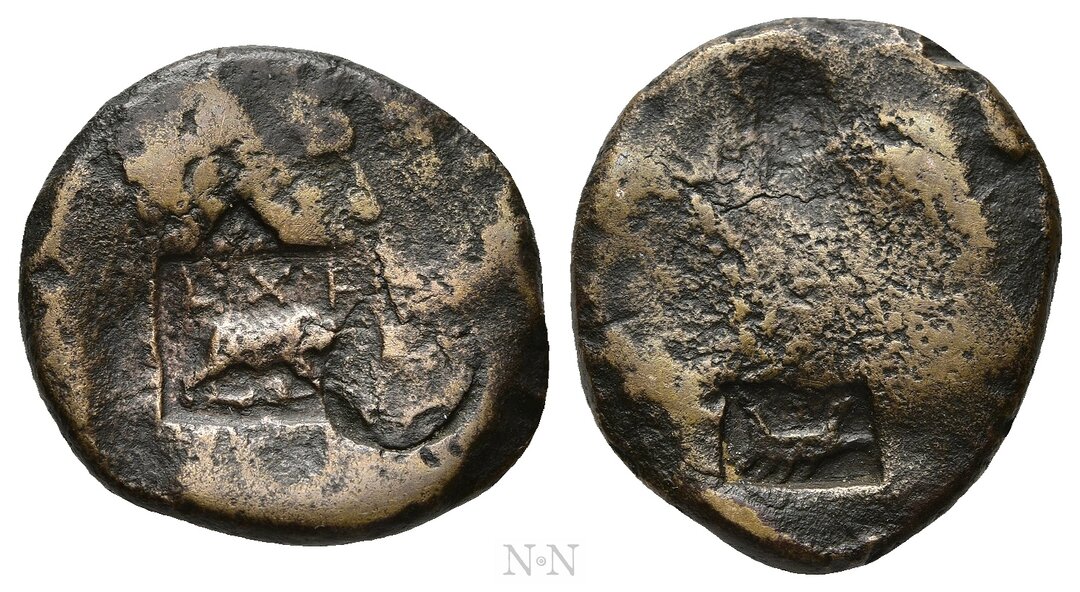

JUDAEA. Legionary Countermarks. Legio X Fretensis. Ae (Circa 81/2-132/5). Sebaste or Caesarea Maritima.
Obv: Laureate head right; 2 c/ms: boar and dolphin surmounted by LXF within rectangular incuse and laureate head right within round incuse.
Rev: Blank; c/m: galley within rectangular incuse.
Howgego 117, 291 and 410.
The Legio X “Fretensis” was created by Emperor Augustus around 40 B.C. to fight Sextus Pompey, son of Pompey the Great, who at that time controlled Sicily, seriously threating Rome’s grain supplies. He chose the number ten in honor of the valiant legion that had served under Caesar years earlier, hoping that this legion would repeat its achievements. During the conflict against Pompey, Legio X defended the Strait of Messina, taking part in the Battle of Mylae and the Battle of Naulochus in 36 B.C.; from the Latin name of the strait, Fretum Siculum, the legion derived its cognomen “Fretensis,” thus becoming a Sicilian legion, and its symbol was the boar. After being transferred to the East, the X Fretensis was involved in numerous campaigns: from its deployment in Syria to operations against the Parthians, and ultimately to its central role in the Jewish revolts. During the First Jewish War, it participated in the siege of Jerusalem, distinguishing itself in the use of siege engines and subsequently becoming the city’s permanent garrison. It was also involved in the conquest of Masada, an episode that remains emblematic of the brutality of the conflict. In the 2nd century, it took part in the Bar Kokhba revolt and, in the following decades, was involved in various skirmishes along the imperial borders. It was not until the late imperial period that it was relocated to Aila, on the Red Sea, where it is still attested at the beginning of the 5th century. The countermarks attributed to Legio X Fretensis appear on numerous bronze coins that circulated between 84/5 and the Bar Kokhba Revolt of 132–135, applied primarily in Sebaste and Jerusalem.
Condition: Coin poor, c/ms very fine.
Weight: 11.83 g.
Diameter: 26 mm.
Estimate: € 100
Obv: Laureate head right; 2 c/ms: boar and dolphin surmounted by LXF within rectangular incuse and laureate head right within round incuse.
Rev: Blank; c/m: galley within rectangular incuse.
Howgego 117, 291 and 410.
The Legio X “Fretensis” was created by Emperor Augustus around 40 B.C. to fight Sextus Pompey, son of Pompey the Great, who at that time controlled Sicily, seriously threating Rome’s grain supplies. He chose the number ten in honor of the valiant legion that had served under Caesar years earlier, hoping that this legion would repeat its achievements. During the conflict against Pompey, Legio X defended the Strait of Messina, taking part in the Battle of Mylae and the Battle of Naulochus in 36 B.C.; from the Latin name of the strait, Fretum Siculum, the legion derived its cognomen “Fretensis,” thus becoming a Sicilian legion, and its symbol was the boar. After being transferred to the East, the X Fretensis was involved in numerous campaigns: from its deployment in Syria to operations against the Parthians, and ultimately to its central role in the Jewish revolts. During the First Jewish War, it participated in the siege of Jerusalem, distinguishing itself in the use of siege engines and subsequently becoming the city’s permanent garrison. It was also involved in the conquest of Masada, an episode that remains emblematic of the brutality of the conflict. In the 2nd century, it took part in the Bar Kokhba revolt and, in the following decades, was involved in various skirmishes along the imperial borders. It was not until the late imperial period that it was relocated to Aila, on the Red Sea, where it is still attested at the beginning of the 5th century. The countermarks attributed to Legio X Fretensis appear on numerous bronze coins that circulated between 84/5 and the Bar Kokhba Revolt of 132–135, applied primarily in Sebaste and Jerusalem.
Condition: Coin poor, c/ms very fine.
Weight: 11.83 g.
Diameter: 26 mm.
Estimate: € 100