Info & contatti
Le mie offerte
Lotti osservati
Condizioni di vendita
Prezzi di spedizione
Metodi di pagamento
Esito stampabile
Sessione Live 4/10/2026 17:00:00 CET
Celtic Coins (1-13)
Greek Coins (14-181)
Roman Provincial Coins (182-296)
Roman Republican Coins (297-425)
Roman Imperial Coins (426-1087)
Migration Period (1088-1097)
Byzantine Coins (1098-1119)
Medieval Coins (1120-1163)
World Coins (1164-1368)
Medals & Tokens (1369-1377)
Group Lots (1378-1594)

FAUSTA (As nobilissima femina, 307-324). Follis. Thessalonica
Fausta Nobilissima Femina
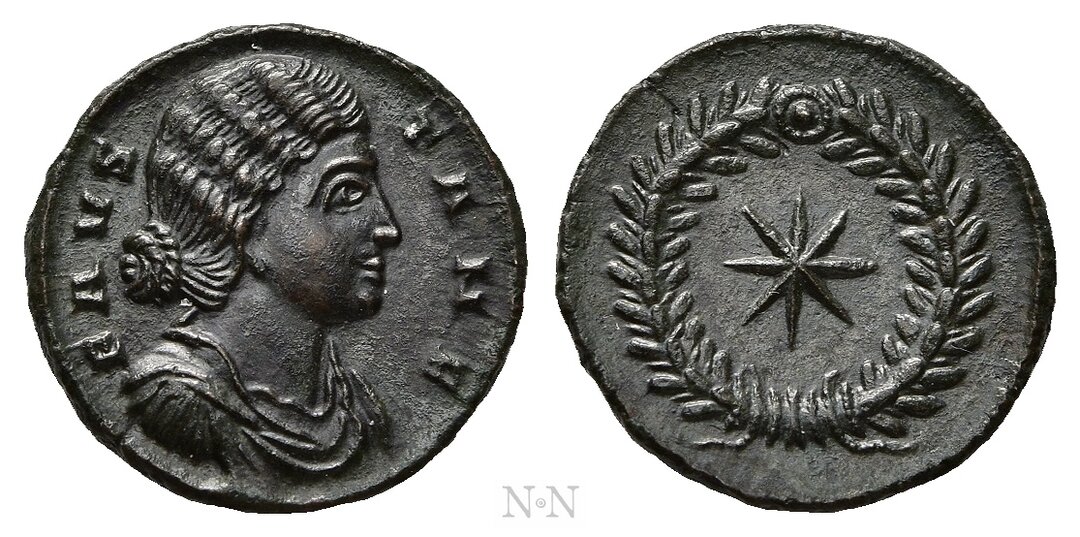

FAUSTA (As nobilissima femina, 307-324). Follis. Thessalonica.
Obv: FAVSTA N F.
Draped bust right.
Rev: Eight-rayed star within laurel wreath.
RIC 51.
Ex Emporium Hamburg (02/06/2000), lot 466. Fausta, born around 289-290, was the daughter of Emperor Maximianus Herculius and Eutropia, and thus a member of one of the most influential families of the Tetrarchic era. Her marriage to Constantine I in 307 was not a romantic union but a political arrangement: it served to consolidate the alliance between Constantine and the Tetrarchic system, and to further legitimize his position in the complex power dynamics of the time. Young and intelligent, Fausta soon found herself at the centre of family tensions and dynastic struggles. In 310, she revealed to Constantine the plot involving her father Maximian, saving her husband’s life and indirectly contributing to the downfall of her own father. Two years later, in 312, she witnessed the defeat of her brother Maxentius at the Battle of Milvian Bridge: his death definitively marked the triumph of the new Constantinian dynasty. As the emperor’s wife, Fausta received the prestigious title of 'nobilissima femina' (as attested by the obverse legend of this coin), reserved for women of imperial rank. After Constantine’s victory over Licinius (324-325), she obtained the title of Augusta. Her fertility further strengthened her position; she had three sons who were destined to become emperors (Constantine II, Constantius II, and Constans I) and two daughters. The year 326 marked Fausta’s downfall. Ancient sources, often contradictory, tell a story of suspicion, accusations and tragedy. According to one version, Fausta accused her stepson Crispus (son of Minervina, Constantine’s first wife) of attempting to seduce her or of plotting against his father. Constantine, believing her, had Crispus executed. Shortly afterward, perhaps overcome by remorse or convinced of his son’s innocence, Constantine had Fausta killed, according to tradition, in a cruel manner: suffocated or killed in the baths, in boiling water. The motives remain unclear.
Condition: Extremely fine.
Weight: 2.78 g.
Diameter: 19 mm.
Estimate: € 1000
Obv: FAVSTA N F.
Draped bust right.
Rev: Eight-rayed star within laurel wreath.
RIC 51.
Ex Emporium Hamburg (02/06/2000), lot 466. Fausta, born around 289-290, was the daughter of Emperor Maximianus Herculius and Eutropia, and thus a member of one of the most influential families of the Tetrarchic era. Her marriage to Constantine I in 307 was not a romantic union but a political arrangement: it served to consolidate the alliance between Constantine and the Tetrarchic system, and to further legitimize his position in the complex power dynamics of the time. Young and intelligent, Fausta soon found herself at the centre of family tensions and dynastic struggles. In 310, she revealed to Constantine the plot involving her father Maximian, saving her husband’s life and indirectly contributing to the downfall of her own father. Two years later, in 312, she witnessed the defeat of her brother Maxentius at the Battle of Milvian Bridge: his death definitively marked the triumph of the new Constantinian dynasty. As the emperor’s wife, Fausta received the prestigious title of 'nobilissima femina' (as attested by the obverse legend of this coin), reserved for women of imperial rank. After Constantine’s victory over Licinius (324-325), she obtained the title of Augusta. Her fertility further strengthened her position; she had three sons who were destined to become emperors (Constantine II, Constantius II, and Constans I) and two daughters. The year 326 marked Fausta’s downfall. Ancient sources, often contradictory, tell a story of suspicion, accusations and tragedy. According to one version, Fausta accused her stepson Crispus (son of Minervina, Constantine’s first wife) of attempting to seduce her or of plotting against his father. Constantine, believing her, had Crispus executed. Shortly afterward, perhaps overcome by remorse or convinced of his son’s innocence, Constantine had Fausta killed, according to tradition, in a cruel manner: suffocated or killed in the baths, in boiling water. The motives remain unclear.
Condition: Extremely fine.
Weight: 2.78 g.
Diameter: 19 mm.
Estimate: € 1000