Info & contatti
Le mie offerte
Lotti osservati
Condizioni di vendita
Prezzi di spedizione
Metodi di pagamento
Sessione Live 1/11/2026 17:00:00 CET
Celtic Coins (1-26)
Greek Coins (27-1279)
Roman Provincial Coins (256-401)
Roman Republican Coins (402-460)
Roman Imperial Coins (461-974)
Migration Period (975-986)
Byzantine Coins (987-1037)
Medieval Coins (1038-1102)
World Coins (1103-1252)
Medals & Tokens (1253-1262)
Group Lots (1263-1479)

LICINIUS I (308-324). GOLD Aureus. Treveri
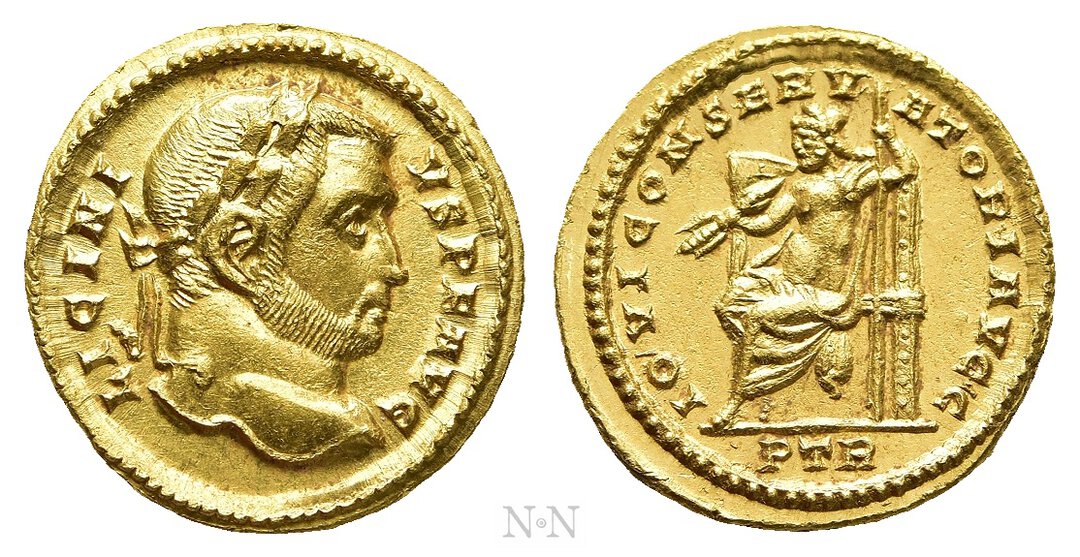

LICINIUS I (308-324). GOLD Aureus. Treveri.
Obv: LICINIVS P F AVG.
Laureate head right.
Rev: IOVI CONSERVATORI AVGG / PTR.
Jupiter seated left on throne with high back, holding thunderbolt and sceptre.
RIC 813; Depeyrot 17/8.
Extremely rare
Licinius was born into a humble farming family in New Dacia, probably shortly before AD 250. He entered the army at a young age and became a close friend of Galerius, who, once made Caesar, entrusted him with important responsibilities. Licinius fought against the Persians in 297 and accompanied Galerius in the Italian campaign against Maxentius in 307. In 308, at the meeting in Carnuntum with Diocletian, Licinius was appointed Augustus. Although Italy was nominally assigned to him, it remained under Maxentius’ control, so for several years Licinius acted as Galerius’ collaborator in the eastern part of the Empire. When Galerius died in 311, the Asian provinces passed to Maximinus Daia, with whom Licinius reached an agreement to govern the Balkan region. Ambitious for wider power, he allied himself with Constantine, while Maximinus sought support from Maxentius. After Constantine’s victory over Maxentius, the two Augusti met in Milan (313), where Licinius married Constantia, Constantine’s sister. He then defeated Maximinus at Campus Serenus, entered Nicomedia in triumph, and became master of the East, eliminating his rival’s supporters. The alliance with Constantine soon deteriorated. Licinius plotted against him through Bassianus, but the conspiracy was uncovered, leading to war in 314. Licinius was defeated at Cibalae and again at Campus Mardiensis, and was forced to cede territory. Peace proved temporary: political tensions and especially religious disputes reignited conflict. Although initially favourable to Christians and co‑author of the Edict of Milan, Licinius later adopted an openly hostile policy, closing churches and excluding Christians from public office. War resumed in 324. Despite inferior forces, Constantine won at Adrianople, besieged Byzantium, defeated Licinius at Chrysopolis, and forced his surrender. Thanks to Constantia’s intercession, Licinius’ life was spared and he was exiled to Thessalonica. The following year, accused of plotting with the Goths, he was executed (325).
Condition: Near uncirculated.
Weight: 4.45 g.
Diameter: 18 mm.
Estimate: € 25000
Extremely rare
Obv: LICINIVS P F AVG.
Laureate head right.
Rev: IOVI CONSERVATORI AVGG / PTR.
Jupiter seated left on throne with high back, holding thunderbolt and sceptre.
RIC 813; Depeyrot 17/8.
Extremely rare
Licinius was born into a humble farming family in New Dacia, probably shortly before AD 250. He entered the army at a young age and became a close friend of Galerius, who, once made Caesar, entrusted him with important responsibilities. Licinius fought against the Persians in 297 and accompanied Galerius in the Italian campaign against Maxentius in 307. In 308, at the meeting in Carnuntum with Diocletian, Licinius was appointed Augustus. Although Italy was nominally assigned to him, it remained under Maxentius’ control, so for several years Licinius acted as Galerius’ collaborator in the eastern part of the Empire. When Galerius died in 311, the Asian provinces passed to Maximinus Daia, with whom Licinius reached an agreement to govern the Balkan region. Ambitious for wider power, he allied himself with Constantine, while Maximinus sought support from Maxentius. After Constantine’s victory over Maxentius, the two Augusti met in Milan (313), where Licinius married Constantia, Constantine’s sister. He then defeated Maximinus at Campus Serenus, entered Nicomedia in triumph, and became master of the East, eliminating his rival’s supporters. The alliance with Constantine soon deteriorated. Licinius plotted against him through Bassianus, but the conspiracy was uncovered, leading to war in 314. Licinius was defeated at Cibalae and again at Campus Mardiensis, and was forced to cede territory. Peace proved temporary: political tensions and especially religious disputes reignited conflict. Although initially favourable to Christians and co‑author of the Edict of Milan, Licinius later adopted an openly hostile policy, closing churches and excluding Christians from public office. War resumed in 324. Despite inferior forces, Constantine won at Adrianople, besieged Byzantium, defeated Licinius at Chrysopolis, and forced his surrender. Thanks to Constantia’s intercession, Licinius’ life was spared and he was exiled to Thessalonica. The following year, accused of plotting with the Goths, he was executed (325).
Condition: Near uncirculated.
Weight: 4.45 g.
Diameter: 18 mm.
Estimate: € 25000
Extremely rare
Osserva:
Base d'asta: € 20'000
Diritti d'asta: 18.90%
Chiusura alle: 2026-11-01 16:00:00 ora di Roma