Info & contatti
Le mie offerte
Lotti osservati
Condizioni di vendita
Prezzi di spedizione
Metodi di pagamento
Sessione Live 6/12/2026 17:00:00 CET
Celtic Coins (1-49)
Greek Coins (50-290)
Roman Provincial Coins (291-476)
Roman Republican Coins (477-630)
Roman Imperial Coins (631-1113)
Migration Period (1114-1118)
Byzantine Coins (1119-1134)
Medieval Coins (1135-1196)
World Coins (1197-1254)
Medals & Tokens (1255-1258)
Group Lots (1259-1483)

COELE. Heliopolis. Philip I 'the Arab' (244-249). Ae
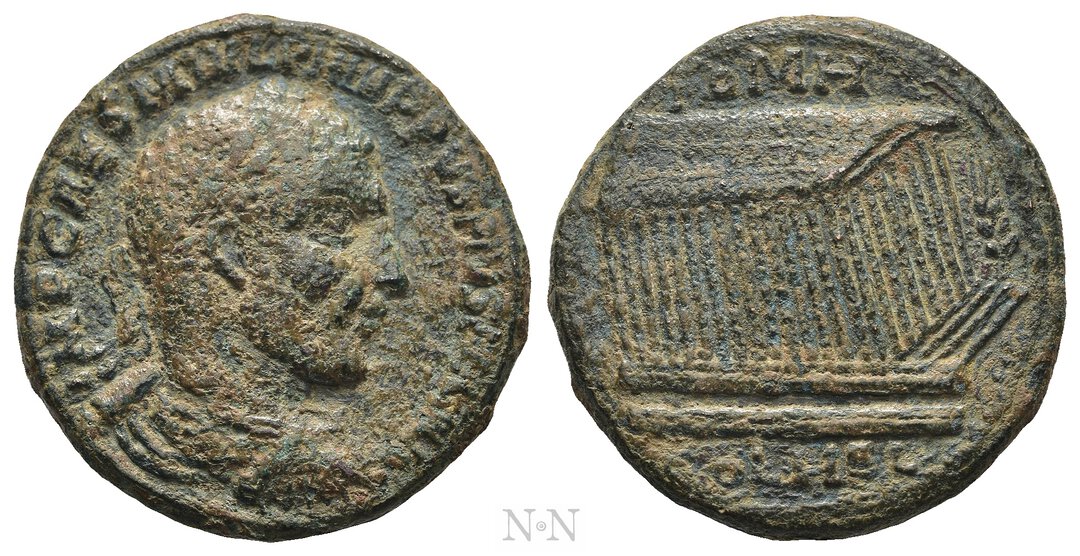

COELE. Heliopolis. Philip I 'the Arab' (244-249). Ae.
Obv: IMP CAES M IVL PHILIPPVS PIVS FEL AVG.
Laureate, draped and cuirassed bust right.
Rev: I O M H / COL HEL.
Temple of Jupiter Heliopolitanus seen in perspective; ear of corn to right.
RPC VIII 2758; BMC 15; Price & Trell p. 164, fig. 290.
The Temple of Jupiter Heliopolitanus is the largest known Roman temple and one of the most complex and impressive buildings ever erected by the Romans, located in present-day Lebanon. The site was declared a UNESCO World Heritage Site in 1984. In the Hellenistic period, under the rule of the Ptolemies who replaced the Seleucids, the city of Baalbek was renamed Heliopolis (“city of the sun”), and the god Baal, who had many characteristics in common with the Greek Zeus, became Jupiter Heliopolitanus. The construction of the Roman temple was begun by Julius Caesar, building on a platform from the Hellenistic period, and was completed during the reign of Nero. The building was supported by 154 enormous columns, twenty meters high, made of granite from Egypt.
Condition: Near very fine; slightly tooled.
Weight: 18.12 g.
Diameter: 29 mm.
Estimate: € 100
Osserva:
Base d'asta: € 80
Diritti d'asta: 18.90%
Chiusura alle: 2026-12-06 16:00:00 ora di Roma