Info & contatti
Le mie offerte
Lotti osservati
Condizioni di vendita
Prezzi di spedizione
Metodi di pagamento
Sessione Live 6/12/2026 17:00:00 CET
Celtic Coins (1-49)
Greek Coins (50-290)
Roman Provincial Coins (291-476)
Roman Republican Coins (477-630)
Roman Imperial Coins (631-1113)
Migration Period (1114-1118)
Byzantine Coins (1119-1134)
Medieval Coins (1135-1196)
World Coins (1197-1254)
Medals & Tokens (1255-1258)
Group Lots (1259-1483)

ANONYMOUS. Aes Grave Triens (Circa 225-217 BC). Rome
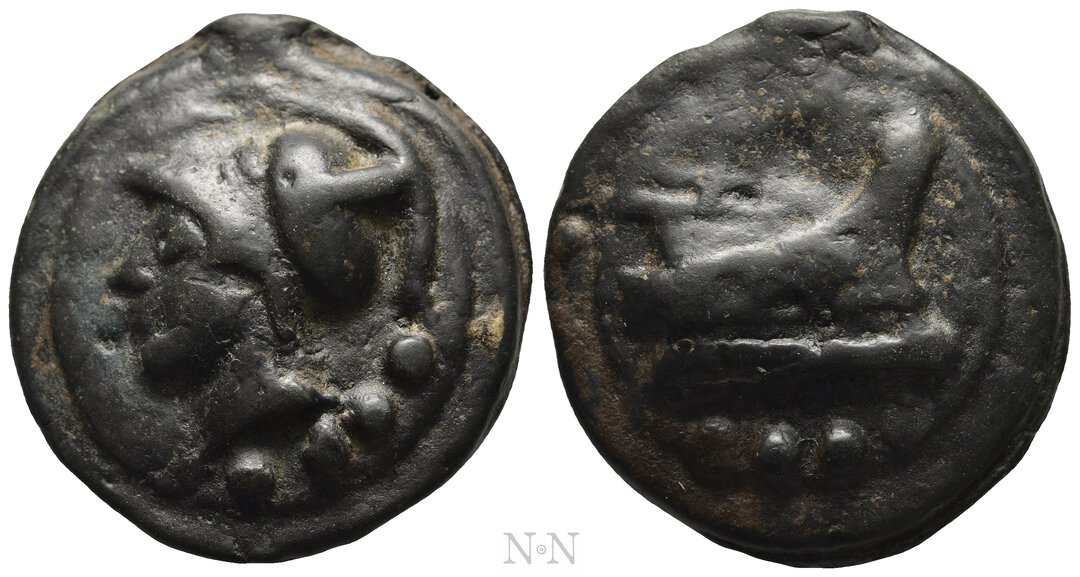

ANONYMOUS. Aes Grave Triens (Circa 225-217 BC). Rome.
Obv: Helmeted head of Minerva left, four pellets (mark of value) below; all on raised disk.
Rev: Prow right, four pellets (mark of value) below; all on raised disk.
Crawford 35/3a; ICC 78; HN Italy 339; RBW 87.
Rome's earliest bronze and silver coinage dates not earlier than the end of the 4th century BC. Produced initially in small quantities, they follow the pattern and weight values of Neapolitan coinage, so they are traditionally called 'Romano-Campananian' series. This occurred mainly after the stipulation of the 'foedum aequum,' an agreement sanctioned between Rome and Neapolis in 326, at the time of the Second Samnite War, which marked the beginning of the Roman conquest of southern Italy. The period in which Rome began to produce coinage, between the second conflict with the Samnites until the end of the Punic Wars, coincides with the most intense phase of Roman expansion, implemented through the foundation of colonies and a widespread network of alliances. These issues responded to the need to meet the costs of military enterprises and subsequent public works in occupied territories. After the Campanian-influenced phase, Rome reorganized its monetary structure around the middle of the third century, introducing fixed images on silver series, with the introduction of the Quadrigatus. On bronze issues, depictions destined to remain throughout the republican phase are introduced: on the obverse a head of a deity on each of the nominals, on the reverse the prow of a ship with rostrum. The prow symbolizes an important naval victory, achieved at the time of the wars against the Carthaginians, when the Romans achieved their first significant victories on the sea. Rome thus produced silver and bronze minted coinage related to the tradition of Greek cities and, at about the same time, heavy cast bronze series typical of Italic areas. Its colonies in non-Hellenic areas, where the use of metal by weight was rooted, also produced heavy bronze coinage, with the local value of the pound and its subdivisions.
Condition: Very fine.
Weight: 85.71 g.
Diameter: 46 mm.
Estimate: € 1250
Osserva:
Base d'asta: € 1'000
Diritti d'asta: 18.90%
Chiusura alle: 2026-12-06 16:00:00 ora di Roma