Info & contatti
Le mie offerte
Lotti osservati
Condizioni di vendita
Prezzi di spedizione
Metodi di pagamento
Sessione Live 6/12/2026 17:00:00 CET
Celtic Coins (1-49)
Greek Coins (50-290)
Roman Provincial Coins (291-476)
Roman Republican Coins (477-630)
Roman Imperial Coins (631-1113)
Migration Period (1114-1118)
Byzantine Coins (1119-1134)
Medieval Coins (1135-1196)
World Coins (1197-1254)
Medals & Tokens (1255-1258)
Group Lots (1259-1483)

DIVA PAULINA (Died before 235). Denarius. Rome
Superb Paulina
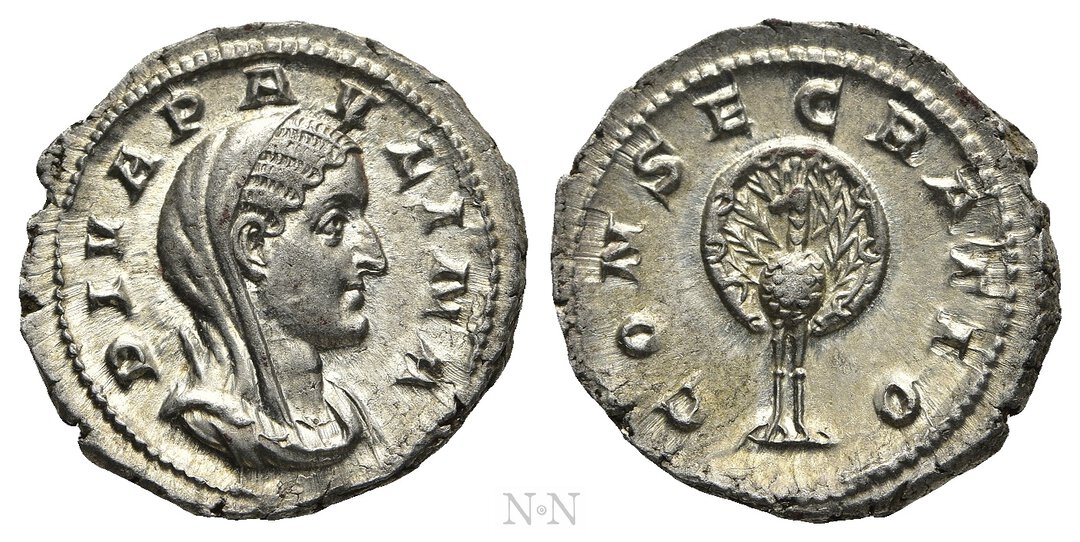

DIVA PAULINA (Died before 235). Denarius. Rome.
Obv: DIVA PAVLINA.
Veiled and draped bust right.
Rev: CONSECRATIO.
Peacock standing facing, head left, with tail spread.
RIC 1 (Maximinus).
Coins bearing Paulina's portrait were minted when her husband, the emperor Maximinus, crushed the Alamanni with a series of victories, restoring peace to the Rhine frontier and earning the title of ‘Germanicus Maximus’. At that time, Maximinus also decided to grant his son Maximus the title of ‘princeps iuventutis’, designating him as his successor. Maximinus continued to achieve military successes against the Sarmatians and Dacians on the Danube front, but he never went to Rome to receive his formal investiture during his three-year reign and was always distant from the Senate's positions. The 'patres' did not support him; first they hoped for the insurrection of Gordian I and II (which was harshly repressed in Africa), then they appointed Balbinus and Pupienus as princes, joined by Gordian III, and declared Maximinus 'hostis publicus' (public enemy). As was traditional, the soldiers killed the emperor, and the bodies of Maximinus and Maximus were desecrated and left unburied. This might not have happened if Maximinus had paid more attention to the suggestions of his wife, Paulina. She was pro-Senate and had urged him to adopt a more moderate approach and not to put pressure on the patres, whom the emperor was harassing in order to finance the war in Germany. To date, there are no known portraits of Paulina other than those on coins, in which she is always depicted wearing a veil, thus without a hairstyle that could be used for identification in other contexts. Her husband's image was struck by damnatio memoriae, and hers suffered the same fate.
Condition: Near uncirculated.
Weight: 3.77 g.
Diameter: 21 mm.
Estimate: € 1000
Osserva:
Base d'asta: € 800
Diritti d'asta: 18.90%
Chiusura alle: 2026-12-06 16:00:00 ora di Roma