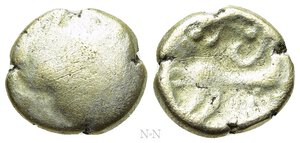
1 - WESTERN EUROPE. Northeast Gaul. Remi (Circa 100-50 BC). EL 1/4 Stater. Obv: Stylized head of Apollo right.Rev: Stylized horse prancing right; crescent above.D&T 181-2. Condition: Near very fine.Weight: 1.52 g. Diameter: 11 mm.
Info & contatti
Le mie offerte
Lotti osservati
Condizioni di vendita
Prezzi di spedizione
Metodi di pagamento
Esito stampabile
Sessione Live 2/3/2025 17:00:00 CET
Celtic Coins (1-34)
Greek Coins (35-347)
Roman Provincial Coins (348-463)
Roman Republican Coins (464-533)
Roman Imperial Coins (534-1140)
Migration Period (1141-1141)
Byzantine Coins (1142-1185)
Medieval Coins (1186-1240)
World Coins (1241-1309)
Group Lots (1310-1537)

Risultati: 61
Highlight
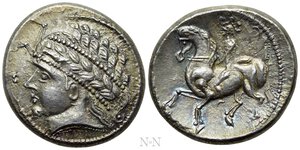
2 - CENTRAL EUROPE. Noricum. Tetradrachm (Circa 170-150 BC). "Kugelreiter" type. Obv: Wreathed and diademed male head left.Rev: Warrior, wearing headdress decorated with three pellets and horse advancing left.Göbl, Noricum, A1-1; Lanz 107-12; Flesche 511-2.Ex Bourgey (24/02/1983), lot 226 Condition: Extremely fine.Weight: 12.03 g. Diameter: 24 mm.
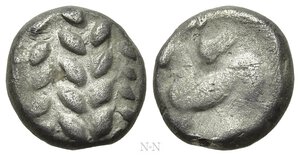
3 - CENTRAL EUROPE. Boii. Drachm (1st century BC). "Simmering" type. Obv: Laurel wreath pattern.Rev: Horse prancing left; bird above.Kostur & Gaspar 198.4; Lanz 855-7; OTA 542/2. Condition: Near very fine.Weight: 1.70 g. Diameter: 12 mm.
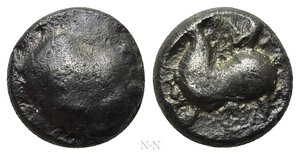
4 - CENTRAL EUROPE. Northern Hungary & Southern Slovakia. Hemiobol (2nd-1st centuries BC). "Karancs" type. Obv: Stylized head right.Rev: Stylized horse left.Kostur & Gaspar 206. Condition: Very fine.Weight: 0.40 g. Diameter: 7 mm.
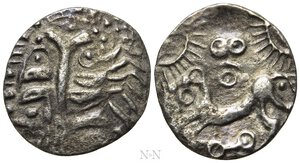
5 - CENTRAL EUROPE. Uncertain tribe. Drachm (Circa 1st century BC). Obv: Devolved head.Rev: Horse prancing left; annulets around; above, sun to left and right.LT -. Condition: Very fine.Weight: 2.32 g. Diameter: 18 mm.
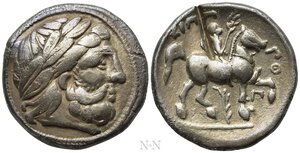
6 - EASTERN EUROPE. Imitations of Philip II of Macedon (2nd-1st centuries BC). Tetradrachm. Obv: Laureate head of Zeus right.Rev: ΦΙΛΙΠΠΘ. Youth, holding palm frond, on horseback right. aphlaston below, Π below raised foreleg.Cf. Le Rider pl. 46, 18 (for prototype). Condition: Near very fine.Weight: 13.43 g. Diameter: 25 mm.
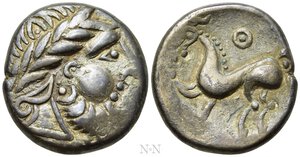
7 - EASTERN EUROPE. Imitations of Philip II of Macedon (2nd-1st centuries BC). Tetradrachm. "Kugelwange" type. Obv: Stylized laureate head of Zeus right.Rev: Stylized horse prancing left; pellet-in-annulet above.Lanz 475; OTA -; Flesche -. Condition: Very fine.Weight: 10.67 g. Diameter: 23 mm.
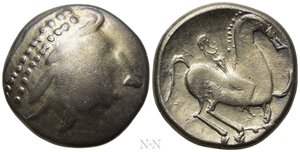
8 - EASTERN EUROPE. Imitations of Philip II of Macedon (2nd century BC). Tetradrachm. Mint in the central Carpathian region. "Kinnlos" type. Obv: Stylized laureate head of Zeus right.Rev: Stylized horse with rider right.Lanz 554-63; OTA 244/1-16; Flesche 720-1. Condition: Near very fine.Weight: 12.23 g. Diameter: 24 mm.
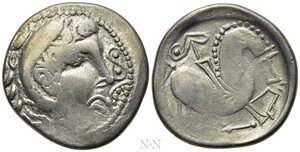
9 - EASTERN EUROPE. Uncertain tribe. Tetradrachm (Circa 2nd-1st century BC). Mint in Carpanthian region. 'Scyphat mit Herakleskopf' type. Obv: Head of Herakles right, wearing lion skin; volute to right.Rev: Stylized horseman right.Lanz 566 (same dies); OTA 252/1-2; Dembski 1166-8. Condition: Near very fine.Weight: 9.65 g. Diameter: 26 mm.
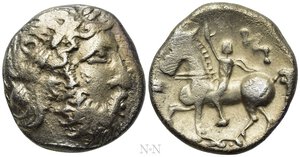
10 - EASTERN EUROPE. Imitations of Philip II of Macedon (2nd century BC). "Tetradrachm". Mint in the southern Carpathian region. "W-reiter" type. Obv: Stylized laureate head of Zeus right.Rev: Stylized horseman left; W-form ornament above.Lanz 672; Flesche 677. Condition: Very fine.Weight: 12.67 g. Diameter: 24 mm.
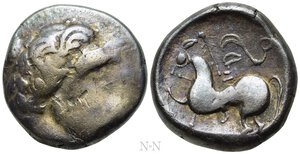
11 - EASTERN EUROPE. Imitations of Philip II of Macedon (2nd century BC). Tetradrachm. "B-Reiter" type. Obv: Stylized laureate head of Zeus right.Rev: Stylized horse with rider left.Lanz 656-9; OTA 308; cf. Flesche 695. Condition: Near very fine.Weight: 13.58 g. Diameter: 23 mm.
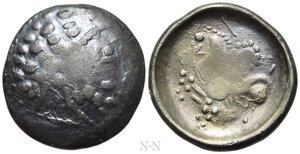
12 - EASTERN EUROPE. Imitations of Philip II of Macedon (2nd-1st centuries BC). Tetradrachm. Mint in Transylvania. "Dreieckhals" type. Obv: Stylized laureate head of Zeus right.Rev: Stylized horse with rider left.Lanz 664-5; OTA 321/1; Flesche 589. Condition: Near very fine.Weight: 8.53 g. Diameter: 24 mm.
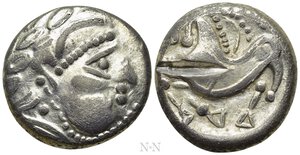
13 - EASTERN EUROPE. Imitations of Philip II of Macedon (2nd century BC). "Tetradrachm". Mint in the northern Carpathian region. "Schnabelpferd" type. Obv: Stylized laureate head of Zeus right.Rev: Stylized horse left.Lanz 666-8; OTA 326; Flesche 680. Condition: Near very fine.Weight: 7.76 g. Diameter: 20 mm.
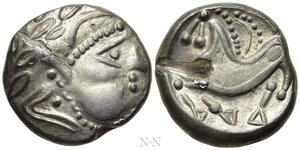
14 - EASTERN EUROPE. Imitations of Philip II of Macedon (2nd century BC). "Tetradrachm". Mint in the northern Carpathian region. "Schnabelpferd" type. Obv: Stylized laureate head of Zeus right.Rev: Stylized horse left.Lanz 666-8; OTA 326; Flesche 680. Condition: Near very fine.Weight: 8.37 g. Diameter: 20 mm.
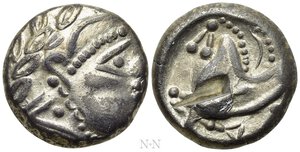
15 - EASTERN EUROPE. Imitations of Philip II of Macedon (2nd century BC). "Tetradrachm". Mint in the northern Carpathian region. "Schnabelpferd" type. Obv: Stylized laureate head of Zeus right.Rev: Stylized horse left.Lanz 666-8; OTA 326; Flesche 680. Condition: Near very fine.Weight: 8.34 g. Diameter: 19 mm.
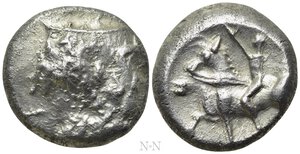
16 - EASTERN EUROPE. Imitations of Philip II of Macedon (2nd century BC). "Tetradrachm". Mint in the southern Carpathian region. "W-reiter" type. Obv: Stylized laureate head of Zeus right.Rev: Stylized horseman left; W-form ornament above.Lanz 671-2; OTA 332; Flesche 677. Condition: Near very fine.Weight: 14.21 g. Diameter: 21 mm.
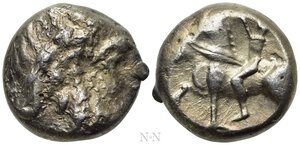
17 - EASTERN EUROPE. Imitations of Philip II of Macedon (2nd century BC). "Tetradrachm". Mint in the southern Carpathian region. "W-reiter" type. Obv: Stylized laureate head of Zeus right.Rev: Stylized horseman left; W-form ornament above.Lanz 671-2; OTA 332; Flesche 677. Condition: Good fine.Weight: 13.83 g. Diameter: 20 mm.
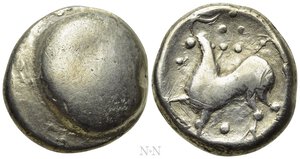
18 - EASTERN EUROPE. Imitations of Philip II of Macedon (2nd-1st centuries BC). Tetradrachm. "Buckelavers" type. Obv: Round bulge.Rev: Stylized horse prancing left.Lanz 680-3; OTA 353; Flesche 499. Condition: Very fine; edge filing.Weight: 10.73 g. Diameter: 20 mm.
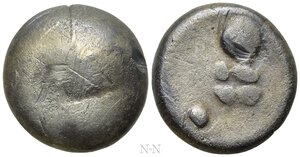
19 - EASTERN EUROPE. Imitations of Philip II of Macedon (2nd-1st centuries BC). Tetradrachm. Mit Buckelavers type. Obv: Round bulge.Rev: Stylized horse prancing left [degraded to grouping of pellets].OTA 353; KMW 1286. Condition: Near very fine.Weight: 10.87 g. Diameter: 19 mm.
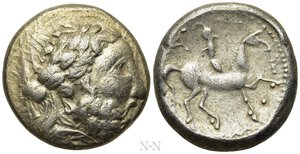
20 - EASTERN EUROPE. Imitations of Philip II of Macedon (2nd-1st centuries BC). Tetradrachm. 'Reiter mit zwei Dreiecksornament" type. Obv: Laureate head of Zeus right.Rev: Stylized horseman riding right; two monograms above.Lanz -; Flesche 552; OTA 413/2. Condition: Near very fine.Weight: 13.37 g. Diameter: 23 mm.
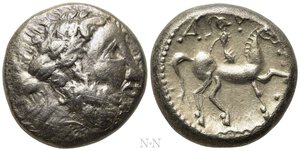
21 - EASTERN EUROPE. Imitations of Philip II of Macedon (2nd-1st centuries BC). Tetradrachm. 'Reiter mit zwei Dreiecksornament" type. Obv: Laureate head of Zeus right.Rev: Stylized horseman riding right; two monograms above.Lanz -; Flesche 552; OTA 413/2. Condition: Very fine.Weight: 13.43 g. Diameter: 22 mm.
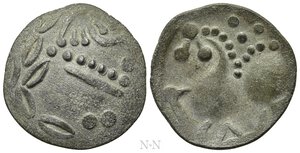
22 - EASTERN EUROPE. Imitations of Philip II of Macedon (2nd century BC). 'Drachm'. Obv: Stylized head of Zeus right.Rev: Stylized horse and rider left.Lanz -; Flesche -; Kostur & Gaspar -. Condition: Very fine.Weight: 1.57 g. Diameter: 16 mm.
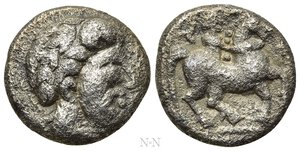
23 - EASTERN EUROPE. Imitations of Philip II of Macedon (2nd-1st centuries BC). Drachm. Obv: Stylized laureate head of Zeus right.Rev: Rider on horseback right.Lanz -. Condition: Good fine.Weight: 1.80 g. Diameter: 12 mm.
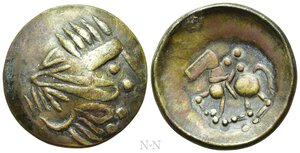
24 - EASTERN EUROPE. Imitations of Philip II of Macedon (2nd century BC). 'Tetradrachm.' "Sattelkopfpferd" type. Obv: Stylized head of Zeus right.Rev: Stylized horse and rider left.Lanz 612ff.; Flesche 724. Condition: Very fine.Weight: 7.41 g. Diameter: 23 mm.
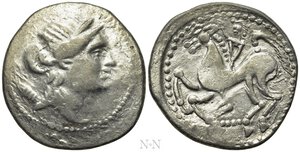
25 - EASTERN EUROPE. Imitations of Macedonian First Meris (1st century BC). Tetradrachm. Mint in Transylvania. "Artemiskopf" type. Obv: Diademed and draped bust of Artemis right, bow and quiver over shoulder.Rev: Stylized horseman riding left; labrys below.Lanz 579; OTA 281; Flesche -. Condition: Very fine.Weight: 8.51 g. Diameter: 28 mm.
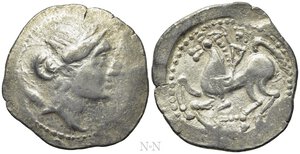
26 - EASTERN EUROPE. Imitations of Macedonian First Meris (1st century BC). Tetradrachm. Mint in Transylvania. "Artemiskopf" type. Obv: Diademed and draped bust of Artemis right, bow and quiver over shoulder.Rev: Stylized horseman riding left; labrys below.Lanz 579; OTA 281; Flesche -. Condition: Near very fine.Weight: 6.66 g. Diameter: 30 mm.
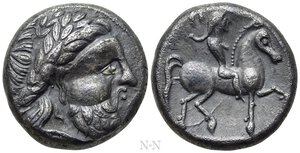
27 - EASTERN EUROPE. Imitations of Audoleon (2nd-1st centuries BC). Tetradrachm. "Π-Typ" type. Obv: Stylized laureate head of Zeus right.Rev: Stylized rider on horse prancing right; Π above.Lanz 716-8; OTA 408; Flesche 545. Condition: Very fine.Weight: 13.14 g. Diameter: 22 mm.
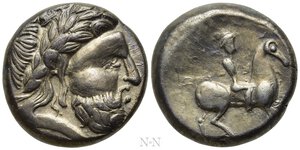
28 - EASTERN EUROPE. Imitations of Audoleon (2nd-1st centuries BC). Tetradrachm. "Π-Typ" type. Obv: Stylized laureate head of Zeus right.Rev: Stylized rider on horse prancing right; Π above.Lanz 716-8; OTA 408; Flesche 545. Condition: Very fine.Weight: 13.16 g. Diameter: 21 mm.
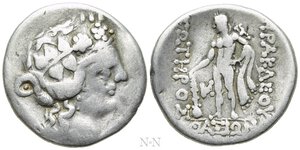
29 - EASTERN EUROPE. Imitations of Thasos. Tetradrachm (2nd-1st centuries BC). Obv: Head of Dionysos right, wearing ivy wreath.Rev: ΗΡΑΚΛΕΟYΣ / ΣΩΤΗΡΟΣ / ΘΑΣΙΩΝ. Herakles standing left, holding club and lion skin; monogram to inner left.OTA Class II; cf. HGC 6, 358-9 (for prototype). Condition: Good fine.Weight: 16.18 g. Diameter: 31 mm.
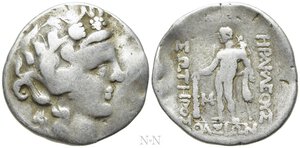
30 - EASTERN EUROPE. Imitations of Thasos. Tetradrachm (2nd-1st centuries BC). Obv: Head of Dionysos right, wearing ivy wreath.Rev: ΗΡΑΚΛΕΟYΣ / ΣΩΤΗΡΟΣ / ΘΑΣΙΩΝ. Herakles standing left, holding club and lion skin; monogram to inner left.OTA Class II; cf. HGC 6, 358-9 (for prototype). Condition: Fine.Weight: 16.18 g. Diameter: 32 mm.
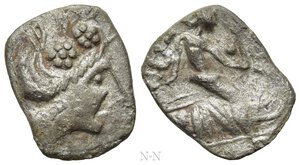
31 - EASTERN EUROPE. Imitating a Tetrobol of Histiaia (3rd-2nd centuries BC). Obv: Wreathed head of the nymph Histiaia right.Rev: Stylized nymph seated right on stern of galley.Cf. HGC 4, 1527 (for prototype). Condition: Very fine.Weight: 1.12 g. Diameter: 13 mm.
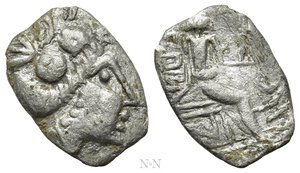
32 - EASTERN EUROPE. Imitating a Tetrobol of Histiaia (3rd-2nd centuries BC). Obv: Wreathed head of the nymph Histiaia right.Rev: Stylized nymph seated right on stern of galley.Cf. HGC 4, 1527 (for prototype). Condition: Very fine.Weight: 0.65 g. Diameter: 13 mm.
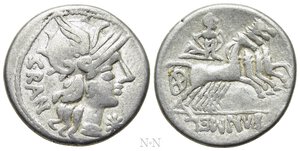
33 - EASTERN EUROPE. Imitations of Roman Republic. Geto-Dacians. Denarius (after 79 BC). Imitating L. Antestius Gragulus for obv. and M. Baebius Q.F. Tampilus for rev.. Obv: Blundered legend. Helmeted head of Roma right; X (mark of value) below chin.Rev: Blundered legend. Apollo, holding reins, branch, bow and arrow, driving quadriga right.Cf. Davis Class A; cf. Crawford 238/1 and 236/1 (for obv./rev. prototypes). Condition: Near very fine.Weight: 3.74 g. Diameter: 19 mm.
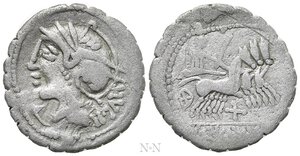
34 - EASTERN EUROPE. Imitations of Roman Republic. Denarius (Circa 1st century BC). Possibly imitating M. Baebius Q.F. Tampilus. Obv: Blundered legend. Helmeted head of Roma left.Rev: Blundered legend. Quadriga right; X below.Cf. Crawford 236/1 (for prototype). Condition: Good fine.Weight: 4.50 g. Diameter: 20 mm.
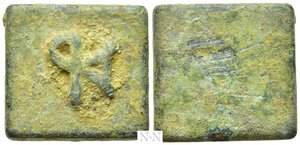
35 - HELLENISTIC AE SQUARE WEIGHT (Circa 4th-2nd century BC). 1/12 Mina. Obv: Large PKA or KAP monogram.Rev: Blank.CPAI -. Condition: Very fine.Weight: 33.87 g. Diameter: 29 mm.
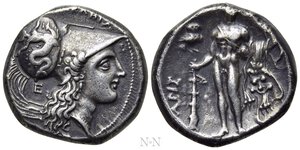
36 - LUCANIA. Herakleia. Nomos - Stater (Circa 281-278 BC). Obv: ├HPAKΛHIΩN. Head of Athena right, wearing crested Corinthian helmet, decorated with Skylla; E behind.Rev: Herakles standing left, holding club and bow, lion skin draped over arm; to upper left, owl standing right; APIΣ to left.Van Keuren 87; HN Italy 1385.Ex Bourgey (26/10/1981), lot 5 Condition: Good very fine.Weight: 7.85 g. Diameter: 20 mm.
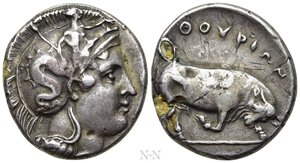
37 - LUCANIA. Thourioi. Fourrèe Stater - Nomos (Circa 400-350 BC). Obv: Helmeted head of Athena right, wearing Attic helmet decorated with Skylla holding staff (or oar) and pointing.Rev: ΘΟΥΡΙΩΝ. Bull butting right; fish right in exergue.Cf. HN Italy 1800 (for prototype).Ex Numismatik Lanz 3.4.1981 Condition: Very fine.Weight: 5.84 g. Diameter: 20 mm.
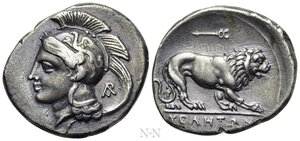
38 - LUCANIA. Velia. Didrachm - Nomos (Circa 280 BC). Obv: Helmeted head of Athena left, helmet decorated with griffin; Φ on neck guard, AP monogram behind neck guard.Rev: YEΛHTΩN. Lion standing right; kerykeion above.Williams 515ff.; HN Italy 1316; SNG ANS 1394; HGC 1, 1325.Ex Bourgey (10-11/03/1981), lot 10 Condition: Very fine.Weight: 7.31 g. Diameter: 22 mm.
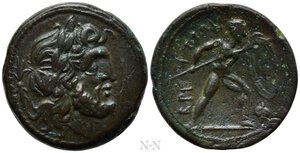
39 - BRUTTIUM. The Brettii. Ae Unit or Drachm (Circa 211-208 BC). Obv: Laureate head of Zeus right; thunderbolt to left.Rev: BPETTIΩN. Warrior advancing right, holding spear and shield; bunch of grapes to lower right.HN Italy 1988; Scheu, Bronze 38; HGC 1, 1367. Condition: Extremely fine.Weight: 7.35 g. Diameter: 22 mm.
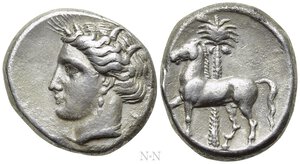
40 - SICILY. Entella. Punic Issues. Tetradrachm (Circa 345/38-320/15 BC). Obv: Wreathed head of Kore left, wearing earring and necklace; Punic letter behind.Rev: Horse walking left; palm tree in background.Jenkins 61 (O16/R55); CNP 208c; HGC 2, 268.The foundation of Entella is traced back to Acestes, son of the river god Krimisos and a Trojan woman or, according to other sources to Prince Elymus, son of Anchises and brother of Aeneas. The city stood on a summit overlooking the Belice valley. Records are scarce until the arrival of the Campanian mercenaries, recruited in 410 BC by the Carthaginians and discharged after the 405 BC treaty, then passed into the pay of Dionysius I of Syracuse. After liberating Dionysius on the island of Ortigia from the Punic siege, the were discharged with rich gifts and settled in various cities on the island. In 404 a group of these mercenaries seized Entella, exterminating the entire male population, and began to mint their own coinage. From then on they implemented a generally pro-Carthaginian policy and, in 398 B.C., were able to stop Syracusan siege attempts with the help of the Punic. The strategic location of the fortress of Entella was coveted for its control of the valley below, and this led to several siege attempts: in 345 it was attacked by the Carthaginians led by General Annon, then in 342 the city was taken by the Syracusans commanded by Timoleon, but in 338 it fell back under Punic influence. During the First Punic War the city was destroyed by the Carthaginians. The “Decrees of Entella,” which were requests for help engraved on bronze slabs, from the inhabitants to neighboring cities, date from this period. In 263 Entella was conquered by the Romans and enjoyed a new period of prosperity until the second century BC when it was abandoned. Condition: Very fine.Weight: 17.01 g. Diameter: 24 mm.
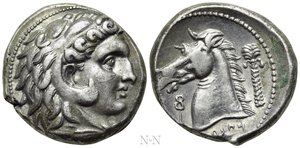
41 - SICILY. Entella. Punic issues (Circa 300-289 BC). Tetradrachm. Obv: Head of Herakles right, wearing lion skin.Rev: Head of horse left; palm tree to right, kerykeion to left; Punic legend below.Jenkins 357 (O113/R291); CNP 272c; HGC 2, 295.The foundation of Entella is traced back to Acestes, son of the river god Krimisos and a Trojan woman or, according to other sources to Prince Elymus, son of Anchises and brother of Aeneas. The city stood on a summit overlooking the Belice valley. Records are scarce until the arrival of the Campanian mercenaries, recruited in 410 BC by the Carthaginians and discharged after the 405 BC treaty, then passed into the pay of Dionysius I of Syracuse. After liberating Dionysius on the island of Ortigia from the Punic siege, the were discharged with rich gifts and settled in various cities on the island. In 404 a group of these mercenaries seized Entella, exterminating the entire male population, and began to mint their own coinage. From then on they implemented a generally pro-Carthaginian policy and, in 398 B.C., were able to stop Syracusan siege attempts with the help of the Punic. The strategic location of the fortress of Entella was coveted for its control of the valley below, and this led to several siege attempts: in 345 it was attacked by the Carthaginians led by General Annon, then in 342 the city was taken by the Syracusans commanded by Timoleon, but in 338 it fell back under Punic influence. During the First Punic War the city was destroyed by the Carthaginians. The “Decrees of Entella,” which were requests for help engraved on bronze slabs, from the inhabitants to neighboring cities, date from this period. In 263 Entella was conquered by the Romans and enjoyed a new period of prosperity until the second century BC when it was abandoned. Condition: Very fine.Weight: 16.84 g. Diameter: 24 mm.
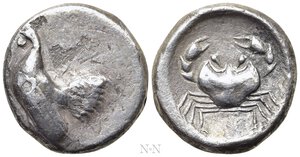
42 - SICILY. Himera. Didrachm (Circa 483/2-472/1 BC). Obv: HIMERA. Cock standing left.Rev: Crab within shallow incuse circle.SNG ANS 157; HGC 2, 438. Condition: Very fine.Weight: 8.08 g. Diameter: 20 mm.
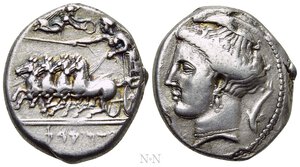
43 - SICILY. Lilybaion (as ‘Cape of Melkart’). Tetradrachm (Circa 330-305 BC). Obv: Charioteer driving quadriga left, holding kentron and reins; Nike flying right above, crowning charioteer.Rev: Female head left, wearing triple-pendant earring and necklace; three dolphins around.Jenkins 26 (O21/R20); HGC 2, 738.RareLilybaion was located at the site of today's Marsala on the western tip of Sicily. The name, literally 'facing Libya' is a direct reference to the geographical location. The city was founded in 397 BC by refugees who survived the destruction of Motya by Dionysius I, who created an important centre thanks to its strategic position and impregnable stronghold, which was later reinforced by the Carthaginians. The fortress was able to resist Pyrrhus in 276 BC and the almost ten-year siege by the Romans during the First Punic War. Following the Roman victory against the Carthaginians and the Treaty of Eryx, the city passed to the Romans and took the name Lilybaeum, continuing to play an important military and commercial role in the Republican period. Its naval base was used by Scipio to finally destroy Carthage. It was also an important base for Julius Caesar during his civil war against Pompey. The abundance, style and coin types minted by Lilybaion testify to the wealth and importance achieved by the city in the Punic period. Condition: Very fine.Weight: 16.78 g. Diameter: 27 mm.
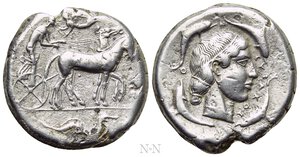
44 - SICILY. Syracuse. Second Democracy (466-406 BC). Tetradrachm. Obv: Charioteer driving quadriga right; above, crowning Nike flying right; ketos to right in exergue.Rev: ΣVRAKOΣION. Diademed head of Arethusa right; four dolphins around.Boehringer Series 486 (V258/R348); Weber 1583 (same dies); HGC 2, 1312.Attractive representation of Ketos, rarely visible almost entirely on the obverse exergue. This is the monster sent by Posidon to punish the pride of Cassiopeia, killed by Perseus and assumed in the Cetus (whale) constellation. When Cassiopeia, wife of the Ethiopian king Cepheus, said in public that she and her daughter Andromeda could claim a beauty superior to their own, they were outraged and asked Poseidon, their lord and protector, to teach their vanity a lesson. The god produced a tsunami that swept over the country and sent the monster Cetus against them. Cepheus asked the oracle of Ammon how to placate the divine wrath and was told that the beautiful Andromeda should be displayed chained on a cliff as a sacrifice to the monster. Perseus, who was flying over those areas, was made aware of the facts and agreed with Cassiopeia to deliver him from the monster in exchange for Andromeda, who was to become his bride. The hero thus beheaded the monster and freed the maiden. Condition: Very fine.Weight: 17.04 g. Diameter: 25 mm.
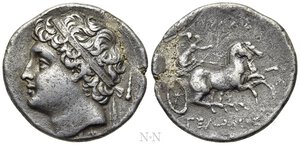
45 - SICILY. Syracuse. Gelon, son of Hieron II (275-215 BC). AR 8 Litrai. Obv: Diademed head of Gelon left; club to right.Rev: ΣYPAKOΣIOI / ΓEΛΩNOΣ. Nike driving biga right, holding kentron and reins.SNG ANS 896 var. (symbol); HGC 2, 1561. Condition: Good fine; restored crack.Weight: 6.85 g. Diameter: 22 mm.
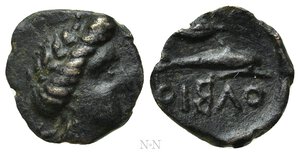
46 - SKYTHIA. Olbia. Ae (Circa 325-320 BC). Obv: Laureate head of Apollo right.Rev: OΛBIO (retrograde). Barley grain right above dolphin right.SNG BM Black Sea 417; SNG Stancomb 358; HGC 3.2, 1924. Condition: Very fine.Weight: 0.46 g. Diameter: 9 mm.
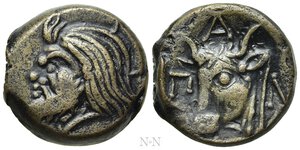
47 - CIMMERIAN BOSPOROS. Pantikapaion. Ae (Circa 325-310 BC). Obv: Wreathed head of bearded satyr left.Rev: Π - A - N. Head of bull left.MacDonald 67; SNG BM Black Sea 890-3; HGC 7 -. Condition: Very fine.Weight: 5.21 g. Diameter: 17 mm.
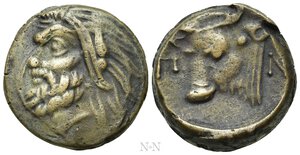
48 - CIMMERIAN BOSPOROS. Pantikapaion. Ae (Circa 325-310 BC). Obv: Wreathed head of bearded satyr left.Rev: Π - A - N. Head of bull left.MacDonald 67; SNG BM Black Sea 890-3; HGC 7 -. Condition: Very fine.Weight: 3.89 g. Diameter: 17 mm.
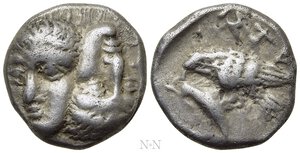
49 - MOESIA. Istros. Drachm (Late 5th-4th centuries BC). Obv: Facing male heads, the right inverted.Rev: ΙΣΤΡI. Sea eagle right, grasping dolphin with talons; all within incuse square.SNG BM Black Sea 225-6. Condition: Very fine.Weight: 6.67 g. Diameter: 18 mm.
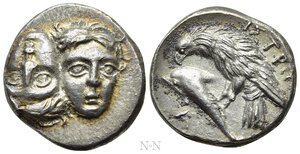
50 - MOESIA. Istros. Drachm (4th century BC). Obv: Facing male heads, the left inverted.Rev: ΙΣΤΡΙΗ. Sea eagle left, grasping dolphin with talons; A below dolphin.SNG BM Black Sea 240; HGC 3.2, 1804. Condition: Good very fine.Weight: 3.85 g. Diameter: 17 mm.
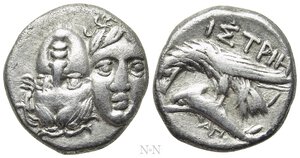
51 - MOESIA. Istros. Drachm (4th century BC). Obv: Facing male heads, the left inverted.Rev: ΙΣΤΡΙΗ. Sea eagle left, grasping dolphin with talons; I below tail feathers, AΠ below dolphin.SNG BM Black Sea -; AMNG I 418; HGC 3.2, 1801. Condition: Very fine.Weight: 4.51 g. Diameter: 18 mm.
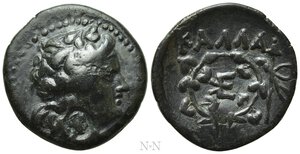
52 - MOESIA. Kallatis (3rd-2nd century BC). Ae. Obv: Wreathed head of Dionysos right; c/m: head of Artemis right, within round incuse.Rev: ΚΑΛΛΑ. Monogram within ivy wreath; thyrsos to right.SNG BM Black Sea -; SNG Stancomb 81 var. (no thyrsos), cf. 77-80 (for c/m); HGC 3.2, 1829. Condition: Very fine.Weight: 5.54 g. Diameter: 22 mm.
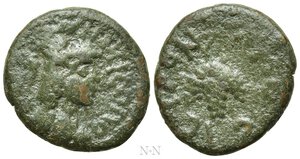
53 - MOESIA INFERIOR. Nicopolis ad Istrum Pseudo-autonomous (2nd-3rd centuries). Ae. Obv: NЄIKOΠΟΛЄΙ. Helmeted bust of Athena right, wearing aegis.Rev: ΠPOC ICTPON. Bunch of grapes.H&J 8.0.8.3; AMNG I/1 1217. Condition: Very fine.Weight: 1.72 g. Diameter: 13 mm.
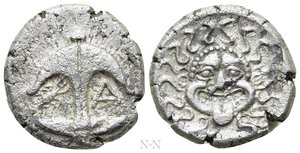
54 - THRACE. Apollonia Pontika. Drachm (Late 5th-4th centuries BC). Obv: Upright anchor; crayfish to left, A to right.Rev: Facing gorgoneion.SNG Bulgaria 120ff.; SNG BM Black Sea 153; HGC 3.2, 1323. Condition: Near very fine.Weight: 3.27 g. Diameter: 15 mm.
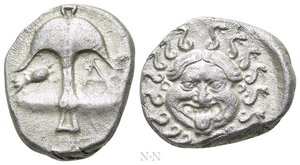
55 - THRACE. Apollonia Pontika. Drachm (Late 5th-4th centuries BC). Obv: Upright anchor; crayfish to left, A to right.Rev: Facing gorgoneion.SNG Bulgaria 120ff.; SNG BM Black Sea 153; HGC 3.2, 1323. Condition: Near very fine.Weight: 3.25 g. Diameter: 16 mm.
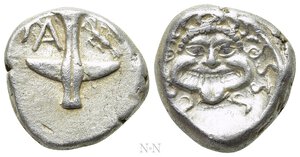
56 - THRACE. Apollonia Pontika. Drachm (Late 5th-4th centuries BC). Obv: Upright anchor; A to left, crayfish to right.Rev: Facing gorgoneion.SNG Bulgaria 229ff.; SNG BM Black Sea 157; HGC 3.2, 1323. Condition: Near very fine.Weight: 3.25 g. Diameter: 14 mm.
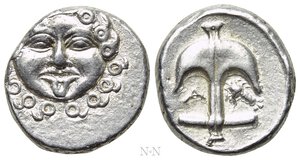
57 - THRACE. Apollonia Pontika. Tetrobol (425-375 BC). Obv: Facing gorgoneion.Rev: Anchor; A to left, crayfish to right.SNG Bulgaria 300ff.; SNG BM Black Sea 160-1. Condition: Good very fine.Weight: 2.88 g. Diameter: 14 mm.
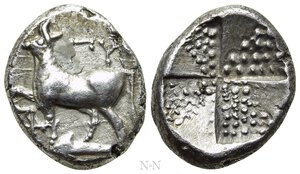
58 - THRACE. Byzantion. Drachm (Circa 387/6-340 BC). Obv: 'ΠΥ. Bull standing on dolphin left; to left, trident below raised foreleg.Rev: Quadripartite incuse square with stippled surface.Schönert-Geiss 712–32; SNG BM Black Sea 8; HGC 3.2, 1387. Condition: Good very fine.Weight: 3.59 g. Diameter: 15 mm.
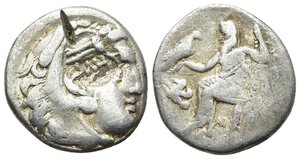
59 - THRACE. Byzantion. Countermarked on a Drachm of Alexander III 'the Great' (336-323 BC). Obv: Head of Herakles right, wearing lion skin; c/m: prow of galley right, ΠY above, within circular incuse.Rev: AΛEΞANΔPOY. Zeus seated left on throne, holding eagle and sceptre. Controls: in left field, forepart of Pegasos left; AI below throne.Price 1385 (for undertype). Condition: C/m Very fine.Weight: 3.74 g. Diameter: 17 mm.
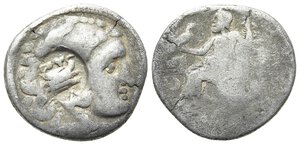
60 - THRACE. Byzantion. Countermarked on a Drachm of Lysimachos (305-281 BC) in the name and types of Alexander III 'the Great'. Obv: Head of Herakles right, wearing lion skin; c/m: prow of galley right, ΠY above, within circular incuse.Rev: AΛEΞANΔPOY. Zeus seated left on throne, holding eagle and sceptre. Controls: In left field, head of lion left above crescent; [pentagram below throne].Cf. Price 1832 (for undertype). Condition: C/m Very fine.Weight: 4.06 g. Diameter: 18 mm.
Caricamento altri risultati...