Banner Naumann 158
Risultati: 1652
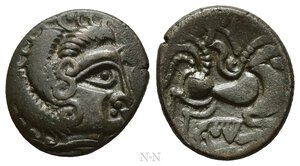
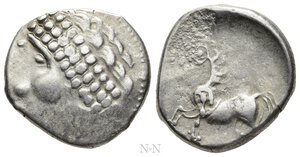
WESTERN EUROPE. Northwest Gaul. Coriosolites. Stater (Circa 100-50 BC) - WESTERN EUROPE. Northwest Gaul. Coriosolites. Stater (Circa 100-50 BC). Obv: Stylized head right.Rev: Stylized horseman on androcephalic horse; boar below.D&T 2340; Depeyrot, NC VIII, 186. Condition: Very fine.Weight: 6.41 g. Diameter: 21 mm.
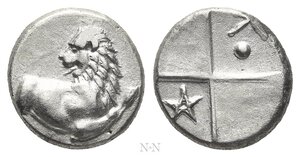
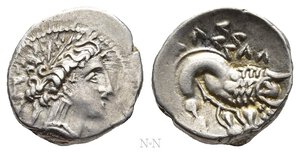
WESTERN EUROPE. Southern Gaul. Insubres. Drachm (2nd-1st century BC). Imitating Massalia - WESTERN EUROPE. Southern Gaul. Insubres. Drachm (2nd-1st century BC). Imitating Massalia. Obv: Female head right; wearing earring.Rev: Stylized lion right.CCBM II 7-9 and S11-20. Condition: Good very fine.Weight: 3.12 g. Diameter: 16 mm.
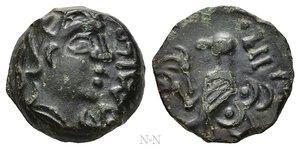
WESTERN EUROPE. Northeast Gaul. Senones. Ae (Circa 80-52 BC) - WESTERN EUROPE. Northeast Gaul. Senones. Ae (Circa 80-52 BC). Obv: GIAMILOS. Stylized head right.Rev: SIINV. Sylized eagle standing left.Depeyrot, NC V, 123; D&T 2631; LT 7565. Condition: Extremely fine.Weight: 3.45 g. Diameter: 15 mm.
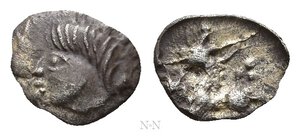
CENTRAL EUROPE. Boii. Obol (1st century BC). 'Roseldorf III' type - CENTRAL EUROPE. Boii. Obol (1st century BC). 'Roseldorf III' type. Obv: Stylized head left.Rev: Stylized horse rearing left; three pellets above.Cf. Kostur & Gaspar 163. Condition: Extremely fine.Weight: 0.40 g. Diameter: 10 mm.
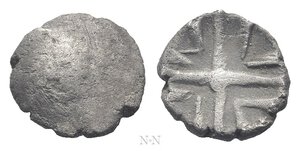
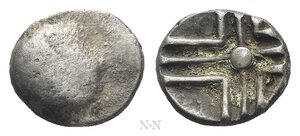
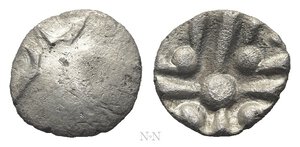
CENTRAL EUROPE. Noricum. Obol (1st century BC). 'Magdalensberg' type - CENTRAL EUROPE. Noricum. Obol (1st century BC). 'Magdalensberg' type. Obv: Central hump.Rev: 'Winckelkreuz' cross.Lanz 241ff.; Flesche 523. Condition: Good very fine.Weight: 0.41 g. Diameter: 9 mm.
CENTRAL EUROPE. Noricum. Obol (1st century BC). 'Magdalensberg' type - CENTRAL EUROPE. Noricum. Obol (1st century BC). 'Magdalensberg' type. Obv: Central hump.Rev: 'Winckelkreuz' cross.Lanz 241ff.; Flesche 523. Condition: Extremely fine.Weight: 0.71 g. Diameter: 10 mm.
CENTRAL EUROPE. Noricum. Obol (1st century BC). 'Magdalensberg' type - CENTRAL EUROPE. Noricum. Obol (1st century BC). 'Magdalensberg' type. Obv: Central hump.Rev: 'Winckelkreuz' cross.Lanz 243ff. Condition: Good very fine.Weight: 0.41 g. Diameter: 9 mm.
CENTRAL EUROPE. Eastern Noricum. Tetradrachm (Circa 2nd-1st century BC). 'Augentyp-Stamm' type - CENTRAL EUROPE. Eastern Noricum. Tetradrachm (Circa 2nd-1st century BC). 'Augentyp-Stamm' type. Obv: Diademed male head left.Rev: Horse prancing left.Lanz 202. Condition: Very fine.Weight: 10.43 g. Diameter: 23 mm.
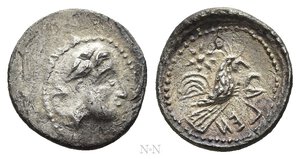
CENTRAL EUROPE. Boii. Obol (3rd-2nd centuries BC). Imitating Cales - CENTRAL EUROPE. Boii. Obol (3rd-2nd centuries BC). Imitating Cales. Obv: Head right with long hair.Rev: CALEN. Cock standing right; star to upper left.Kostur & Gaspar 81.Very rare Condition: Uncirculated.Weight: 1.04 g. Diameter: 13 mm.
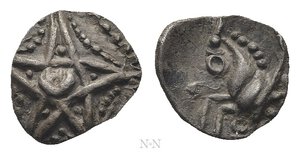
CENTRAL EUROPE. Boii. Obol (1st century BC). 'Star/Pegasos' type - CENTRAL EUROPE. Boii. Obol (1st century BC). 'Star/Pegasos' type. Obv: Pentagram with central pellet.Rev: Stylized forepart of Pegasos left.Dembski 779; Kostur & Gaspar 164. Condition: Extremely fine.Weight: 0.35 g. Diameter: 9 mm.
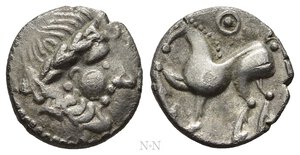
EASTERN EUROPE. Imitations of Philip II of Macedon (2nd century BC). Tetradrachm. Mint in the central Carpathian region. 'Ringelkopfreiter' type - EASTERN EUROPE. Imitations of Philip II of Macedon (2nd century BC). Tetradrachm. Mint in the central Carpathian region. 'Ringelkopfreiter' type. Obv: Stylized laureate head of Zeus right.Rev: Stylized horse with rider right.Cf. Lanz 565; cf. Flesche 698. Condition: Extremely fine.Weight: 13.05 g. Diameter: 31 mm.
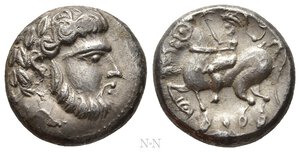
EASTERN EUROPE. Imitations of Philip II of Macedon (2nd-1st centuries BC). Tetradrachm. 'Baumreiter' type - EASTERN EUROPE. Imitations of Philip II of Macedon (2nd-1st centuries BC). Tetradrachm. 'Baumreiter' type. Obv: Stylized head of Zeus right.Rev: Youth riding horse left, wearing crested helmet and holding branch or sceptre.Lanz 416-20; Flesche 691; OTA 129.1. Condition: Near extremely fine.Weight: 14.28 g. Diameter: 23 mm.
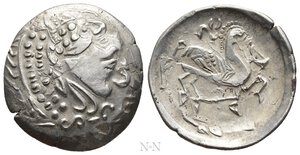
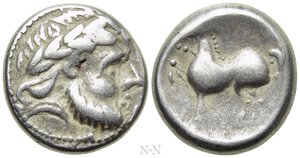
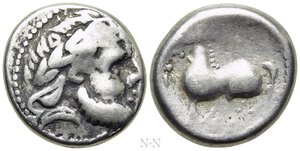
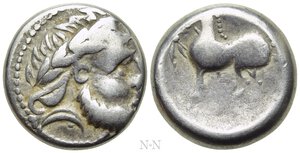
EASTERN EUROPE. Imitations of Philip II of Macedon (2nd-1st centuries BC). Tetradrachm. 'Kugelwange ohne Ringel' type - EASTERN EUROPE. Imitations of Philip II of Macedon (2nd-1st centuries BC). Tetradrachm. 'Kugelwange ohne Ringel' type. Obv: Stylized laureate head of Zeus right.Rev: Stylized horse prancing left.Lanz -; Karl 479. Condition: Near very fine.Weight: 12.06 g. Diameter: 22 mm.
EASTERN EUROPE. Imitations of Philip II of Macedon (2nd-1st centuries BC). Tetradrachm. 'Kugelwange ohne Ringel' type - EASTERN EUROPE. Imitations of Philip II of Macedon (2nd-1st centuries BC). Tetradrachm. 'Kugelwange ohne Ringel' type. Obv: Stylized laureate head of Zeus right.Rev: Stylized horse prancing left.Lanz -; Karl 479. Condition: Near very fine.Weight: 11.85 g. Diameter: 23 mm.
EASTERN EUROPE. Imitations of Philip II of Macedon (2nd-1st centuries BC). Tetradrachm. 'Kugelwange ohne Ringel' type - EASTERN EUROPE. Imitations of Philip II of Macedon (2nd-1st centuries BC). Tetradrachm. 'Kugelwange ohne Ringel' type. Obv: Stylized laureate head of Zeus right.Rev: Stylized horse prancing left.Lanz -; Karl 479. Condition: Near very fine.Weight: 11.80 g. Diameter: 21 mm.
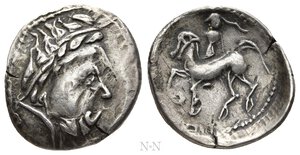
EASTERN EUROPE. Imitations of Philip II of Macedon (2nd-1st centuries BC). Drachm - EASTERN EUROPE. Imitations of Philip II of Macedon (2nd-1st centuries BC). Drachm. Obv: Stylized laureate head of Zeus right.Rev: Stylized horseman prancing left.Lanz -. Condition: Very fine.Weight: 4.39 g. Diameter: 21 mm.
EASTERN EUROPE. Imitations of Philip II of Macedon (2nd-1st centuries BC). Drachm. 'Kugelwange' type - EASTERN EUROPE. Imitations of Philip II of Macedon (2nd-1st centuries BC). Drachm. 'Kugelwange' type. Obv: Stylized laureate head of Zeus right.Rev: Stylized horse prancing left; above, pellet-in-annulet.Lanz 509ff.; OTA 204; Flesche 616. Condition: Good very fine.Weight: 2.28 g. Diameter: 15 mm.
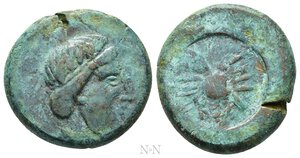
UNCERTAIN MINT. Ae (Circa 4th-2nd century BC). Possibly imitative - UNCERTAIN MINT. Ae (Circa 4th-2nd century BC). Possibly imitative. Obv: Head of Zeus(?) right.Rev: Crab within incuse square.Unpublished in the standard references. Condition: Fine.Weight: 16.98 g. Diameter: 26 mm.
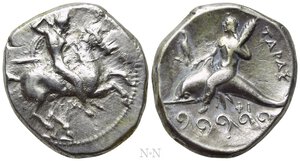
CALABRIA. Tarentum. Nomos (Circa 332-302 BC) - CALABRIA. Tarentum. Nomos (Circa 332-302 BC). Obv: Warrior, holding shield and two spears, and preparing to cast third spear, on horse rearing right; ΣIM below.Rev: TAPAΣ. Phalanthos, holding distaff, riding dolphin left; to left, eagle standing left; below, ΦI above waves.Vlasto 573-7; HN Italy 933; HGC 1, 800. Condition: Good very fine.Weight: 7.87 g. Diameter: 20 mm.
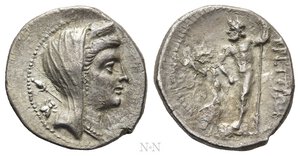
BRUTTIUM. The Brettii. Drachm (Circa 216-214 BC) - BRUTTIUM. The Brettii. Drachm (Circa 216-214 BC). Obv: Veiled head of Hera Lakinia right, wearing polos; sceptre and fly over shoulder.Rev: BPETTIΩN. Zeus standing left, right foot on ionic capital, holding sceptre; to left, eagle standing left on thunderbolt.HN Italy 1970; SNG Fitzwilliam 703; HGC 1, 1357. Condition: Near very fine.Weight: 4.06 g. Diameter: 20 mm.
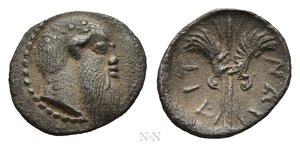
SICILY. Aitna. Litra (Circa 465-460 BC) - SICILY. Aitna. Litra (Circa 465-460 BC). Obv: Wreathed head of Silenos right.Rev: AIT-NAI. Winged thunderbolt.SNG ANS 1239; Jameson 537; HGC 2, 65.Ex Roma Numismatics II (2011), lot 76 Condition: Extremely fine.Weight: 0.59 g. Diameter: 11 mm.
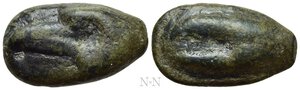
SICILY. Akragas. Cast Ae Onkia (Circa 440-430 BC) - SICILY. Akragas. Cast Ae Onkia (Circa 440-430 BC). Obv: Head of eagle left.Rev: Claw of crab left.CNS 8; SNG ANS 1019-20; HGC 2, 130. Condition: Very fine.Weight: 4.85 g. Diameter: 20 mm.
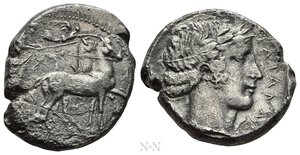
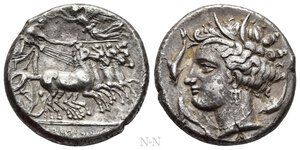
SICILY. Katane. Tetradrachm (Circa 445-435 BC) - SICILY. Katane. Tetradrachm (Circa 445-435 BC). Obv: Charioteer, holding kentron and reins, driving slow quadriga of horses right; above, Nike flying right, crowning horses.Rev: KATANAION. Laureate head of Apollo right.Mirone 44; SNG ANS 1247-51; HGC 2 567.Ex Fritz Rudolf Künker E-61 (2020), lot 27 Condition: Very fine.Weight: 16.11 g. Diameter: 28 mm.
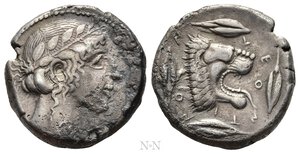
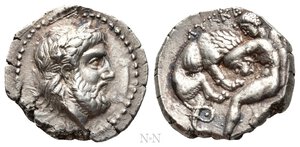
SICILY. Leontinoi. Tetradrachm (Circa 450-440 BC) - SICILY. Leontinoi. Tetradrachm (Circa 450-440 BC). Obv: Head of Apollo right, wearing laurel wreath.Rev: LEONTINON. Head of roaring lion right; four barley grains around.Boehringer, Münzgeschichte 35 (same obv. die); SNG ANS 220 (same obv. die); Rizzo pl. XXIII, 2 (same obv. die); HGC 2, 667.Ex Hollschek XIII/979 (1961) Condition: Very fine.Weight: 16.81 g. Diameter: 25 mm.
SICILY. Lilybaion (as ‘Cape of Melkart’). Tetradrachm (Circa 330-305 BC) - SICILY. Lilybaion (as ‘Cape of Melkart’). Tetradrachm (Circa 330-305 BC). Obv: Charioteer driving fast quadriga right; above, Nike flying left, crowning charioteer.Rev: Wreathed head of Kore-Persephone left; three dolphins around.Jenkins, Punic 39 (O14/R30); CNP 303; HGC 2, 742; SNG Lloyd 1605 (same dies); Boston MFA 70 (same dies).Ex Gerhard Hirsch Nachfolger 272 (2011), lot 128. Lilybaion was located at the site of today's Marsala on the western tip of Sicily. The name, literally 'facing Libya' is a direct reference to the geographical location. The city was founded in 397 BC by refugees who survived the destruction of Motya by Dionysius I, who created an important centre thanks to its strategic position and impregnable stronghold, which was later reinforced by the Carthaginians. The fortress was able to resist Pyrrhus in 276 BC and the almost ten-year siege by the Romans during the First Punic War. Following the Roman victory against the Carthaginians and the Treaty of Eryx, the city passed to the Romans and took the name Lilybaeum, continuing to play an important military and commercial role in the Republican period. Its naval base was used by Scipio to finally destroy Carthage. It was also an important base for Julius Caesar during his civil war against Pompey. The abundance, style and coin types minted by Lilybaion testify to the wealth and importance achieved by the city in the Punic period. Condition: Very fine.Weight: 16.27 g. Diameter: 25 mm.
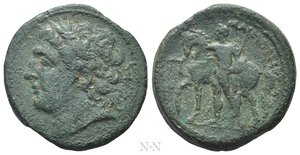
SICILY. Messana. The Mamertinoi. Ae Pentonkion (211-208 BC) - SICILY. Messana. The Mamertinoi. Ae Pentonkion (211-208 BC). Obv: Laureate head of Ares left; to right, sword in scabbard.Rev: MAMEPTINΩN. Warrior standing left, holding spear and leading horse left; Π (mark of value) to left.CNS 25; SNG ANS 423-6; HGC 2, 849. Condition: Near very fine.Weight: 12.00 g. Diameter: 27 mm.
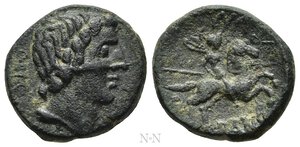
SICILY. Morgantina. The Hispani (Mid 2nd century BC). Ae - SICILY. Morgantina. The Hispani (Mid 2nd century BC). Ae. Obv: C SIC LIVN. Bare male head right.Rev: HISPANORVM. Warrior riding horse right, holding spear.CNS 1; SNG ANS 484-93; HGC 2, 915. Condition: Good very fine.Weight: 7.05 g. Diameter: 21 mm.
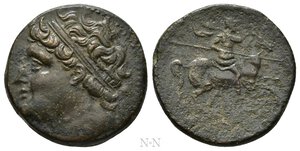
SICILY. Syracuse. Hieron II (275-215 BC). Ae - SICILY. Syracuse. Hieron II (275-215 BC). Ae. Obv: Diademed head left.Rev: IEPΩNOΣ. Horseman galloping right, holding lance.CNS 195; HGC 2, 1548. Condition: Very fine.Weight: 18.33 g. Diameter: 27 mm.
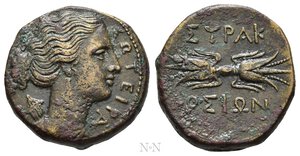
SICILY. Syracuse. Agathokles (317-289 BC). Ae - SICILY. Syracuse. Agathokles (317-289 BC). Ae. Obv: ΣΩΤΕΙΡΑ. Draped bust of Artemis Soteira right, with quiver over shoulder.Rev: ΣYPAK / OΣIΩN. Winged thunderbolt.CNS 138; SNG ANS 749; HGC 2, 1461. Condition: Near very fine.Weight: 9.10 g. Diameter: 22 mm.
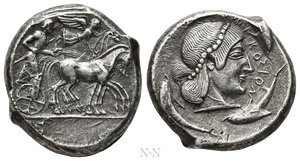
SICILY. Syracuse. Deinomenid Tyranny (485-466 BC). Tetradrachm - SICILY. Syracuse. Deinomenid Tyranny (485-466 BC). Tetradrachm. Obv: Charioteer driving quadriga right; above, crowning Nike flying right.Rev: ΣVRAKOΣION. Diademed head of Arethusa right; four dolphins around.Boehringer 172 (V75/R120); Randazzo 339-41 (same dies); HGC 2, 1306. Condition: Good very fine.Weight: 17.01 g. Diameter: 25 mm.
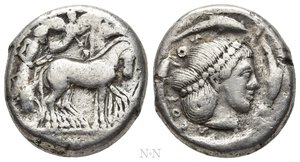
SICILY. Syracuse. Deinomenid Tyranny (485-466 BC). Tetradrachm - SICILY. Syracuse. Deinomenid Tyranny (485-466 BC). Tetradrachm. Obv: Charioteer driving quadriga right; above, crowning Nike flying right.Rev: ΣVRAKOΣION. Diademed head of Arethusa right; four dolphins around.Boehringer 343 (V168/R242); HGC 2, 1307. Condition: Good fine.Weight: 16.78 g. Diameter: 24 mm.
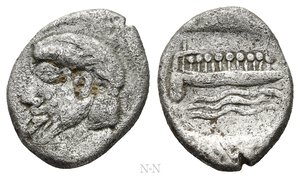
SAMARIA(?). Uncertain Levantine series. Drachm (Circa 4th century BC) - SAMARIA(?). Uncertain Levantine series. Drachm (Circa 4th century BC). Obv: Male head left.Rev: Galley right above waves.HGC 10, -. Condition: Very fine.Weight: 3.11 g. Diameter: 17 mm.
BLACK SEA REGION. Uncertain. Proto Money. Ae Ingot - BLACK SEA REGION. Uncertain. Proto Money. Ae Ingot. Obv: Pelta shaped.Rev: .Cf. Topalov p. 108-109, table XIX. Condition: See picture.Weight: 3.80 g. Diameter: 47 mm.
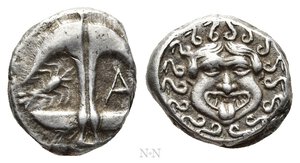
THRACE. Apollonia Pontika. Drachm (Late 5th-4th centuries BC) - THRACE. Apollonia Pontika. Drachm (Late 5th-4th centuries BC). Obv: Upright anchor; crayfish to left, A to right.Rev: Facing gorgoneion.SNG Bulgaria 120ff.; SNG BM Black Sea 153; HGC 3.2, 1323. Condition: Good very fine.Weight: 3.23 g. Diameter: 15 mm.
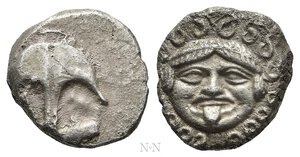
THRACE. Apollonia Pontika. Drachm (Late 5th-4th centuries BC) - THRACE. Apollonia Pontika. Drachm (Late 5th-4th centuries BC). Obv: Upright anchor; A to left, crayfish to right.Rev: Facing gorgoneion.Cf. SNG Bulgaria 252; HGC 3.2, 1323. Condition: Very fine.Weight: 3.18 g. Diameter: 15 mm.
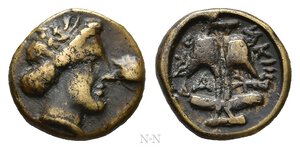
THRACE. Apollonia Pontika. Ae Dichalkon (Mid 4th-3rd centuries BC) - THRACE. Apollonia Pontika. Ae Dichalkon (Mid 4th-3rd centuries BC). Obv: Laureate head of Apollo right.Rev: ΔIXA / ΛKHI. Upright anchor; A to left, crayfish to right.SNG Bulgaria 390-401; SNG BM Black Sea 179-181; HGC 3.2, 1333. Condition: Very fine.Weight: 1.86 g. Diameter: 12 mm.
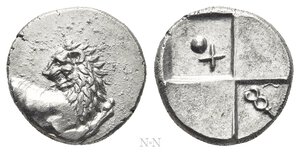
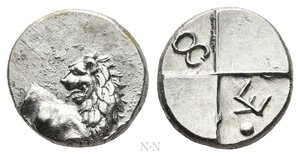
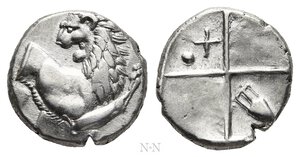
THRACE. Chersonesos. Hemidrachm (Circa 386-338 BC) - THRACE. Chersonesos. Hemidrachm (Circa 386-338 BC). Obv: Forepart of lion right, head left.Rev: Quadripartite incuse square with alternating raised and sunken quarters; pellet and X in one quarter, kerykeion in opposite quarter.McClean 4120; CN online 6352; HGC 3.2, 1437. Condition: Mint State.Weight: 2.40 g. Diameter: 14 mm.
THRACE. Chersonesos. Hemidrachm (Circa 386-338 BC) - THRACE. Chersonesos. Hemidrachm (Circa 386-338 BC). Obv: Forepart of lion right, head left.Rev: Quadripartite incuse square with alternating raised and sunken quarters; pellet and monogram in one quarter, pentagram and pellet in opposite quarter.Cf. McClean 4071; HGC 3.2, 1437. Condition: Extremely fine.Weight: 2.37 g. Diameter: 13 mm.
THRACE. Chersonesos. Hemidrachm (Circa 386-338 BC) - THRACE. Chersonesos. Hemidrachm (Circa 386-338 BC). Obv: Forepart of lion right, head left.Rev: Quadripartite incuse square with alternating raised and sunken quarters; monogram with pellet and kerykeion in sunken quarters.Weber 2421; CN online 53783; HGC 3.2, 1437. Condition: Mint State.Weight: 2.43 g. Diameter: 14 mm.
THRACE. Chersonesos. Hemidrachm (Circa 386-338 BC) - THRACE. Chersonesos. Hemidrachm (Circa 386-338 BC). Obv: Forepart of lion right, head left.Rev: Quadripartite incuse square with alternating raised and sunken quarters; pellet and X in one quarter, amphora in opposite quarter.CN Online 10199. Condition: Very fine.Weight: 2.44 g. Diameter: 13 mm.
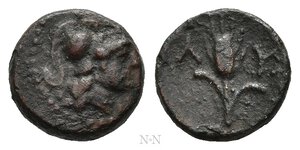
THRACE. Lysimacheia. Ae (Circa 225-199/8 BC) - THRACE. Lysimacheia. Ae (Circa 225-199/8 BC). Obv: Helmeted head of Athena right.Rev: Λ - Y. Grain ear.SNG Copehagen -, cf. 920 (Lion on obv.); HGC 3.2 -, cf. 1503 (same). Condition: Very fine.Weight: 1.06 g. Diameter: 11 mm.
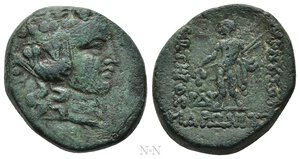
THRACE. Maroneia. Ae (1st century BC) - THRACE. Maroneia. Ae (1st century BC). Obv: Head of Dionysos right, wearing ivy wreath.Rev: ΔIONYΣOY ΣΩTHPOΣ / MAPΩNITΩN. Dionysos standing left, holding bunch of grapes and narthex stalks. Control: Monogram to inner left.Schönert-Geiss 1434-1508; HGC 3.2, 1557. Condition: Good fine.Weight: 10.87 g. Diameter: 26 mm.
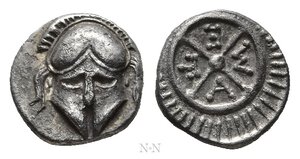
THRACE. Mesambria. Diobol (Circa 420-320 BC) - THRACE. Mesambria. Diobol (Circa 420-320 BC). Obv: Facing helmet.Rev: M - E - T - A. Four-spoked wheel.SNG BM Black Sea 268-9 & 271; HGC 3.2, 1560. Condition: Good very fine.Weight: 1.24 g. Diameter: 11 mm.
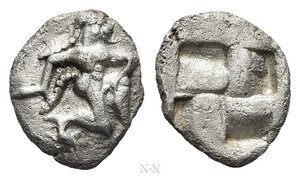
THRACE. Thasos. Diobol (Circa 500-480 BC) - THRACE. Thasos. Diobol (Circa 500-480 BC). Obv: Satyr running right.Rev: Quadripartite incuse square.Le Rider, Thasiennes 4; SNG Copenhagen 191-4 (Lete in Macedon); HGC 6, 333. Condition: Very fine.Weight: 0.80 g. Diameter: 11 mm.
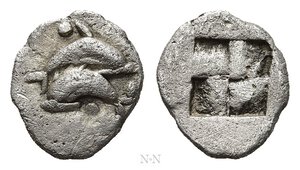
THRACE. Thasos. 1/16 Stater or Obol (Circa 500-480 BC) - THRACE. Thasos. 1/16 Stater or Obol (Circa 500-480 BC). Obv: Two dolphins swimming in opposite directions; pellets around.Rev: Quadripartite incuse square.Le Rider, Thasiennes, 9; HGC 6, 337 (Hemiobol). Condition: Very fine.Weight: 0.48 g. Diameter: 9 mm.
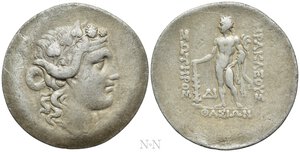
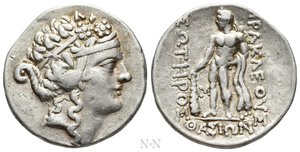
THRACE. Thasos. Tetradrachm (Circa 148-90/80 BC) - THRACE. Thasos. Tetradrachm (Circa 148-90/80 BC). Obv: Head of Dionysos right, wearing ivy wreath.Rev: HPAKΛEOYΣ / ΣΩTHPOΣ / ΘAΣIΩN. Herakles standing left, holding club and lion skin. Control: ΔI monogram to inner left.Le Rider 51; HGC 6, 358. Condition: Good fine.Weight: 16.47 g. Diameter: 35 mm.
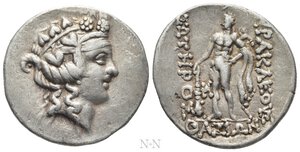
THRACE. Thasos. Tetradrachm (Circa 148-90/80 BC) - THRACE. Thasos. Tetradrachm (Circa 148-90/80 BC). Obv: Head of Dionysos right, wearing ivy wreath.Rev: HPAKΛEOYΣ / ΣΩTHPOΣ / ΘAΣIΩN. Herakles standing left, holding club and lion skin. Control: M to inner left.SNG Copenhagen 1039; HGC 6, 359. Condition: Very fine.Weight: 16.88 g. Diameter: 31 mm.
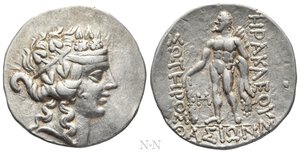
THRACE. Thasos. Tetradrachm (Circa 148-90/80 BC) - THRACE. Thasos. Tetradrachm (Circa 148-90/80 BC). Obv: Head of Dionysos right, wearing ivy wreath.Rev: HPAKΛEOYΣ / ΣΩTHPOΣ / ΘAΣIΩN. Herakles standing left, holding club and lion skin. Control: Monogram to inner left.SNG Copenhagen 1040-5; HGC 6, 359. Condition: Very fine.Weight: 16.69 g. Diameter: 32 mm.
THRACE. Thasos. Tetradrachm (Circa 148-90/80 BC) - THRACE. Thasos. Tetradrachm (Circa 148-90/80 BC). Obv: Head of Dionysos right, wearing ivy wreath.Rev: HPAKΛEOYΣ / ΣΩTHPOΣ / ΘAΣIΩN. Herakles standing left, holding club and lion skin. Control: Monogram to inner left.SNG Copenhagen 1040-5; HGC 6, 359. Condition: Very fine.Weight: 16.63 g. Diameter: 33 mm.
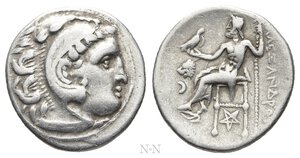
KINGS OF THRACE (Macedonian). Lysimachos (305-281 BC). Drachm. Kolophon. In the name of Alexander III of Macedon - KINGS OF THRACE (Macedonian). Lysimachos (305-281 BC). Drachm. Kolophon. In the name of Alexander III of Macedon. Obv: Head of Herakles right, wearing lion skin.Rev: AΛΕΞΑΝΔΡΟΥ. Zeus seated left on throne, holding eagle and sceptre. Controls: In left field, head of lion left above crescent; pentagram below throne.Thompson -; Price 1832; HGC 3, 1751d. Condition: Good fine.Weight: 4.27 g. Diameter: 18 mm.
KINGS OF PAEONIA. Lykkeios (Circa 358/6-335 BC). Tetradrachm. Astibos or Damastion - KINGS OF PAEONIA. Lykkeios (Circa 358/6-335 BC). Tetradrachm. Astibos or Damastion. Obv: Laureate head of Zeus right.Rev: ΛΥΚΚEΙΟΥ. Herakles strangling the Nemean Lion; bow and quiver to right.Paeonian Hoard 63; AMNG III/2, 8; HGC 3.1, 142. Condition: Extremely fine.Weight: 12.14 g. Diameter: 23 mm.
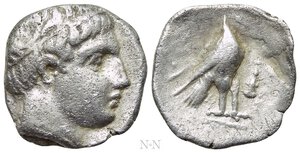
KINGS OF PAEONIA. Patraos (Circa 335-315 BC). Tetrobol - KINGS OF PAEONIA. Patraos (Circa 335-315 BC). Tetrobol. Obv: Laureate head of Apollo right.Rev: ΠΑΤΡΑΟΥ. Eagle standing right; club to right.SNG ANS 1052-3 var. (control); HGC 3.1, 150. Condition: Near very fine.Weight: 1.69 g. Diameter: 14 mm.
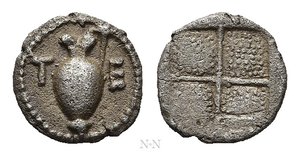
MACEDON. Terone. Hemiobol (Circa 424-422 BC) - MACEDON. Terone. Hemiobol (Circa 424-422 BC). Obv: T - E. Oinochoe.Rev: Quadripartite incuse square.SNG ANS 755; HGC 3.1, 702. Condition: Very fine.Weight: 0.24 g. Diameter: 7 mm.
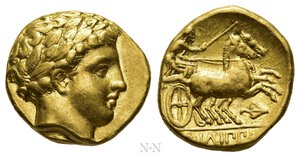
KINGS OF MACEDON. Philip II (359-336 BC). GOLD Stater. Amphipolis - KINGS OF MACEDON. Philip II (359-336 BC). GOLD Stater. Amphipolis. Obv: Laureate head of Apollo right.Rev: ΦΙΛΙΠΠΟΥ. Charioteer driving biga right. Control: ivy-leaf below.Le Rider 63 (D31/R52); SNG ANS 250-4.In the Classical period throughout Greece silver coinage predominated, while gold was minted by a few cities. In Asia Minor electrum coins were still struck in three mints (Kyzikos, Mytilene and Phokaia) until the Athenian hegemony that followed the victory over the Persians. In 405 BC the issue of Lampsakos gold staters based on the Persian weight system began. Athens produced the first and only precious metal issues toward the end of the Peloponnesian War, in 407-6 BC, at a time of severe crisis when silver mining in Laurion began to fail and it was forced to melt down the Parthenon's gold statues. Aside from these cases, the first important and massive gold coinage in the Greek context was that of Philip II of Macedon. He minted abundant series of coins in several mints. Having conquered the city of Krenides, where the Thasians had already exploited gold mines, Philip renamed the city Philippi and started the production of philippéioi, gold staters weighing two Attic drachms. Apollo's youthful head appears on the obverse, a galloping chariot on the reverse, types glorifying the Macedonian ruler who had triumphed at the Olympian Games in 356 BC. The series also includes fractions. Condition: Very fine.Weight: 8.60 g. Diameter: 18 mm.
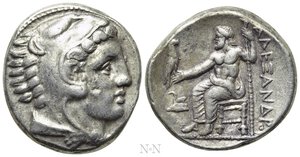
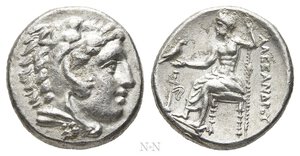
KINGS OF MACEDON. Alexander III 'the Great' (336-323 BC). Tetradrachm. Amphipolis. Lifetime issue - KINGS OF MACEDON. Alexander III 'the Great' (336-323 BC). Tetradrachm. Amphipolis. Lifetime issue. Obv: Head of Herakles right, wearing lion skin.Rev: AΛΕΞΑΝΔΡΟY. Zeus seated left on throne, holding eagle and sceptre. Control: In left field, prow left.Price 4. Condition: Very fine.Weight: 17.22 g. Diameter: 25 mm.
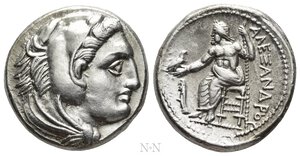
KINGS OF MACEDON. Alexander III 'the Great' (336-323 BC). Tetradrachm. Amphipolis. Possible lifetime issue - KINGS OF MACEDON. Alexander III 'the Great' (336-323 BC). Tetradrachm. Amphipolis. Possible lifetime issue. Obv: Head of Herakles right, wearing lion skin.Rev: AΛΕΞΑΝΔΡΟΥ. Zeus seated left on throne, holding eagle and sceptre. Control: In left field, herm left.Price 78. Condition: Extremely fine.Weight: 17.22 g. Diameter: 25 mm.
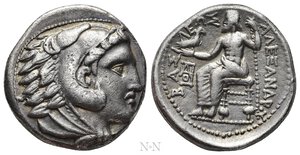
KINGS OF MACEDON. Alexander III 'the Great' (336-323 BC). Tetradrachm. Amphipolis - KINGS OF MACEDON. Alexander III 'the Great' (336-323 BC). Tetradrachm. Amphipolis. Obv: Head of Herakles right, wearing lion skin.Rev: BAΣIΛEΩΣ / AΛΕΞΑΝΔΡΟΥ. Zeus seated left on throne, holding eagle and sceptre. Control: Monogram in left field.Price 121. Condition: Very fine.Weight: 16.85 g. Diameter: 25 mm.
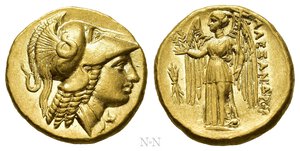
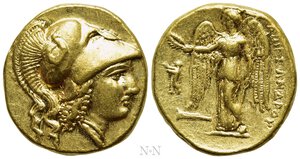
KINGS OF MACEDON. Alexander III 'the Great' (336-323 BC). GOLD Stater. 'Amphipolis' - KINGS OF MACEDON. Alexander III 'the Great' (336-323 BC). GOLD Stater. 'Amphipolis'. Obv: Head of Athena right, wearing Corinthian helmet decorated with coiled serpent.Rev: AΛΕΞΑΝΔΡΟY. Nike standing left, holding wreath and stylis. Control: thunderbolt in left field.Price 164.Already with Philip II the occupation of the Mount Pangaion region with its rich gold mines had made possible the abundant emission of gold coins, something that until then had been throughout Greece rather rare and linked to extraordinary circumstances or moments of crisis. Alexander, who imposed a single coinage throughout his vast empire, was able to issue States and their fractions in gold, using the Attic weight as the unit of measure. On the Staters the head of the goddess Athena with Corinthian helmet was depicted on the obverse, while a winged Nike was reproduced on the reverse. On silver tetradrachms, on the other hand, the head of Herakles with lion skin was depicted on the obverse and Zeus seated on a throne on the reverse (Phidian model). Toward the end of his reign there is an assimilation of the ruler with Herakles. The practice, derived from the Eastern world of reproducing the portrait of the ruler on the coin, represents a change with Alexander's coinage. But as if the human figure did not dare to suddenly replace that of the gods, the image is clothed with religious content, through its deification or identification with the deity. Even after his death for a long time Tetradrachms with the effigy of Alexander continued to be issued by his successors. The Macedonian king had the possibility to exploit for his coinage a large amount of precious metal from the vast empire he had conquered. The extremely rich mines scattered throughout this territory also made his successors self-sufficient.. The coin from that time became a symbol of the ruler's power and absolute authority; no longer protected by the image of deities, it became an instrument of propaganda and power. Condition: Mint State.Weight: 8.61 g. Diameter: 18 mm.
KINGS OF MACEDON. Alexander III 'the Great' (336-323 BC). GOLD Stater. Aigai(?) - KINGS OF MACEDON. Alexander III 'the Great' (336-323 BC). GOLD Stater. Aigai(?). Obv: Head of Athena right, wearing Corinthian helmet decorated with serpent.Rev: AΛΕΞΑΝΔΡΟΥ. Nike standing left, holding wreath and stylis. Controls: to left, pankratiast standing left, raising arms; rudder to lower left.Price 188.RareAlready with Philip II the occupation of the Mount Pangaion region with its rich gold mines had made possible the abundant emission of gold coins, something that until then had been throughout Greece rather rare and linked to extraordinary circumstances or moments of crisis. Alexander, who imposed a single coinage throughout his vast empire, was able to issue Staters and their fractions in gold, using the Attic weight as the unit of measure. On the Staters the head of the goddess Athena with Corinthian helmet was depicted on the obverse, while a winged Nike was reproduced on the reverse. On silver tetradrachms, on the other hand, the head of Herakles with lion skin was depicted on the obverse and Zeus seated on a throne on the reverse (Phidian model). Toward the end of his reign there is an assimilation of the ruler with Herakles. The practice, derived from the Eastern world of reproducing the portrait of the ruler on the coin, represents a change with Alexander's coinage. But as if the human figure did not dare to suddenly replace that of the gods, the image is clothed with religious content, through its deification or identification with the deity. Even after his death for a long time Tetradrachms with the effigy of Alexander continued to be issued by his successors. The Macedonian king had the possibility to exploit for his coinage a large amount of precious metal from the vast empire he had conquered. The extremely rich mines scattered throughout this territory also made his successors self-sufficient. The coin from that time became a symbol of the ruler's power and absolute authority; no longer protected by the image of deities, it became an instrument of propaganda and power. Condition: Mint State.Weight: 8.59 g. Diameter: 18 mm.
KINGS OF MACEDON. Alexander III 'the Great' (336-323 BC). Drachm. Lampsakos - KINGS OF MACEDON. Alexander III 'the Great' (336-323 BC). Drachm. Lampsakos. Obv: Head of Herakles right, wearing lion skin.Rev: AΛΕΞΑΝΔΡΟΥ. Zeus seated left on throne, holding eagle and sceptre. Control: Sheathed sword in left field.Price 1349. Condition: Very fine.Weight: 4.09 g. Diameter: 16 mm.