Info & contacts
PDF Catalogue
My bids
Watched Lots
Terms Of Sale
Shipping costs
Payment methods
Printable results
Live Bidding Thursday 9th April 2026 02:30:00 PM CET
The Connoisseur’s Collection (1-136)
Greek (137-254)
Roman Republic (255-299)
Roman Empire (300-345)
Migration of the German tribes (346-346)
Byzantine (347-354)
Colombia (355-355)
Ethiopia (356-356)
France (357-360)
Italy (361-376)
Papal States (377-379)
Savoy (380-382)
Islam (383-384)
Netherlands (385-385)
Switzerland (386-391)
French Medals (392-397)
Italian Medals (398-411)

Risultati: 14
Lot # 398
-
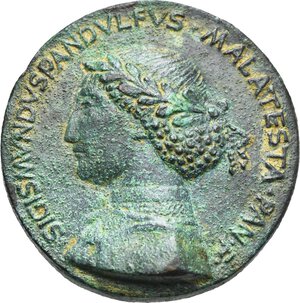
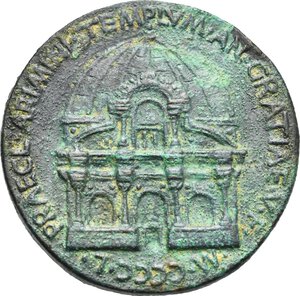
Italy. Rimini. Sigismondo Pandolfo Malatesta, 1417-1468. Lord of Rimini, Fano and Senigallia,1432. Medal, 1450 (Bronze, 40.28 mm, 37.98 g) by Matteo de'Pasti. For the construction of the Tempio Malatestiano. SIGISMVNDVS PANDVLFVS MALATESTA PAN F, Laureate and armored bust left. Rev. PRAECL ARIMINI TEMPLVM AN GRATIAE V F - M CCCC L, Façade of San Francesco at Rimini, according to plans by Leon Battista Alberti. Armand I, 21, 17. Hill 183. Kress 66. Pollard 47a. Vannel Toderi, Bargello 78. An attractive example with a green and greenish-black patina. Faults on the reverse from the model used to make the mould, otherwise, better than Very Fine. Contemporary cast.
Pieces of this kind,lacking the artist's signature, were typically produced for placement in foundation dposits.
Lot # 399
-
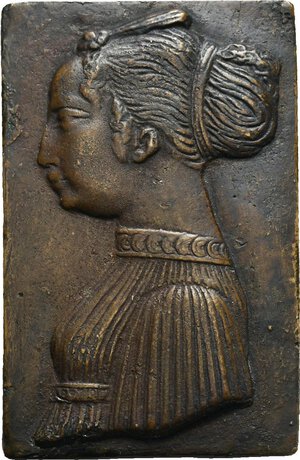
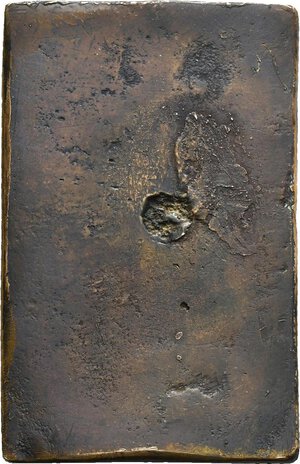
Italy. Ferrara school or northern Italy. Female portrait. Uniface plaquette, 1475-1500 (Bronze, 50.22 x 49.32mm. 128 g). Bust to the left, cut below the breast, her hair gathered in an elaborate chignon bound by a fillet adorned with jewels and ribbons and a pleated gown fastened by a collar with circular motifs. Scaglia M377, in bibliography: “Artemide 2016 n. 206 (misure 70 x 50 mm, per l’unico altro esemplare ad oggi noto in bibliografia), dove l'effigiata è identificata come una fanciulla di casa Gonzaga, forse Lucia o Leonella figlie di Gianfrancesco Gonzaga e il rilievo attribuito alla cerchia di Pisanello in base alla somiglianza del profilo con quello della medaglia per Cecilia Gonzaga.” Very fine contemporary cast. Third known example?
Lot # 400
-
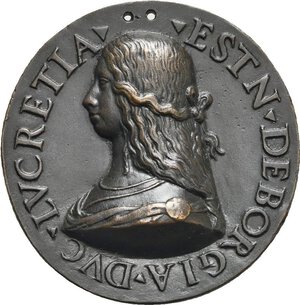
Lucrezia Borgia, 1480-1519. Uniface medal (Bronze, 57.69 mm, 64 g.) by Giancristoforo Romano. LVCRETIA ESTN DEBORGIA DVC, Bust of Lucrezia Borgia facing left in high relief; long flowing wawy hair up the neck, with a braid drawn from temples across and knotted in a pigtail behind her head. She has a low scooped neckline on her dress fastened on her left shoulder with a brooch and a double cord pendant on her breast. Hill 231. Boccolari 76A. Holed. A later cast.
Lot # 401
-
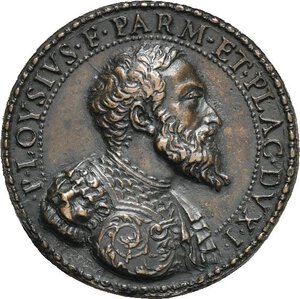
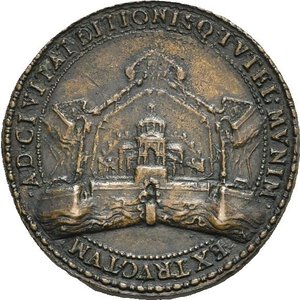
Parma. Pierluigi Farnese, 1503-1547. Medal (Bronze, 36.5 mm, 20.67 g.), undated but 1546 by Gian Federico Bonzagni. P LOYSIVS F PARM ET PLAC DVX I, Bearded bust of the Duke, wearing elaborately decorated armor right. Rev. AD CIVITAT DI TIONISQ TVTEL MVNIM EX TRVCTVM, Citadel of Parma. Armand I, 222, 6. Hill 103. Hill-Pollard 70, 375. Kress 375. Johnson-Martini 97,913. Toderi-Vannel 2124. Extremely Fine contemporary cast.
The medal was produced in 1546 for the construction of the citadel of Parma, commissioned by Pierluigi Farnese, but then designed and begun in 1591 by Alessandro Farnese.
Pierluigi Farnese was the first Duke of Castro (1537–1545) and the first Duke of Parma and Piacenza (1545–1547), illegitimate son of Cardinal Alessandro Farnese, later Pope Paul III. Initially a soldier of often brutal reputation who took part in the 1527 Sack of Rome, he rose rapidly thanks to his father’s favor, becoming gonfaloniere of the Church and consolidating Farnese power in central Italy. His authoritarian rule,the hostility from local nobility and the opposition of Emperor Charles V led to a conspiracy in which he was assassinated at Piacenza in 1547.
Lot # 402
-
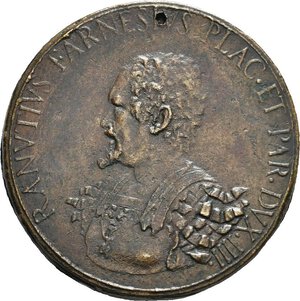
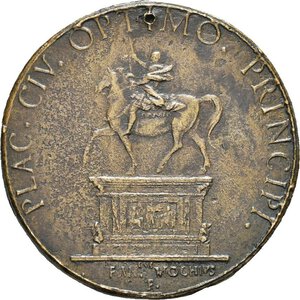
Ranuccio I Farnese, 1569-1622, duke of Parma and Piacenza. Medal, 1625 (Bronze, 53.83 mm, 76 g.) by Francesco Mocchi. RANVTIVS FARNESIVS PLAC ET PAR DVX III, Armored and draped bust of Ranuccio I Farnese to the left with bare-headed bearded face wearing badge of the Golden Fleece. Rev. On the plinth, PLAC CIV OPTIMO PRINCIPI, Equestrian monument with the duke on horseback facing left, in ancient-style armor, on a pedestal adorned with figural reliefs; in the exergue, FAN.CVS MOCHIVS F. Scaglia p. 332 n. 318. G. Crocicchio, Le Monete dei Farnese-La zecca di Piacenza 1545-1731, p. 177, n. 828. Affo’ 5, XLVII. A very fine contemporary cast, holed. The Scaglia collection catalogue states that only four examples of this medal are known. Excessively rare.
Ranuccio I Farnese, Duke of Parma and Piacnza, called the Tuscan sculptor Francesco Mochi from Rome to create two imposing bronze equestrian statues, one for himself and one for his father Alessandro, to be placed in the main square of Piacenza, now called Piazza Cavalli (cavalli=horses). The two equestrian statues are known as “Mochi's horses” and are one of the most important equestrian units in 17th-century Europe. They were cast in bronze in several stages over a period of about 17 years, using technical and formal solutions that were very advanced for the time.
Lot # 403
-
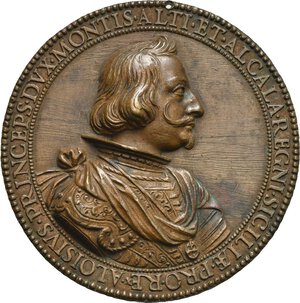
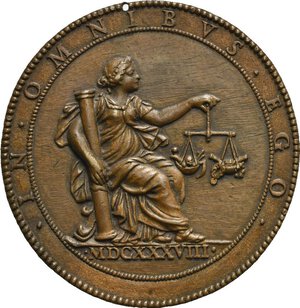
Italy. Sicily (Spanish rule). Luis Guillermo de Moncada, 5th Prince of Paternò, 7th Duke of Montalto, Viceroy of Naples and Sicily, 1614-1672. Medal, 1638 (Bronze, 60 mm, 52.85 g) by J.M. Pirix. ALOISIVS PRINCEPS DVX MONTIS ALTI ET ALCALA REGNI SICILIAE PRO RE *, Armoured and draped bust right, with full moustache; on neck cut: J M PIRIX. Rev. IN OMNIBVS EGO, Justice seated right, holding a column and scales, the pans of which contain objects symbolizing death and wealth; in exergue, MDCXXXVIII. Siciliano 37. Forrer 563. Stunning brownish patina with minor green oxides on obverse. Minor hole at 12 o’clock and scattered hairlines in the fields. Nevertheless, a truly magnificent and original piece, preserved in outstanding overall condition. Good Extremely Fine. Extremely Rare.
Ex Interational Coin Exchange 19 November 2011, lot 2422.
Lot # 404
-
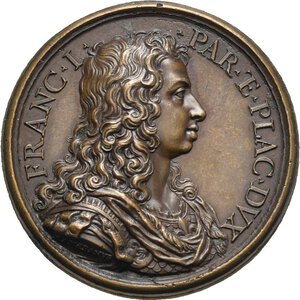
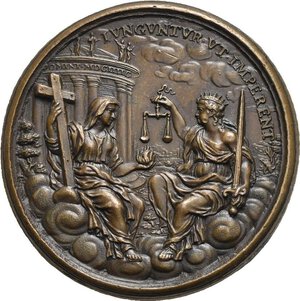
Italy. Francesco Farnese, duke of Parma and Piacenza, 1678-1729. Medal, 1696 (Bronze, 52.09 mm. 76 g.) by G. Hamerani. FRANC I PAR ET PLAC DVX, Cuirassed and draped bust right with long curling hair falling on his shoulder; on truncation, HAMERANVS. Rev. IVNGVNTVR VT IMPERENT, Allegorical figure of Justice on the right with scales and sword in front of the allegorical figure of the Christian faith holding a cross and a torch, both seating on clouds. In the left background is a round pillared building with four statues on the top and inside the entablature, DOMINI MDCIIIIC. Börner 1267. Molinari 112. Johnson 163. Struck. Extremely fine. Rare.
The medal evokes the idea that ducal power is based on the alliance between the Catholic faith and the proper administration of justice, in line with the policy of balance and papal legitimacy pursued by Francis in the early years of his reign after 1694.
Lot # 405
-
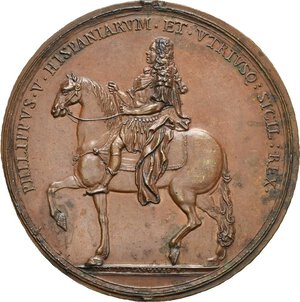
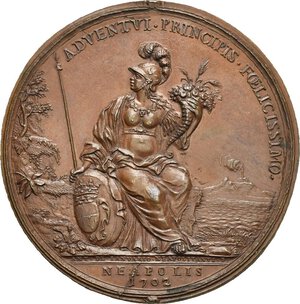
Italy. Kingdom of Naples and Sardinia. Philip V of Spain, 1700-1714. Medal, 1702 (Bronze, 60.67 mm, 70.44 g) by Maria Antonio de Gennaro. Visit of the King to Naples. PHILIPPVS V HISPANIARVM ET VTRVSQ SICIL REX, The king, in armor, on horseback facing left; on the exergual line, ANT DE IANVARIO F. Rev. ADVENTVI PRINCIPIS FOELICISSIMO, Female figure, helmeted and armored, seated facing forward and turned to the left, holding a cornucopia and a spear; beside her, the coat of arms of the city of Naples. In the distance, the sea and Mount Vesuvius; on the exergual line, ANT DE IANVARIO NEAPOLITANVS F; in exergue, NEAPOLIS / 1702. Siciliano 69. Collezione Johnson 310. Molinari 185. Stunning reddish patina. Minor die break on reverse, and two small metal flows at 12 and 6 o’clock, but overall exceptional preservation. Near Uncirculated, possibly one of the best specimens known. Scarce.
Lot # 406
-
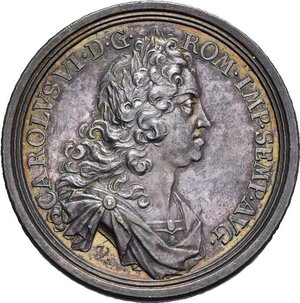
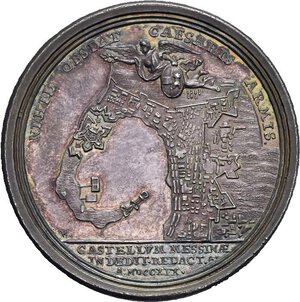
Italy. Kingdom of Sicily. Charles VI of Habsburg, 1711-1740. Medal, 1719 (Silver, 44 mm, 29.79 g) by G.W. Vestner and P.P. Werner. For the Surrender of the Citadel of Messina. CAROLVS VI D G - ROM IMP SEMP AVG, Laureate and draped bust right; below, V. Rev. NIHIL OBSTAT CAESARIS ARMIS, Plan of the City and Port of Messina, over which Victory flies, bearing crown and shield; on lower left, W; in exergue, CASTELLVM MESSINAE / IN DEDIT REDACT / A MDCCXIX. Montenuovo 1544. Siciliano 91. Sicilia Numismatica, pl. 232. Wonderful specimen with a splendid iridescent patina. Near Uncirculated. Extremely Rare: struck for a very limited number of Officers.
Imperial medal of 1719 struck by Charles VI to celebrate the surrender of Messina during the War of Sicily of 1718-1720. On the reverse, the plan of the citadel and the harbor, with the legend (translated) "Nothing obstructs the arms of the Emperor." A clear message of military propaganda, celebrating the presumed invincibility of the Austrians. But behind the triumphalist emphasis, the fact remains that control of the island was temporary and contested: the reality was less glorious than the medal wants to make us believe. A small medallic masterpiece, between art, rhetoric, and imperial ambition.
Lot # 407
-
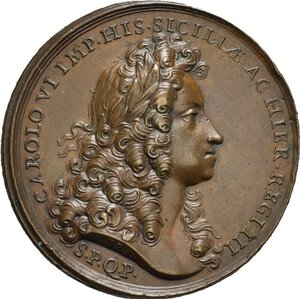
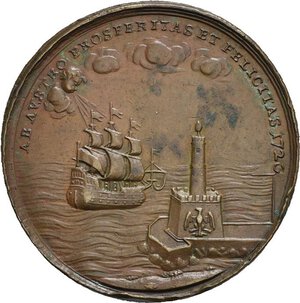
Italy. Kingdom of Sicily. Charles VI of Habsburg, 1711-1740. Medal, 1720 (Bronze, 43.86 mm, 32.41 g) by A. Travani. Tribute of the Senate of Palermo on his acclaimation as Charles III of Sicily and Jerusalem. CAROLO VI IMP HIS SICILIAE AC HIER REGI III, Laureate head right; below, S P Q P; on neck cut, A TRA. Rev. AB AVSTRO PROSPERITAS ET FELICITAS 1720, A galleon sailing right on a calm sea, driven by the wind; mountains in the background and, in the foreground, the port of Palermo with a lighthouse at whose base is a spread-winged eagle. Siciliano 95. Montenuovo 1568. Forrer 128. Coll. Johnson 792, 624. Beautiful brownish patina from an old collection. Minor edge knocks and slight oxidation on the reverse. Extremely Fine.
Lot # 408
-
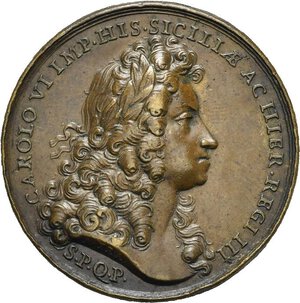
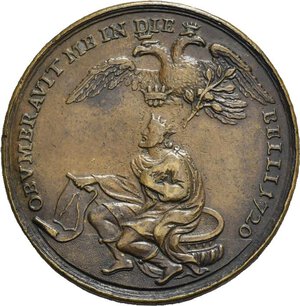
Italy. Kingdom of Sicily. Charles VI of Habsburg, 1711-1740. Medal, 1720 (Bronze, 43 mm, 26.66 g) by A. Travani. Tribute of the Senate of Palermo on his acclaimation as Charles III of Sicily and Jerusalem. CAROLO VI IMP HIS SICILIAE AC HIER REGI III, Laureate head right; below, S P Q P; on neck cut, A TRA. Rev. OBVMBRAVIT ME IN DIE BELLI 1720, Crowned elder (the Genius of Palermo), seated left on a basin, holds a map of Sicily and a serpent; above, a double-headed eagle flies, holding a crown and a flowering branch in its talons. Montenuovo cfr. 1569 (silver). Forrer 128. Siciliano 94. Beautiful brownish patina from an old collection. Scattered marks and little scratches. Good Very Fine. Rare.
Lot # 409
-
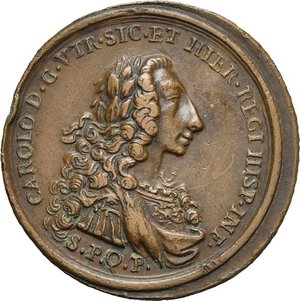
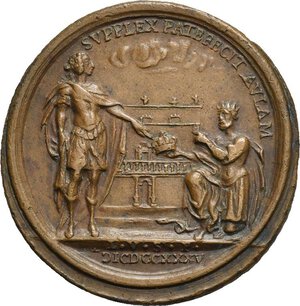
Italy. Kingdom of Sicily. Charles VI of Habsburg, 1711-1740. Medal, 1735 (Bronze, 47 mm, 33.58 g) by Livio Vittorio Scheper. Coronation of Charles and the Anointing in the cathedral of Palermo. CAROLO D G VTR SIC ET HIER REGI HISP INF, Laureate, draped and cuirassed bust right; below, S P Q P. Rev. SVPPLEX PATEFECIT AVLAM (the supplicating people opened the royal palace), The King, standing left, receives the Royal crown from an elderly kneeling figure (the Genius of Palermo); at his feet, a serpent, and in the background, a building and clouds in the sky; in exergue, ƆICDCCXXXV; along the exergual line, L V S F (Livio Vittorio Scheper fecit). D'Auria 1. Ricciardi 2. Beautiful brownish patina from an old collection. Edge knock and minor scratches on obverse. Good Very Fine. Extremely Rare.
Lot # 410
-
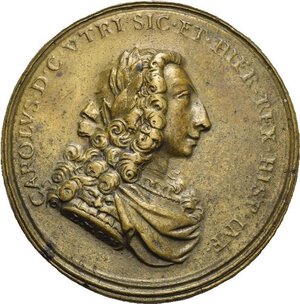
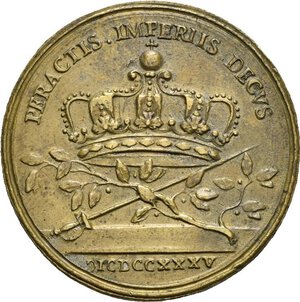
Italy. Kingdom of Sicily. Charles VI of Habsburg, 1711-1740. Medal, 1735. (Bronze, 46 mm, 37.79 g) by Livio Vittorio Scheper. Coronation of Charles and the return of the Kingdoms of Naples and Sicily to dynastic autonomy. CAROLVS D G VTRI SIC ET HIER REX HISP INF, Laureate, draped and cuirassed bust right; on neck cut, L V SCH. Rev. PERACTIS IMPERIIS DECVS, Royal crown over crossed olive branch and sword; in exergue, ƆICDCCXXXV. D'Auria 2. Ricciardi 1. Beautiful brownish patina from an old collection. Small edge mark at 7 o’clock. A full Good Very Fine. Very Rare.
The reverse legend of this medal, 'Having completed his military duties, he requested the dignity he had long desired', refers to a passage from Horace, specifically from the Carmina, Book IV.
Lot # 411
-
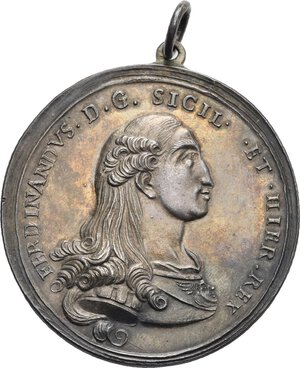
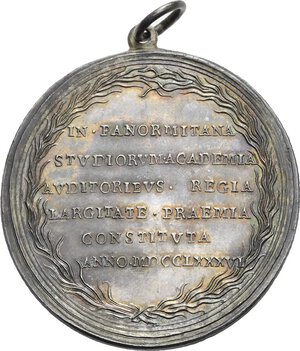
Italy. Kingdom of the Two Sicilies. Ferdinand IV of Bourbon, 1st Period, 1759-1799. Large Medal, 1786. (Silver, 52.2 mm, 69.34 g) by unknow medallist. Establishment of prizes at the University of Palermo. ERDINANDVS D G SICIL ET HIER REX, Armoured bust of the King to the right. Rev. Tied palm branches enclosing the inscription: IN PANORMITANA / STVDIORVM ACADEMIA /AVDITORIBVS REGIA / LARGITATE PRAEMIA /CONSTITVTA / ANNO MDCCLXXXVI (Prizes to the auditors of the Royal Academy of Studies of Palermo by royal munificence). D'Auria 45. Ricciardi 40. With suspension loop and silver ring. A specimen of magnificent preservation, with a deep old cabinet tone: probably the finest specimen ever offered for sale, in significantly better condition than the one from the D'Auria Collection. About Uncirculated. Extremely Rare.
Caricamento altri risultati...