Banner Artemide eLive Auktion 44
Risultati: 5

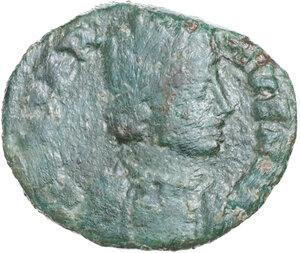
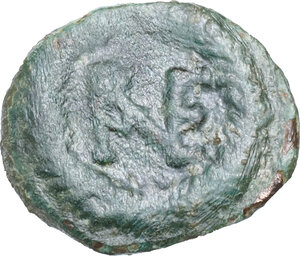
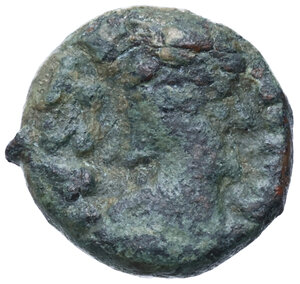
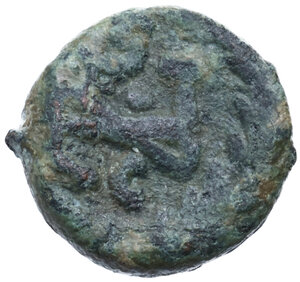
673 - Ostrogothic Italy, Theoderic (493-526 AD). AE Decanummium, Ravenna or Rome mint, 512-522 AD. D/ Turreted and draped bust of Felix Ravenna right. R/ Monogram within wreath. MIB 72a. AE. 2.33 g. 16.5 mm. Pleasant glossy dark green patina. Good F.

Osserva:
Base d'asta: € 40
Offerte asta: : -
Prossima offerta minimo : € 40
Diritti d'asta: 22.00%
Chiusura alle: 2026-10-04 14:00:00 ora di Roma

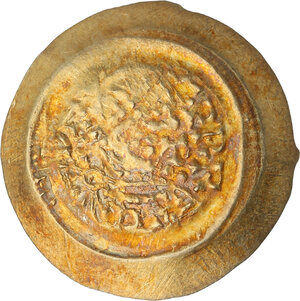
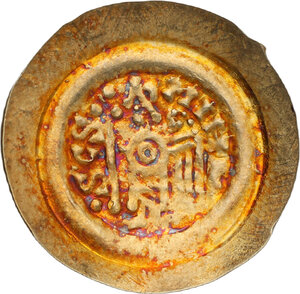
674 - The Lombards at Pavia. Liutprand (712-744 AD). AV Tremissis. D/ [DN LIV]TPRΛ. Diademed, draped and cuirassed bust right; T to right; on bust, Rx ligate. R/ SCS MIHIL. St. Michael, winged, standing left, holding staff ending in trefoil and round shield. CNI 19. AV. 1.21 g. 21 mm. R. VF. The Lombards were a Germanic people whose existence was already recorded by Tacitus. By the beginning of the sixth century, they had established themselves in Pannonia and had embraced Arian Christianity. In 568-569 AD, they launched their invasion of Italy, rapidly gaining control of the territory stretching from the Alps to the Po Valley, an area that would later become known as Lombardy. Under King Alboin, Pavia became the capital of their kingdom in 571 AD. After the death of Alboin’s successor in 574 AD, the Lombard dukes failed to agree on a new ruler, leading to a ten-year period without a king. During this time, two autonomous Lombard duchies emerged at Spoleto and Benevento. Apart from the reign of Liutprand (712-744 AD), the Lombard kings were generally unable to exercise strong and effective authority, and the kingdom was ultimately conquered by Charlemagne in 774 AD. The Duchy of Benevento, meanwhile, prospered under its earliest dukes, Zotto and Arichis (571-641 AD), extending its influence over much of southern Italy, with the exception of Apulia and Calabria. Its position later weakened as it faced repeated conflicts with the Lombard kingdom, the Carolingians, the Byzantines, the Papal States, and eventually Arab forces. Following the assassination of Sicard in 839 AD, a civil war caused the larger duchy to fragment. Thereafter, a succession of minor Lombard rulers intermittently governed a much-reduced Benevento until the middle of the eleventh century. The Lombard Duchy of Spoleto experienced similar pressures, being repeatedly threatened by neighboring powers. It eventually lost its independence when it fell under Charlemagne’s control in 776 AD. In contrast to Lombardy and Benevento, however, no coinage is known to have been issued by the Duchy of Spoleto.

Osserva:
Base d'asta: € 800
Offerte asta: : -
Prossima offerta minimo : € 800
Diritti d'asta: 22.00%
Chiusura alle: 2026-10-04 14:00:00 ora di Roma

675 - Ostrogothic Italy, Athalaric (526-534 AD). AE Minimus, Rome mint. D/ Diademed, draped and cuirassed bust of Justinian I right. R/ Monogram of Athalaric within wreath. MIB 80. AE. 1.29 g. 11 mm. Good F.

Osserva:
Base d'asta: € 50
Offerte asta: : -
Prossima offerta minimo : € 50
Diritti d'asta: 22.00%
Chiusura alle: 2026-10-04 14:00:00 ora di Roma

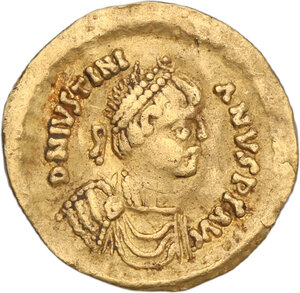
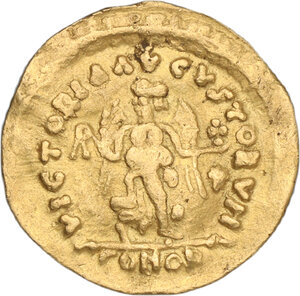
676 - Ostrogothic Italy, Athalaric to Witigis (526-540 AD). AV Tremissis. Pseudo-Imperial Coinage. In the name of Justinian I. Rome or Ravenna mint, c. 527/30-539 AD. D/ DN IVSTINI-ANVS PP AVG. Pearl-diademed, draped and cuirassed bust right. R/ VICTORIA AVGVSTORVM. Victory advancing right, head left, holding wreath and globus cruciger; to right, star; in exergue, CONOB. COI 37 (Rome or Ravenna); MEC 1, 123 (Ostrogoths) and 298 (Lombards). ; MIB 29 (Rome). AV. 1.48 g. 16 mm. RR. Minor marks. VF.

Osserva:
Base d'asta: € 400
Offerte asta: : -
Prossima offerta minimo : € 400
Diritti d'asta: 22.00%
Chiusura alle: 2026-10-04 14:00:00 ora di Roma

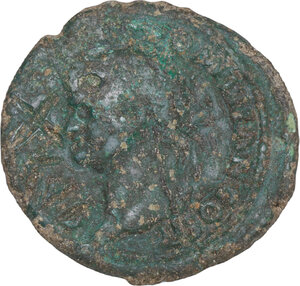
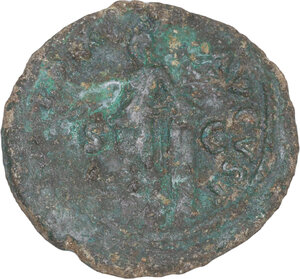
677 - Ostrogothic Italy. Non-Regal Bronze Issue from the time of Theoderic and Athalaric. AE Follis. Early to mid 6th century. 'Countermarked' early Imperial bronze issue. XLII (mark of value = 42 Nummi) cut into obverse of AE As of Domitian. D/ [CAESAR AVG F] DOMITIAN COS II. Laureate head of Domitian left, XLII cut to left. R/ PAX AVGVST S C. Pax standing left leaning on column, holding caduceus and branch. RIC II-p. 1 (2nd ed.) (Vesp.) 670 (for undertype). AE. 10.46 g. 29.5 mm. R. Rare and interesting. Good F. These countermarked issues have long been considered as made in Vandalic North Africa, but the hoard evidence and the results of the latest studies makes it seem that they were, in fact, made in the Ostrogothic Italy, and were in use there during the first quarter or first half of the 6th century (Cf, NAC, May 1993, 457). The mark of value XLII refer to a twelfth of a silver unit valued at 500 nummi, which itself amount to the 24th fraction of a gold solidus valued at 12,000 nummi. (Cf. Grierson, MEC, p.28-31). These are not countermarked coins in the usual sense of word, since the LXII figure was not punched or stamped with a single instrument, but seems to have been cut or incised with several chisel strokes. (C. Morrisson,1983). J. Friedlander suggested that for the more finely incised series the pieces were certainly softened by fire in order to be able to engrave more easily the deep and crude strokes. (“Die Erwerbungen des Konigl. Munzkabinets vom 1.Jan.1877 bis 31 Marz 1878” ZfN VI, 1879, p.1-26). Such crude workmanship seem to point to the markings being done by private persons, at least in the case of the most anomalous countermarks. While for the more finely incised countermarks – like our outstanding example – the role of some official authority cannot be excluded. (C. Morrisson). Tentatively, Morrisson suggests that an official practice of marking and re-issuing older bronzes was followed with varying success by private individuals as and when they came into possession of similar pieces. The only paper devoted solely to these countermarked coins is : Morrisson, C. “The re-use of obsolete coins : the case of Roman imperial bronzes revived in the late fifth century” in: ed. C.N.L. (Brooke et al. Studies in Numismatic Method presented to Philip Grierson, Cambridge 1983).XLVI, 487.

Osserva:
Base d'asta: € 80
Offerte asta: : -
Prossima offerta minimo : € 80
Diritti d'asta: 22.00%
Chiusura alle: 2026-10-04 14:00:00 ora di Roma