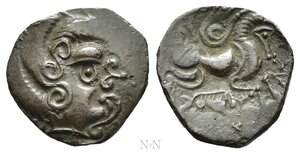
WESTERN EUROPE. Northwest Gaul. Coriosolites. BI Stater (Circa 100-50 BC) - WESTERN EUROPE. Northwest Gaul. Coriosolites. BI Stater (Circa 100-50 BC). Obv: Stylized head right; S-like ear, epsilon-shaped nose.Rev: Stylized biga and driver right; below, boar right.Depeyrot, NC VIII, 184; D&T 2339. Condition: Good very fine.Weight: 5.26 g. Diameter: 23 mm. Estimate: € 200
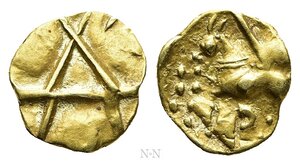
WESTERN EUROPE. Northern Gaul. Nervii. GOLD 1/4 Stater (Circa 115-100 BC) - WESTERN EUROPE. Northern Gaul. Nervii. GOLD 1/4 Stater (Circa 115-100 BC). Obv: Crossed lines making rough A shape.Rev: Rider on horseback left, holding reins; lyre below.D&T 94-5. Condition: Very fine.Weight: 1.93 g. Diameter: 13 mm. Estimate: € 250
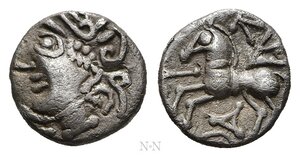
WESTERN EUROPE. Central Gaul. Lingones. Quinarius (1st century BC). 'Kaletedou' type - WESTERN EUROPE. Central Gaul. Lingones. Quinarius (1st century BC). 'Kaletedou' type. Obv: Helmeted head left.Rev: Horse prancing left; wheel below.Depeyrot, NC IV, 285; D&T 3195-6; LT 8178. Condition: Very fine.Weight: 1.40 g. Diameter: 12 mm. Estimate: € 50
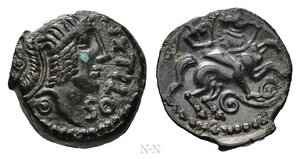
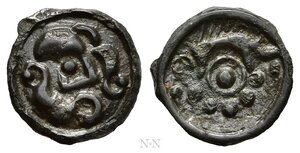
WESTERN EUROPE. Northeast Gaul. Suessiones. Potin (Circa 50-30 BC) - WESTERN EUROPE. Northeast Gaul. Suessiones. Potin (Circa 50-30 BC). Obv: Stylized head right; fibula to right.Rev: Stylized boar right above pellet-in-circle; annulet to left, five pellets below.Depeyrot, NC VI, 123; D&T 531A. Condition: Good very fine.Weight: 1.91 g. Diameter: 18 mm. Estimate: € 50
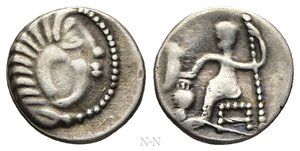
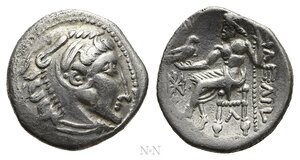
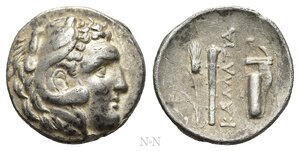
EASTERN EUROPE. Imitations of Alexander III 'the Great' of Macedon. Drachm (3rd-2nd century BC) - EASTERN EUROPE. Imitations of Alexander III 'the Great' of Macedon. Drachm (3rd-2nd century BC). Obv: Stylized head of Herakles right, wearing lion skin.Rev: Stylized Zeus seated left with eagle and sceptre. Control: amphora in left field.Lanz 896; OTA 577. Condition: Very fine.Weight: 3.13 g. Diameter: 19 mm. Estimate: € 50
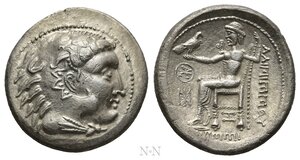
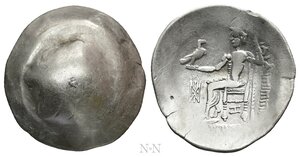
EASTERN EUROPE. Imitations of Philip III Arrhidaios of Macedon (3rd-2nd centuries BC). Tetradrachm - EASTERN EUROPE. Imitations of Philip III Arrhidaios of Macedon (3rd-2nd centuries BC). Tetradrachm. Obv: Head of Herakles right, wearing lion skin.Rev: Zeus seated left on throne, holding eagle and sceptre. Controls: two monograms in left field, Ξ below throne.Lanz 898-9; OTA 581/9. Condition: Good very fine.Weight: 16.01 g. Diameter: 28 mm. Estimate: € 100
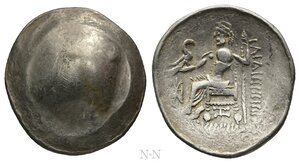
EASTERN EUROPE. Imitations of Philip III Arrhidaios of Macedon (3rd-2nd centuries BC). Tetradrachm - EASTERN EUROPE. Imitations of Philip III Arrhidaios of Macedon (3rd-2nd centuries BC). Tetradrachm. Obv: Head of Herakles right, wearing lion skin.Rev: Zeus seated left on throne, holding eagle and sceptre. Controls: monogram in left field, Z below throne.Lanz 906. Condition: Very fine.Weight: 14.91 g. Diameter: 28 mm. Estimate: € 50
EASTERN EUROPE. Imitations of Philip III Arrhidaios of Macedon (3rd-2nd centuries BC). Tetradrachm - EASTERN EUROPE. Imitations of Philip III Arrhidaios of Macedon (3rd-2nd centuries BC). Tetradrachm. Obv: Head of Herakles right, wearing lion skin.Rev: Zeus seated left on throne, holding eagle and sceptre. Controls: monogram in left field, Z below throne.Lanz 906. Condition: Very fine.Weight: 15.10 g. Diameter: 31 mm. Estimate: € 50
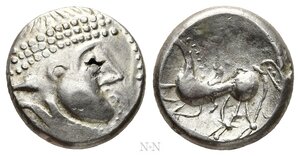
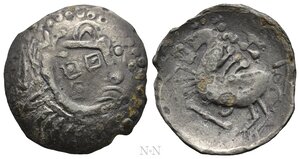
EASTERN EUROPE. Imitations of Philip II of Macedon (2nd-1st century BC). Tetradrachm. 'Velemer' type - EASTERN EUROPE. Imitations of Philip II of Macedon (2nd-1st century BC). Tetradrachm. 'Velemer' type. Obv: Stylized diademed beardless head of Zeus right.Rev: Stylized horse with rider left.Lanz 746-56; OTA 471/1. Condition: Very fine.Weight: 8.94 g. Diameter: 21 mm. Estimate: € 200
EASTERN EUROPE. Imitations of Alexander III-Philip III of Macedon (Circa 2nd century BC). Drachm - EASTERN EUROPE. Imitations of Alexander III-Philip III of Macedon (Circa 2nd century BC). Drachm. Obv: Head of Herakles right, wearing lion skin.Rev: Blundered legend. Zeus seated left on throne, holding eagle and sceptre. Control: monogram in left field, Λ below throne.Lanz 936; OTA 591/1. Condition: Very fine.Weight: 3.95 g. Diameter: 18 mm. Estimate: € 100
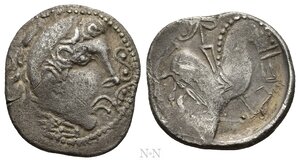
EASTERN EUROPE. Uncertain tribe. Tetradrachm (Circa 2nd-1st century BC). Mint in Carpanthian region. 'Scyphat mit Herakleskopf' type - EASTERN EUROPE. Uncertain tribe. Tetradrachm (Circa 2nd-1st century BC). Mint in Carpanthian region. 'Scyphat mit Herakleskopf' type. Obv: Head of Herakles right, wearing lion skin; volute to right.Rev: Stylized horseman right.Lanz 566; OTA 252/1-2; Dembski 1166-8. Condition: Near very fine.Weight: 10.50 g. Diameter: 27 mm. Estimate: € 100
EASTERN EUROPE. Uncertain tribe. Tetradrachm (Circa 2nd-1st century BC). Mint in Carpanthian region. 'Herakleskopf' type - EASTERN EUROPE. Uncertain tribe. Tetradrachm (Circa 2nd-1st century BC). Mint in Carpanthian region. 'Herakleskopf' type. Obv: Head of Herakles right, wearing lion skin.Rev: Stylized horseman left.Cf. Lanz 570; Flesche -. Condition: Near very fine.Weight: 9.00 g. Diameter: 33 mm. Estimate: € 50
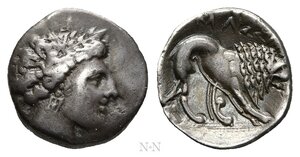
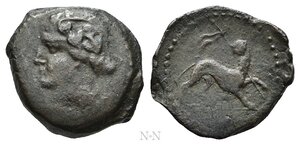
CENTRAL ITALY. Uncertain (Minturnae?). Ae (mid-late 1st century BC) - CENTRAL ITALY. Uncertain (Minturnae?). Ae (mid-late 1st century BC). Obv: Wreathed head of young Dionysos left.Rev: Panther standing right, head facing, holding thyrsos in jaws.Stannard & Sinner, "A Central Italian Coin with Dionysus/Panther Types, and Contacts Between Central Italy and Spain, in the 2nd and 1st Centuries BC," in Saguntum 46 (2014), p. 159-180, fig. 1, 1-6 var. (head of Dionysos right); HN Italy 2673 var. (same).Extremely rare with head left Condition: Very fine.Weight: 5.30 g. Diameter: 21 mm. Estimate: € 50
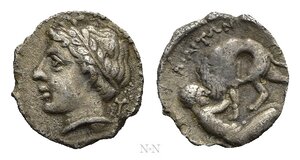
CAMPANIA. Neapolis. Obol (320-300 BC) - CAMPANIA. Neapolis. Obol (320-300 BC). Obv: Laureate head of male left; Y to right.Rev: NEOΠOΛITΩN. Herakles kneeling right, strangling the Nemean Lion.HN Italy 572; SNG BN 692; HGC 1, 465.Scarce Condition: Good very fine.Weight: 0.48 g. Diameter: 10 mm. Estimate: € 50
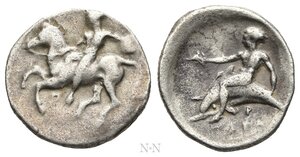
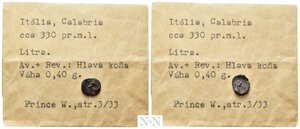
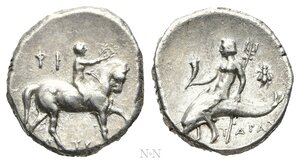
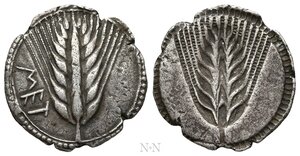
CALABRIA. Tarentum. Tritartemorion or 3/4 Obol (Circa 325-280 BC) - CALABRIA. Tarentum. Tritartemorion or 3/4 Obol (Circa 325-280 BC). Obv: Head of horse left.Rev: Head of horse right.HN Italy 981; HGC 1, 861.With 1970s / 1980s collectors envelope. Condition: Very fine.Weight: 0.40 g. Diameter: 10 mm. Estimate: € 50
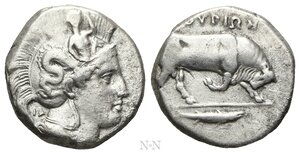
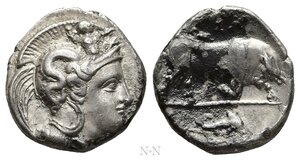
LUCANIA. Thourioi. Distater (Circa 400-350 BC) - LUCANIA. Thourioi. Distater (Circa 400-350 BC). Obv: Head of Athena right, wearing crested Attic helmet, decorated with Skylla raising left hand to head, scanning; IΔ behind neck guard.Rev: ΘΟΥΡΙΩΝ. Bull butting right; in exergue, fish right.Noe F28; HN Italy 1803; HGC 1, 1255.After the foundation of Thurium (444 BC), there was a reduction in the weight of Staters in all the cities on the Ionian Sea, probably due to the period of crisis following the burning of the Pythagorean schools. The coins of Thurium spread considerably in the region, making up for the rarefaction of those of the other mints. It is difficult to say why the minting of these Distaters was decided, which became regular after the detachment from Athens, evidenced by the type of obverse showing Athena's helmet no longer encircled by the laurel wreath but decorated with Scylla. Thurium indeed supported Athens in the war against Syracuse, but refused to recognise it as motherland in 434/3 BC. Condition: Very fine.Weight: 15.50 g. Diameter: 24 mm. Estimate: € 500
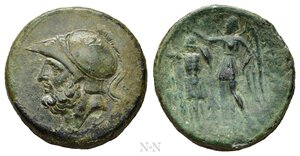
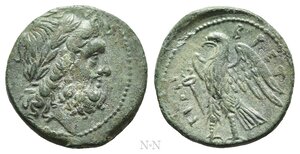
BRUTTIUM. The Brettii. Ae Unit or Drachm (Circa 214-211 BC) - BRUTTIUM. The Brettii. Ae Unit or Drachm (Circa 214-211 BC). Obv: Laureate head of Zeus right.Rev: BPETTIΩN. Eagle standing left, with wings spread; kerykeion to left.HN Italy 1980; HGC 1, 1366. Condition: Very fine.Weight: 6.82 g. Diameter: 22 mm. Estimate: € 100
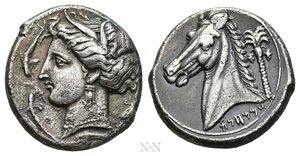
SICILY. Entella. Punic Issues. Tetradrachm (Circa 320/15-300 BC) - SICILY. Entella. Punic Issues. Tetradrachm (Circa 320/15-300 BC). Obv: Head of Arethousa left, wearing grain-ear wreath, triple-pendant earring and pearl necklace; four dolphins around.Rev: Head of horse left; palm tree to right.Jenkins, Punic, 167 (O50/R131); CNP 267; HGC 2, 284.Ex Bourgey Paris (24-25 February 1983), lot 36.
The foundation of Entella is traced back to Acestes, son of the river god Krimisos and a Trojan woman or, according to other sources to Prince Elymus, son of Anchises and brother of Aeneas. The city stood on a summit overlooking the Belice valley. Records are scarce until the arrival of the Campanian mercenaries, recruited in 410 BC by the Carthaginians and discharged after the 405 BC treaty, then passed into the pay of Dionysius I of Syracuse. After liberating Dionysius on the island of Ortigia from the Punic siege, the were discharged with rich gifts and settled in various cities on the island. In 404 a group of these mercenaries seized Entella, exterminating the entire male population, and began to mint their own coinage. From then on they implemented a generally pro-Carthaginian policy and, in 398 B.C., were able to stop Syracusan siege attempts with the help of the Punic. The strategic location of the fortress of Entella was coveted for its control of the valley below, and this led to several siege attempts: in 345 it was attacked by the Carthaginians led by General Annon, then in 342 the city was taken by the Syracusans commanded by Timoleon, but in 338 it fell back under Punic influence. During the First Punic War the city was destroyed by the Carthaginians. The “Decrees of Entella,” which were requests for help engraved on bronze slabs, from the inhabitants to neighboring cities, date from this period. In 263 Entella was conquered by the Romans and enjoyed a new period of prosperity until the second century BC when it was abandoned. Condition: Very fine.Weight: 16.78 g. Diameter: 25 mm. Estimate: € 1000
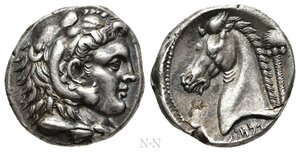
SICILY. Entella. Punic issues. Tetradrachm (Circa 300-289 BC) - SICILY. Entella. Punic issues. Tetradrachm (Circa 300-289 BC). Obv: Head of Herakles right, wearing lion skin.Rev: Head of horse left; palm tree to right; Punic legend below.Jenkins, Punic, Series 5a, 319 (O103/R262); CNP 271; HGC 2, 293.Ex H. H. Kricheldorf VII (1959), lot 136.
The foundation of Entella is traced back to Acestes, son of the river god Krimisos and a Trojan woman or, according to other sources to Prince Elymus, son of Anchises and brother of Aeneas. The city stood on a summit overlooking the Belice valley. Records are scarce until the arrival of the Campanian mercenaries, recruited in 410 BC by the Carthaginians and discharged after the 405 BC treaty, then passed into the pay of Dionysius I of Syracuse. After liberating Dionysius on the island of Ortigia from the Punic siege, the were discharged with rich gifts and settled in various cities on the island. In 404 a group of these mercenaries seized Entella, exterminating the entire male population, and began to mint their own coinage. From then on they implemented a generally pro-Carthaginian policy and, in 398 B.C., were able to stop Syracusan siege attempts with the help of the Punic. The strategic location of the fortress of Entella was coveted for its control of the valley below, and this led to several siege attempts: in 345 it was attacked by the Carthaginians led by General Annon, then in 342 the city was taken by the Syracusans commanded by Timoleon, but in 338 it fell back under Punic influence. During the First Punic War the city was destroyed by the Carthaginians. The “Decrees of Entella,” which were requests for help engraved on bronze slabs, from the inhabitants to neighboring cities, date from this period. In 263 Entella was conquered by the Romans and enjoyed a new period of prosperity until the second century BC when it was abandoned. Condition: Good very fine.Weight: 16.78 g. Diameter: 26 mm. Estimate: € 1000
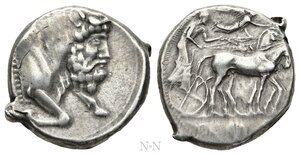
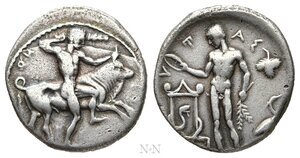
SICILY. Selinos. Didrachm (Circa 455-440 BC) - SICILY. Selinos. Didrachm (Circa 455-440 BC). Obv: ΣΕΛΙNONTION. Herakles standing right, holding Cretan Bull by its horns and preparing to strike it with club.Rev: HYΨAΣ. River god Hypsas standing left, holding branch and sacrificing with patera over serpent-entwined altar to left; to right, selinon leaf over heron right.SNG ANS 702-7; HGC 2, 1224. Condition: Near very fine.Weight: 8.40 g. Diameter: 24 mm. Estimate: € 500
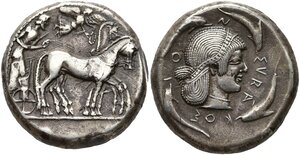
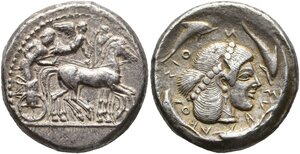
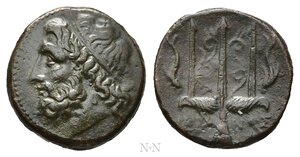
SICILY. Syracuse. Hieron II (275-215 BC). Ae - SICILY. Syracuse. Hieron II (275-215 BC). Ae. Obv: Head of Poseidon left, wearing tainia.Rev: ΙΕΡΩ - ΝΟΣ. Ornamented trident head flanked by two dolphins.CNS 197; HGC 2, 1550. Condition: Very fine.Weight: 6.58 g. Diameter: 20 mm. Estimate: € 50
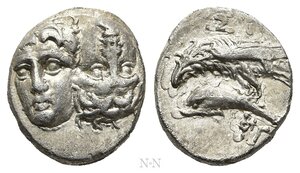
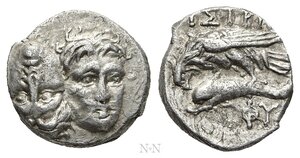
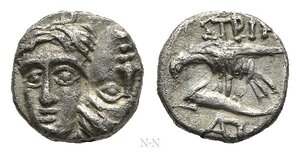
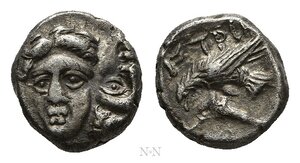
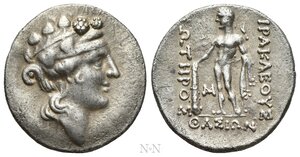
MOESIA. Istros. Drachm (4th century BC) - MOESIA. Istros. Drachm (4th century BC). Obv: Facing male heads, the right inverted.Rev: ΙΣΤΡΙΗ. Sea eagle left, grasping dolphin with talons; ΦY below.SNG BM Black Sea 256; SNG Stancomb 148 var. (right head inverted); HGC 3.2, 1803. Condition: Very fine.Weight: 5.07 g. Diameter: 18 mm. Estimate: € 100
MOESIA. Istros. Drachm (4th century BC) - MOESIA. Istros. Drachm (4th century BC). Obv: Facing male heads, the left inverted.Rev: Sea eagle left, grasping dolphin with talons; ΦY below.SNG BM Black Sea 256 var. (right head inverted); SNG Stancomb 148; HGC 3.2, 1803. Condition: Good very fine.Weight: 5.86 g. Diameter: 18 mm. Estimate: € 100
MOESIA. Istros. Trihemiobol or 1/4 Drachm (4th century BC) - MOESIA. Istros. Trihemiobol or 1/4 Drachm (4th century BC). Obv: Facing male heads, the right inverted.Rev: IΣTPIH. Sea-eagle left, grasping dolphin with talons; monogram below.SNG BM Black Sea 250; HGC 3.2, 1807. Condition: Extremely fine.Weight: 1.20 g. Diameter: 10 mm. Estimate: € 100
MOESIA. Istros. Trihemiobol or 1/4 Drachm (4th century BC) - MOESIA. Istros. Trihemiobol or 1/4 Drachm (4th century BC). Obv: Facing male heads, the right inverted.Rev: IΣTPIH. Sea-eagle left, grasping dolphin with talons; Θ (?) below dolphin.SNG BM Black Sea 250 var. (control); SNG Stancomb 143 var. (same); HGC 3.2, 1807. Condition: Very fine.Weight: 1.56 g. Diameter: 10 mm. Estimate: € 100
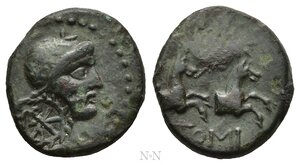
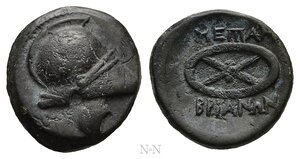
MOESIA INFERIOR. Tomis. Ae (2nd century BC) - MOESIA INFERIOR. Tomis. Ae (2nd century BC). Obv: Laureate head of Zeus right; c/m: monogram within wreath in round incuse.Rev: TOMI. Two horse foreparts right, each surmounted by star.AMNG I 2461; HGC 3.2, 1939. Condition: Very fine.Weight: 6.95 g. Diameter: 22 mm. Estimate: € 50
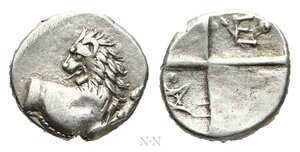
THRACE. Chersonesos. Hemidrachm (Circa 386-338 BC) - THRACE. Chersonesos. Hemidrachm (Circa 386-338 BC). Obv: Forepart of lion right, head left.Rev: Quadripartite incuse square with alternating raised and sunken quarters; pellet and monogram VE in one quarter, pentagram and pellet in opposite quarter.McClean 4071; HGC 3.2, 1437. Condition: Very fine.Weight: 2.56 g. Diameter: 14 mm. Estimate: € 100
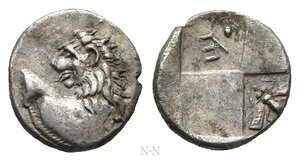
THRACE. Chersonesos. Hemidrachm (Circa 386-338 BC) - THRACE. Chersonesos. Hemidrachm (Circa 386-338 BC). Obv: Forepart of lion right, head left.Rev: Quadripartite incuse square with alternating raised and sunken quarters; pellet and monogram VE in one quarter, bee in opposite quarter.McClean 4114-6; SNG Copenhagen 830; HGC 3.2, 1437. Condition: Very fine.Weight: 1.53 g. Diameter: 15 mm. Estimate: € 100
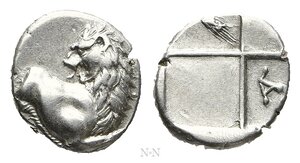
THRACE. Chersonesos. Hemidrachm (Circa 386-338 BC) - THRACE. Chersonesos. Hemidrachm (Circa 386-338 BC). Obv: Forepart of lion right, head left.Rev: Quadripartite incuse square with alternating raised and sunken quarters; monogram in one sunken quarter, grain ear in the other.Cf. McClean 4089; HGC 3.2, 1437. Condition: Very fine.Weight: 2.35 g. Diameter: 13 mm. Estimate: € 50
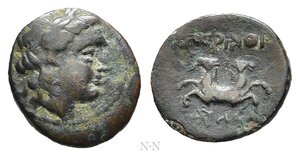
THRACE. Perinthos. Ae (3rd century BC) - THRACE. Perinthos. Ae (3rd century BC). Obv: Laureate head of Apollo right.Rev: ΠΕΡΙΝΘΙΩΝ. Conjoined foreparts of horses facing outward; monogram below.Cf. Schönert-Geiss 14; HGC 3.2, 1626.Very rare Condition: Near very fine.Weight: 2.07 g. Diameter: 15 mm. Estimate: € 50