Banner Naumann 173
Risultati: 51
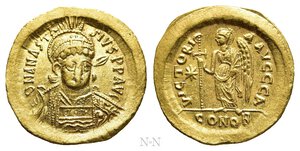
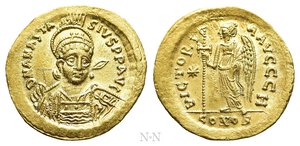
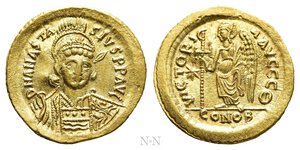
ANASTASIUS I (491-518). GOLD Solidus. Constantinople - ANASTASIUS I (491-518). GOLD Solidus. Constantinople. Obv: D N ANASTASIVS P P AVG. Helmeted and cuirassed bust facing slightly right, holding spear and shield decorated with horseman motif.Rev: VICTORIA AVGGG A / CONOB. Victory standing left, holding long staff surmounted by reversed staurogram; star to left.MIBE 7; DOC 7a; Sear 5.Anastasius was nicknamed ‘dikoros’ (=two pupils) because of the different color of his eyes. When Zeno died, since he had no living heirs, his widow Ariadne had the difficult choice of appointing a successor to the people, who demanded an orthodox emperor. Ariadne eventually chose Anastasius, about whom we only know that he was a palace official, responsible for maintaining silence during important sacred ceremonies. After Zeno's funeral, Anastasius received the crown from the patriarch, was acclaimed augustus by the crowd in 491, and married Ariadne to legitimize the succession. His main task was to restore Constantinople's finances, which had been severely affected during his predecessor's reign. He managed to balance the budget despite a policy of tax relief, making the people pay less tax, but in cash rather than in kind. This favored the cities but was to the detriment of the people living in the countryside, and in fact many revolts broke out in rural areas. He also revolutionized the tax collection system by introducing the ‘vindices’ and encouraged the return of copper folles, which began to circulate again with a precise value ratio to the gold solidus. Anastasius demonstrated wisdom and competence, and the Byzantine Empire flourished once again. A great amount of money flowed into the state treasury, which favored the work of his successors, particularly Justinian I. With regard to foreign policy, Anastasius reached an agreement with Theodoric, king of the Roman-Barbarian kingdom in Italy, promoting trade that benefited both kingdoms. Despite his undeniable qualities as an administrator, Anastasius was constantly threatened by intrigues and uprisings. He was also engaged in a long war against the Persians (502-506), which ended with a peace treaty and the construction of the Anastasian Wall to defend Constantinople along the Propontis and the Black Sea. However, the internal situation was more delicate. The emperor was not orthodox, as the people had asked Ariadne, but a convinced Monophysite, and he attracted much dissent, partly because he contributed to distancing the Eastern Church from that of Rome by interfering in the nomination of the new pope. The discontent led to a civil war (513-515) with the insurrection of Vitalian at the head of the Isaurians, who was eventually defeated by the general Marinus of Syria. Anastasius died in 518 at the age of almost ninety, but left no children to succeed him to the throne. Condition: Very fine.Weight: 4.44 g. Diameter: 21 mm.Estimate: € 850
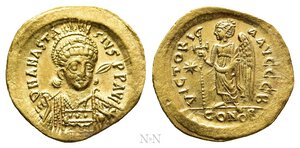
ANASTASIUS I (491-518). GOLD Solidus. Constantinople - ANASTASIUS I (491-518). GOLD Solidus. Constantinople. Obv: D N ANASTASIVS P P AVG. Helmeted and cuirassed bust facing slightly right, holding spear and shield decorated with horseman motif.Rev: VICTORIA AVGGG B / CONOB. Victory standing left, holding long staff surmounted by reversed staurogram; star to left.MIBE 7; DOC 7b; Sear 5.Anastasius was nicknamed ‘dikoros’ (=two pupils) because of the different color of his eyes. When Zeno died, since he had no living heirs, his widow Ariadne had the difficult choice of appointing a successor to the people, who demanded an orthodox emperor. Ariadne eventually chose Anastasius, about whom we only know that he was a palace official, responsible for maintaining silence during important sacred ceremonies. After Zeno's funeral, Anastasius received the crown from the patriarch, was acclaimed augustus by the crowd in 491, and married Ariadne to legitimize the succession. His main task was to restore Constantinople's finances, which had been severely affected during his predecessor's reign. He managed to balance the budget despite a policy of tax relief, making the people pay less tax, but in cash rather than in kind. This favored the cities but was to the detriment of the people living in the countryside, and in fact many revolts broke out in rural areas. He also revolutionized the tax collection system by introducing the ‘vindices’ and encouraged the return of copper folles, which began to circulate again with a precise value ratio to the gold solidus. Anastasius demonstrated wisdom and competence, and the Byzantine Empire flourished once again. A great amount of money flowed into the state treasury, which favored the work of his successors, particularly Justinian I. With regard to foreign policy, Anastasius reached an agreement with Theodoric, king of the Roman-Barbarian kingdom in Italy, promoting trade that benefited both kingdoms. Despite his undeniable qualities as an administrator, Anastasius was constantly threatened by intrigues and uprisings. He was also engaged in a long war against the Persians (502-506), which ended with a peace treaty and the construction of the Anastasian Wall to defend Constantinople along the Propontis and the Black Sea. However, the internal situation was more delicate. The emperor was not orthodox, as the people had asked Ariadne, but a convinced Monophysite, and he attracted much dissent, partly because he contributed to distancing the Eastern Church from that of Rome by interfering in the nomination of the new pope. The discontent led to a civil war (513-515) with the insurrection of Vitalian at the head of the Isaurians, who was eventually defeated by the general Marinus of Syria. Anastasius died in 518 at the age of almost ninety, but left no children to succeed him to the throne. Condition: Extremely fine.Weight: 4.47 g. Diameter: 21 mm.Estimate: € 900
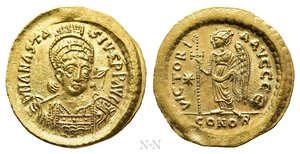
ANASTASIUS I (491-518). GOLD Solidus. Constantinople - ANASTASIUS I (491-518). GOLD Solidus. Constantinople. Obv: D N ANASTASIVS P P AVG. Helmeted and cuirassed bust facing slightly right, holding spear and shield decorated with horseman motif.Rev: VICTORIA AVGGG Є / CONOB. Victory standing left, holding long staff surmounted by reversed staurogram; star to left.MIBE 7; DOC 7e; Sear 5.Anastasius was nicknamed ‘dikoros’ (=two pupils) because of the different color of his eyes. When Zeno died, since he had no living heirs, his widow Ariadne had the difficult choice of appointing a successor to the people, who demanded an orthodox emperor. Ariadne eventually chose Anastasius, about whom we only know that he was a palace official, responsible for maintaining silence during important sacred ceremonies. After Zeno's funeral, Anastasius received the crown from the patriarch, was acclaimed augustus by the crowd in 491, and married Ariadne to legitimize the succession. His main task was to restore Constantinople's finances, which had been severely affected during his predecessor's reign. He managed to balance the budget despite a policy of tax relief, making the people pay less tax, but in cash rather than in kind. This favored the cities but was to the detriment of the people living in the countryside, and in fact many revolts broke out in rural areas. He also revolutionized the tax collection system by introducing the ‘vindices’ and encouraged the return of copper folles, which began to circulate again with a precise value ratio to the gold solidus. Anastasius demonstrated wisdom and competence, and the Byzantine Empire flourished once again. A great amount of money flowed into the state treasury, which favored the work of his successors, particularly Justinian I. With regard to foreign policy, Anastasius reached an agreement with Theodoric, king of the Roman-Barbarian kingdom in Italy, promoting trade that benefited both kingdoms. Despite his undeniable qualities as an administrator, Anastasius was constantly threatened by intrigues and uprisings. He was also engaged in a long war against the Persians (502-506), which ended with a peace treaty and the construction of the Anastasian Wall to defend Constantinople along the Propontis and the Black Sea. However, the internal situation was more delicate. The emperor was not orthodox, as the people had asked Ariadne, but a convinced Monophysite, and he attracted much dissent, partly because he contributed to distancing the Eastern Church from that of Rome by interfering in the nomination of the new pope. The discontent led to a civil war (513-515) with the insurrection of Vitalian at the head of the Isaurians, who was eventually defeated by the general Marinus of Syria. Anastasius died in 518 at the age of almost ninety, but left no children to succeed him to the throne. Condition: Near mint state.Weight: 4.50 g. Diameter: 21 mm.Estimate: € 900
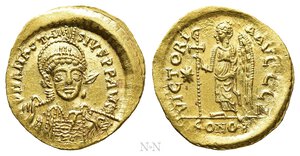
ANASTASIUS I (491-518). GOLD Solidus. Constantinople - ANASTASIUS I (491-518). GOLD Solidus. Constantinople. Obv: D N ANASTASIVS P P AVG. Helmeted and cuirassed bust facing slightly right, holding spear and shield decorated with horseman motif.Rev: VICTORIA AVGGG Z / CONOB. Victory standing left, holding long staff surmounted by reversed staurogram; star to left.MIBE 7; DOC 7g; Sear 5.Anastasius was nicknamed ‘dikoros’ (=two pupils) because of the different color of his eyes. When Zeno died, since he had no living heirs, his widow Ariadne had the difficult choice of appointing a successor to the people, who demanded an orthodox emperor. Ariadne eventually chose Anastasius, about whom we only know that he was a palace official, responsible for maintaining silence during important sacred ceremonies. After Zeno's funeral, Anastasius received the crown from the patriarch, was acclaimed augustus by the crowd in 491, and married Ariadne to legitimize the succession. His main task was to restore Constantinople's finances, which had been severely affected during his predecessor's reign. He managed to balance the budget despite a policy of tax relief, making the people pay less tax, but in cash rather than in kind. This favored the cities but was to the detriment of the people living in the countryside, and in fact many revolts broke out in rural areas. He also revolutionized the tax collection system by introducing the ‘vindices’ and encouraged the return of copper folles, which began to circulate again with a precise value ratio to the gold solidus. Anastasius demonstrated wisdom and competence, and the Byzantine Empire flourished once again. A great amount of money flowed into the state treasury, which favored the work of his successors, particularly Justinian I. With regard to foreign policy, Anastasius reached an agreement with Theodoric, king of the Roman-Barbarian kingdom in Italy, promoting trade that benefited both kingdoms. Despite his undeniable qualities as an administrator, Anastasius was constantly threatened by intrigues and uprisings. He was also engaged in a long war against the Persians (502-506), which ended with a peace treaty and the construction of the Anastasian Wall to defend Constantinople along the Propontis and the Black Sea. However, the internal situation was more delicate. The emperor was not orthodox, as the people had asked Ariadne, but a convinced Monophysite, and he attracted much dissent, partly because he contributed to distancing the Eastern Church from that of Rome by interfering in the nomination of the new pope. The discontent led to a civil war (513-515) with the insurrection of Vitalian at the head of the Isaurians, who was eventually defeated by the general Marinus of Syria. Anastasius died in 518 at the age of almost ninety, but left no children to succeed him to the throne. Condition: Near mint state.Weight: 4.52 g. Diameter: 21 mm.Estimate: € 900
ANASTASIUS I (491-518). GOLD Solidus. Constantinople - ANASTASIUS I (491-518). GOLD Solidus. Constantinople. Obv: D N ANASTASIVS P P AVG. Helmeted and cuirassed bust facing slightly right, holding spear and shield decorated with horseman motif.Rev: VICTORIA AVGGG H / CONOB. Victory standing left, holding long staff surmounted by reversed staurogram; star to left.MIBE 7; DOC 7h; Sear 5.Anastasius was nicknamed ‘dikoros’ (=two pupils) because of the different color of his eyes. When Zeno died, since he had no living heirs, his widow Ariadne had the difficult choice of appointing a successor to the people, who demanded an orthodox emperor. Ariadne eventually chose Anastasius, about whom we only know that he was a palace official, responsible for maintaining silence during important sacred ceremonies. After Zeno's funeral, Anastasius received the crown from the patriarch, was acclaimed augustus by the crowd in 491, and married Ariadne to legitimize the succession. His main task was to restore Constantinople's finances, which had been severely affected during his predecessor's reign. He managed to balance the budget despite a policy of tax relief, making the people pay less tax, but in cash rather than in kind. This favored the cities but was to the detriment of the people living in the countryside, and in fact many revolts broke out in rural areas. He also revolutionized the tax collection system by introducing the ‘vindices’ and encouraged the return of copper folles, which began to circulate again with a precise value ratio to the gold solidus. Anastasius demonstrated wisdom and competence, and the Byzantine Empire flourished once again. A great amount of money flowed into the state treasury, which favored the work of his successors, particularly Justinian I. With regard to foreign policy, Anastasius reached an agreement with Theodoric, king of the Roman-Barbarian kingdom in Italy, promoting trade that benefited both kingdoms. Despite his undeniable qualities as an administrator, Anastasius was constantly threatened by intrigues and uprisings. He was also engaged in a long war against the Persians (502-506), which ended with a peace treaty and the construction of the Anastasian Wall to defend Constantinople along the Propontis and the Black Sea. However, the internal situation was more delicate. The emperor was not orthodox, as the people had asked Ariadne, but a convinced Monophysite, and he attracted much dissent, partly because he contributed to distancing the Eastern Church from that of Rome by interfering in the nomination of the new pope. The discontent led to a civil war (513-515) with the insurrection of Vitalian at the head of the Isaurians, who was eventually defeated by the general Marinus of Syria. Anastasius died in 518 at the age of almost ninety, but left no children to succeed him to the throne. Condition: Extremely fine.Weight: 4.46 g. Diameter: 22 mm.Estimate: € 900
ANASTASIUS I (491-518). GOLD Solidus. Constantinople - ANASTASIUS I (491-518). GOLD Solidus. Constantinople. Obv: D N ANASTASIVS P P AVG. Helmeted and cuirassed bust facing slightly right, holding spear and shield decorated with horseman motif.Rev: VICTORIA AVGGG Θ / CONOB. Victory standing left, holding long staff surmounted by reversed staurogram; star to left.MIBE 7; DOC 7i; Sear 5.Anastasius was nicknamed ‘dikoros’ (=two pupils) because of the different color of his eyes. When Zeno died, since he had no living heirs, his widow Ariadne had the difficult choice of appointing a successor to the people, who demanded an orthodox emperor. Ariadne eventually chose Anastasius, about whom we only know that he was a palace official, responsible for maintaining silence during important sacred ceremonies. After Zeno's funeral, Anastasius received the crown from the patriarch, was acclaimed augustus by the crowd in 491, and married Ariadne to legitimize the succession. His main task was to restore Constantinople's finances, which had been severely affected during his predecessor's reign. He managed to balance the budget despite a policy of tax relief, making the people pay less tax, but in cash rather than in kind. This favored the cities but was to the detriment of the people living in the countryside, and in fact many revolts broke out in rural areas. He also revolutionized the tax collection system by introducing the ‘vindices’ and encouraged the return of copper folles, which began to circulate again with a precise value ratio to the gold solidus. Anastasius demonstrated wisdom and competence, and the Byzantine Empire flourished once again. A great amount of money flowed into the state treasury, which favored the work of his successors, particularly Justinian I. With regard to foreign policy, Anastasius reached an agreement with Theodoric, king of the Roman-Barbarian kingdom in Italy, promoting trade that benefited both kingdoms. Despite his undeniable qualities as an administrator, Anastasius was constantly threatened by intrigues and uprisings. He was also engaged in a long war against the Persians (502-506), which ended with a peace treaty and the construction of the Anastasian Wall to defend Constantinople along the Propontis and the Black Sea. However, the internal situation was more delicate. The emperor was not orthodox, as the people had asked Ariadne, but a convinced Monophysite, and he attracted much dissent, partly because he contributed to distancing the Eastern Church from that of Rome by interfering in the nomination of the new pope. The discontent led to a civil war (513-515) with the insurrection of Vitalian at the head of the Isaurians, who was eventually defeated by the general Marinus of Syria. Anastasius died in 518 at the age of almost ninety, but left no children to succeed him to the throne. Condition: Near extremely fine.Weight: 4.49 g. Diameter: 21 mm.Estimate: € 900
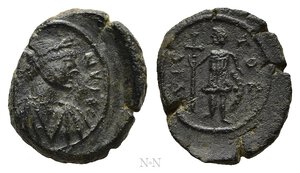
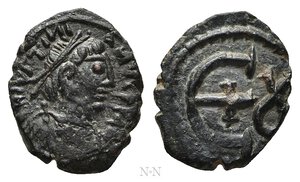
JUSTIN I (518-527). Pentanummium. Cherson - JUSTIN I (518-527). Pentanummium. Cherson. Obv: D N IVSTINVS PP. Diademed, draped and cuirassed bust right.Rev: VICTOR. Emperor standing facing, head left, holding long cross and resting on grounded shield.MIBE 77; DOC -; Sear 112B. Condition: Very fine.Weight: 3.04 g. Diameter: 16 mm.Estimate: € 50
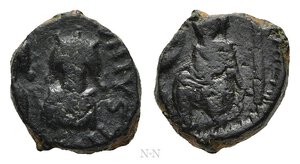
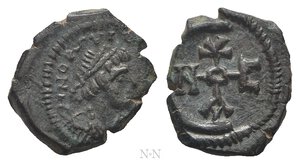
JUSTIN I & JUSTINIAN I (527). Pentanummium. Antioch - JUSTIN I & JUSTINIAN I (527). Pentanummium. Antioch. Obv: D N IVSTIN ET IVSTINIANVS PP A. Diademed, draped and cuirassed bust of Justin and Justinian facing.Rev: Є (retrograde). Tyche of Antioch seated left; all within shrine.MIBE 13; DOC 17; Sear 133. Condition: Good fine.Weight: 2.52 g. Diameter: 12 mm.Estimate: € 50
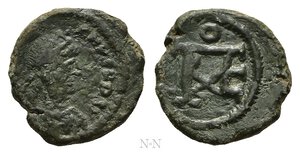
JUSTINIAN I (527-565). Pentanummium. Cherson - JUSTINIAN I (527-565). Pentanummium. Cherson. Obv: D N IVSTINIANVS P P AV. Diademed, draped and cuirassed bust right.Rev: Monogram of Cherson.MIBE 253; DOC 108; Sear 197. Condition: Very fine.Weight: 2.24 g. Diameter: 15 mm.Estimate: € 100
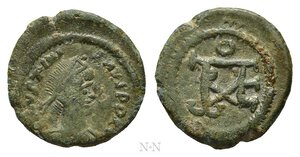
JUSTINIAN I (527-565). Pentanummium. Cherson - JUSTINIAN I (527-565). Pentanummium. Cherson. Obv: D N IVSTINIANVS P P AV. Diademed, draped and cuirassed bust right.Rev: Monogram of Cherson.MIBE 253; DOC 108; Sear 197. Condition: Very fine.Weight: 1.94 g. Diameter: 14 mm.Estimate: € 50
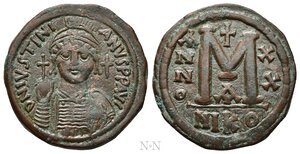
JUSTINIAN I (527-565). Follis. Nicomedia. Dated RY 20 (546/7) - JUSTINIAN I (527-565). Follis. Nicomedia. Dated RY 20 (546/7). Obv: D N IVSTINIANVS P P AVG. Helmeted and cuirassed bust facing, holding globus cruciger and shield decorated with horseman motif; cross to right.Rev: Large M; A/N/N/O - X/X across field, cross above, A below; NIKO.MIBE 112; DOC 126a; Sear 201. Condition: Very fine.Weight: 20.13 g. Diameter: 34 mm.Estimate: € 50
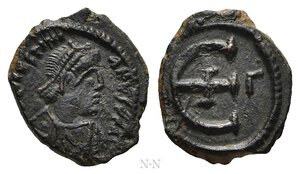
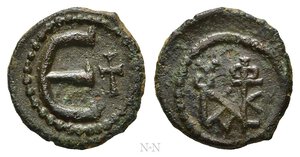
JUSTINIAN I (527-565). Pentanummium. Theoupolis (Antioch) - JUSTINIAN I (527-565). Pentanummium. Theoupolis (Antioch). Obv: D N IVSTINIANVS P P AVG. Diademed, draped and cuirassed bust right.Rev: Large Є with internal cross; Γ to right.MIBE 141; DOC 268c; Sear 241. Condition: Very fine.Weight: 2.85 g. Diameter: 17 mm.Estimate: € 50
JUSTINIAN I (527-565). Pentanummium. Theoupolis (Antioch) - JUSTINIAN I (527-565). Pentanummium. Theoupolis (Antioch). Obv: D N IVSTIИIAИVS P P AV. Diademed, draped and cuirassed bust right.Rev: Large Є with internal cross; large γ to right.MIBE 162; DOC 270; Sear 243. Condition: Good very fine.Weight: 2.16 g. Diameter: 17 mm.Estimate: € 50
JUSTINIAN I (527-565). Pentanummium. Theoupolis (Antioch) - JUSTINIAN I (527-565). Pentanummium. Theoupolis (Antioch). Obv: Blundered legend. Diademed, draped and cuirassed bust right.Rev: Large C containing cruciform monogram.MIBE 163; DOC 272; Sear 245. Condition: Good very fine.Weight: 2.17 g. Diameter: 15 mm.Estimate: € 50
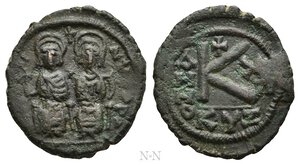
JUSTIN II, with SOPHIA (565-578). Half Follis. Cyzicus. Dated RY 11 (575/6) - JUSTIN II, with SOPHIA (565-578). Half Follis. Cyzicus. Dated RY 11 (575/6). Obv: D N IVSTINVS P P A. Justin and Sophia seated facing on double throne, holding globus cruciger and cruciform sceptre, respectively; cross above.Rev: Large K; A/N/N/O - XI across field; cross above; KYZ in exergue.MIBE 51; DOC 134; Sear 373. Condition: Extremely fine.Weight: 6.24 g. Diameter: 24 mm.Estimate: € 50
JUSTIN II (565-578). Pentanummium. Theoupolis (Antioch) - JUSTIN II (565-578). Pentanummium. Theoupolis (Antioch). Obv: Monogram.Rev: Large Є; cross to right.MIBE 65a; DOC 186; Sear 386. Condition: Good very fine.Weight: 2.34 g. Diameter: 17 mm.Estimate: € 50
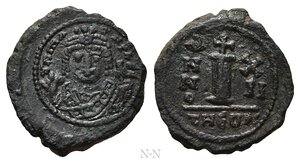
MAURICE TIBERIUS (582-602). Decanummium. Theoupolis (Antioch). Dated RY 12 (594/5) - MAURICE TIBERIUS (582-602). Decanummium. Theoupolis (Antioch). Dated RY 12 (594/5). Obv: D N mAЧ CN P AЧ. Crowned bust facing, wearing consular robe and holding mappa and eagle-tipped sceptre.Rev: Large I; cross above, A/N/N/O - X/II across field; TҺЄЧP'.MIBE 102C; DOC (205); Sear 537. Condition: Very fine.Weight: 3.47 g. Diameter: 20 mm.Estimate: € 50
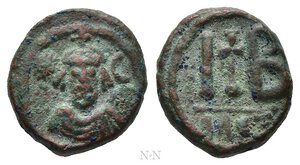
HERACLIUS (610-641). 12 Nummi. Alexandria - HERACLIUS (610-641). 12 Nummi. Alexandria. Obv: Draped and cuirassed bust facing, wearing crown surmounted by cross; eight-rayed star to left, crescent to right.Rev: Large IB; cross on globe between; AΛЄΞ in exergue.MIB 202b; DOC 191; Sear 855.This coin was struck during the occupation of Egypt by the Sasanids who, in 614 besieged and conquered Jerusalem and in 615 also attempted to besiege Constantinople. Heraclius, with the help of the Church, led a series of victories over the army commanded by Shahrbarz, marching into the heart of the Persian empire and eventually conquering Nineve. In 628 King Khosrau II (possibly depicted on the obverse of this coin) was killed by his son Sheroe, who signed a peace treaty with Heraclius. Condition: Very fine.Weight: 6.28 g. Diameter: 12 mm.Estimate: € 50
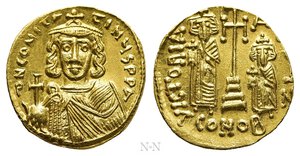
CONSTANTINE IV POGONATUS, with HERACLIUS and TIBERIUS (668-685). GOLD Solidus. Constantinople - CONSTANTINE IV POGONATUS, with HERACLIUS and TIBERIUS (668-685). GOLD Solidus. Constantinople. Obv: δ N CONSTATINЧS PP A. Crowned bust facing, wearing chlamys and holding globus cruciger.Rev: VICTORIA AVGЧ Z / CONOB. Cross potent set on three steps; crowned and draped figures of Heraclius and Tiberius standing facing to left and right, each holding globus cruciger.MIB 1A; DOC -; Sear 1147 var. (obv. legend). Condition: Extremely fine.Weight: 4.46 g. Diameter: 19 mm.Estimate: € 500
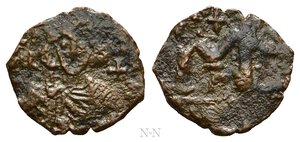
JUSTINIAN II (First reign, 685-695). Follis. Constantinople. Uncertain date - JUSTINIAN II (First reign, 685-695). Follis. Constantinople. Uncertain date. Obv: Crowned, draped and cuirassed bust facing, holding globus cruciger; cross to right.Rev: Large M; A/N/N/O - [...] across field; cross above, Γ below; [CON].Sear 1260. Condition: Good fine.Weight: 2.28 g. Diameter: 20 mm.Estimate: € 50
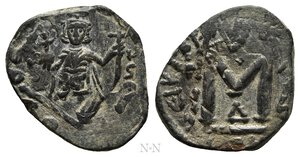
TIBERIUS III APSIMAR (698-705). Follis. Constantinople. Dated RY 4 (701/2) - TIBERIUS III APSIMAR (698-705). Follis. Constantinople. Dated RY 4 (701/2). Obv: Tiberius standing facing, holding globus cruciger and long cross.Rev: Large M; A/N/N/O - Δ across field; cross above, Δ below; CON.Sear 1367.Rare Condition: Good very fine.Weight: 4.47 g. Diameter: 24 mm.Estimate: € 100Rare
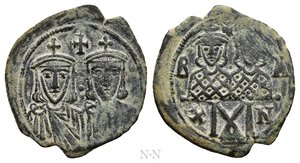
LEO IV, with CONSTANTINE VI, CONSTANTINE V and LEO III (775-780). Follis. Constantinople - LEO IV, with CONSTANTINE VI, CONSTANTINE V and LEO III (775-780). Follis. Constantinople. Obv: Crowned and draped facing busts of Constantine VI and Leo IV; cross above.Rev: B - A. Crowned facing busts of Leo III and Constantine V; cross above; in exergue, M above A and between X - N.DOC 4; Sear 1586. Condition: Very fine.Weight: 4.57 g. Diameter: 26 mm.Estimate: € 100
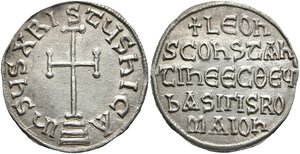
LEO V THE ARMENIAN (813-820). Miliaresion. Constantinople - LEO V THE ARMENIAN (813-820). Miliaresion. Constantinople. Obv: IhSЧS XRISTЧS nICA. Cross potent set on three steps.Rev: + LЄOn / S COnSTAn/TInЄ ЄC ΘЄЧ / bASILIS RO/mAIOn. Legend in five lines.DOC 4; Sear 1628. Condition: Uncirculated.Weight: 2.05 g. Diameter: 23 mm.Estimate: € 300
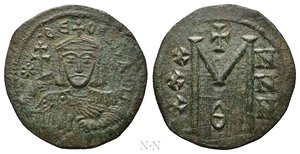
THEOPHILUS (829-842). Follis. Constantinople - THEOPHILUS (829-842). Follis. Constantinople. Obv: (star) ΘЄOFIL ЬASIL. Crowned and draped bust facing, holding patriarchal cross and akakia.Rev: Large M; X/X/X - N/N/N across field; cross above, Θ below.DOC 13; Sear 1666. Condition: Very fine.Weight: 8.00 g. Diameter: 29 mm.Estimate: € 50
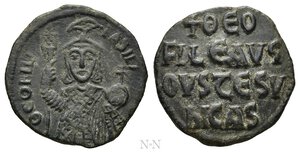
THEOPHILUS (829-842). Follis. Constantinople - THEOPHILUS (829-842). Follis. Constantinople. Obv: ΘЄOFIL' ЬASIL'. Facing bust, holding labarum and globus cruciger, and wearing crown surmounted by tufa.Rev: + ΘЄO / FILЄ AVς / OVSTЄ SV / ҺICAS. Legend in four lines.DOC 15; Sear 1667. Condition: Very fine.Weight: 6.89 g. Diameter: 26 mm.Estimate: € 50
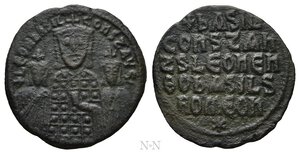
BASIL I the MACEDONIAN, with LEO VI and CONSTANTINE (867-886). Follis. Constantinople - BASIL I the MACEDONIAN, with LEO VI and CONSTANTINE (867-886). Follis. Constantinople. Obv: + LЄOҺ ЬASIL S COҺST AЧGG. Crowned half-length facing busts of Basil, wearing loros and holding akakia, between Leo and Constantine, each wearing chlamys.Rev: + ЬASIL / COҺSTAҺ / T S LЄOҺ ЄҺ / ΘO ЬASILS / ROMЄOҺ / (star). Legend in six lines.DOC 11; Sear 1712. Condition: Near very fine.Weight: 5.81 g. Diameter: 26 mm.Estimate: € 50
BASIL I THE MACEDONIAN (867-886). Ae. Cherson - BASIL I THE MACEDONIAN (867-886). Ae. Cherson. Obv: Large B; cross to right.Rev: Large Π°; cross to left and right.DOC 17c; Sear 1720. Condition: Near very fine.Weight: 2.00 g. Diameter: 16 mm.Estimate: € 50
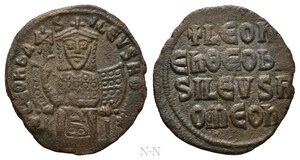
LEO VI the WISE (886-912). Follis. Constantinople - LEO VI the WISE (886-912). Follis. Constantinople. Obv: + LЄOҺ bASILЄVS ROM' (star). Leo enthroned facing, wearing crown, holding labarum and akakia.Rev: + LЄOn/ЄҺ ΘЄΟ bA/SILЄVS R/OMЄOҺ. Legend in four lines.DOC 5; Sear 1728. Condition: Very fine.Weight: 5.58 g. Diameter: 25 mm.Estimate: € 50
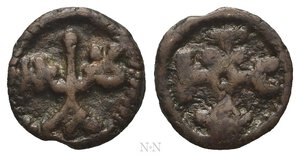
JOHN I TZIMISCES (969-976). Ae. Cherson - JOHN I TZIMISCES (969-976). Ae. Cherson. Obv: Cruciform monogram.Rev: Cruciform monogram.DOC 8; Sear 1794. Condition: Near very fine.Weight: 2.15 g. Diameter: 17 mm.Estimate: € 50
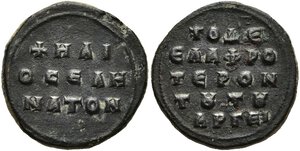
BYZANTINE AE WEIGHT. Time of Basil II and Constantine VIII (Circa 1005-1030). 1 Nomisma - BYZANTINE AE WEIGHT. Time of Basil II and Constantine VIII (Circa 1005-1030). 1 Nomisma. Obv: + HΛI / OCЄΛH / NATON. Legend in three lines.Rev: TO ΔЄ / ЄΛAΦPOTЄPON TƔTƔ / APΓЄI. Legend in five lines.BZS.1951.31.5.529; Zacos 2224a. Condition: Extremely fine.Weight: 4.28 g. Diameter: 19 mm.Estimate: € 500
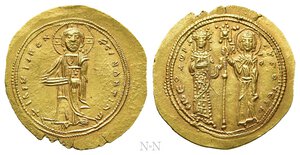
THEODORA (1055-1056). GOLD Histamenon Nomisma. Constantinople - THEODORA (1055-1056). GOLD Histamenon Nomisma. Constantinople. Obv: + IhS XIS REX REGNATIm. Christ Pantokrator standing facing on footstool, holding book.Rev: + ΘΕΟΔωPA AVΓOVCTA. Theodora, wearing crown and loros, and the Virgin standing facing, holding between them labarum with pellet on shaft.DOC 1a; Sear 1837.Theodora Porphyrogenita was born in 984, the youngest daughter of Emperor Constantine VIII and Helena. For many years she lived in the background of the imperial court, overshadowed by her elder sister Zoe, who was considered the more politically relevant of the two. Her life changed only when the deaths of Basil II and then her father placed her once again at the centre of imperial affairs. In her youth she had been promised to Otto III, but the marriage never took place: the emperor, struck by Zoe’s beauty, chose her instead. Teodora remained in the palace, watching the intrigues of the Macedonian dynasty unfold around her. Upon Constantine VIII’s death, he attempted to marry her to Romanos III Argyros, but Teodora refused, citing both consanguinity and the fact that Romanos already had a wife. The throne passed to Zoe and Romanos, whose marriage soon deteriorated into hostility, extravagance and plots. Teodora, still respected by part of the court, was accused of conspiracy and forced into a convent, where she remained for thirteen years. During Zoe’s turbulent reign with her husbands (Romanus III, Michael IV, and later Michael V Kalaphates) Teodora was repeatedly watched, confined and even compelled to take holy orders. But when Michael V attempted to exile Zoe, the people revolted. Both sisters were recalled, and Teodora was taken from the convent and crowned basilissa alongside Zoe. The joint rule of the Porphyrogenita sisters was brief but vigorous. Teodora, more disciplined and capable than Zoe, led reforms against corruption, improved administration and ordered the arrest and blinding of Michael V and his brother, ending their usurpation. When Zoe married Constantine IX Monomachos, Teodora was sidelined but retained considerable influence. The people regarded her as a stabilising figure, and in moments of crisis it was she who reassured the crowd and protected the Empire’s continuity. After the deaths of Zoe (1050) and Constantine IX (1055), Teodora, now elderly, returned to power. With determination she was proclaimed sole reigning Empress, the last sovereign of the Macedonian dynasty. She governed firmly, purging corrupt officials, controlling the aristocracy and intervening in ecclesiastical appointments, though her severity drew criticism. In 1056 she fell gravely ill. With no husband or heirs, she adopted Michael Bringas as her successor, but died shortly afterwards, on 31 August 1056, at the age of 76. Her death marked the end of the Macedonian dynasty, one of the most illustrious in Byzantine history. Condition: Extremely fine.Weight: 4.39 g. Diameter: 25 mm.Estimate: € 3000
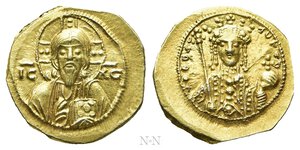
THEODORA (1055-1056). GOLD Tetarteron Nomisma. Constantinople - THEODORA (1055-1056). GOLD Tetarteron Nomisma. Constantinople. Obv: IC - XC. Bust of Christ Pantokrator facing.Rev: + ӨЄOΔω AVΓOV. Crowned bust of Theodora facing, wearing loros and holding globus cruciger and jeweled sceptre.DOC 2; Sear 1838.Theodora Porphyrogenita was born in 984, the youngest daughter of Emperor Constantine VIII and Helena. For many years she lived in the background of the imperial court, overshadowed by her elder sister Zoe, who was considered the more politically relevant of the two. Her life changed only when the deaths of Basil II and then her father placed her once again at the centre of imperial affairs. In her youth she had been promised to Otto III, but the marriage never took place: the emperor, struck by Zoe’s beauty, chose her instead. Teodora remained in the palace, watching the intrigues of the Macedonian dynasty unfold around her. Upon Constantine VIII’s death, he attempted to marry her to Romanos III Argyros, but Teodora refused, citing both consanguinity and the fact that Romanos already had a wife. The throne passed to Zoe and Romanos, whose marriage soon deteriorated into hostility, extravagance and plots. Teodora, still respected by part of the court, was accused of conspiracy and forced into a convent, where she remained for thirteen years. During Zoe’s turbulent reign with her husbands (Romanus III, Michael IV, and later Michael V Kalaphates) Teodora was repeatedly watched, confined and even compelled to take holy orders. But when Michael V attempted to exile Zoe, the people revolted. Both sisters were recalled, and Teodora was taken from the convent and crowned basilissa alongside Zoe. The joint rule of the Porphyrogenita sisters was brief but vigorous. Teodora, more disciplined and capable than Zoe, led reforms against corruption, improved administration and ordered the arrest and blinding of Michael V and his brother, ending their usurpation. When Zoe married Constantine IX Monomachos, Teodora was sidelined but retained considerable influence. The people regarded her as a stabilising figure, and in moments of crisis it was she who reassured the crowd and protected the Empire’s continuity. After the deaths of Zoe (1050) and Constantine IX (1055), Teodora, now elderly, returned to power. With determination she was proclaimed sole reigning Empress, the last sovereign of the Macedonian dynasty. She governed firmly, purging corrupt officials, controlling the aristocracy and intervening in ecclesiastical appointments, though her severity drew criticism. In 1056 she fell gravely ill. With no husband or heirs, she adopted Michael Bringas as her successor, but died shortly afterwards, on 31 August 1056, at the age of 76. Her death marked the end of the Macedonian dynasty, one of the most illustrious in Byzantine history. Condition: Good very fine.Weight: 4.01 g. Diameter: 20 mm.Estimate: € 2500
MICHAEL VII DUCAS (1071-1078). Miliaresion. Constantinople - MICHAEL VII DUCAS (1071-1078). Miliaresion. Constantinople. Obv: + ΘKЄ ROHΘЄI Tω Cω ΔOYΛ. The Theotokos (Virgin Mary) standing facing on dais, orans.Rev: + MIXAHΛ BACIΛ O ΔɄK. Michael, crowned and wearing military attire, standing facing, holding long cross and resting on hilt of sheathed sword; double border.DOC 7a; Sear 1873. Condition: Good very fine.Weight: 2.38 g. Diameter: 26 mm.Estimate: € 600
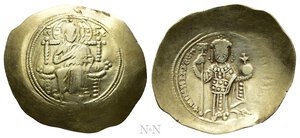
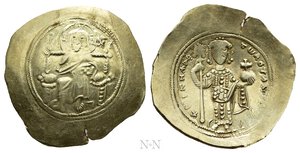
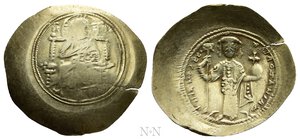
NICEPHORUS III BOTANIATES (1078-1081). EL Histamenon Nomisma. Constantinople - NICEPHORUS III BOTANIATES (1078-1081). EL Histamenon Nomisma. Constantinople. Obv: IC - XC. Christ Pantokrator seated facing on throne with back.Rev: +NIKHΦ ΔECΠ Tω BOTANIAT'. Nicephorus standing facing on daïs, holding labarum and globus cruciger.DOC 2; Sear 1882. Condition: Very fine.Weight: 4.29 g. Diameter: 32 mm.Estimate: € 400
NICEPHORUS III BOTANIATES (1078-1081). EL Histamenon Nomisma. Constantinople - NICEPHORUS III BOTANIATES (1078-1081). EL Histamenon Nomisma. Constantinople. Obv: IC - XC. Christ Pantokrator seated facing on throne with back.Rev: +NIKHΦ ΔECΠ Tω BOTANIAT'. Nicephorus standing facing on daïs, holding labarum and globus cruciger.DOC 2; Sear 1882. Condition: Very fine.Weight: 4.41 g. Diameter: 29 mm.Estimate: € 400
NICEPHORUS III BOTANIATES (1078-1081). EL Histamenon Nomisma. Constantinople - NICEPHORUS III BOTANIATES (1078-1081). EL Histamenon Nomisma. Constantinople. Obv: IC - XC. Christ Pantokrator seated facing on throne with back.Rev: +NIKHΦ ΔECΠ Tω BOTANIAT'. Nicephorus standing facing on daïs, holding labarum and globus cruciger.DOC 2; Sear 1882. Condition: Very fine.Weight: 4.32 g. Diameter: 31 mm.Estimate: € 400
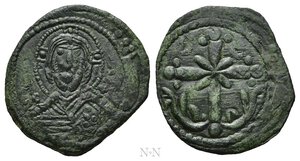
ANONYMOUS FOLLES. Class I. Attributed to Nicephorus III Botaniates (1078-1081) - ANONYMOUS FOLLES. Class I. Attributed to Nicephorus III Botaniates (1078-1081). Obv: IC - XC. Facing bust of Christ Pantokrator, holding book of Gospels.Rev: Latin cross with central X, globus and two pellets at the end of each extremity; crescents to upper left and right, floral scroll to lower left and right.DOC I; Sear 1889. Condition: Very fine.Weight: 3.45 g. Diameter: 26 mm.Estimate: € 50
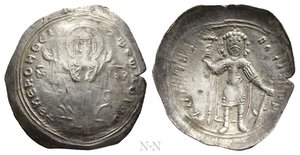
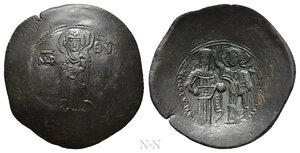
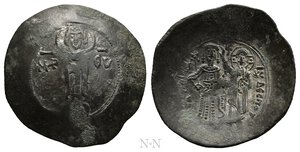
ANDRONICUS I COMNENUS (1183-1185). Trachy. Constantinople - ANDRONICUS I COMNENUS (1183-1185). Trachy. Constantinople. Obv: MP - ΘV. The Virgin Mary standing facing on daïs, holding bust of Holy Infant on breast.Rev: ANΔPONIKOC ΔЄCΠOTHC. Andronicus standing facing, holding labarum and globus cruciger, and being crowned by Christ to right.DOC 3; Sear 1985. Condition: Very fine.Weight: 4.15 g. Diameter: 30 mm.Estimate: € 50
ANDRONICUS I COMNENUS (1183-1185). Trachy. Constantinople - ANDRONICUS I COMNENUS (1183-1185). Trachy. Constantinople. Obv: MP - ΘV. The Virgin Mary standing facing on daïs, holding bust of Holy Infant on breast.Rev: ANΔPONIKOC ΔЄCΠOTHC. Andronicus standing facing, holding labarum and globus cruciger, and being crowned by Christ to right.Sear 1985. Condition: Good very fine.Weight: 4.32 g. Diameter: 31 mm.Estimate: € 50
LATIN EMPIRE (1204-1261). Trachy. Constantinople. Large module - LATIN EMPIRE (1204-1261). Trachy. Constantinople. Large module. Obv: St. Peter standing facing, holding cruciform sceptre and two keys.Rev: The Theotokos Hagiosoritissa (Virgin Mary) standing slightly right, orans; manus Dei to upper right.Sear 2039. Condition: Very fine.Weight: 2.06 g. Diameter: 27 mm.Estimate: € 50
LATIN EMPIRE (1204-1261). Trachy. Constantinople. Small module - LATIN EMPIRE (1204-1261). Trachy. Constantinople. Small module. Obv: Half-length figure of St. Nicholas facing, orans.Rev: St. John the Baptist standing facing, holding short patriarchal cross.Sear 2052. Condition: Very fine.Weight: 1.10 g. Diameter: 20 mm.Estimate: € 50
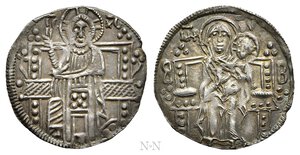
ANONYMOUS PALAEOLOGAN COINAGE. Basilikon (Circa 1280-1350). Constantinople - ANONYMOUS PALAEOLOGAN COINAGE. Basilikon (Circa 1280-1350). Constantinople. Obv: IC - XC. Christ Pantokrator seated facing on throne, holding book of Gospels.Rev: MHP - ΘV. The Theotokos seated facing on throne, holding infant Christ; (retrograde) B - B flanking.DOC V 544-8; Sear 2587.Very rare Condition: Good very fine.Weight: 2.09 g. Diameter: 21 mm.Estimate: € 500Very rare
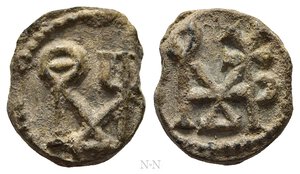
BYZANTINE LEAD TESSERA. Uncertain (6th-8th century) - BYZANTINE LEAD TESSERA. Uncertain (6th-8th century). Obv: Monogram.Rev: Monogram.. Condition: Good very fine.Weight: 9.71 g. Diameter: 19 mm.Estimate: € 50
BYZANTINE LEAD TESSERA. Uncertain (6th-8th century) - BYZANTINE LEAD TESSERA. Uncertain (6th-8th century). Obv: Monogram.Rev: Monogram.. Condition: Very fine.Weight: 4.38 g. Diameter: 24 mm.Estimate: € 50
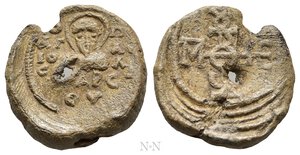
BYZANTINE LEAD SEALS. Theodoros, metropolitan bishop of Tarsos (7th century) - BYZANTINE LEAD SEALS. Theodoros, metropolitan bishop of Tarsos (7th century). Obv: O AΓIOC - ΠAVΛOC / TAPCOV. Nimbate bust of St. Paul facing.Rev: Cruciform monogram.Zacos/Veglery 2965A. Condition: Very fine.Weight: 11.38 g. Diameter: 25 mm.Estimate: € 50
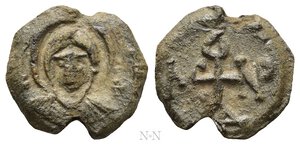
BYZANTINE LEAD SEALS. Uncertain (7th-8th century) - BYZANTINE LEAD SEALS. Uncertain (7th-8th century). Obv: Facing nimbate bust; cross to left and right.Rev: Cruciform monogram.. Condition: Very fine.Weight: 7.29 g. Diameter: 21 mm.Estimate: € 50
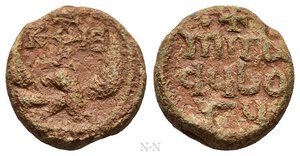
BYZANTINE LEAD SEALS. Uncertain (Circa 7th-9th century). - BYZANTINE LEAD SEALS. Uncertain (Circa 7th-9th century).. Obv: Eagle standing facing, head right, with wings spread; above, cruciform invocative monogram.Rev: Legend in four lines.. Condition: Near very fine.Weight: 14.76 g. Diameter: 21 mm.Estimate: € 50
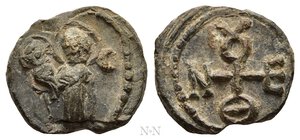
BYZANTINE LEAD SEALS. Uncertain (Circa 7th-11th century) - BYZANTINE LEAD SEALS. Uncertain (Circa 7th-11th century). Obv: Theotokos (Virgin Mary) standing facing, holding infant Christ; crescent to right.Rev: Cruciform monogram.. Condition: Good very fine.Weight: 6.85 g. Diameter: 21 mm.Estimate: € 50
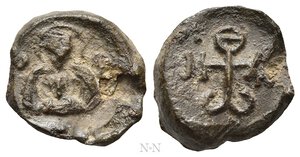
BYZANTINE LEAD SEALS. Uncertain (7th-12th century) - BYZANTINE LEAD SEALS. Uncertain (7th-12th century). Obv: Facing bust of the Virgin Mary, holding Christ medallion on breast.Rev: Cruciform monogram.. Condition: Very fine.Weight: 8.48 g. Diameter: 22 mm.Estimate: € 50
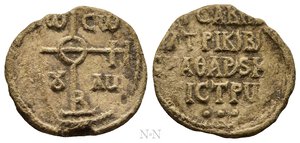
BYZANTINE LEAD SEALS. Sabinos(?) patrikios (8th-11th century) - BYZANTINE LEAD SEALS. Sabinos(?) patrikios (8th-11th century). Obv: Tω - Cω / ΔƔ - Λω. Cruciform monogram.Rev: ]CAB[...] / [Π]ATPIK B / [CΠ]AΘAP SM / ICTPω. Legend in four lines; three pellets below.. Condition: Very fine.Weight: 7.32 g. Diameter: 22 mm.Estimate: € 50
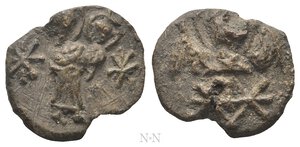
BYZANTINE LEAD SEALS. Anonymous (Circa 8th-12th century) - BYZANTINE LEAD SEALS. Anonymous (Circa 8th-12th century). Obv: Theotokos (Virgin Mary) standing facing, holding infant Christ; star to left and right.Rev: Facing bust of angel; star below.. Condition: Good very fine.Weight: 6.03 g. Diameter: 22 mm.Estimate: € 50