Info & contatti
Le mie offerte
Lotti osservati
Condizioni di vendita
Prezzi di spedizione
Metodi di pagamento
Esito stampabile
Sessione Live 1/2/2026 17:00:00 CET
Celtic Coins (1-21)
Greek Coins (22-190)
Roman Provincial Coins (191-309)
Roman Republican Coins (310-342)
Roman Imperial Coins (343-634)
Migration Period (635-638)
Byzantine Coins (639-682)
Medieval Coins (683-728)
World Coins (729-753)
Medals & Tokens (754-755)
Group Lots (756-840)

LUCANIA. Sybaris. Nomos - Stater (Circa 550-510 BC)
Classic Archaic Type
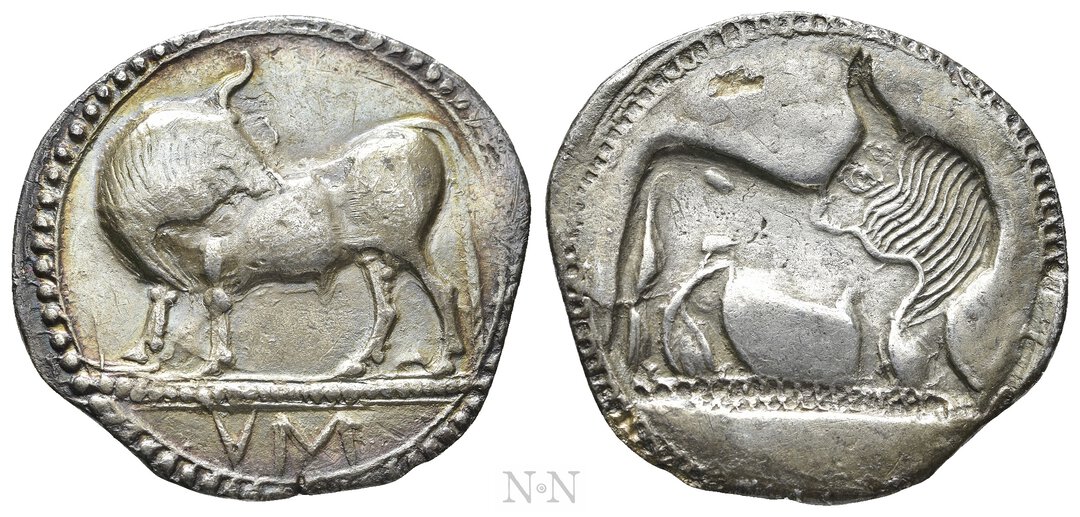

LUCANIA. Sybaris. Nomos - Stater (Circa 550-510 BC).
Obv: Bull standing left, head right; V M in exergue.
Rev: Incuse bull standing right, head left.
HN Italy 1729; SNG ANS 828-44; HGC 1, 1231.
The Greek colonial presence on the coasts of southern Italy and in Sicily generated very important cities and significant coin productions, initially characterized by the “incuse coin phenomenon,” which featured reverse types equal to obverse types, but in negative instead of relief. This was not simply an embossed worked foil, but an actual minting process, which involved the use of a reverse die with types rendered in relief. Various hypotheses have been advanced over time regarding this choice; there was probably a desire on the part of the Magna Graecia cities to differentiate these coins from those produced by the other Greek mints. Moreover, it could have been an expedient that made overstruck difficult, thus avoiding one of the possible causes of coin migration to places far from the issuing centers. This coin type was clearly intended for a local Magna Graecia market, as the hoards data show. Hence the existence of a circulation area controlled by the Magnogrean cities is assumed. The coinage of Sybaris is based on the “Achaean-Corinthian” weight system, with a stater of 7.80-8g, divided into three drachms, also used by Tarentum and other colonies of Achaean origin, such as Metapontion, Kroton and Kaulonia. The destruction of the city by Croton in 510 is a very important chronological term. Sybaris must have begun minting incuse coinage around 530 and may have been the first to introduce this type of coinage. The emblem chosen by the city is the bull with head reverted, found in an abundance of issues with different fractions (Drachms, Triobols and Obols).
Condition: Good very fine.
Weight: 7.69 g.
Diameter: 30 mm.
Obv: Bull standing left, head right; V M in exergue.
Rev: Incuse bull standing right, head left.
HN Italy 1729; SNG ANS 828-44; HGC 1, 1231.
The Greek colonial presence on the coasts of southern Italy and in Sicily generated very important cities and significant coin productions, initially characterized by the “incuse coin phenomenon,” which featured reverse types equal to obverse types, but in negative instead of relief. This was not simply an embossed worked foil, but an actual minting process, which involved the use of a reverse die with types rendered in relief. Various hypotheses have been advanced over time regarding this choice; there was probably a desire on the part of the Magna Graecia cities to differentiate these coins from those produced by the other Greek mints. Moreover, it could have been an expedient that made overstruck difficult, thus avoiding one of the possible causes of coin migration to places far from the issuing centers. This coin type was clearly intended for a local Magna Graecia market, as the hoards data show. Hence the existence of a circulation area controlled by the Magnogrean cities is assumed. The coinage of Sybaris is based on the “Achaean-Corinthian” weight system, with a stater of 7.80-8g, divided into three drachms, also used by Tarentum and other colonies of Achaean origin, such as Metapontion, Kroton and Kaulonia. The destruction of the city by Croton in 510 is a very important chronological term. Sybaris must have begun minting incuse coinage around 530 and may have been the first to introduce this type of coinage. The emblem chosen by the city is the bull with head reverted, found in an abundance of issues with different fractions (Drachms, Triobols and Obols).
Condition: Good very fine.
Weight: 7.69 g.
Diameter: 30 mm.