
Late Republican Period. Circa 2nd - 1st centuries BC. Tessera Lusoria of the Fool. (Bone, 52 x 6 x 3 mm, 5.35 g). Rod-shaped, with a rectangular cross-section and one rounded end decorated with concentric circles, pierced by a tiny hole at the junction with the body of the plaque; at both ends, horizontally, two pairs of incised lines can be seen as decoration. Inscription on two sides: NUGATOR / I. Cf. C. Hülsen, "Miscellanea epigrafica, XXI. Tessere lusorie", in "Mitteilungen des Deutschen Archäologischen Instituts, Römische Abteilung", Vol. 11, 1896, pp. 227-257. L. Pedroni, G. Devoto, "Tessere da una collezione privata", in "Archeologia Classica", Vol. 47, 1995, pp. 178-179, figg. 5a-6a (this specimen). Cf. G. Baratta, "Un set di Tesserae Lusoriae da Corfinium", in "Anuari de filologia. Antiqua et mediaevalia", Vol. 8, 2018, pp. 134‐147. Excellent state of preservation, with no evident fractures or chips. Very Rare specimen.From a British private collection, later passing into a Swiss collection in the early 2000s.The Tesserae Lusoriae were small rectangular rods, mostly made of bone and more rarely of ivory, engraved on both sides: on one face appeared a name, an adjective, or a playful epithet, while the other bore a Roman numeral. The known numbering ranges from I to LX, but the evidence suggests an organized game, with pieces numbered from I to XXV, accompanied by special tokens bearing the numbers XXX and LX, and possibly also counters numbered between XXVI and XXIX. The numerical variations and the presence of distinctive pieces indicate a structured game, although its rules and purpose remain unknown and perhaps forever lost. In Spain and Italy, specimens have been found both as isolated pieces and as complete sets placed within rich burials (for instance, at Vaste – 17 tesserae; Perugia – 16; Syracuse – 8; Corfinio – 6), suggesting a circulation among the upper-middle classes. While the deposition of a single piece may have held an apotropaic or commemorative meaning - linked to the fortune of the deceased or an ancestor, thus serving as an amulet - the inclusion of an entire set within a tomb may point to more complex symbolism. In the case of the 16 tesserae discovered in Perugia, their association with glass hemispheres, a mirror, decorative fragments from a cista, and inscribed pebbles has led scholars to suggest that the deceased, likely an extraordinary individual, might have been a magician in life.In short, one could almost say that these tesserae were either oracular tools used to divine the will of the gods, or the ancient precursors of Magic: The Gathering, created by Richard Garfield.
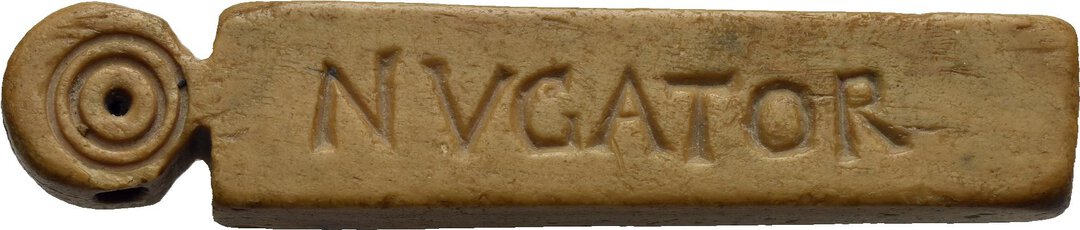
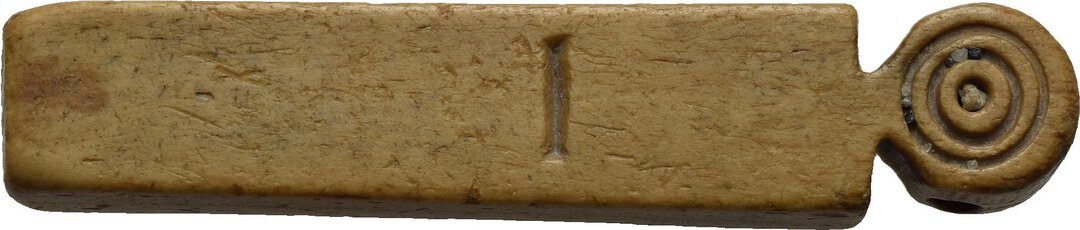
Late Republican Period. Circa 2nd - 1st centuries BC. Tessera Lusoria of the Fool. (Bone, 52 x 6 x 3 mm, 5.35 g). Rod-shaped, with a rectangular cross-section and one rounded end decorated with concentric circles, pierced by a tiny hole at the junction with the body of the plaque; at both ends, horizontally, two pairs of incised lines can be seen as decoration. Inscription on two sides: NUGATOR / I. Cf. C. Hülsen, "Miscellanea epigrafica, XXI. Tessere lusorie", in "Mitteilungen des Deutschen Archäologischen Instituts, Römische Abteilung", Vol. 11, 1896, pp. 227-257. L. Pedroni, G. Devoto, "Tessere da una collezione privata", in "Archeologia Classica", Vol. 47, 1995, pp. 178-179, figg. 5a-6a (this specimen). Cf. G. Baratta, "Un set di Tesserae Lusoriae da Corfinium", in "Anuari de filologia. Antiqua et mediaevalia", Vol. 8, 2018, pp. 134‐147. Excellent state of preservation, with no evident fractures or chips. Very Rare specimen.
From a British private collection, later passing into a Swiss collection in the early 2000s.
The Tesserae Lusoriae were small rectangular rods, mostly made of bone and more rarely of ivory, engraved on both sides: on one face appeared a name, an adjective, or a playful epithet, while the other bore a Roman numeral. The known numbering ranges from I to LX, but the evidence suggests an organized game, with pieces numbered from I to XXV, accompanied by special tokens bearing the numbers XXX and LX, and possibly also counters numbered between XXVI and XXIX. The numerical variations and the presence of distinctive pieces indicate a structured game, although its rules and purpose remain unknown and perhaps forever lost. In Spain and Italy, specimens have been found both as isolated pieces and as complete sets placed within rich burials (for instance, at Vaste – 17 tesserae; Perugia – 16; Syracuse – 8; Corfinio – 6), suggesting a circulation among the upper-middle classes. While the deposition of a single piece may have held an apotropaic or commemorative meaning - linked to the fortune of the deceased or an ancestor, thus serving as an amulet - the inclusion of an entire set within a tomb may point to more complex symbolism. In the case of the 16 tesserae discovered in Perugia, their association with glass hemispheres, a mirror, decorative fragments from a cista, and inscribed pebbles has led scholars to suggest that the deceased, likely an extraordinary individual, might have been a magician in life.
In short, one could almost say that these tesserae were either oracular tools used to divine the will of the gods, or the ancient precursors of Magic: The Gathering, created by Richard Garfield.