
Info & contacts
My bids
Watched Lots
My Consignment
Terms Of Sale
Shipping costs
Payment methods
Bid increments
Printable results
Live Bidding Saturday 6th June 2026 03:00:00 PM CET
Greek Coins (1-103)
Ancient and Medieval Asia (104-114)
The Roman Republic (115-293)
The Roman Empire (294-500)
Live Bidding Sunday 7th June 2026 03:00:00 PM CET
The Roman Empire (501-582)
Barbaric and Migration Period Coinage (583-589)
The Byzantine Empire (590-613)
Leads of the Ancient World (614-643)
Large Lots (644-695)
Islam (696-705)
Oriente Latino (706-708)
World Coins (709-898)
Antiquities (899-947)

MEDIEVAL BRONZE BOOK FITTING (BOSS / FURNITURE)
Late Middle Ages, 15th–16th century.
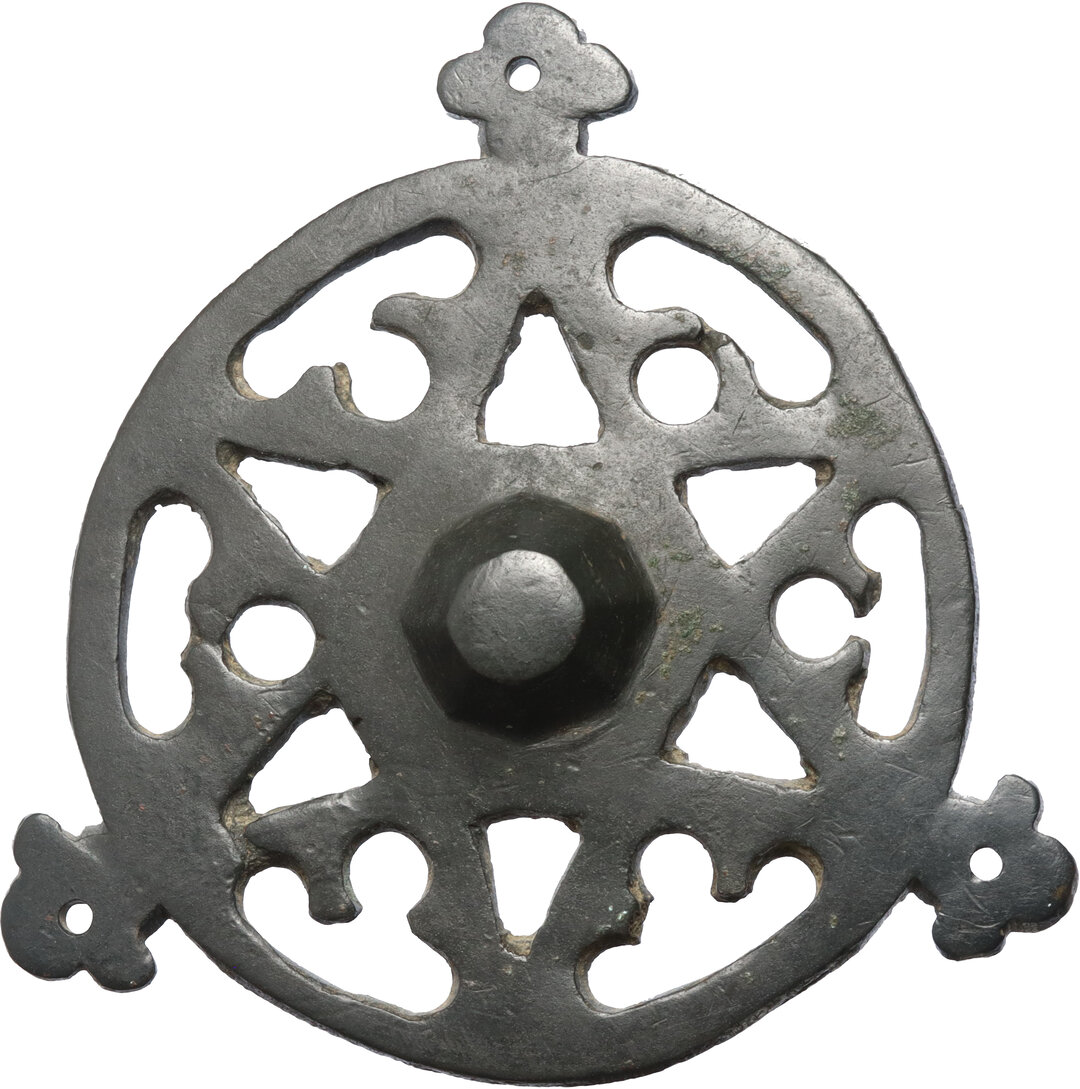
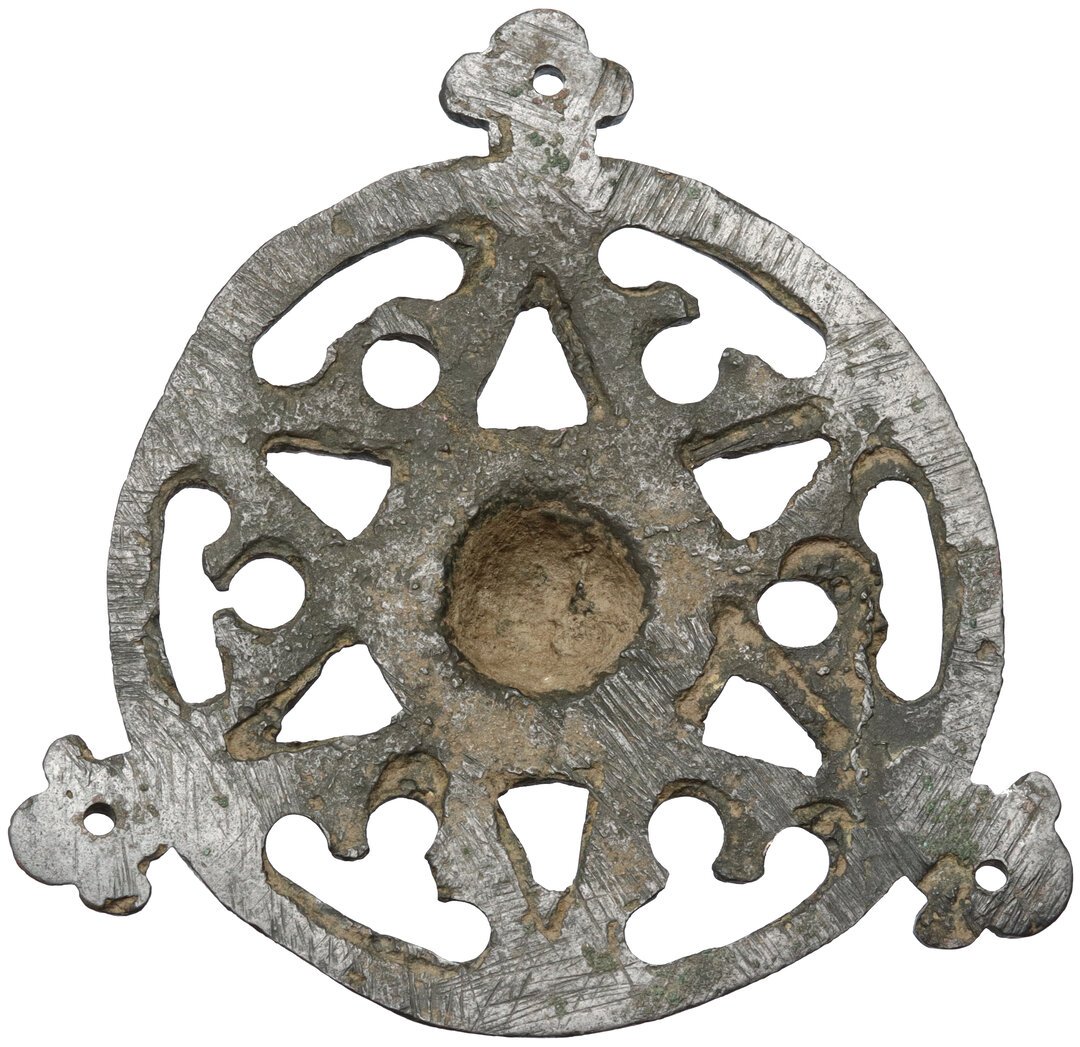
Cast bronze book fitting in the form of a large openwork roundel, decorated with a geometric and foliate design incorporating a hexagram motif. At the center is a prominent domed boss, intended to protect the cover surface when the volume was laid flat.
Three attachment lugs with perforations are preserved for fixing the piece to a leather-bound wooden cover. Such fittings formed part of the protective and decorative metal furniture of late medieval books.
The surface shows a dark patina with minor wear.
Diameter: 83 mm.
Weight: 83.78 g. Metalwork embellishments such as fittings, bosses and corners are called book furniture. Since books were often stored lying down until the 16th century, the covering material (usually leather) constantly rubbed against the surface it rested on, leading to permanent damage and diminishing the value of the binding. Fittings therefore served to create slightly raised contact surfaces, thus preventing the delicate binding material from coming into direct contact with the surface below. Book furniture were common around all four corners of the cover and in the center, reinforced by so-called bosses or knobs.
Late Middle Ages, 15th–16th century.
Cast bronze book fitting in the form of a large openwork roundel, decorated with a geometric and foliate design incorporating a hexagram motif. At the center is a prominent domed boss, intended to protect the cover surface when the volume was laid flat.
Three attachment lugs with perforations are preserved for fixing the piece to a leather-bound wooden cover. Such fittings formed part of the protective and decorative metal furniture of late medieval books.
The surface shows a dark patina with minor wear.
Diameter: 83 mm.
Weight: 83.78 g. Metalwork embellishments such as fittings, bosses and corners are called book furniture. Since books were often stored lying down until the 16th century, the covering material (usually leather) constantly rubbed against the surface it rested on, leading to permanent damage and diminishing the value of the binding. Fittings therefore served to create slightly raised contact surfaces, thus preventing the delicate binding material from coming into direct contact with the surface below. Book furniture were common around all four corners of the cover and in the center, reinforced by so-called bosses or knobs.