Info & contatti
Le mie offerte
Lotti osservati
Condizioni di vendita
Prezzi di spedizione
Metodi di pagamento
Esito stampabile
Sessione Live 2/8/2026 17:00:00 CET
Celtic Coins (1-15)
Greek Coins (16-215)
Roman Provincial Coins (216-305)
Roman Republican Coins (306-402)
Roman Imperial Coins (403-740)
Migration Period (741-745)
Byzantine Coins (746-768)
Medieval Coins (769-822)
World Coins (823-885)
Medals & Tokens (886-897)
Group Lots (898-1022)

Q. CASSIUS LONGINUS. Denarius (55 BC). Rome
Genius Populi Romani
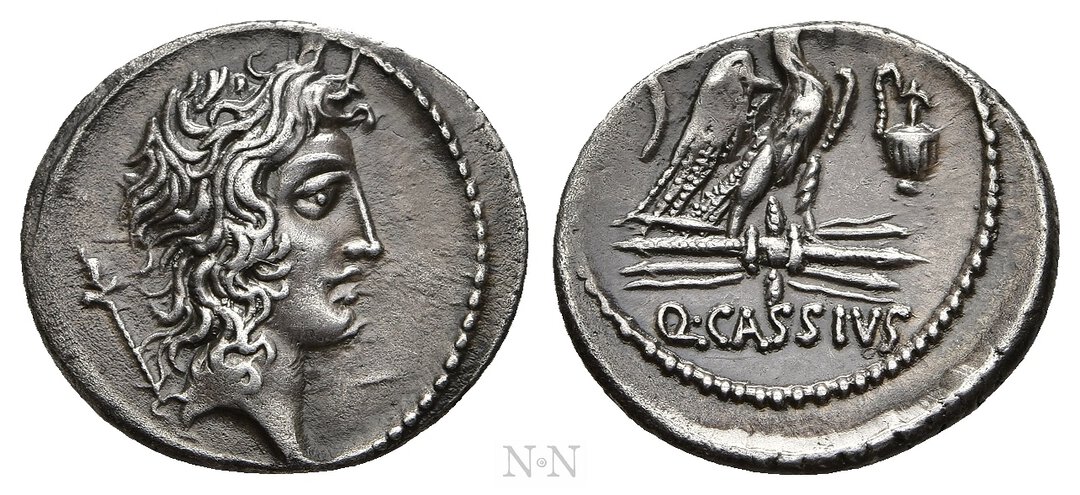

Q. CASSIUS LONGINUS. Denarius (55 BC). Rome.
Obv: Head of Genius Populi Romani right; sceptre to left.
Rev: Q CASSIVS.
Eagle, with wings spread, standing right on thunderbolt; lituus to left, capis to right.
Crawford 428/3; RBW 1535.
The concept of the Genius held a central place in Roman religion: a quiet yet constant presence, understood as a protective spirit and an intermediary between human beings and the divine. Every person was believed to be born accompanied by their own Genius, who safeguarded their existence and guided them through life’s most delicate decisions. Over time, this idea expanded to include animals, objects, buildings, cities and natural places, creating a world populated by invisible forces watching over every aspect of daily life. The Genius did not have a single fixed form. It could appear as a winged youth, as a symbolic animal (most commonly a serpent) or simply as a spiritual force perceptible in the atmosphere of a particular place. From this evolution emerged the Genius Loci, the spirit of a place, felt especially in locations rich in history or natural beauty. Its favour depended on the respect shown towards the place itself, a principle the Romans considered essential for maintaining harmony with their surroundings. The presence of the Genius is well documented in monetary iconography. It appears already in the Republican period and becomes increasingly common during the Empire, taking on different forms depending on context. There were Genii associated with professions, guilds, the army, the Senate, justice and even the gods, often represented through symbolic animals such as the eagle, the peacock or the owl. Each figure had a protective function and a specific role within the complex structure of Roman religious life. Particularly significant was the Genius of the emperor, regarded as the most powerful of all. Its depiction on coins emphasised the connection between the ruler and the prosperity of the Empire, and its cult spread throughout Roman territory. With the rise of Christianity and the religious reforms of the fourth century, the Genius gradually disappeared from public life and from coinage. Yet the concept did not vanish entirely: many of its characteristics were absorbed into the figure of the guardian angel, which inherited its protective role and spiritual nature. In this way, the ancient Roman idea of the Genius did not fade away but transformed, continuing to live on in new forms within the religious and symbolic culture of the Western world.
Condition: Extremely fine.
Weight: 3.83 g.
Diameter: 20 mm.
Estimate: € 200
Obv: Head of Genius Populi Romani right; sceptre to left.
Rev: Q CASSIVS.
Eagle, with wings spread, standing right on thunderbolt; lituus to left, capis to right.
Crawford 428/3; RBW 1535.
The concept of the Genius held a central place in Roman religion: a quiet yet constant presence, understood as a protective spirit and an intermediary between human beings and the divine. Every person was believed to be born accompanied by their own Genius, who safeguarded their existence and guided them through life’s most delicate decisions. Over time, this idea expanded to include animals, objects, buildings, cities and natural places, creating a world populated by invisible forces watching over every aspect of daily life. The Genius did not have a single fixed form. It could appear as a winged youth, as a symbolic animal (most commonly a serpent) or simply as a spiritual force perceptible in the atmosphere of a particular place. From this evolution emerged the Genius Loci, the spirit of a place, felt especially in locations rich in history or natural beauty. Its favour depended on the respect shown towards the place itself, a principle the Romans considered essential for maintaining harmony with their surroundings. The presence of the Genius is well documented in monetary iconography. It appears already in the Republican period and becomes increasingly common during the Empire, taking on different forms depending on context. There were Genii associated with professions, guilds, the army, the Senate, justice and even the gods, often represented through symbolic animals such as the eagle, the peacock or the owl. Each figure had a protective function and a specific role within the complex structure of Roman religious life. Particularly significant was the Genius of the emperor, regarded as the most powerful of all. Its depiction on coins emphasised the connection between the ruler and the prosperity of the Empire, and its cult spread throughout Roman territory. With the rise of Christianity and the religious reforms of the fourth century, the Genius gradually disappeared from public life and from coinage. Yet the concept did not vanish entirely: many of its characteristics were absorbed into the figure of the guardian angel, which inherited its protective role and spiritual nature. In this way, the ancient Roman idea of the Genius did not fade away but transformed, continuing to live on in new forms within the religious and symbolic culture of the Western world.
Condition: Extremely fine.
Weight: 3.83 g.
Diameter: 20 mm.
Estimate: € 200