Info & contatti
Le mie offerte
Lotti osservati
Condizioni di vendita
Prezzi di spedizione
Metodi di pagamento
Esito stampabile
Sessione Live 2/8/2026 17:00:00 CET
Celtic Coins (1-15)
Greek Coins (16-215)
Roman Provincial Coins (216-305)
Roman Republican Coins (306-402)
Roman Imperial Coins (403-740)
Migration Period (741-745)
Byzantine Coins (746-768)
Medieval Coins (769-822)
World Coins (823-885)
Medals & Tokens (886-897)
Group Lots (898-1022)

Risultati: 61
Lotto n. 306
-
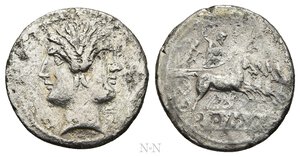
ANONYMOUS. Didrachm or Quadrigatus (Circa 225-214 BC). Rome. Obv: Laureate head of Janus.Rev: Jupiter, holding sceptre and thunderbolt, in quadriga driven by Victory right; ROMA incuse on tablet in exergue.Crawford 28/3; HN Italy 334; RBW 65-6. Condition: Good fine.Weight: 6.16 g. Diameter: 23 mm.Estimate: € 50
Lotto n. 307
-
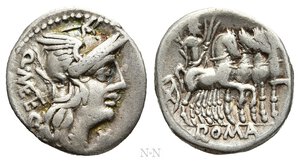
Q. CAECILIUS METELLUS. Denarius (130 BC). Rome. Obv: Q METE. Helmeted head of Roma right; mark of value to lower right.Rev: ROMA. Jupiter, holding palm frond, reins and thunderbolt, driving quadriga right.Crawford 256/1; RBW 1042. Condition: Near very fine.Weight: 3.83 g. Diameter: 19 mm.Estimate: € 50
Ex Numismatik Naumann 2017
Lotto n. 308
-
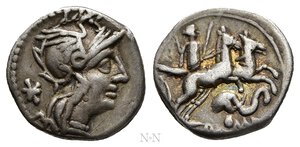
L. CAECILIUS METELLUS DIADEMATUS. Denarius (128 BC). Rome. Obv: Helmeted head of Roma right; star (mark of value) behind.Rev: ROMA. Pax driving biga right, holding olive branch, sceptre and reins; below, elephant’s head right with bell around neck.Crawford 262/1; RBW 1060.Ex Numismatik Naumann 53 (2017), lot 620 Condition: Near very fine.Weight: 3.84 g. Diameter: 18 mm.Estimate: € 50
Lotto n. 309
-
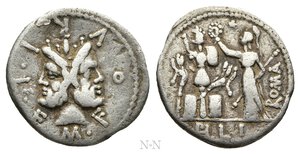
M. FURIUS L.F. PHILUS. Denarius (120 BC). Rome. Obv: M FOVRI L F. Laureate head of Janus.Rev: ROMA / PHILI. Roma standing left, holding sceptre and crowning trophy of Gallic arms and carnyces to left.Crawford 281/1; RBW 1105. Condition: Good fine.Weight: 3.77 g. Diameter: 20 mm.Estimate: € 50
Lotto n. 310
-
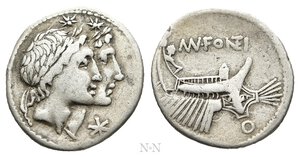
MN. FONTEIUS. Denarius (108-107 BC). Rome. Obv: Jugate laureate heads of the Dioscuri right; mark of value to lower right.Rev: MN FONTEI. Galley right; two pellets to right, O below.Crawford 307/1b; RBW -. Condition: Very fine.Weight: 3.80 g. Diameter: 20 mm.Estimate: € 100
Lotto n. 311
-
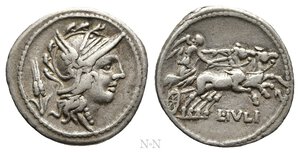
L. JULIUS. Denarius (101 BC). Rome. Obv: Helmeted head of Roma right; grain ear to left.Rev: L IVLI. Victory driving biga right.Crawford 323/1; RBW 1179. Condition: Very fine.Weight: 4.16 g. Diameter: 20 mm.Estimate: € 50
Lotto n. 312
-
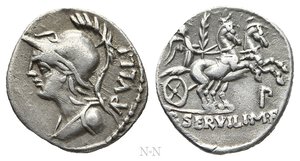
P. SERVILIUS M. F. RULLUS. Denarius (100 BC). Rome. Obv: RVLLI. Helmeted bust of Minerva left, wearing aegis.Rev: P SERVILI M F. Victory driving biga right, holding reins and palm frond; P below.Crawford 328/1; RBW 1185. Condition: Very fine.Weight: 3.48 g. Diameter: 19 mm.Estimate: € 100
Lotto n. 313
-
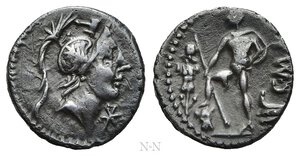
C. MALLEOLUS C. F. Denarius (118 BC). Rome. Obv: Helmeted head of Mars right; above, mallet right; mark of value to lower right.Rev: C MAL. Naked warrior standing left, holding spear and placing foot on cuirass; trophy to left; to right, prow.Crawford 335/3b; RBW 1203. Condition: Very fine.Weight: 3.81 g. Diameter: 19 mm.Estimate: € 100
Lotto n. 314
-
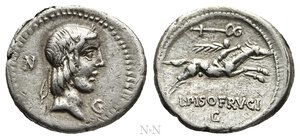
L. CALPURNIUS PISO FRUGI. Denarius (90 BC). Rome. Obv: Laureate head of Apollo right; N behind, G before.Rev: L PISO FRVGI. Warrior riding horse right, holding reins and palm frond; caduceus above, G below.Crawford 340/1. Condition: Very fine.Weight: 3.87 g. Diameter: 20 mm.Estimate: € 100
Lotto n. 315
-
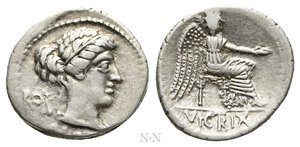
M. CATO. Denarius (89 BC). Rome. Obv: ROMA / M CATO. Diademed and draped female bust right.Rev: VICTRIX. Victory seated right on throne, holding patera and palm frond.Crawford 343/1b; RBW -. Condition: Very fine.Weight: 3.89 g. Diameter: 20 mm.Estimate: € 100
Lotto n. 316
-
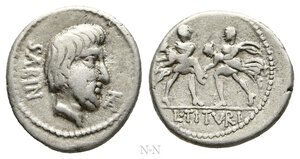
L. TITURIUS L.F. SABINUS. Denarius (89 BC). Rome. Obv: SABIN. Bareheaded and bearded head of King Tatius right; monogram to right.Rev: L TITVRI. Two soldiers, facing each other, each carrying off a Sabine woman in his arms.Crawford 344/1a; RBW -.The episode of the Rape of the Sabine Women is recounted by Livy and Plutarch. According to legend, among the many problems faced by the Romans was a shortage of women. Therefore, in order to ensure the future of the Roman race, various alliances were formed with the aim of finding a way to bring women from neighboring populations to Rome. One of the populations involved was that of the Sabines, who rejected the Roman proposal. Romulus and his companions then took advantage of the games in honor of the god Consus to invite the Sabines and kidnap the women, thus starting the war. But faced with the fact that their Sabine relatives and those who had meanwhile become their Roman husbands could be killed in battle, the women began to beg for an end to the massacre. As a result, what became known as the Rape of the Sabine Women led to a situation of peace and prosperity for the two peoples. Condition: Near very fine.Weight: 3.96 g. Diameter: 20 mm.Estimate: € 100
Lotto n. 317
-
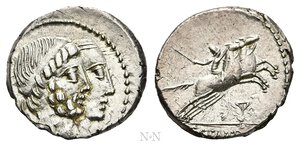
C. CENSORINUS. Denarius (88 BC). Rome. Obv: Jugate heads of Numa Pompilius and Ancus Marcius right.Rev: C CENSO. Desultor with two horses right, wearing cap and whip; symbol below.Crawford 346/1c-d. Condition: Near uncirculated.Weight: 4.00 g. Diameter: 19 mm.Estimate: € 200
Lotto n. 318
-
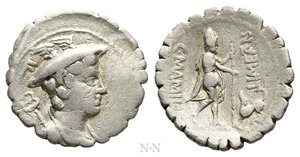
C. MAMILIUS LIMETANUS. Serrate Denarius (82 BC). Rome. Obv: Draped bust of Mercury right, wearing petasus; to left, F above caduceus.Rev: C MAMIL / LIMETAN. Ulysses advancing right, holding staff and extending hand to his dog Argus.Crawford 362/1; RBW type as 1370.In book XVII of the Odyssey, Odysseus returns to Ithaka disguised as a beggar and is recognized only by his faithful dog Argos, now old. Once a superb hunting dog, Argos raises his head and wags his tail at the sight of Odysseus, but dies immediately after recognizing him, demonstrating his loyalty and love, preventing him from inadvertently revealing his master's identity and allowing Odysseus to plan his revenge. Condition: Near very fine.Weight: 3.91 g. Diameter: 20 mm.Estimate: € 200
Lotto n. 319
-
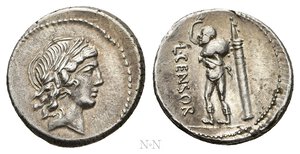
L. CENSORINUS. Denarius (82 BC). Rome. Obv: Laureate head of Apollo right.Rev: L CENSOR. Marsyas standing left, raising hand and holding wineskin over shoulder; to right, column bearing statue of Victory.Crawford 363/1d; RBW 1372. Condition: Good very fine.Weight: 3.95 g. Diameter: 19 mm.Estimate: € 100
Lotto n. 320
-
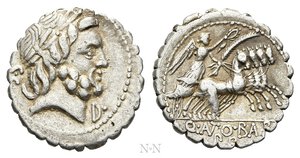
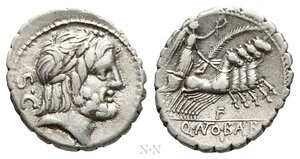
Q. ANTONIUS BALBUS. Serrate Denarius (83-82 BC). Rome. Obv: S•C. Laureate head of Jupiter right; control mark D• to lower right.Rev: Q ANTO BALB PR. Victory driving quadriga right, holding reins, wreath and palm frond.Crawford 364/1c; RBW -. Condition: Very fine.Weight: 3.95 g. Diameter: 19 mm.Estimate: € 100
Lotto n. 321
-
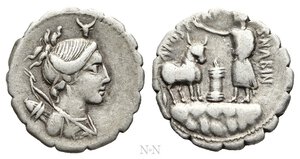
Q. ANTONIUS BALBUS. Serrate Denarius (83-82 BC). Rome. Obv: S•C. Laureate head of Jupiter right.Rev: Q ANTO BALB / PR. Victory driving quadriga right, holding reins, wreath and palm frond; F below horses.Crawford 364/1d; RBW type as 1374. Condition: Good very fine.Weight: 3.91 g. Diameter: 19 mm.Estimate: € 100
Lotto n. 322
-
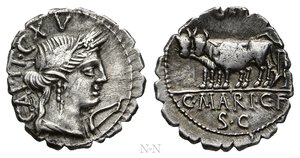
A. POSTUMIUS A. F. SP. N. ALBINUS. Serrate Denarius (81 BC). Rome. Obv: Draped bust of Diana right, with bow and quiver over shoulder; bucranium above.Rev: A POST A F / S N ALBIN. Togate figure right standing left on rock, holding aspergillum over bull; between them, lighted altar.Crawford 372/1; RBW 1392. Condition: Near very fine.Weight: 3.73 g. Diameter: 20 mm.Estimate: € 100
Lotto n. 323
-
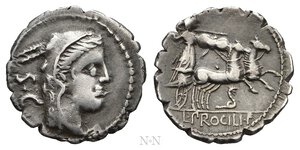
C. MARIUS C. F. CAPITO. Serrate Denarius (81 BC). Rome. Obv: CAPIT CXV. Draped bust of Ceres, wearing grain wreath. Control: narrow fibula.Rev: C MARI C F / S C. Founder plowing left with yoke of oxen; CXV above.Crawford 378/1c; RBW type as 1403-5. Condition: Good very fine.Weight: 3.83 g. Diameter: 19 mm.Estimate: € 200
Lotto n. 324
-
L. PROCILIUS. Serrate Denarius (80 BC). Rome. Obv: Head of Juno Sospita right, wearing goat skin; S C to left.Rev: L PROCILI F. Juno Sospita, holding spear, shield and reins, driving biga right; below, serpent coiled right.Crawford 379/2; RBW 1407. Condition: Very fine.Weight: 3.78 g. Diameter: 20 mm.Estimate: € 50
Lotto n. 325
-
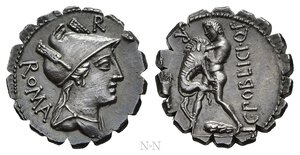
C. POBLICIUS Q.F. Serrate Denarius (80 BC). Rome. Obv: ROMA. Helmeted and draped bust of Roma right; R above.Rev: C POBLICI Q F. Hercules standing left, wrestling the Nemean Lion; club below, quiver with bow and arrows to left, R above.Crawford 380/1; RBW type as 1408. Condition: Extremely fine.Weight: 3.77 g. Diameter: 19 mm.Estimate: € 200
Lotto n. 326
-
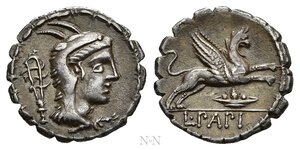
L. PAPIUS. Serrate Denarius (79 BC). Rome. Obv: Head of Juno Sospita right, wearing goat’s skin. Control: sistrum behind.Rev: L PAPI. Griffin leaping right. Control: fruit plate below.Crawford 384/1 (controls 91); RBW type as 1412-3. Condition: Good very fine.Weight: 3.83 g. Diameter: 19 mm.Estimate: € 200
Lotto n. 327
-
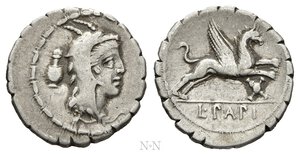
L. PAPIUS. Serrate Denarius (79 BC). Rome. Obv: Head of Juno Sospita right, wearing goat’s skin. Control: jar behind.Rev: L PAPI. Griffin leaping right. Control: quatrefoil below.Crawford 384/1 (controls 172); RBW type as 1412-3. Condition: Very fine.Weight: 3.90 g. Diameter: 20 mm.Estimate: € 100
Lotto n. 328
-
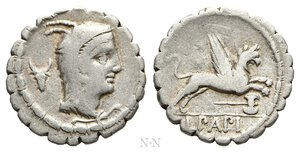
L. PAPIUS. Serrate Denarius (79 BC). Rome. Obv: Head of Juno Sospita right, wearing goat’s skin. Control: bucranium behind.Rev: Griffin leaping right. Control: double-axe below.Crawford 384/1 (controls 14). Condition: Good fine.Weight: 3.82 g. Diameter: 19 mm.Estimate: € 50
Lotto n. 329
-
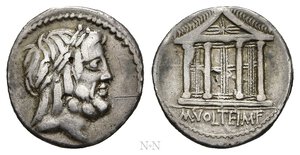
M. VOLTEIUS M.F. Denarius (75 BC). Rome. Obv: Laureate head of Jupiter right.Rev: M VOLTEI M F. Tetrastyle temple of Jupiter Capitolinus, with winged thunderbolt in pediment.Crawford 385/1; RBW 1414. Condition: Very fine.Weight: 4.20 g. Diameter: 18 mm.Estimate: € 100
Lotto n. 330
-
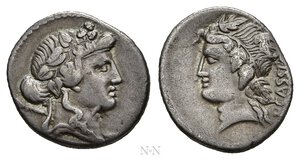
L. CASSIUS Q.F. LONGINUS. Denarius (75 BC). Rome. Obv: Head of Liber or young Bacchus right, wearing ivy wreath and with thyrsus over shoulder.Rev: L CASSI Q F. Head of Libera left, wearing ivy wreath.Crawford 386/1; RBW 1419. Condition: Very fine.Weight: 3.83 g. Diameter: 18 mm.Estimate: € 100
Lotto n. 331
-
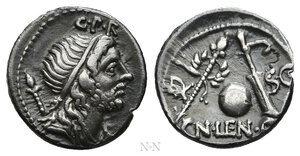
CN. LENTULUS. Denarius (76-75 BC). Spain. Obv: C P R. Diademed and draped bust of Genius Populi Romani right, with sceptre over shoulder.Rev: EX - S C / C N LEN Q. Sceptre with wreath, terrestrial globe and rudder.Crawford 393/1a; RBW 1432. Condition: Good very fine.Weight: 3.83 g. Diameter: 19 mm.Estimate: € 100
Lotto n. 332
-
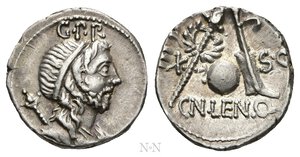
CN. LENTULUS. Denarius (76-75 BC). Spain. Obv: C P R. Diademed and draped bust of Genius Populi Romani right, with sceptre over shoulder.Rev: EX S C / C N LEN Q. Sceptre with wreath, terrestrial globe and rudder.Crawford 393/1a; RBW 1432. Condition: Extremely fine; luster in field.Weight: 4.00 g. Diameter: 19 mm.Estimate: € 100
Lotto n. 333
-
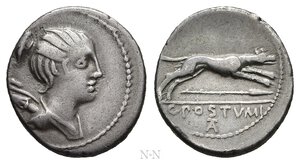
C. POSTUMIUS. Denarius (73 BC). Rome. Obv: Draped bust of Diana right, with bow and quiver over shoulder.Rev: C POSTVMI / TA. Hound springing right; below, spear right.Crawford 394/1a; RBW 1434. Condition: Good fine.Weight: 4.00 g. Diameter: 20 mm.Estimate: € 50
Lotto n. 334
-
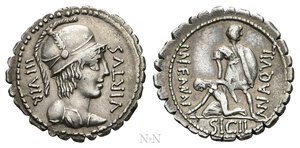
MN. AQUILIUS MN.F. MN.N. Serrate Denarius (65 BC). Rome. Obv: VIRTVS III VIR. Helmeted and draped bust of Virtus right.Rev: MN F MN N / MN AQVIL / SICIL. Mn. Aquillius standing left, head right, raising Sicilia kneeling left.Crawford 401/1; RBW 1443. Condition: Good very fine.Weight: 3.84 g. Diameter: 20 mm.Estimate: € 200
Lotto n. 335
-
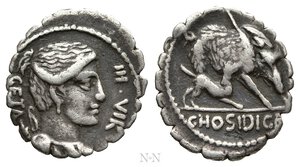
C. HOSIDIUS C.F. GETA. Serrate Denarius (64 BC). Rome. Obv: III VIR / GETA. Diademed and draped bust of Diana right, with bow and quiver over shoulder.Rev: C HOSIDI C F. Calydonian Boar standing right, pierced by spear and harried by hound below.Crawford 407/1; RBW 1455. Condition: Near very fine.Weight: 3.73 g. Diameter: 20 mm.Estimate: € 50
Lotto n. 336
-
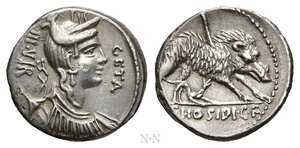
C. HOSIDIUS C.F. GETA. Denarius (64 BC). Rome. Obv: III VIR / GETA. Diademed and draped bust of Diana right, with bow and quiver over shoulder.Rev: C HOSIDI C F. Calydonian Boar standing right, pierced by spear and harried by hound below.Crawford 407/2; RBW 1456. Condition: Good very fine.Weight: 3.87 g. Diameter: 18 mm.Estimate: € 200
Lotto n. 337
-
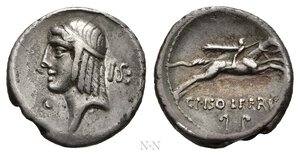
C. PISO L.F. FRUGI. Denarius (68 BC). Rome. Obv: Diademed head of Apollo left. Control: IS: behind.Rev: C PISO L F FRVG. Warrior riding horse right, holding palm frond; control below.Crawford 408/1b; Hersh, Piso 435 (O801/R2155). Condition: Very fine.Weight: 4.09 g. Diameter: 18 mm.Estimate: € 100
Lotto n. 338
-
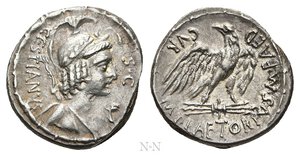
M. PLAETORIUS M.F. CESTIANUS. Denarius (57 BC). Rome. Obv: CESTIANVS / S C. Helmeted, laureate and draped bust of Vacuna right, with bow and quiver over shoulder; cornucopia to right.Rev: M PLAETORIVS M F AED CVR. Eagle standing right on winged thunderbolt, head left, with wings spread.Crawford 409/1; RBW 1482. Condition: Near extremely fine; some luster in field.Weight: 3.94 g. Diameter: 19 mm.Estimate: € 200
Lotto n. 339
-
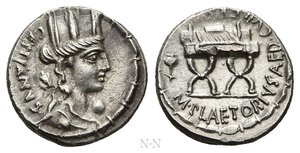
M. PLAETORIUS M.F. CESTIANUS. Denarius (57 BC). Rome. Obv: CESTIANVS. Turreted and draped bust of Cybele right; forepart of lion to left, globe to lower right.Rev: M PLAETORIVS AED CVR EX S C. Curule chair. Control: poppy to left.Crawford 409/2; RBW type as 1484. Condition: Extremely fine; edge filings.Weight: 3.72 g. Diameter: 19 mm.Estimate: € 100
Lotto n. 340
-
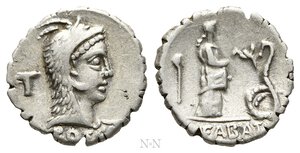
L. ROSCIUS FABATUS. Serrate Denarius (59 BC). Rome. Obv: L ROSCI. Head of Juno Sospita right, wearing goat skin headdress; one-handled cup to left.Rev: FABATI. Female standing right, feeding coiled serpent to right; symbol to left.Crawford 412/1; RBW type as 1491-2. Condition: Very fine.Weight: 3.78 g. Diameter: 18 mm.Estimate: € 100
Lotto n. 341
-
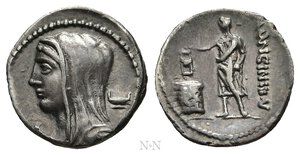
L. CASSIUS LONGINUS. Denarius (63 BC). Rome. Obv: Veiled and draped bust of Vesta left; control-letter to left, calix to right.Rev: LONGIN III V. Voter standing left, dropping tablet inscribed V (uti rogas) into cista to left.Crawford 413/1; RBW type as 1493. Condition: Good very fine.Weight: 3.69 g. Diameter: 19 mm.Estimate: € 200
Lotto n. 342
-
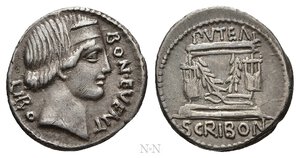
L. SCRIBONIUS LIBO. Denarius (62 BC). Rome. Obv: BON EVENT / LIBO. Diademed head of Bonus Eventus right.Rev: PVTEAL / SCRIBON. Puteal Scribonianum (Scribonian wellhead) decorated with garland and two lyres; tongs at base.Crawford 416/1b; RBW 1501. Condition: Good very fine.Weight: 4.00 g. Diameter: 20 mm.Estimate: € 100
Lotto n. 343
-
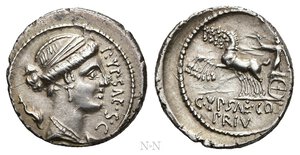
P. PLAUTIUS HYPSAEUS. Denarius (57 BC). Rome. Obv: P VPSAE S C. Draped bust of Leuconoë right; to left, dolphin swimming right.Rev: C VPSAE COS / PRIV / CEPIT. Jupiter, holding reins and preparing to hurl thunderbolt, driving quadriga left.Crawford 420/2a; RBW 1515. Condition: Extremely fine.Weight: 4.00 g. Diameter: 19 mm.Estimate: € 200
Lotto n. 344
-
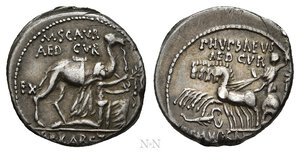
M. AEMILIUS SCAURUS and P. PLAUTIUS HYPSAEUS. Denarius (58 BC). Rome. Obv: M SCAVR / AED CVR / EX S C / REX ARETAS. Nabatean King Aretas kneeling right, holding reins and filleted olive branch before camel standing right.Rev: P HVPSAEV / AED CVR / CAPTV / C HVPSAE COS / PREIVE. Jupiter driving galloping quadriga left, holding reins and hurling thunderbolt; scorpion below horses.Crawford 422/1b; RBW 1519. Condition: Good very fine.Weight: 4.10 g. Diameter: 20 mm.Estimate: € 100
Lotto n. 345
-
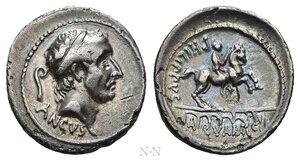
L. MARCIUS PHILIPPUS. Denarius (57 BC). Rome. Obv: ANCVS. Diademed head of Ancus Marcius right; lituus to left.Rev: PHILIPPVS / AQVAM R. Equestrian statue on aqueduct right; flower below statue.Crawford 425/1; RBW 1524.This denarius was issued in 56 BC by L. Marcius Philippus in honor of his ancestor Q. Marcius Rex. On the obverse, the coin depicts the head of the fourth king of Rome, Ancus Marcius, identified by the legend, from whom the Marcia gens claimed to descend and who, according to a legend (reported by Pliny the Elder), was the first to provide an aqueduct to the city. The reverse depicts an equestrian statue (Marcius Rex) placed on an arched structure, clearly identified as an aqueduct by the legend. The aqueduct depicted here was built in 144 BC by Marcius Rex (to whom the statue refers), and supplied water to many areas of Rome. It was over 90 km long and mostly underground. As was common in the Republican period, the designs on both sides are purely propagandistic, aimed at celebrating the gens to which the monetary magistrate belonged, with references to mythical and historical ancestors, legitimizing his personal ambitions. Condition: Very fine.Weight: 3.68 g. Diameter: 20 mm.Estimate: € 100
Lotto n. 346
-
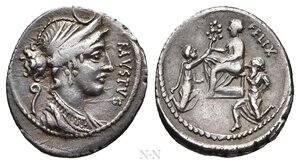
FAUSTUS CORNELIUS SULLA. Denarius (56 BC). Rome. Obv: FAVSTVS. Diademed and draped bust of Diana right; lituus to left, crescent above.Rev: FELIX. Sulla seated left on raised seat; on left, Bocchus, king of Mauretania, kneels right, offering olive branch; to right, Jugurtha, king of Numidia, kneeling left, with hands tied behind him.Crawford 426/1; RBW 1525.Giugurta, prince of Numidia, received part of the kingdom from the uncle Micipsa, together with his sons, Hiempsal and Adherbal. He killed the former and defeated Adherbal, who went to Rome to ask for help. The Senate sent a commission led by Lucius Opimius, who proceeded to divide the kingdom. The richest part, bordering the Roman province, was given to Adherbal; the westernmost part to Jugurtha. Soon the two princes were again in conflict and Adherbal was killed (112 BC). Rome then declared war on Jugurtha and sent first L.C. Bestia, then Q. Caecilius Metellus (later known as Metellus Numidicus), who achieved an important victory in 108 BC. In 107 BC, Marius was elected consul and led another campaign against Jugurtha, who had meanwhile allied himself with Bocchus of Mauretania. In the end, Bocchus betrayed Jugurtha and handed him over to L. Cornelius Sulla, sent by Marius, who dragged him in chains to Rome in 104. This Denarius was struck by Faustus, son of Lucius Cornelius Sulla. Condition: Very fine.Weight: 3.80 g. Diameter: 21 mm.Estimate: € 200
Lotto n. 347
-
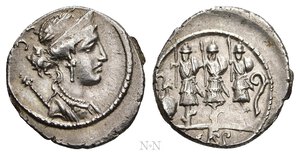
FAUSTUS CORNELIUS SULLA. Denarius (56 BC). Rome. Obv: S C. Laureate, diademed and draped bust of Venus right, sceptre over shoulder.Rev: Three trophies; capis to left, lituus to right; FAVSTVS monogram in exergue.Crawford 426/3; RBW 1528. Condition: Extremely fine.Weight: 3.94 g. Diameter: 20 mm.Estimate: € 200
Genius Populi Romani
Lotto n. 348
-
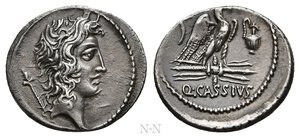
Q. CASSIUS LONGINUS. Denarius (55 BC). Rome. Obv: Head of Genius Populi Romani right; sceptre to left.Rev: Q CASSIVS. Eagle, with wings spread, standing right on thunderbolt; lituus to left, capis to right.Crawford 428/3; RBW 1535.The concept of the Genius held a central place in Roman religion: a quiet yet constant presence, understood as a protective spirit and an intermediary between human beings and the divine. Every person was believed to be born accompanied by their own Genius, who safeguarded their existence and guided them through life’s most delicate decisions. Over time, this idea expanded to include animals, objects, buildings, cities and natural places, creating a world populated by invisible forces watching over every aspect of daily life.
The Genius did not have a single fixed form. It could appear as a winged youth, as a symbolic animal (most commonly a serpent) or simply as a spiritual force perceptible in the atmosphere of a particular place. From this evolution emerged the Genius Loci, the spirit of a place, felt especially in locations rich in history or natural beauty. Its favour depended on the respect shown towards the place itself, a principle the Romans considered essential for maintaining harmony with their surroundings.
The presence of the Genius is well documented in monetary iconography. It appears already in the Republican period and becomes increasingly common during the Empire, taking on different forms depending on context. There were Genii associated with professions, guilds, the army, the Senate, justice and even the gods, often represented through symbolic animals such as the eagle, the peacock or the owl. Each figure had a protective function and a specific role within the complex structure of Roman religious life.
Particularly significant was the Genius of the emperor, regarded as the most powerful of all. Its depiction on coins emphasised the connection between the ruler and the prosperity of the Empire, and its cult spread throughout Roman territory. With the rise of Christianity and the religious reforms of the fourth century, the Genius gradually disappeared from public life and from coinage. Yet the concept did not vanish entirely: many of its characteristics were absorbed into the figure of the guardian angel, which inherited its protective role and spiritual nature.
In this way, the ancient Roman idea of the Genius did not fade away but transformed, continuing to live on in new forms within the religious and symbolic culture of the Western world. Condition: Extremely fine.Weight: 3.83 g. Diameter: 20 mm.Estimate: € 200
Lotto n. 349
-
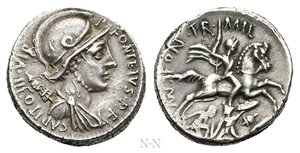
P. FONTEIUS P.F. CAPITO. Denarius (55 BC). Rome. Obv: P FONTEIVS P F CAPITO III VIR. Helmeted and draped bust of Mars right, with trophy over shoulder.Rev: MN FONT TR MIL. Warrior riding horse right, thrusting spear at fallen enemy who is about to slay unarmed captive; helmet and shield to right.Crawford 429/1; RBW 1536. Condition: Good very fine.Weight: 4.08 g. Diameter: 18 mm.Estimate: € 200
Lotto n. 350
-
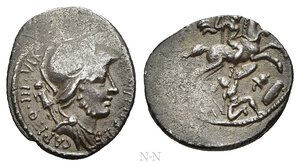
P. FONTEIUS P.F. CAPITO. Denarius (55 BC). Rome. Obv: P FONTEIVS P F CAPITO III VIR. Helmeted and draped bust of Mars right, with trophy over shoulder.Rev: MN FONT TR MIL. Warrior riding horse right, thrusting spear at fallen enemy who is about to slay unarmed captive; helmet and shield to right.Crawford 429/1; RBW 1536. Condition: Very fine.Weight: 3.58 g. Diameter: 20 mm.Estimate: € 100
Lotto n. 351
-
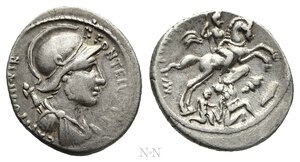
P. FONTEIUS P.F. CAPITO. Denarius (55 BC). Rome. Obv: P FONTEIVS P F CAPITO III VIR. Helmeted and draped bust of Mars right, with trophy over shoulder.Rev: MN FONT TR MIL. Warrior riding horse right, thrusting spear at fallen enemy who is about to slay unarmed captive; helmet and shield to right.Crawford 429/1; RBW 1536. Condition: Very fine.Weight: 3.45 g. Diameter: 19 mm.Estimate: € 100
Lotto n. 352
-
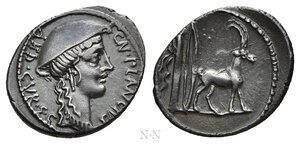
CN. PLANCIUS. Denarius (55 BC). Rome. Obv: CN PLANCIVS / AED CVR SC. Head of Diana Planciana right, wearing petasus.Rev: Cretan goat standing right; bow and quiver to left.Crawford 432/1; RBW 1541. Condition: Very fine.Weight: 3.72 g. Diameter: 21 mm.Estimate: € 100
Lotto n. 353
-
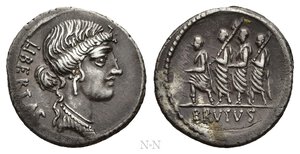
Q. SERVILIUS CAEPIO (M. JUNIUS) BRUTUS. Denarius (54 BC). Rome. Obv: LIBERTAS. Head of Libertas right.Rev: BRVTVS. The consul L. Junius Brutus advancing left between two lictors, carrying fasces over shoulder; accensus to left.Crawford 433/1; RBW 1542. Condition: Very fine.Weight: 4.13 g. Diameter: 19 mm.Estimate: € 250
Lotto n. 354
-
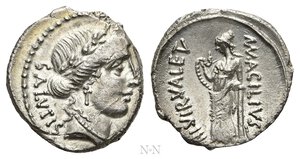
MAN. ACILIUS GLABRIO. Denarius (49 BC). Rome. Obv: SALVTIS (downwards). Laureate head of Salus right.Rev: MN ACILIVS / III VIR VALETV. Valetudo standing left, holding serpent and leaning upon column to right.Crawford 442/1b; CRI 16a; RBW -. Condition: Uncirculated.Weight: 3.92 g. Diameter: 20 mm.Estimate: € 100
Choice Julius Caesar
Lotto n. 355
-
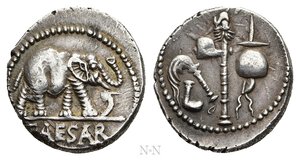
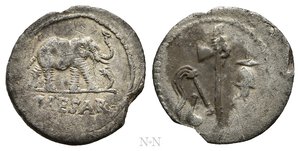
JULIUS CAESAR. Denarius (49 BC). Military mint traveling with Caesar. Obv: CAESAR. Elephant advancing right, trampling upon horned serpent.Rev: Emblems of the pontificate: simpulum, aspergillum, securis and apex.Crawford 443/1; CRI 9; RBW 1557.With the beginning of the Civil Wars, this is the first coin issued in open defiance of the Senate, bearing the name of a private individual. There is no agreement on the place of issue, Crawford attributes it to an itinerant mint. According to D. Van Meter (The Hanbook of Roman Imperial Coins) the coin, was minted in 49-48 to finance the invasion of Italy, the allegory would refer to the salvation of the Republic (the snake/dragon), crushed by Metellus Scipio (whose gens had an elephant depicted on their coins). It is generally believed that it is a dragon that is trampled upon; the African elephant would not only allude to the victory against Ariovistus in 58 BC (the dragon was on the banner of the Germans) but also to the name of Caesar, who discovered the existence of a homograph word for elephant in the Mauri' language in Mauretania. Religious emblems here depicted are symbols of priestly offices: the jug and the lituus representing the functions associated with the Pontefices and the Augures. Both ensure the legitimacy of all political action, ensuring the salvation of the Roman state through respect for the divine will. Caesar himself holds most of the religious offices and uses them for propaganda purposes in a new type of coin that emphasises his supreme authority. Condition: Near extremely fine.Weight: 4.00 g. Diameter: 18 mm.Estimate: € 2500
Lotto n. 356
-
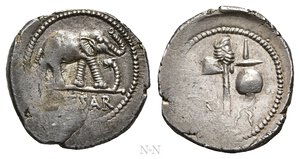
JULIUS CAESAR. Denarius (49 BC). Military mint traveling with Caesar. Obv: CAESAR. Elephant advancing right, trampling upon horned serpent.Rev: Emblems of the pontificate: simpulum, aspergillum, securis and apex.Crawford 443/1; CRI 9; RBW 1557.With the beginning of the Civil Wars, this is the first coin issued in open defiance of the Senate, bearing the name of a private individual. There is no agreement on the place of issue, Crawford attributes it to an itinerant mint. According to D. Van Meter (The Hanbook of Roman Imperial Coins) the coin, was minted in 49-48 to finance the invasion of Italy, the allegory would refer to the salvation of the Republic (the snake/dragon), crushed by Metellus Scipio (whose gens had an elephant depicted on their coins). It is generally believed that it is a dragon that is trampled upon; the African elephant would not only allude to the victory against Ariovistus in 58 BC (the dragon was on the banner of the Germans) but also to the name of Caesar, who discovered the existence of a homograph word for elephant in the Mauri' language in Mauretania. Religious emblems here depicted are symbols of priestly offices: the jug and the lituus representing the functions associated with the Pontefices and the Augures. Both ensure the legitimacy of all political action, ensuring the salvation of the Roman state through respect for the divine will. Caesar himself holds most of the religious offices and uses them for propaganda purposes in a new type of coin that emphasises his supreme authority. Condition: Good very fine.Weight: 3.93 g. Diameter: 20 mm.Estimate: € 500
Lotto n. 357
-
JULIUS CAESAR. Denarius (49 BC). Military mint traveling with Caesar. Obv: CAESAR. Elephant advancing right, trampling upon horned serpent.Rev: Emblems of the pontificate: simpulum, aspergillum, securis and apex.Crawford 443/1; CRI 9; RBW 1557. Condition: Fine.Weight: 3.49 g. Diameter: 20 mm.Estimate: € 100
Lotto n. 358
-
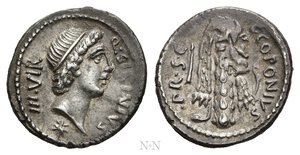
Q. SICINIUS & C. COPONIUS. Denarius (49 BC). Military mint in the East, moving with Pompey; C. Coponius, praetor. Obv: Q SICINIVS III VIR. Diademed head of Apollo right; star below.Rev: C COPONIVS PR S C. Club surmounted by lion skin; arrow to left, bow to right.Crawford 444/1a; CRI 3; RBW 1558. Condition: Near extremely fine.Weight: 3.76 g. Diameter: 18 mm.Estimate: € 100
Personification of Gaule
Lotto n. 359
-
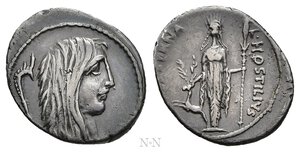
L. HOSTILIUS SASERNA. Denarius (48 BC). Rome. Obv: Head of Gallia right; carnyx to left.Rev: L HOSTILIVS / SASERNA. Diana of Ephesus standing facing, holding spear and stag by the horns.Crawford 448/3; CRI 19; RBW 1570.This denarius refers to the Roman expansion of the Empire with the annexation of the province of Gallia Comata, or the 'Tres Galliae', through its female personification characterized by long hair (“comata” = “hairy” or “leafy”) and by the presence of the Celtic carnyx in the field. This iconography also appears on the breastplate of the Augustus of Prima Porta.
For the reverse to pair with the personification of Gallia Comata, the Ephesus Artemis was chosen, dressed in a long chiton, holding a spear in her left hand and restraining a doe by the antlers with her right. She is therefore a territorial deity, whose cult spread beyond the Alps thanks to the Greek colonists of Massalia, but also an expression of an ancient bond between the transalpine region and the city of Rome, where, in the archaic age, King Servius Tullius built on the Aventine Hill the temple of Diana–Artemis, marked by clear Ionian influences.
This coin also offers one of the finest representations of the carnyx, the long Celtic war trumpet that was not merely a musical instrument: it became a powerful symbol of identity, strong enough to enter permanently into both Celtic and Roman monetary iconography. Ancient sources describe it as an object with a harsh and striking sound, used in battle and associated with the prestige of the warrior aristocracy. Archaeological depictions show that it also had a ritual and sacred role.
On Celtic coins, the carnyx often appears together with the horse, the chariot, and other attributes of the military elite, a way to exalt the rank, courage and warrior tradition of the Gallic and British tribes. The Romans, on the other hand, adopted it as an emblem of the defeated enemy. In Republican and later Imperial denarii, the carnyx appears in trophies of barbarian arms, alongside oval shields and chariot wheels, or at the feet of prisoners in chains.
There is, however, also a second use: in some issues, especially in Gallic colonies, the carnyx is represented not as a symbol of defeat but as a local identity marker integrated into the new Roman reality. It is the sign of a process of Romanization that did not entirely erase traditions but reused them to build a provincial identity loyal to Rome. Condition: Very fine.Weight: 3.75 g. Diameter: 21 mm.Estimate: € 250
Lotto n. 360
-
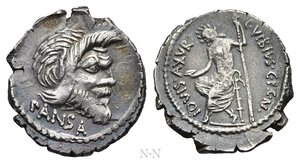
C. VIBIUS C.F. CN. PANSA CAETRONIANUS. Denarius (48 BC). Rome. Obv: PANSA. Mask of Pan right.Rev: C VIBIVS C F CN IOVIS AXVR. Jupiter Axurus seated left on throne, holding patera and sceptre.Crawford 449/1a; RBW 1571. Condition: Good very fine.Weight: 4.08 g. Diameter: 20 mm.Estimate: € 100
Ex Kunst und Münzen 1979
Lotto n. 361
-
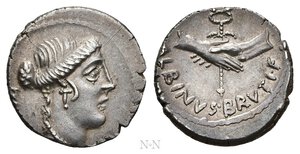
ALBINUS BRUTI F. Denarius (48 BC). Rome. Obv: PIETAS. Head of Pietas right.Rev: ALBINVS BRVTI F. Caduceus superimposed by two clasping hands.Crawford 450/2; RBW 1577.Ex Kunst und Münzen, Lugano, XIX (1979), lot 1582 (collector's note) Condition: Near uncirculated.Weight: 4.00 g. Diameter: 18 mm.Estimate: € 200
Lotto n. 362
-
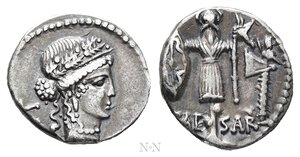
JULIUS CAESAR. Denarius (48-47 BC). Military mint traveling with Caesar. Obv: Laureate female head (Clementia?) right; LII to left.Rev: CAE - SAR. Gallic trophy, with oval shield and carnyx; securis surmounted by head of wolf to right.Crawford 452/2; CRI 11; RBW -. Condition: Good very fine.Weight: 3.97 g. Diameter: 18 mm.Estimate: € 750
Lotto n. 363
-
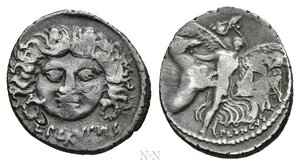
L. PLAUTIUS PLANCUS. Denarius (47 BC). Rome. Obv: L PLAVTIVS. Facing head of Medusa with coiled snakes at either side.Rev: PLANCVS. Draped and winged Aurora flying right, leading the four horses of Sol.Crawford 453/1a; RBW 1583. Condition: Good fine.Weight: 3.65 g. Diameter: 19 mm.Estimate: € 100
Lotto n. 364
-
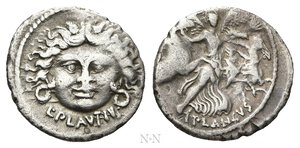
L. PLAUTIUS PLANCUS. Denarius (47 BC). Rome. Obv: L PLAVTIVS. Facing head of Medusa with coiled snakes at either side.Rev: PLANCVS. Draped and winged Aurora flying right, leading the four horses of Sol.Crawford 453/1a; RBW 1583. Condition: Very fine.Weight: 3.57 g. Diameter: 19 mm.Estimate: € 100
Lotto n. 365
-
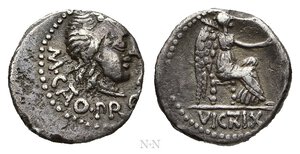
M. PORCIUS CATO. Quinarius (47-46 BC). Utica. Obv: M CATO PRO PR. Head of Liber right.Rev: VICTRIX. Victory seated right on throne, holding wreath and palm frond.Crawford 462/2; CRI 47; RBW -. Condition: Near very fine.Weight: 1.70 g. Diameter: 14 mm.Estimate: € 50
Caricamento altri risultati...