Info & contatti
Le mie offerte
Lotti osservati
Condizioni di vendita
Prezzi di spedizione
Metodi di pagamento
Esito stampabile
Sessione Live 2/8/2026 17:00:00 CET
Celtic Coins (1-15)
Greek Coins (16-215)
Roman Provincial Coins (216-305)
Roman Republican Coins (306-402)
Roman Imperial Coins (403-740)
Migration Period (741-745)
Byzantine Coins (746-768)
Medieval Coins (769-822)
World Coins (823-885)
Medals & Tokens (886-897)
Group Lots (898-1022)

T. CARISIUS. Denarius (46 BC). Rome
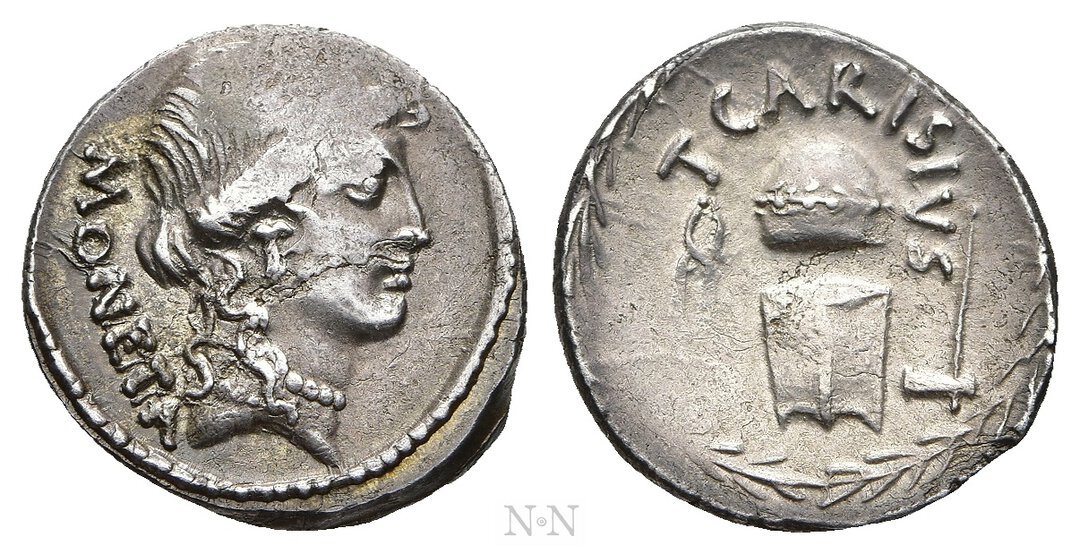

T. CARISIUS. Denarius (46 BC). Rome.
Obv: MONETA.
Head of Juno Moneta right.
Rev: T CARISIVS.
Implements for coining money: anvil die with punch die above, tongs and hammer; all within laurel wreath.
Crawford 464/2; RBW 1614.
This type of reverse is one of the rare depictions from the ancient world of the tools used to mint coins. The process of coin minting remained essentially unchanged from antiquity until the dawn of the modern age, when machinery finally appeared. Yet no detailed descriptions have been handed down by classical authors, which makes the images found on frescoes and on coins such as this one particularly valuable. On the reverse are depicted the essential tools typical of ancient mint workshops. At the centre stands a sturdy cylindrical anvil, into the upper surface of which the obverse die was set. The conical object above the anvil, decorated with a garland, may represent the reverse die, also known as the 'hammer die', as it received the direct blow of the hammer to impress the image onto the metal flan. The reverse die, therefore, was a loose element, placed on the anvil each time before striking a new flan. It should be noted, however, that according to some interpretations the object may instead evoke a pileus, the characteristic headgear of Vulcan, the god‑smith. On either side of the anvil are shown a hammer and a pair of tongs, used to place the heated metal flan onto the anvil. This task was entrusted to the 'suppostores', while those in charge of the hammer were called 'malliatores', and with their blow they impressed the images on both faces of the coin. In the Republican period, the Roman mint was located in the sanctuary on the Capitoline Hill dedicated to Juno Moneta, the deity depicted on the obverse and clearly identified by the legend. The epithet Moneta, meaning 'she who warns', appears to have been common for goddesses protecting the city’s acropolis, and her cult, particularly ancient, may date back to the late sixth century BC.
Condition: Very fine.
Weight: 3.67 g.
Diameter: 20 mm.
Estimate: € 100
Obv: MONETA.
Head of Juno Moneta right.
Rev: T CARISIVS.
Implements for coining money: anvil die with punch die above, tongs and hammer; all within laurel wreath.
Crawford 464/2; RBW 1614.
This type of reverse is one of the rare depictions from the ancient world of the tools used to mint coins. The process of coin minting remained essentially unchanged from antiquity until the dawn of the modern age, when machinery finally appeared. Yet no detailed descriptions have been handed down by classical authors, which makes the images found on frescoes and on coins such as this one particularly valuable. On the reverse are depicted the essential tools typical of ancient mint workshops. At the centre stands a sturdy cylindrical anvil, into the upper surface of which the obverse die was set. The conical object above the anvil, decorated with a garland, may represent the reverse die, also known as the 'hammer die', as it received the direct blow of the hammer to impress the image onto the metal flan. The reverse die, therefore, was a loose element, placed on the anvil each time before striking a new flan. It should be noted, however, that according to some interpretations the object may instead evoke a pileus, the characteristic headgear of Vulcan, the god‑smith. On either side of the anvil are shown a hammer and a pair of tongs, used to place the heated metal flan onto the anvil. This task was entrusted to the 'suppostores', while those in charge of the hammer were called 'malliatores', and with their blow they impressed the images on both faces of the coin. In the Republican period, the Roman mint was located in the sanctuary on the Capitoline Hill dedicated to Juno Moneta, the deity depicted on the obverse and clearly identified by the legend. The epithet Moneta, meaning 'she who warns', appears to have been common for goddesses protecting the city’s acropolis, and her cult, particularly ancient, may date back to the late sixth century BC.
Condition: Very fine.
Weight: 3.67 g.
Diameter: 20 mm.
Estimate: € 100