Info & contatti
Le mie offerte
Lotti osservati
Condizioni di vendita
Prezzi di spedizione
Metodi di pagamento
Esito stampabile
Sessione Live 2/8/2026 17:00:00 CET
Celtic Coins (1-15)
Greek Coins (16-215)
Roman Provincial Coins (216-305)
Roman Republican Coins (306-402)
Roman Imperial Coins (403-740)
Migration Period (741-745)
Byzantine Coins (746-768)
Medieval Coins (769-822)
World Coins (823-885)
Medals & Tokens (886-897)
Group Lots (898-1022)

OCTAVIAN. Denarius (36 BC). Mint in central or southern Italy
Temple of Divus Julius Caesar
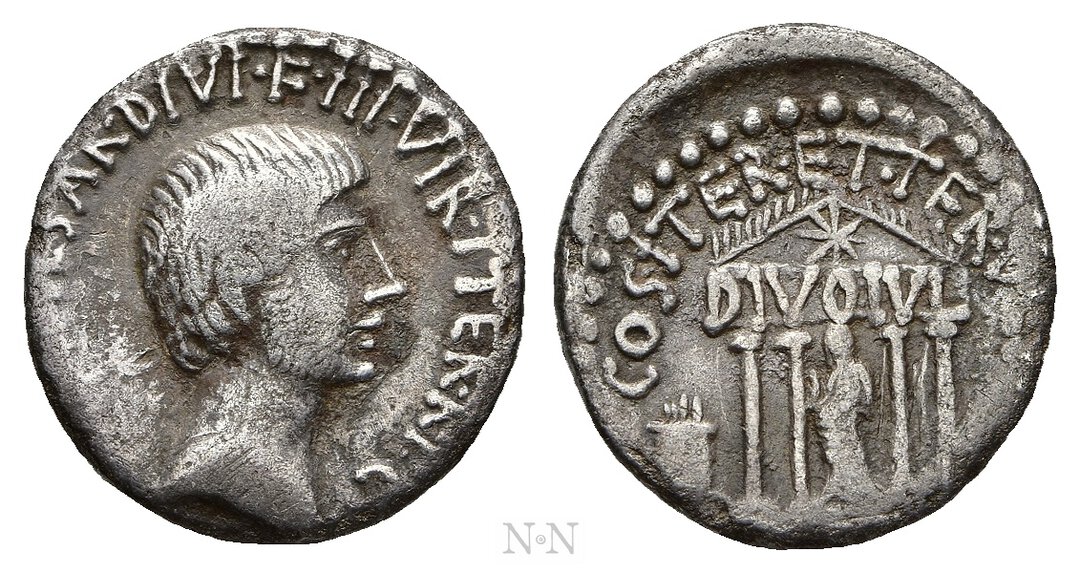

OCTAVIAN. Denarius (36 BC). Mint in central or southern Italy.
Obv: IMP CAESAR DIVI F III VIR ITER R P C.
Bare head right.
Rev: COS ITER ET TER DESIG.
Tetrastyle temple, containing veiled and togate statue of Julius Caesar holding lituus; in pediment, star; on architrave, inscription DIVO IVL; in left field, lighted altar.
Crawford 540/2; CRI 315; RBW 1829.
The Temple of Caesar, or Temple of the Divine Julius, commemorating the imperator who died tragically and prematurely in a conspiracy, was built by his successor Octavian in the Forum of Caesar. It closed the eastern side of the Forum Square, framed by Augustus’ triumphal arch celebrating his victory over the Parthians and by the portico of the Arch of Gaius and Lucius Caesar. Today, only the massive central section of the podium remains. The temple stood on a podium with two lateral stairways and a circular altar between them, marking the place where Caesar’s body was cremated. Inside the cella stood a statue of Caesar crowned with a star, recalling the comet that appeared after his death and was interpreted as a divine sign announcing his reception among the gods. Ancient sources recount that, after his assassination in Pompey’s Curia at Largo Argentina, Caesar’s body was taken to the Roman Forum for cremation, and a marble column inscribed Parenti Patriae ('to the father of the fatherland') was erected on the spot. A few weeks later, the consul Dolabella had the column and altar removed and paved over the area. In 42 BC, however, the triumvirs Octavian, Antony and Lepidus, determined to avenge Caesar and honour him for posterity, decreed that a temple should be built on that very site. Civil wars delayed the project, and only twelve years later was the temple finally dedicated by Augustus, now sole ruler and emperor. It was Augustus who introduced the eastern custom of deifying rulers after death. The temple was dedicated to Caesar on 10 August 29 BC. The temple appears on this coin of Octavian, where one can recognise the statue of Caesar holding the augural lituus, the depicted comet, and, in front of the portico, a round altar. The entire structure was framed at the back and along the sides by a portico, the Porticus Iulia, while in front of the pronaos stood one of the Forum’s speaker platforms, the rostra ad Divi Julii, decorated with the ship prows taken from Antony and Cleopatra’s fleet after their defeat at Actium in 31 BC. This tribune was often mentioned in connection with funerary ceremonies for members of the imperial family, and coins of Hadrian recall an address he delivered before the temple. Under Septimius Severus the temple was damaged by fire, possibly together with the Regia and the House of the Vestals; yet it was promptly restored and survived until the decline of the pagan cult.
Condition: Good fine.
Weight: 3.50 g.
Diameter: 18 mm.
Estimate: € 100
Obv: IMP CAESAR DIVI F III VIR ITER R P C.
Bare head right.
Rev: COS ITER ET TER DESIG.
Tetrastyle temple, containing veiled and togate statue of Julius Caesar holding lituus; in pediment, star; on architrave, inscription DIVO IVL; in left field, lighted altar.
Crawford 540/2; CRI 315; RBW 1829.
The Temple of Caesar, or Temple of the Divine Julius, commemorating the imperator who died tragically and prematurely in a conspiracy, was built by his successor Octavian in the Forum of Caesar. It closed the eastern side of the Forum Square, framed by Augustus’ triumphal arch celebrating his victory over the Parthians and by the portico of the Arch of Gaius and Lucius Caesar. Today, only the massive central section of the podium remains. The temple stood on a podium with two lateral stairways and a circular altar between them, marking the place where Caesar’s body was cremated. Inside the cella stood a statue of Caesar crowned with a star, recalling the comet that appeared after his death and was interpreted as a divine sign announcing his reception among the gods. Ancient sources recount that, after his assassination in Pompey’s Curia at Largo Argentina, Caesar’s body was taken to the Roman Forum for cremation, and a marble column inscribed Parenti Patriae ('to the father of the fatherland') was erected on the spot. A few weeks later, the consul Dolabella had the column and altar removed and paved over the area. In 42 BC, however, the triumvirs Octavian, Antony and Lepidus, determined to avenge Caesar and honour him for posterity, decreed that a temple should be built on that very site. Civil wars delayed the project, and only twelve years later was the temple finally dedicated by Augustus, now sole ruler and emperor. It was Augustus who introduced the eastern custom of deifying rulers after death. The temple was dedicated to Caesar on 10 August 29 BC. The temple appears on this coin of Octavian, where one can recognise the statue of Caesar holding the augural lituus, the depicted comet, and, in front of the portico, a round altar. The entire structure was framed at the back and along the sides by a portico, the Porticus Iulia, while in front of the pronaos stood one of the Forum’s speaker platforms, the rostra ad Divi Julii, decorated with the ship prows taken from Antony and Cleopatra’s fleet after their defeat at Actium in 31 BC. This tribune was often mentioned in connection with funerary ceremonies for members of the imperial family, and coins of Hadrian recall an address he delivered before the temple. Under Septimius Severus the temple was damaged by fire, possibly together with the Regia and the House of the Vestals; yet it was promptly restored and survived until the decline of the pagan cult.
Condition: Good fine.
Weight: 3.50 g.
Diameter: 18 mm.
Estimate: € 100