Info & contatti
Le mie offerte
Lotti osservati
Condizioni di vendita
Prezzi di spedizione
Metodi di pagamento
Esito stampabile
Sessione Live 2/8/2026 17:00:00 CET
Celtic Coins (1-15)
Greek Coins (16-215)
Roman Provincial Coins (216-305)
Roman Republican Coins (306-402)
Roman Imperial Coins (403-740)
Migration Period (741-745)
Byzantine Coins (746-768)
Medieval Coins (769-822)
World Coins (823-885)
Medals & Tokens (886-897)
Group Lots (898-1022)

VITELLIUS (69). Denarius. Rome
Bust Variant
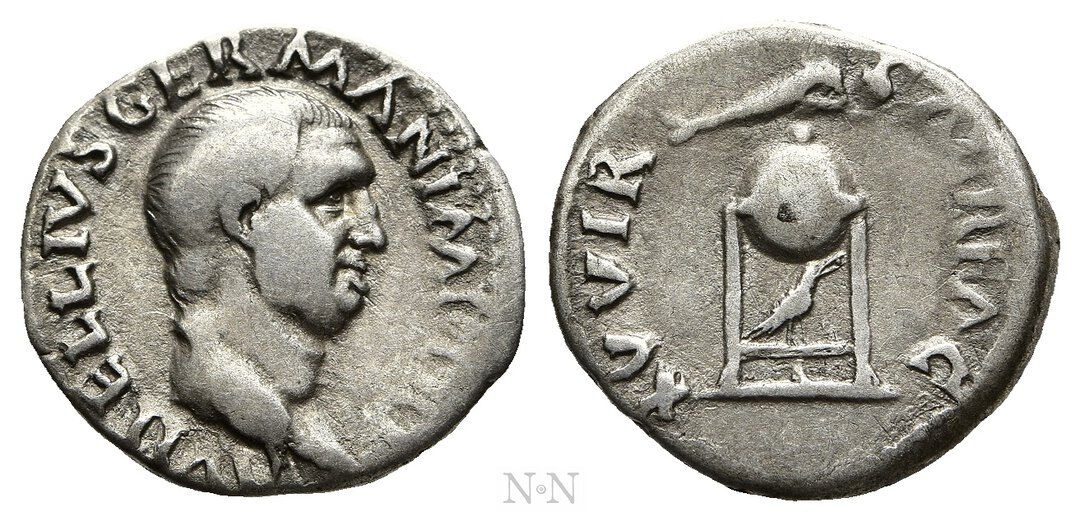

VITELLIUS (69). Denarius. Rome.
Obv: A VITELLIVS GERMAN IMP TR P.
Bare head right.
Rev: XV VIR SACR FAC.
Tripod, dolphin on top, raven on strut between legs.
RIC² 86 var. (head laureate); RSC 112.
Very rare
Vitellius was born in AD 15 and rose to prominence largely thanks to his talent for flattery and for pleasing the emperors. His origins were the subject of conflicting stories, ranging from descent from ancient Italic deities to being the son of a freedman cobbler. After a youth marked by excess, he managed to win favour with Caligula, Claudius and Nero by exploiting their personal passions, and even poisoned his own son out of fear that he was plotting against him. Galba sent him to Lower Germany more to remove him from Rome than out of confidence, yet Vitellius quickly won over the soldiers by granting favours and cancelling punishments. The German legions, encouraged by Valens and Caecina Alienus, proclaimed him emperor and defeated Otho at Bedriacum. Vitellius entered Rome like a triumphator, presented his young son as heir, and declared his intention to found a new dynasty. He replaced the praetorian guard, punished Galba’s killers, and honoured Nero, earning the hostility of senatorial historians. When news arrived that the troops had proclaimed Vespasian, his power collapsed swiftly: the Danubian armies defeated his forces in the second battle of Bedriacum, the Misenum fleet deserted him, and Valens’ attempt to raise new troops failed. In Rome, the Capitoline Hill was set ablaze during the fighting, and Vitellius, after trying to flee, was captured, dragged along the Via Sacra and killed. He suffered damnatio memoriae, and his brother and son died with him. His failure stemmed from the growing strength of provincial armies, the marginal role of the Senate, and his limited military experience, worsened by his choice of collaborators who were openly at odds with one another. Yet Vitellius did show respect for the Senate, allowing his reign to begin only after its ratification and refusing titles he considered too grand for himself.
Condition: Near very fine.
Weight: 3.20 g.
Diameter: 20 mm.
Estimate: € 440
Obv: A VITELLIVS GERMAN IMP TR P.
Bare head right.
Rev: XV VIR SACR FAC.
Tripod, dolphin on top, raven on strut between legs.
RIC² 86 var. (head laureate); RSC 112.
Very rare
Vitellius was born in AD 15 and rose to prominence largely thanks to his talent for flattery and for pleasing the emperors. His origins were the subject of conflicting stories, ranging from descent from ancient Italic deities to being the son of a freedman cobbler. After a youth marked by excess, he managed to win favour with Caligula, Claudius and Nero by exploiting their personal passions, and even poisoned his own son out of fear that he was plotting against him. Galba sent him to Lower Germany more to remove him from Rome than out of confidence, yet Vitellius quickly won over the soldiers by granting favours and cancelling punishments. The German legions, encouraged by Valens and Caecina Alienus, proclaimed him emperor and defeated Otho at Bedriacum. Vitellius entered Rome like a triumphator, presented his young son as heir, and declared his intention to found a new dynasty. He replaced the praetorian guard, punished Galba’s killers, and honoured Nero, earning the hostility of senatorial historians. When news arrived that the troops had proclaimed Vespasian, his power collapsed swiftly: the Danubian armies defeated his forces in the second battle of Bedriacum, the Misenum fleet deserted him, and Valens’ attempt to raise new troops failed. In Rome, the Capitoline Hill was set ablaze during the fighting, and Vitellius, after trying to flee, was captured, dragged along the Via Sacra and killed. He suffered damnatio memoriae, and his brother and son died with him. His failure stemmed from the growing strength of provincial armies, the marginal role of the Senate, and his limited military experience, worsened by his choice of collaborators who were openly at odds with one another. Yet Vitellius did show respect for the Senate, allowing his reign to begin only after its ratification and refusing titles he considered too grand for himself.
Condition: Near very fine.
Weight: 3.20 g.
Diameter: 20 mm.
Estimate: € 440