Info & contatti
Le mie offerte
Lotti osservati
Condizioni di vendita
Prezzi di spedizione
Metodi di pagamento
Esito stampabile
Sessione Live 2/8/2026 17:00:00 CET
Celtic Coins (1-15)
Greek Coins (16-215)
Roman Provincial Coins (216-305)
Roman Republican Coins (306-402)
Roman Imperial Coins (403-740)
Migration Period (741-745)
Byzantine Coins (746-768)
Medieval Coins (769-822)
World Coins (823-885)
Medals & Tokens (886-897)
Group Lots (898-1022)

COMMODUS (Caesar, 166-177). Dupondius. Rome
Marcomannic War Issue
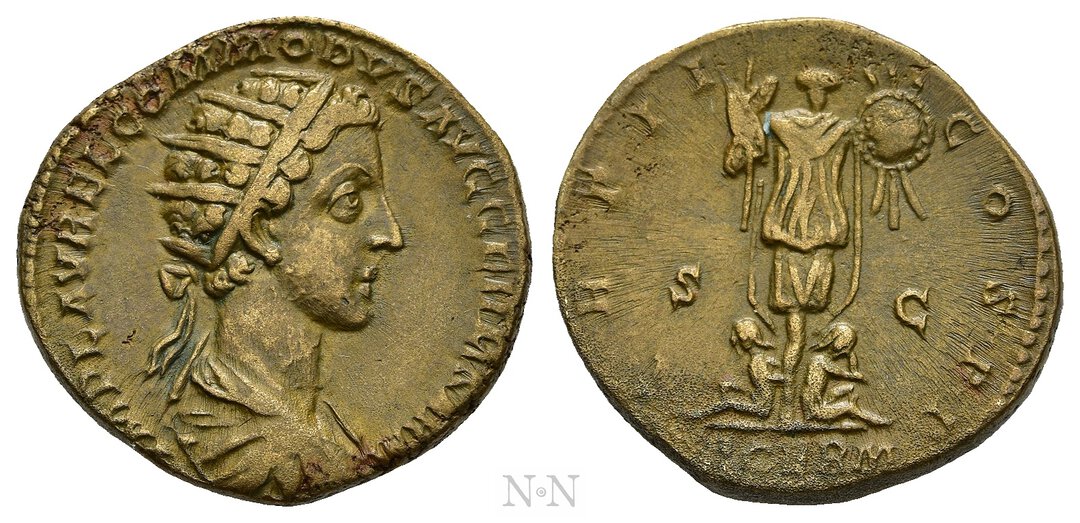

COMMODUS (Caesar, 166-177). Dupondius. Rome.
Obv: IMP L AVREL COMMODVS AVG GERM SARM.
Radiate and draped bust right.
Rev: TR P II COS P P / DE GERM.
Trophy between two bound and seated captives.
RIC 1568a (Aurelius).
Rare bust type for issue
The Marcomannic Wars (AD 166–180) were among the most critical moments faced by the Roman Empire: a long and exhausting conflict that severely tested Rome’s political, economic and military stability. Marcus Aurelius confronted a wave of barbarian invasions that swept across the Danube and reached Italy itself, further aggravated by a devastating epidemic arriving from the East. After the dangerous usurpation attempt by Avidius Cassius, Marcus Aurelius decided in AD 177 to associate his young son Commodus with imperial power. This choice broke with the tradition of the Antonine dynasty, which had always adopted the “best man” as successor, and was seen as an act driven by paternal affection and by a quasi‑sacred idea of dynastic continuity. Commodus accompanied his father to the Danubian front during the final years of the conflict. The Roman armies achieved fresh victories, and in AD 179–180 they wintered deep within enemy territory. It was a moment when the war finally seemed to be turning decisively in Rome’s favour. But on 17 March AD 180 Marcus Aurelius died at Vindobona. Only a few weeks later, Commodus brought the war to an end by concluding peace. Ancient sources, often hostile to Commodus, describe the treaties as “ignominious”, accusing him of having signed them for frivolous reasons: a desire to return to the comforts of Rome and a dislike of the Danubian climate. Yet it is unlikely that the young emperor acted against the advice of all his generals and counsellors. There existed a genuine “peace party”, aware that although the barbarians were exhausted, Rome too was worn out. In other words, Commodus’ peace was not necessarily an act of weakness but a decision shaped by political realism: the principal objective — securing the frontier — had been achieved, and continuing the war would have further drained an empire already strained by epidemics, economic difficulties and internal tensions
Condition: Very fine.
Weight: 13.08 g.
Diameter: 25 mm.
Estimate: € 300
Obv: IMP L AVREL COMMODVS AVG GERM SARM.
Radiate and draped bust right.
Rev: TR P II COS P P / DE GERM.
Trophy between two bound and seated captives.
RIC 1568a (Aurelius).
Rare bust type for issue
The Marcomannic Wars (AD 166–180) were among the most critical moments faced by the Roman Empire: a long and exhausting conflict that severely tested Rome’s political, economic and military stability. Marcus Aurelius confronted a wave of barbarian invasions that swept across the Danube and reached Italy itself, further aggravated by a devastating epidemic arriving from the East. After the dangerous usurpation attempt by Avidius Cassius, Marcus Aurelius decided in AD 177 to associate his young son Commodus with imperial power. This choice broke with the tradition of the Antonine dynasty, which had always adopted the “best man” as successor, and was seen as an act driven by paternal affection and by a quasi‑sacred idea of dynastic continuity. Commodus accompanied his father to the Danubian front during the final years of the conflict. The Roman armies achieved fresh victories, and in AD 179–180 they wintered deep within enemy territory. It was a moment when the war finally seemed to be turning decisively in Rome’s favour. But on 17 March AD 180 Marcus Aurelius died at Vindobona. Only a few weeks later, Commodus brought the war to an end by concluding peace. Ancient sources, often hostile to Commodus, describe the treaties as “ignominious”, accusing him of having signed them for frivolous reasons: a desire to return to the comforts of Rome and a dislike of the Danubian climate. Yet it is unlikely that the young emperor acted against the advice of all his generals and counsellors. There existed a genuine “peace party”, aware that although the barbarians were exhausted, Rome too was worn out. In other words, Commodus’ peace was not necessarily an act of weakness but a decision shaped by political realism: the principal objective — securing the frontier — had been achieved, and continuing the war would have further drained an empire already strained by epidemics, economic difficulties and internal tensions
Condition: Very fine.
Weight: 13.08 g.
Diameter: 25 mm.
Estimate: € 300