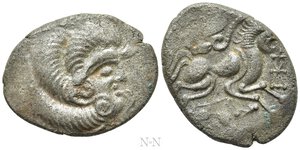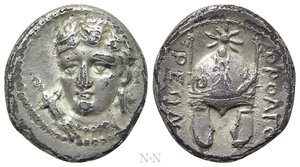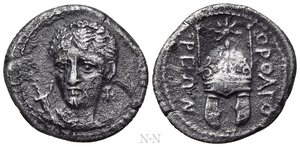
WESTERN EUROPE. Northwest Gaul. Coriosolites. Stater (Circa 100-50 BC) - WESTERN EUROPE. Northwest Gaul. Coriosolites. Stater (Circa 100-50 BC). Obv: Stylized head right.Rev: Stylized horseman on androcephalic horse; ornaments above, boar below.D&T 2338. Condition: Very fine.Weight: 5.84 g. Diameter: 24 mm.
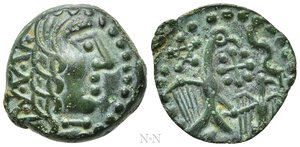
WESTERN EUROPE. Northwest Gaul. Carnutes. Ae (Circa 100-50 BC) - WESTERN EUROPE. Northwest Gaul. Carnutes. Ae (Circa 100-50 BC). Obv: Stylized head right.Rev: Two eagles flying; pentagram above larger eagle's right wing; between eagles, cross with pellet in each quarter; serpent to right.D&T 2582. Condition: Extremely fine.Weight: 3.55 g. Diameter: 17 mm.
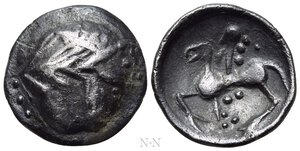
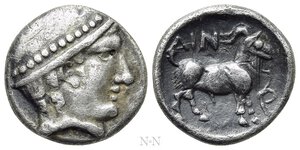
EASTERN EUROPE. Uncertain. Obol (Circa 2nd-1st century BC) - EASTERN EUROPE. Uncertain. Obol (Circa 2nd-1st century BC). Obv: Sytlized head right.Rev: Stylized horse with horseman left.Lanz 840; OTA -; Dembski -.Rare Condition: Very fine.Weight: 0.91 g. Diameter: 12 mm.
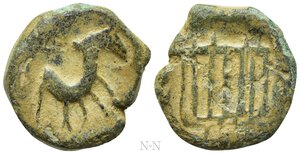
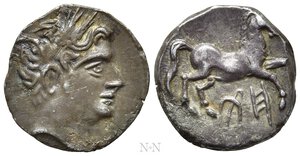
EASTERN EUROPE. Imitations of Maroneia. Ae (Circa 3rd-2nd century BC) - EASTERN EUROPE. Imitations of Maroneia. Ae (Circa 3rd-2nd century BC). Obv: Stylized horse prancing right.Rev: Stylized grape arbor in linear square.Cf. HGC 3.2, 1545 (for prototype). Condition: Very fine.Weight: 4.03 g. Diameter: 17 mm.
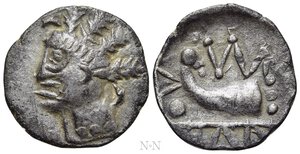
EASTERN EUROPE. Imitating Histiaia. Tetrobol (3rd-2nd centuries BC) - EASTERN EUROPE. Imitating Histiaia. Tetrobol (3rd-2nd centuries BC). Obv: Wreathed head of the nymph Histiaia left.Rev: Stylized nymph seated right on stern of galley.Cf. HGC 4, 1527 (for prototype). Condition: Very fine.Weight: 1.90 g. Diameter: 15 mm.
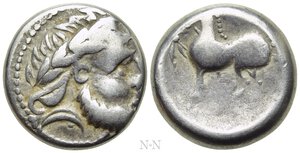
EASTERN EUROPE. Imitations of Philip II of Macedon (2nd-1st centuries BC). Tetradrachm. 'Kugelwange ohne Ringel' type - EASTERN EUROPE. Imitations of Philip II of Macedon (2nd-1st centuries BC). Tetradrachm. 'Kugelwange ohne Ringel' type. Obv: Stylized laureate head of Zeus right.Rev: Stylized horse prancing left.Lanz -; Karl 479. Condition: Near very fine.Weight: 11.80 g. Diameter: 21 mm.
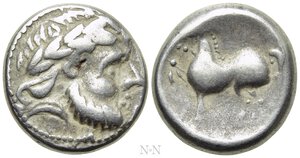
EASTERN EUROPE. Imitations of Philip II of Macedon (2nd-1st centuries BC). Tetradrachm. 'Kugelwange ohne Ringel' type - EASTERN EUROPE. Imitations of Philip II of Macedon (2nd-1st centuries BC). Tetradrachm. 'Kugelwange ohne Ringel' type. Obv: Stylized laureate head of Zeus right.Rev: Stylized horse prancing left.Lanz -; Karl 479. Condition: Near very fine.Weight: 12.06 g. Diameter: 22 mm.
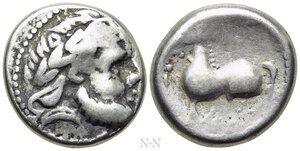
EASTERN EUROPE. Imitations of Philip II of Macedon (2nd-1st centuries BC). Tetradrachm. 'Kugelwange ohne Ringel' type - EASTERN EUROPE. Imitations of Philip II of Macedon (2nd-1st centuries BC). Tetradrachm. 'Kugelwange ohne Ringel' type. Obv: Stylized laureate head of Zeus right.Rev: Stylized horse prancing left.Lanz -; Karl 479. Condition: Near very fine.Weight: 11.85 g. Diameter: 23 mm.
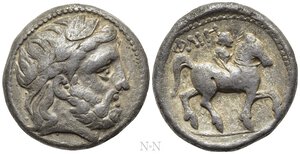
EASTERN EUROPE. Imitations of Philip II of Macedon (2nd-1st centuries BC). Tetradrachm - EASTERN EUROPE. Imitations of Philip II of Macedon (2nd-1st centuries BC). Tetradrachm. Obv: Laureate head of Zeus right.Rev: ΦΛΙΠ. Youth on horse right, holding palm frond.Cf. Lanz 362-3. Condition: Good fine.Weight: 14.04 g. Diameter: 25 mm.
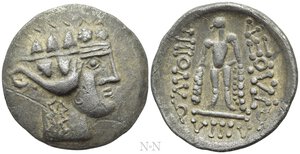
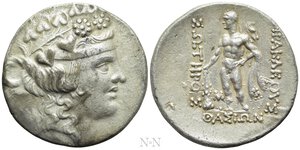
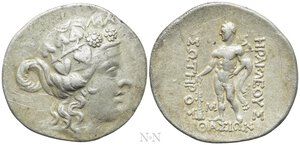
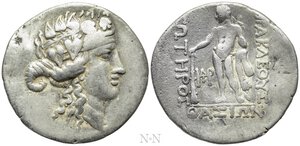
EASTERN EUROPE. Imitations of Thasos. Tetradrachm (2nd-1st centuries BC) - EASTERN EUROPE. Imitations of Thasos. Tetradrachm (2nd-1st centuries BC). Obv: Head of Dionysos right, wearing ivy wreath.Rev: Blundered legend. Herakles standing left, holding club and lion skin.OTA Class III. Condition: Very fine.Weight: 15.95 g. Diameter: 31 mm.
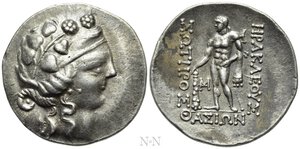
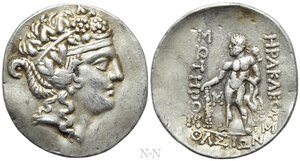
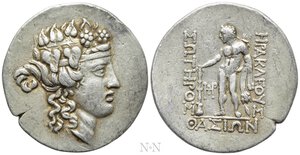
EASTERN EUROPE. Imitations of Thasos. Tetradrachm (2nd-1st centuries BC) - EASTERN EUROPE. Imitations of Thasos. Tetradrachm (2nd-1st centuries BC). Obv: Head of Dionysos right, wearing ivy wreath.Rev: ΗΡΑΚΛΕΟYΣ / ΣΩΤΗΡΟΣ / ΘΑΣΙΩΝ. Herakles standing left, holding club and lion skin; monogram to inner left.OTA Class II; cf HGC 6, 358-9 (for prototype). Condition: Good very fine.Weight: 16.79 g. Diameter: 32 mm.
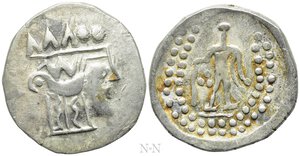
EASTERN EUROPE. Imitations of Thasos. Tetradrachm (2nd-1st centuries BC) - EASTERN EUROPE. Imitations of Thasos. Tetradrachm (2nd-1st centuries BC). Obv: Head of Dionysos right, wearing ivy wreath.Rev: Herakles standing left, holding club and lion skin.OTA Class V; Lanz 983ff. Condition: Very fine.Weight: 15.65 g. Diameter: 31 mm.
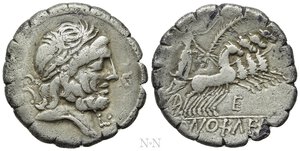
EASTERN EUROPE. Imitations of Roman Republic. Geto-Dacians. Serrate Denarius. Imitating Q. Antonius Balbus (83-82 BC) - EASTERN EUROPE. Imitations of Roman Republic. Geto-Dacians. Serrate Denarius. Imitating Q. Antonius Balbus (83-82 BC). Obv: S•C. Laureate head of Jupiter right; L• below chin.Rev: Blundered legend. Victory driving quadriga right, holding reins, wreath and palm frond; E below horses.Cf. Crawford 364/1c (for prototype); Davis Class A, Group 1b. Condition: Near very fine.Weight: 4.90 g. Diameter: 20 mm.
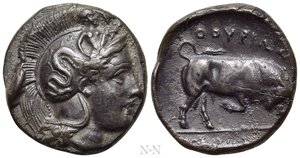
LUCANIA. Thourioi. Stater - Nomos (Circa 400-350 BC) - LUCANIA. Thourioi. Stater - Nomos (Circa 400-350 BC). Obv: Helmeted head of Athena right, wearing Attic helmet decorated with Skylla holding staff (or oar) and pointing.Rev: ΘΟΥΡΙΩΝ. Bull butting right; fish right in exergue.HN Italy 1800; SNG ANS 1010-2; HGC 1, 1260. Condition: Good very fine.Weight: 7.79 g. Diameter: 22 mm.
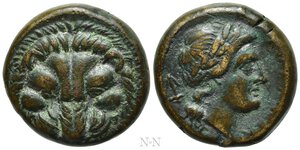
BRUTTIUM. Rhegion. Ae (Circa 351-280 BC) - BRUTTIUM. Rhegion. Ae (Circa 351-280 BC). Obv: Facing head of lion.Rev: PHΓINΩN. Laureate head of Apollo right; anchor to left.HN Italy 2534a; HGC 1, 1682. Condition: Very fine.Weight: 8.83 g. Diameter: 20 mm.
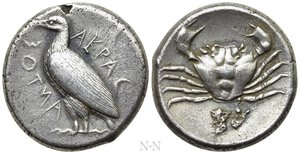
SICILY. Akragas. Tetradrachm (Circa 465/0–445/0 BC) - SICILY. Akragas. Tetradrachm (Circa 465/0–445/0 BC). Obv: AKPAΓANTOΣ. Eagle standing left.Rev: Crab.Westermark Period II, Group II; HGC 2, 77; SNG ANS 978.Historical sources give the date of Akragas' founding as the 50th Olympiad (585-580 BC), placing it among the last Greek colonies established in Sicily. The settlers probably came from Rhodes and Gela, under the command of the ecists Aristonoo and Pistilos, who located a site not far from the sea on the Akragas River, after which the city was named. During the tyranny of Phalaris (570-555 BC) the city built walls and began an expansionist campaign, later continued by Theron (488-473), who won an important battle victory over the Carthaginians at Himera, gaining a vast territory. From that time Akragas experienced enormous political, economic and cultural development, culminating in the period of democratic rule, which was established after the death of Theron. In 406 BC the city was besieged by the Carthaginians, who finally sacked and burned it several times, without however, favoring the establishment of a Punic colony. With Timoleon's victory over Carthage in 339, the city was rebuilt on the same site, then taken back by the Carthaginians and remained under their influence until 210, when it passed into Roman hands at the end of the Second Punic War. The eagle depicted on the obverse of this coin, and on most of the issues of Akragas, is surely to be related to Zeus, to whom the inhabitants dedicated the most important temple in the city. The crab, on the other hand, which appears on all the reverses, is associated with Poseidon, demonstrating the city's great connection with the sea from the time of its founding, which was important for its economy related to maritime trade. On some silver coins, a human face appears on the carapace of the crab, most likely depicting the river god Akragas in an original way. Condition: Very fine.Weight: 17.16 g. Diameter: 26 mm.
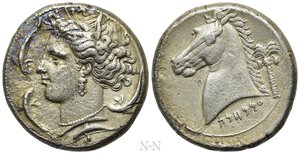
SICILY. Entella. Punic Issues. Tetradrachm (Circa 320/15-300 BC) - SICILY. Entella. Punic Issues. Tetradrachm (Circa 320/15-300 BC). Obv: Head of Arethousa left, wearing grain-ear wreath; four dolphins around.Rev: Head of horse left; palm tree to right.Jenkins, Punic, Series 3a; CNP 267; HGC 2, 284.The foundation of Entella is traced back to Acestes, son of the river god Krimisos and a Trojan woman or, according to other sources to Prince Elymus, son of Anchises and brother of Aeneas. The city stood on a summit overlooking the Belice valley. Records are scarce until the arrival of the Campanian mercenaries, recruited in 410 BC by the Carthaginians and discharged after the 405 BC treaty, then passed into the pay of Dionysius I of Syracuse. After liberating Dionysius on the island of Ortigia from the Punic siege, the were discharged with rich gifts and settled in various cities on the island. In 404 a group of these mercenaries seized Entella, exterminating the entire male population, and began to mint their own coinage. From then on they implemented a generally pro-Carthaginian policy and, in 398 B.C., were able to stop Syracusan siege attempts with the help of the Punic. The strategic location of the fortress of Entella was coveted for its control of the valley below, and this led to several siege attempts: in 345 it was attacked by the Carthaginians led by General Annon, then in 342 the city was taken by the Syracusans commanded by Timoleon, but in 338 it fell back under Punic influence. During the First Punic War the city was destroyed by the Carthaginians. The “Decrees of Entella,” which were requests for help engraved on bronze slabs, from the inhabitants to neighboring cities, date from this period. In 263 Entella was conquered by the Romans and enjoyed a new period of prosperity until the second century BC when it was abandoned. Condition: Very fine.Weight: 16.84 g. Diameter: 26 mm.
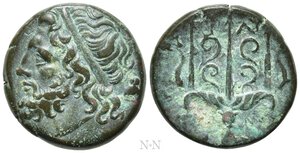
SICILY. Syracuse. Hieron II (275-215 BC). Ae - SICILY. Syracuse. Hieron II (275-215 BC). Ae. Obv: Head of Poseidon left, wearing tainia; to right, owl standing right, head facing.Rev: ΙΕΡΩ - ΝΟΣ. Ornamented trident head flanked by two dolphins.CNS 197 Ds 35 Rs 1; HGC 2, 1550. Condition: Very fine.Weight: 6.91 g. Diameter: 20 mm.
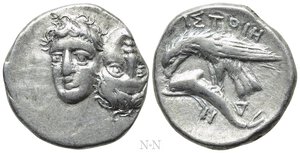
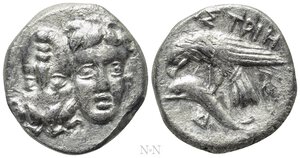
MOESIA. Istros. Drachm (4th century BC) - MOESIA. Istros. Drachm (4th century BC). Obv: Facing male heads, the left inverted.Rev: ΙΣΤΡΙΗ. Sea eagle right, grasping dolphin with talons; Δ below dolphin.SNG BM Black Sea 245 var. (also H to right); HGC 3.2, 1803. Condition: Very fine.Weight: 4.73 g. Diameter: 18 mm.
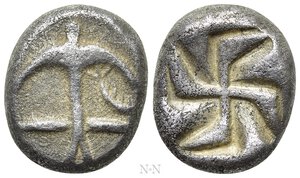
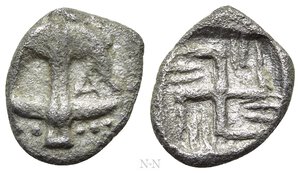
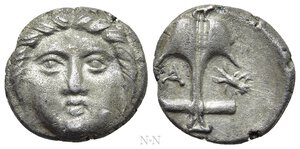
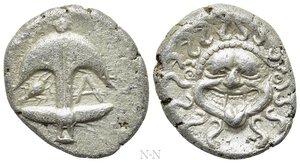
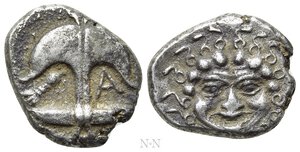
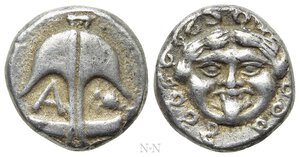
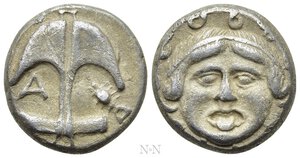
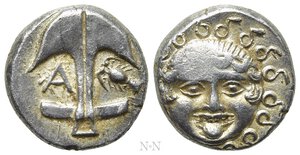
THRACE. Apollonia Pontika. Diobol (Circa 375-335 BC) - THRACE. Apollonia Pontika. Diobol (Circa 375-335 BC). Obv: Facing laureate head of Apollo.Rev: Upright anchor; A to left, crayfish to right; all within incuse circle.SNG Bulgaria 325ff.; SNG BM Black Sea 167; HGC 3.2, 1315. Condition: Very fine.Weight: 1.22 g. Diameter: 11 mm.
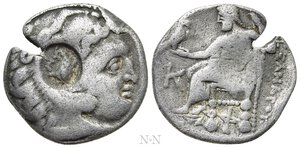
THRACE. Byzantion. Countermarked on a Kolophon Drachm in the name and types of Alexander III 'the Great' (336-323 BC) - THRACE. Byzantion. Countermarked on a Kolophon Drachm in the name and types of Alexander III 'the Great' (336-323 BC). Obv: Head of Herakles right, wearing lion skin; c/m: prow of galley right, ΠY above, within circular incuse.Rev: AΛEΞANΔPOY. Zeus seated left on throne, holding eagle and sceptre. Controls: Monogram in left field; below throne, Φ below strut.Price 1823 (for undertype); Numismatik Naumann 149, lot 99 (for c/m). Condition: Good fine.Weight: 3.80 g. Diameter: 18 mm.
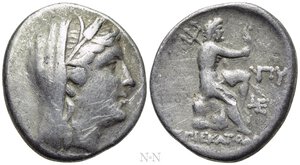
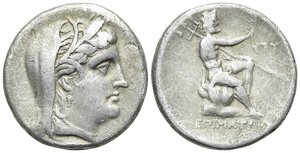
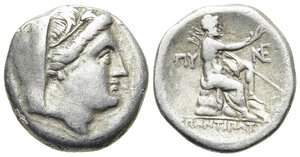
THRACE. Byzantion. 9 Obols (Circa 240-220 BC). Antipatros, magistrate - THRACE. Byzantion. 9 Obols (Circa 240-220 BC). Antipatros, magistrate. Obv: Veiled and wreathed head of Demeter right.Rev: EΠI ANTIΠATPOY. Poseidon seated right on rocks, holding trident and aphlaston; ΠY to left, ME monogram to right.Schönert-Geiss, Byzantion 1026-36; SNG Copenhagen 487; HGC 3.2, 1409.Rare Condition: Near very fine.Weight: 5.38 g. Diameter: 20 mm.
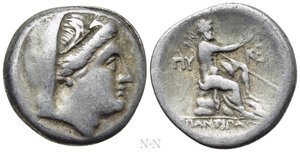
THRACE. Byzantion. 9 Obols (Circa 240-220 BC). Antipatros, magistrate - THRACE. Byzantion. 9 Obols (Circa 240-220 BC). Antipatros, magistrate. Obv: Veiled and wreathed head of Demeter right.Rev: EΠI ANTIΠATPOY. Poseidon seated right on rocks, holding trident and aphlaston; monogram to left and right.Schönert-Geiss, Byzantion 1026-36; HGC 3.2, 1409; CN online 6059. Condition: Very fine.Weight: 5.48 g. Diameter: 19 mm.
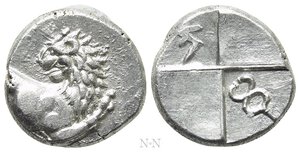
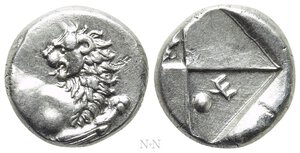
THRACE. Chersonesos. Hemidrachm (Circa 386-338 BC) - THRACE. Chersonesos. Hemidrachm (Circa 386-338 BC). Obv: Forepart of lion right, head left.Rev: Quadripartite incuse square with alternating raised and sunken quarters; monogram with pellet and uncertain control in sunken quarters.HGC 3.2, 1437. Condition: Extremely fine.Weight: 2.55 g. Diameter: 13 mm.
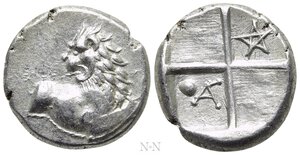
THRACE. Chersonesos. Hemidrachm (Circa 386-338 BC) - THRACE. Chersonesos. Hemidrachm (Circa 386-338 BC). Obv: Forepart of lion right, head reverted.Rev: Quadripartite incuse square with alternating raised and sunken quarters; pellet and AΓ monogram in one quarter, amphora in opposite quarter.McClean 4066; CN online 6563; HGC 3.2, 1437. Condition: Good very fine.Weight: 2.32 g. Diameter: 13 mm.
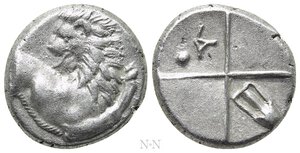
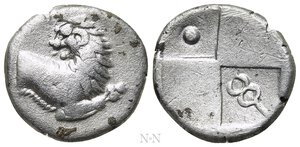
THRACE. Chersonesos. Hemidrachm (Circa 386-338 BC) - THRACE. Chersonesos. Hemidrachm (Circa 386-338 BC). Obv: Forepart of lion right, head left.Rev: Quadripartite incuse square with alternating raised and sunken quarters; pellet in one quarter, kerykeion in opposite quarter.McClean -; BMC -; CN Online -; HGC 3.2, 1437. Condition: Near very fine.Weight: 1.89 g. Diameter: 14 mm.
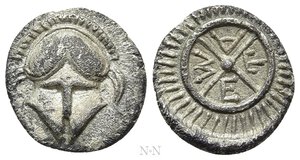
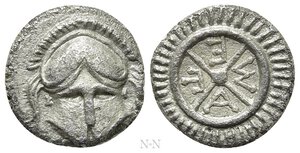
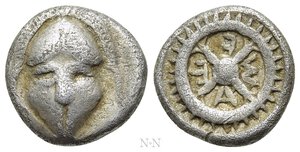
THRACE. Mesambria. Obol (Circa 4th century BC) - THRACE. Mesambria. Obol (Circa 4th century BC). Obv: Facing Corinthian helmet.Rev: M - E - T - A. Four-spoked wheel.SNG BM Black Sea 267; SNG Stancomb 218; HGC 3.2, 1566. Condition: Near very fine.Weight: 0.57 g. Diameter: 8 mm.
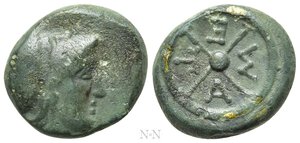
THRACE. Mesambria. Ae (4th century BC) - THRACE. Mesambria. Ae (4th century BC). Obv: Head of Athena right, wearing Corinthian helmet.Rev: M - E - T - A. Four-spoked wheel.SNG BM Black Sea 278; HGC 3.2, 1580.Rare Condition: Very fine.Weight: 1.28 g. Diameter: 10 mm.