Dea Moneta
login
Banner Naumann 159
Triumph of Sulla
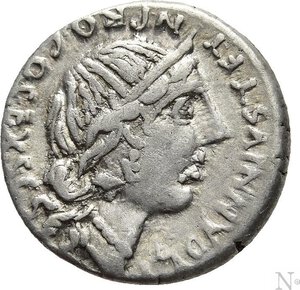
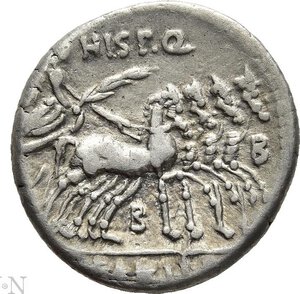
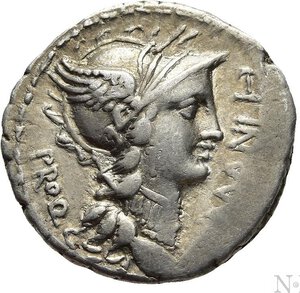
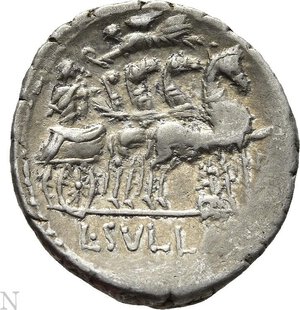
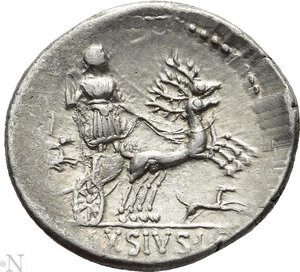
Lot # 529 - L. CORNELIUS SULLA and L. MANLIUS TORQUATUS. Denarius (82 BC). Mint moving with Sulla. Obv: PROQ / L MANLI. Helmeted head of Roma right.Rev: L SVLLA IMP. Triumphator, being crowned by Victory flying left, driving quadriga right, holding reins and caduceus.Crawford 367/3; RBW -.Lucius Cornelius Sulla, after an important political career as quaestor during the war against Jugurtha and then as praetor in the Social War of 93 BC, led the conquest and destruction of Stabiae and the siege of Nola, achieving several successes. In 88 BC, at the age of fifty, he was elected consul together with Q. Pompeius Rufus and was entrusted with the command of operations against Mithridates VI, king of Pontus. Starting from Phrygia and Mysia, Mithridates also succeeded in subjugating Lycia, Pamphylia, and Ionia. These events had prompted part of the province of Achaea and Athens to rebel against Roman rule. After capturing and killing Manius Aquilius, the Roman general in charge of the legions in that area, the Roman Senate declared war on him. Sulla arrived in Greece and sacked rebellious Athens, then won two important victories against Mithridates at Chaeronea and Orchomenus. Meanwhile, in Rome, an alliance between the equites and the plebeians brought Marius to a position of command and started a civil war. Marius wanted to command the army against Mithridates and convinced the Senate to entrust him with the operation. Sulla then marched on Rome with six legions, violating the sacred boundary of the pomerium, and forced Marius and his followers to flee to Africa. Upon the death of Marius and Cinna, a second, even bloodier civil war broke out against the populares and the Italic peoples. Sulla eventually managed to enter Rome and severely punished his opponents and their families. He was elected dictator in 82, when this coin was struck, which shows the celebration of his triumph. Condition: Very fine.Weight: 3.92 g. Diameter: 19 mm.
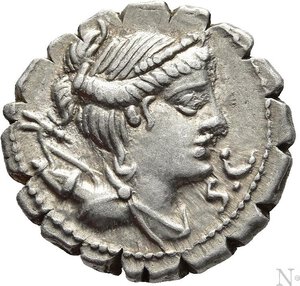
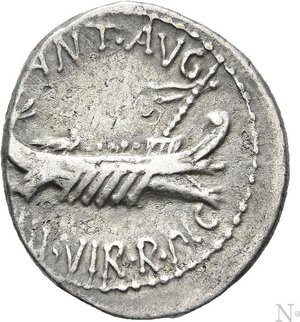
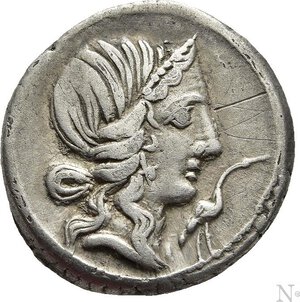
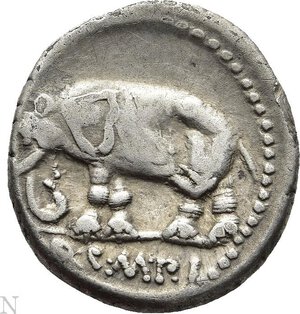
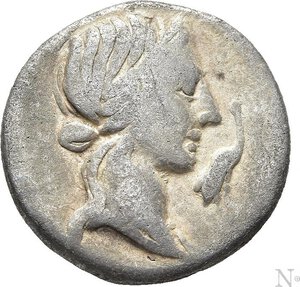
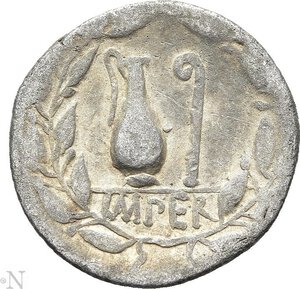
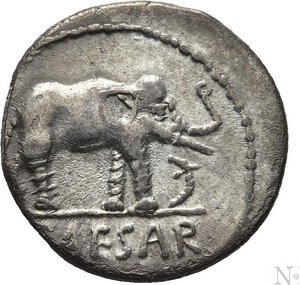
Lot # 550 - JULIUS CAESAR. Denarius (49 BC). Military mint traveling with Caesar. Obv: CAESAR. Elephant advancing right, trampling upon horned serpent.Rev: Emblems of the pontificate: simpulum, aspergillum, securis and apex.Crawford 443/1; CRI 9; RBW 1557.With the beginning of the Civil Wars, this is the first coin issued in open defiance of the Senate, bearing the name of a private individual. There is no agreement on the place of issue, Crawford attributes it to an itinerant mint. According to D. Van Meter (The Hanbook of Roman Imperial Coins) the coin, was minted in 49-48 to finance the invasion of Italy, the allegory would refer to the salvation of the Republic (the snake/dragon), crushed by Metellus Scipio (whose gens had an elephant depicted on their coins). It is generally believed that it is a dragon that is trampled upon; the African elephant would not only allude to the victory against Ariovistus in 58 BC (the dragon was on the banner of the Germans) but also to the name of Caesar, who discovered the existence of a homograph word for elephant in the Mauri' language in Mauretania. Religious emblems here depicted are symbols of priestly offices: the jug and the lituus representing the functions associated with the Pontefices and the Augures. Both ensure the legitimacy of all political action, ensuring the salvation of the Roman state through respect for the divine will. Caesar himself holds most of the religious offices and uses them for propaganda purposes in a new type of coin that emphasises his supreme authority. Condition: Extremely fine.Weight: 3.16 g. Diameter: 18 mm.
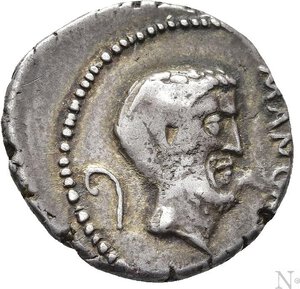
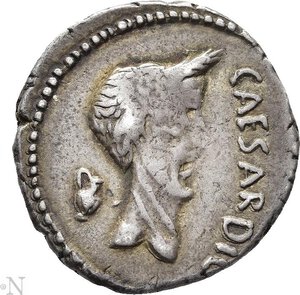
Lot # 553 - MARK ANTONY, with JULIUS CAESAR. Denarius (43 BC). Military mint traveling with Antony in Cisalpine Gaul. Posthumous Caesar issue. Obv: M ANTO IMP R P C. Bare head of Antony right; lituus to left.Rev: CAESAR DIC. Wreathed head of Julius Caesar right; capis to left.Crawford 488/2; CRI 123; RBW -.Following the assassination of Julius Caesar (44 BC), the city celebrated the feat of the conspirators who had ended the dictator's life. Mark Antony, by reading the deceased's will and delivering an eloquent speech, managed to win to his side the Roman people, forcing the Caesaricides to leave Rome, but allowing Brutus to move to Mantua where he gained control of Gallia Comata. The political scene changed when Octavian, Caesar's great-nephew, came to power. Using his family name and wanting to get revenge for his dad, he got a lot of support in the Senate and pushed for tougher measures against Caesar's killers. Antony then moved against Brutus and started the siege of Modena, but he lost more and more support in the Senate, partly because of Cicero's Philippics, and was declared a “public enemy.” This led to a confrontation between the armies of Antony and Octavian at Modena, where the two consuls, Hirtius and Pansa, lost their lives. Octavian won the battle but eventually made peace with Antony. This agreement led to the creation of the Second Triumvirate (43 BC) together with the Magister Equitum, Marcus Lepidus. Unlike the First Triumvirate, the Second was a genuine political office lasting five years and approved by law. The triumvirs drew up a list of citizens believed to be Caesar's killers or their accomplices and brutally restored order in Rome. This denarius, which also bears Caesar's portrait, is intended to remind the people of Antony's role alongside the beloved dictator and his commitment to avenging his assassination. Condition: Near very fine.Weight: 3.67 g. Diameter: 19 mm.