Info & contatti
Le mie offerte
Lotti osservati
Condizioni di vendita
Prezzi di spedizione
Metodi di pagamento
Esito stampabile
Sessione Live 5/7/2026 17:00:00 CET
Celtic Coins (1-25)
Greek Coins (26-218)
Roman Provincial Coins (219-296)
Roman Republican Coins (297-336)
Roman Imperial Coins (337-876)
Migration Period (877-880)
Byzantine Coins (881-904)
Medieval Coins (905-921)
World Coins (922-959)
Medals & Tokens (960-961)
Group Lots (962-1178)

Risultati: 24
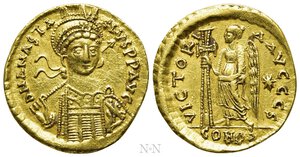
Lotto n. 881
-
ANASTASIUS I (491-518). GOLD Solidus. Constantinople. Obv: D N ANASTASIVS P P AVG. Helmeted and cuirassed bust facing slightly right, holding spear and shield decorated with horseman motif.Rev: VICTORIA AVGGG S / CONOB. Victory standing left, holding jeweled cross; star to right.MIBE 4; DOC 5b; Sear 3. Condition: Very fine.Weight: 4,48 g. Diameter: 20 mm.Estimate: € 300.
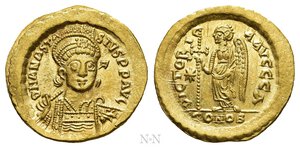
Lotto n. 882
-
ANASTASIUS I (491-518). GOLD Solidus. Constantinople. Obv: D N ANASTASIVS P P AVG. Helmeted and cuirassed bust facing slightly right, holding spear and shield decorated with horseman motif.Rev: VICTORIA AVGGG A / CONOB. Victory standing left, holding long staff surmounted by reversed staurogram; star to left.MIBE 7; DOC 7a; Sear 5.Anastasius was nicknamed ‘dikoros’ (=two pupils) because of the different color of his eyes. When Zeno died, since he had no living heirs, his widow Ariadne had the difficult choice of appointing a successor to the people, who demanded an orthodox emperor. Ariadne eventually chose Anastasius, about whom we only know that he was a palace official, responsible for maintaining silence during important sacred ceremonies. After Zeno's funeral, Anastasius received the crown from the patriarch, was acclaimed augustus by the crowd in 491, and married Ariadne to legitimize the succession. His main task was to restore Constantinople's finances, which had been severely affected during his predecessor's reign. He managed to balance the budget despite a policy of tax relief, making the people pay less tax, but in cash rather than in kind. This favored the cities but was to the detriment of the people living in the countryside, and in fact many revolts broke out in rural areas. He also revolutionized the tax collection system by introducing the ‘vindices’ and encouraged the return of copper folles, which began to circulate again with a precise value ratio to the gold solidus. Anastasius demonstrated wisdom and competence, and the Byzantine Empire flourished once again. A great amount of money flowed into the state treasury, which favored the work of his successors, particularly Justinian I. With regard to foreign policy, Anastasius reached an agreement with Theodoric, king of the Roman-Barbarian kingdom in Italy, promoting trade that benefited both kingdoms. Despite his undeniable qualities as an administrator, Anastasius was constantly threatened by intrigues and uprisings. He was also engaged in a long war against the Persians (502-506), which ended with a peace treaty and the construction of the Anastasian Wall to defend Constantinople along the Propontis and the Black Sea. However, the internal situation was more delicate. The emperor was not orthodox, as the people had asked Ariadne, but a convinced Monophysite, and he attracted much dissent, partly because he contributed to distancing the Eastern Church from that of Rome by interfering in the nomination of the new pope. The discontent led to a civil war (513-515) with the insurrection of Vitalian at the head of the Isaurians, who was eventually defeated by the general Marinus of Syria. Anastasius died in 518 at the age of almost ninety, but left no children to succeed him to the throne. Condition: Extremely fine.Weight: 4.49 g. Diameter: 22 mm.Estimate: € 800.
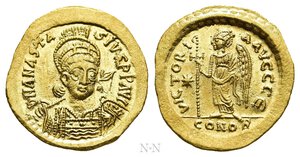
Lotto n. 883
-
ANASTASIUS I (491-518). GOLD Solidus. Constantinople. Obv: D N ANASTASIVS P P AVG. Helmeted and cuirassed bust facing slightly right, holding spear and shield decorated with horseman motif.Rev: VICTORIA AVGGG Є / CONOB. Victory standing left, holding long staff surmounted by reversed staurogram; star to left.MIBE 7; DOC 7e; Sear 5.Anastasius was nicknamed ‘dikoros’ (=two pupils) because of the different color of his eyes. When Zeno died, since he had no living heirs, his widow Ariadne had the difficult choice of appointing a successor to the people, who demanded an orthodox emperor. Ariadne eventually chose Anastasius, about whom we only know that he was a palace official, responsible for maintaining silence during important sacred ceremonies. After Zeno's funeral, Anastasius received the crown from the patriarch, was acclaimed augustus by the crowd in 491, and married Ariadne to legitimize the succession. His main task was to restore Constantinople's finances, which had been severely affected during his predecessor's reign. He managed to balance the budget despite a policy of tax relief, making the people pay less tax, but in cash rather than in kind. This favored the cities but was to the detriment of the people living in the countryside, and in fact many revolts broke out in rural areas. He also revolutionized the tax collection system by introducing the ‘vindices’ and encouraged the return of copper folles, which began to circulate again with a precise value ratio to the gold solidus. Anastasius demonstrated wisdom and competence, and the Byzantine Empire flourished once again. A great amount of money flowed into the state treasury, which favored the work of his successors, particularly Justinian I. With regard to foreign policy, Anastasius reached an agreement with Theodoric, king of the Roman-Barbarian kingdom in Italy, promoting trade that benefited both kingdoms. Despite his undeniable qualities as an administrator, Anastasius was constantly threatened by intrigues and uprisings. He was also engaged in a long war against the Persians (502-506), which ended with a peace treaty and the construction of the Anastasian Wall to defend Constantinople along the Propontis and the Black Sea. However, the internal situation was more delicate. The emperor was not orthodox, as the people had asked Ariadne, but a convinced Monophysite, and he attracted much dissent, partly because he contributed to distancing the Eastern Church from that of Rome by interfering in the nomination of the new pope. The discontent led to a civil war (513-515) with the insurrection of Vitalian at the head of the Isaurians, who was eventually defeated by the general Marinus of Syria. Anastasius died in 518 at the age of almost ninety, but left no children to succeed him to the throne. Condition: Extremely fine.Weight: 4.50 g. Diameter: 21 mm.Estimate: € 800.
Lotto n. 884
-
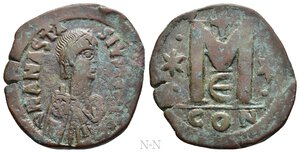
ANASTASIUS I (491-518). Follis. Constantinople. Obv: D N ANASTASIVS P P AVG. Diademed, draped and cuirassed bust right.Rev: Large M; to left and right, star between two pellets; cross above, Є below; CON.MIBE 28b; DOC 231; Sear 21. Condition: Near very fine.Weight: 17.30 g. Diameter: 35 mm.Estimate: € 50.
Superb Thessalonica Solidus
Lotto n. 885
-
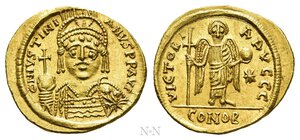
JUSTINIAN I (527-565). GOLD Solidus. Thessalonica. Obv: D N IVSTINIANVS P P AVG. Helmeted and cuirassed bust facing, holding globus cruciger and shield decorated with horseman motif.Rev: VICTORIA AVGGG / CONOB. Angel standing facing, holding globus and long linear cross; star to right.MIBE 22; DOC 7 (Constantinople); Sear 138. Condition: Uncirculated.Weight: 4.44 g. Diameter: 21 mm.Estimate: € 2000.
Lotto n. 886
-
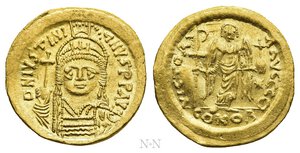
JUSTINIAN I (527-565). GOLD Solidus. Constantinople. Obv: D N IVSTINIANVS P P AVG. Helmeted and cuirassed bust facing, holding globus cruciger and shield decorated with horseman motif.Rev: VICTORIA AVGGG Θ / CONOB. Angel standing facing, holding globus cruciger and long staff surmounted by staurogram; star to right.MIBE 7; DOC 9i; Sear 140. Condition: Extremely fine.Weight: 4.46 g. Diameter: 20 mm.Estimate: € 750.
Outstanding!
Lotto n. 887
-
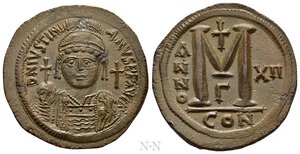
JUSTINIAN I (527-565). Follis. Constantinople. Dated RY 12 (538/9). Obv: D N IVSTINIANVS P P AVG. Helmeted and cuirassed bust facing, holding globus cruciger and shield decorated with horseman motif; cross to right.Rev: Large M; A/N/N/O - X/II across field, cross above, Γ below; CON.MIBE 95a; DOC 37c; Sear 163. Condition: Extremely fine.Weight: 23.05 g. Diameter: 41 mm.Estimate: € 500.
Lotto n. 888
-
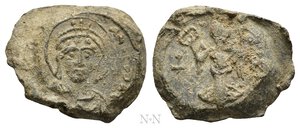
JUSTINIAN I (527-565). Lead seal. Obv: D N IVSTINI ANVS P P AVC. Crowned, nimbate and draped bust facing.Rev: Victory standing facing, holding wreath in each hand; small cross to left and right.BLS I 3. Condition: Good very fine.Weight: 10.19 g. Diameter: 22 mm.Estimate: € 50.
Lotto n. 889
-
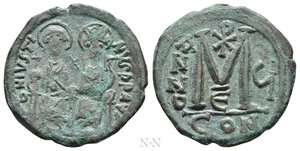
JUSTIN II, with SOPHIA (565-578). Follis. Constantinople. Dated RY 6 (570/1). Obv: D N IVSTINVS PP AVG. Nimbate figures of Justin and Sophia seated facing on double throne, holding globus cruciger and cruciform sceptre, respectively.Rev: Large M between A/N/N/O and date; christogram above, Є below; CON in exergue.MIBE 43c; DOC 29e; Sear 360. Condition: Very fine.Weight: 16.34 g. Diameter: 30 mm.Estimate: € 50.
Lotto n. 890
-
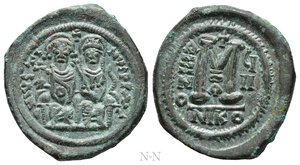
JUSTIN II, with SOPHIA (565-578). Follis. Nicomedia. Dated RY 8 (572/3). Obv: D N IVSTINVS P P AVC. Justin, holding globus cruciger, and Sophia, holding cruciform sceptre, seated facing on double throne, both crowned; cross between heads.Rev: Large M between A/N/N/O and G/II; above, cross; beneath, A; in exergue, NIKO.MIBE 46b; DOC 98a; Sear 369. Condition: Extremely fine.Weight: 14.86 g. Diameter: 30 mm.Estimate: € 50.
Uncirculated Mauricius Tiberius
Lotto n. 891
-
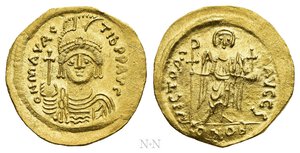
MAURICE TIBERIUS (582-602). GOLD Solidus. Constantinople. Obv: O N mAVRC TIЬ P P AVG. Draped and cuirassed facing bust, wearing plumed helmet and holding globus cruciger.Rev: VICTORIA AVGG S / CONOB. Angel standing facing, holding globus cruciger and long staff surmounted by staurogram.MIBE 6; DOC 5f; Sear 478.Maurice, born in 539 in Cappadocia to a long‑established Roman family, grew up at the court of Justin II and soon became close to Tiberius, the future emperor. His military career began brilliantly: as magister militum he led difficult campaigns against the Persians, restoring discipline and achieving victories that earned him great prestige.
Upon the death of Tiberius II, Maurice ascended the throne (582) and married the emperor’s daughter, Constantina. His reign was marked by constant military pressure on several fronts: in the east, against the Sasanian Persians, where he managed to restore Khosrow II to the throne in exchange for significant territorial gains; in the north, against Avars and Slavs, with harsh and often unpopular campaigns; in Italy, where he unsuccessfully tried to halt the Lombard advance despite unstable alliances with the Franks; and in Spain, where the Visigoths gradually reduced the Byzantine presence.
On the administrative level, he introduced decisive reforms: the creation of the exarchates (Ravenna and Carthage), which combined civil and military authority, anticipating the future Byzantine structure of the 'themata'. In religious matters, he maintained a moderate stance, seeking to ease internal conflicts between Rome and Constantinople.
In his final years, discontent grew: high taxes, his refusal to pay ransoms to enemies, and the order for troops to winter beyond the Danube sparked a military revolt. The centurion Phocas was proclaimed emperor and marched on Constantinople. Maurice fled, but was captured and executed along with his sons in 602. Condition: Uncirculated.Weight: 4.39 g. Diameter: 20 mm.Estimate: € 750.
Lotto n. 892
-
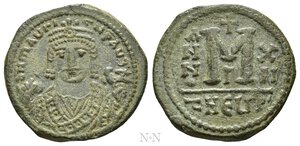
MAURICE TIBERIUS (582-602). Follis. Theoupolis (Antioch). Dated RY 12 (593/4). Obv: Crowned bust facing, wearing consular robes and holding mappa and eagle-tipped sceptre.Rev: Large M; A/N/N/O - X/II, cross above, Γ below; THЄUP'.MIBE 96C; DOC 164c; Sear 533. Condition: Good very fine.Weight: 11.49 g. Diameter: 29 mm.Estimate: € 50.
Lotto n. 893
-
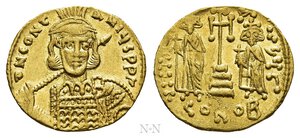
CONSTANTINE IV POGONATUS, with HERACLIUS and TIBERIUS (668-685). GOLD Solidus. Constantinople. Obv: δ N CONTANINЧS PP'. Diademed, helmeted and cuirassed bust facing slightly right, holding spear and shield decorated with horseman motif.Rev: VICTORIA AVGЧ Γ / CONOB. Cross potent set upon three steps; to left and right, Heraclius and Tiberius standing facing, holding globus cruciger.MIB 4c; DOC 6c; Sear 1153. Condition: Good very fine.Weight: 4.40 g. Diameter: 19 mm.Estimate: € 50.
Lotto n. 894
-
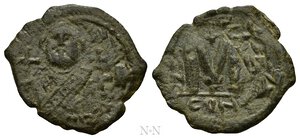
LEONTIUS (695-698). Follis. Constantinople. Uncertain date. Obv: D LЄON PЄ AV. Crowned bust facing, wearing loros and holding globus cruciger.Rev: Large M between A/N/N/O and [date]; officina letter below, CON in exergue.MIB 32; Sear 1334.Overstruck Condition: Very fine.Weight: 4.13 g. Diameter: 27 mm.Estimate: € 400.
Lotto n. 895
-
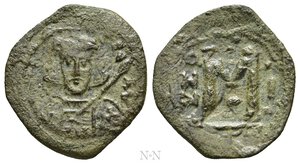
TIBERIUS III APSIMAR (698-705). Follis. Constantinople. Dated RY 1 (698/9). Obv: Crowned and cuirassed bust facing, holding shield and spear.Rev: Large M; A/N/N/O - I across field, cross above, Γ below; CON.MIB 73; DOC 8c; Sear 1366. Condition: Extremely fine.Weight: 4.83 g. Diameter: 27 mm.Estimate: € 50.
Lotto n. 896
-
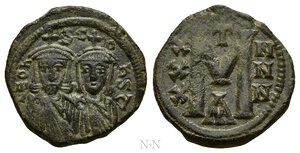
LEO V THE ARMENIAN with CONSTANTINE (813-820). Follis. Constantinople. Obv: LЄOҺ S COҺST. Crowned facing busts of Leo and Constantine.Rev: Large M; X/X/X - N/N/N across field; cross above, A below.Sear 1630. Condition: Very fine.Weight: 6.40 g. Diameter: 23 mm.Estimate: € 50.
Lotto n. 897
-
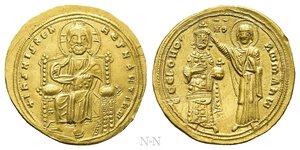
ROMANUS III ARGYRUS (1028-1034). GOLD Histamenon Nomisma. Constantinople. Obv: + IҺS XIS RЄX RЄGNANTIҺm. Christ Pantokrator seated facing on throne.Rev: ΘCЄ ЬOHΘ RωmAҺω. Romanus standing facing, holding globus cruciger and being crowned by the Virgin Mary standing to right.DOC 1c; Sear 1819. Condition: Very fine.Weight: 4.41 g. Diameter: 24 mm.Estimate: € 1000.
Lotto n. 898
-
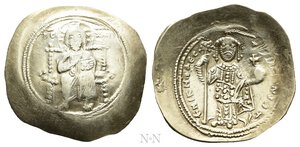
NICEPHORUS III BOTANIATES (1078-1081). EL Histamenon Nomisma. Constantinople. Obv: IC - XC. Christ Pantokrator seated facing on throne with back.Rev: +NIKHΦ ΔECΠ Tω BOTANIAT'. Nicephorus standing facing on daïs, holding labarum and globus cruciger.DOC 2; Sear 1882. Condition: Very fine.Weight: 4.32 g. Diameter: 27 mm.Estimate: € 400.
Lotto n. 899
-
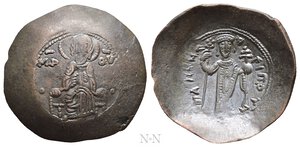
MANUEL I COMNENUS (1143-1180). Trachy. Constantinople. Obv: MP - ΘV. The Virgin Mary seated facing on throne.Rev: MANOVHΛ ΔECΠOTHC. Manuel standing facing, holding labarum and globus surmounted by patriarchal cross.DOC 12a; Sear 1964. Condition: Good very fine.Weight: 4.10 g. Diameter: 31 mm.Estimate: € 50.
Lotto n. 900
-
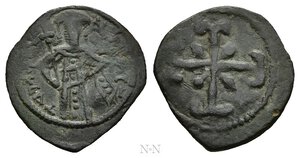
ANDRONICUS III PALAEOLOGUS (1328-1341). Ae Assarion. Constantinople. Obv: AVTOKPA PωMAION. Andronicus standing facing, holding cruciform sceptre.Rev: Cross ancrée set upon short cross in saltire.LPC p. 126, 13; PCPC 205; Sear 2481. Condition: Very fine.Weight: 1.61 g. Diameter: 20 mm.Estimate: € 50.
Lotto n. 901
-
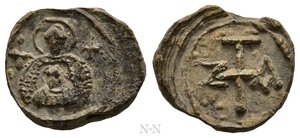
BYZANTINE SEALS. Uncertain (Circa 6th-7th century). Obv: Facing bust of the Theotokos (Virgin Mary), holding Christ medallion on breast; cross to left and right.Rev: Monogram.. Condition: Extremely fine.Weight: 8.34 g. Diameter: 22 mm.Estimate: € 50.
Lotto n. 902
-
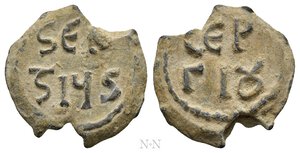
BYZANTINE SEALS. Sergios (Circa 6th century). Obv: CЄP ΓIƔ in two lines.Rev: SЄR ΓIЧS in two lines.Cf. BZS.1958.106.4707. Condition: Extremely fine.Weight: 7.00 g. Diameter: 23 mm.Estimate: € 50.
Lotto n. 903
-
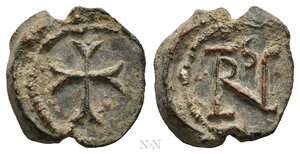
BYZANTINE SEALS. Uncertain (Circa 6th-10th century). Obv: Cross fourchéè.Rev: Monogram.. Condition: Extremely fine.Weight: 5.81 g. Diameter: 20 mm.Estimate: € 50.
Lotto n. 904
-
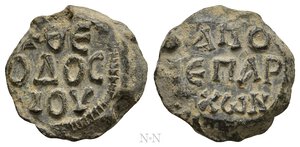
BYZANTINE SEALS. Theodosios apo eparchon (Circa 7th-8th century). Obv: + ΘЄ OΔOC IOY. Legend in three lines.Rev: AΠO ЄΠAP XωN. Legend in three lines.Cf. BZS.1951.31.5.1441. Condition: Extremely fine.Weight: 9.30 g. Diameter: 21 mm.Estimate: € 50.
Caricamento altri risultati...