Info & contatti
Le mie offerte
Lotti osservati
Condizioni di vendita
Prezzi di spedizione
Metodi di pagamento
Esito stampabile
Sessione Live 5/7/2026 17:00:00 CET
Celtic Coins (1-25)
Greek Coins (26-218)
Roman Provincial Coins (219-296)
Roman Republican Coins (297-336)
Roman Imperial Coins (337-876)
Migration Period (877-880)
Byzantine Coins (881-904)
Medieval Coins (905-921)
World Coins (922-959)
Medals & Tokens (960-961)
Group Lots (962-1178)

Risultati: 61
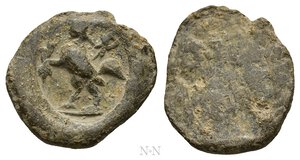
Lotto n. 26
-
GREEK. Uncertain. PB Tessera/Seal (Circa 2nd-1st century BC). Obv: Harpy(?) standing left.Rev: Blank.. Condition: Very fine.Weight: 5.59 g. Diameter: 22 mm.Estimate: € 50.
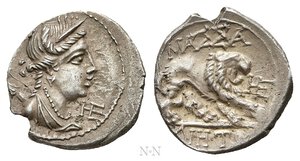
Lotto n. 27
-
GAUL. Massalia. Drachm (Circa 220-125 BC). Obv: Bust of Artemis right, bow and quiver over shoulder; HE monogram to right.Rev: MAΣΣA / ΛIHT. Lion advancing right; HE monogram to right.Maurel (2019) 571; Depeyrot 38.3. Condition: Good very fine.Weight: 2.45 g. Diameter: 16 mm.Estimate: € 200.
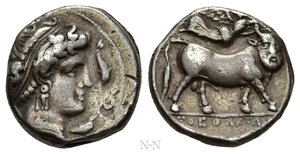
Lotto n. 28
-
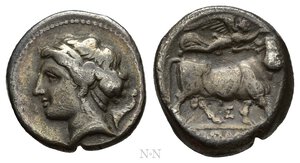
CAMPANIA. Neapolis. Nomos - Didrachm (Circa 300 BC). Obv: Diademed head of nymph right; four dolphins around.Rev: ΝΕΟΠΟΛΙΤΩΝ. Man-headed bull walking right; above, Nike flying right, placing wreath on bull's head.HN Italy 576; SNG ANS 329-32; HGC 1, 452. Condition: Very fine.Weight: 6.41 g. Diameter: 20 mm.Estimate: € 200.
Lotto n. 29
-
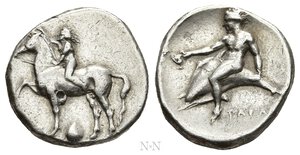
CAMPANIA. Neapolis. Nomos - Didrachm (Circa 275-250 BC). Obv: Head of nymph left; dolphin behind.Rev: NEOΠOΛITΩN. Man-headed bull standing right; above, Nike flying right, placing wreath on bull's head; E below.Sambon 523; HN Italy 586; SNG ANS 412; HGC 1, 454. Condition: Good fine.Weight: 7.07 g. Diameter: 20 mm.Estimate: € 200.
Lotto n. 30
-
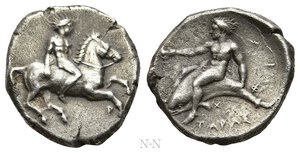
CALABRIA. Tarentum. Nomos (Circa 390-380 BC). Obv: Nude youth crowning horse prancing left; shell below.Rev: ΤΑΡΑΣ. Phalanthos, holding kantharos, on dolphin left.Vlasto 412; HN Italy 875; HGC 1, 773. Condition: Very fine.Weight: 7.88 g. Diameter: 22 mm.Estimate: € 300.
Lotto n. 31
-
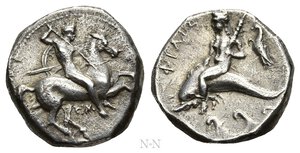
CALABRIA. Tarentum. Nomos (Circa 365-355 BC). Obv: Nude youth on horse trotting right; P below.Rev: TAPAΣ. Phalanthos, holding kantharos, riding dolphin left; X below, Φ to right.Vlasto 478; HN Italy 880; HGC 1, 778. Condition: Very fine.Weight: 7.82 g. Diameter: 21 mm.Estimate: € 300.
Lotto n. 32
-
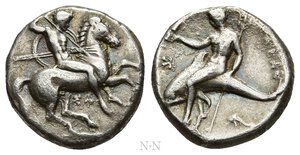
CALABRIA. Tarentum. Nomos (Circa 332-302 BC). Obv: Warrior, holding shield and two spears, and preparing to cast third spear, on horse rearing right; ΣIM below.Rev: TAPAΣ. Phalanthos, holding distaff, riding dolphin left; to right, eagle standing left; ΦIΛIΣ to left, waves below.Vlasto 575-7; HN Italy 933; HGC 1, 800. Condition: Very fine.Weight: 7.57 g. Diameter: 20 mm.Estimate: € 300.
Lotto n. 33
-
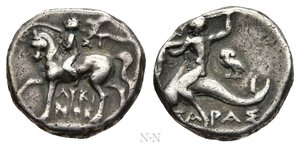
CALABRIA. Tarentum. Nomos (Circa 315-302 BC). Obv: Warrior, holding shield and two spears, preparing to cast a third, on horseback right; ΣA below.Rev: TAPAΣ. Phalanthos, holding kantharos and trident, riding dolphin left; retrograde K below arm; below, dolphin left.Vlasto 609; HN Italy 937; HGC 1, 803. Condition: Very fine.Weight: 7.79 g. Diameter: 20 mm.Estimate: € 300.
Lotto n. 34
-
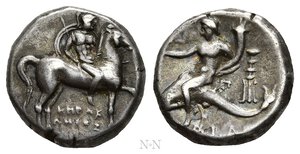
CALABRIA. Tarentum. Nomos (Circa 272-240 BC). Obv: Crowning youth on horse standing left; ΣY to right, ΛYKI/NOΣ below.Rev: ΤΑΡΑΣ. Phalanthos, preparing to hurl spear, riding dolphin left; to right, owl standing left, head facing.Vlasto 836-41; HN Italy 1025; HGC 1, -. Condition: Near very fine.Weight: 6.47 g. Diameter: 18 mm.Estimate: € 150.
Lotto n. 35
-
CALABRIA. Tarentum. Nomos (Circa 272-240 BC). Herakletos, magistrate. Obv: Helmeted horseman riding right, holding spear and shield; ՒHPAK/ΛHTOΣ below.Rev: ΤΑΡΑΣ. Phalanthos on dolphin left, holding flower and cornucopia; monogram and thymiaterion to right.Vlasto 890-2; HN Italy 1037; HGC 1, 892. Condition: Very fine.Weight: 6.28 g. Diameter: 18 mm.Estimate: € 300.
Lotto n. 36
-
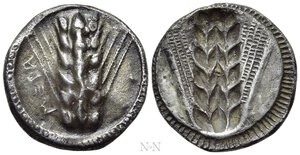
LUCANIA. Metapontion. Nomos - Stater (Circa 510-470 BC). Obv: META. Barley ear with six grains.Rev: Incuse barley ear.Noe class IX, 204-5; HN Italy 1482; HGC 1, 1028. Condition: Very fine.Weight: 7,91 g. Diameter: 23 mm.Estimate: € 200.
Lotto n. 37
-
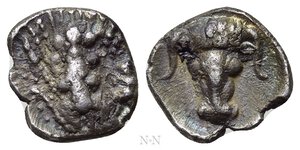
LUCANIA. Metapontion. Obol (Circa 440-430 BC). Obv: Ear of barley.Rev: Facing head of ox.Noe 346; SNG ANS -; HN Italy 1500. Condition: Good very fine.Weight: ,37 g. Diameter: 8 mm.Estimate: € 80.
Lotto n. 38
-
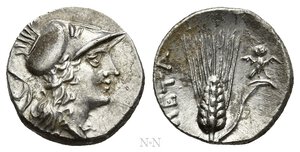
LUCANIA. Metapontion. Punic occupation. Half Shekel or Drachm (Circa 215-207 BC). Obv: Helmeted head of Athena right.Rev: META. Barley ear of five grains; above leaf, owl right, head facing, with wings spread.Robinson 6; HN Italy 1634; SNG ANS 550; HGC 1, 1092. Condition: Near extremely fine.Weight: 3.80 g. Diameter: 17 mm.Estimate: € 250.
Lotto n. 39
-
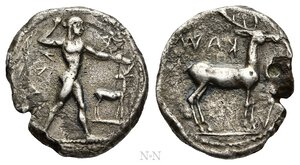
BRUTTIUM. Kaulonia. Fourrèe Nomos - Stater (Circa 475-425 BC). Obv: KAVΛ. Apollo advancing right, holding branch; small daimon running right on Apollo's left arm; to right, stag standing right, head left.Rev: KAV (retrograde). Stag standing right; branch to right.Cf. HN Italy 2046 (for prototype). Condition: Very fine.Weight: 6.79 g. Diameter: 22 mm.Estimate: € 250.
Ex Hirsch 1973
Lotto n. 40
-
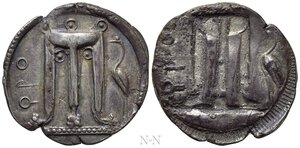
BRUTTIUM. Kroton. Nomos - Stater (Circa 530-500 BC). Obv: ϘΡΟ. Tripod; to right, stork standing left.Rev: ϘΡΟ. Incuse tripod; to right, stork standing left.HN Italy 2081; SNG ANS 248-9; HGC 1, 1444.Ex Gerhard Hirsch Nachfolger 84 (1973), lot 7; ex Dr. Busso Peus Nachf. 299 (1980), lot 64 Condition: Good very fine.Weight: 7,97 g. Diameter: 24 mm.Estimate: € 250.
Lotto n. 41
-
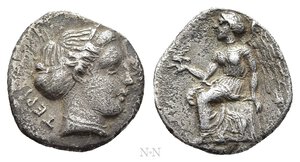
BRUTTIUM. Terina. Drachm (Circa 420-400 BC). Obv: TEPI. Head of the nymph Terina right.Rev: Nike seated left on plinth, holding bird.Holloway & Jenkins 70; HN Italy 2623; HGC 1, 1759. Condition: Very fine.Weight: 2.23 g. Diameter: 15 mm.Estimate: € 200.
Lotto n. 42
-
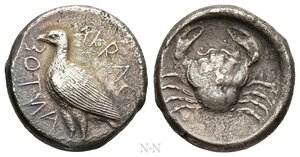
SICILY. Akragas. Tetradrachm (Circa 465/0–445/0 BC). Obv: AKPAΓANTOΣ. Eagle standing left.Rev: Crab.Westermark Period II, Group II, 343 (O9/R32); SNG ANS 964; HGC 2, 78.Historical sources give the date of Akragas' founding as the 50th Olympiad (585-580 BC), placing it among the last Greek colonies established in Sicily. The settlers probably came from Rhodes and Gela, under the command of the ecists Aristonoo and Pistilos, who located a site not far from the sea on the Akragas River, after which the city was named. During the tyranny of Phalaris (570-555 BC) the city built walls and began an expansionist campaign, later continued by Theron (488-473), who won an important battle victory over the Carthaginians at Himera, gaining a vast territory. From that time Akragas experienced enormous political, economic and cultural development, culminating in the period of democratic rule, which was established after the death of Theron. In 406 BC the city was besieged by the Carthaginians, who finally sacked and burned it several times, without however, favoring the establishment of a Punic colony. With Timoleon's victory over Carthage in 339, the city was rebuilt on the same site, then taken back by the Carthaginians and remained under their influence until 210, when it passed into Roman hands at the end of the Second Punic War. The eagle depicted on the obverse of this coin, and on most of the issues of Akragas, is surely to be related to Zeus, to whom the inhabitants dedicated the most important temple in the city. The crab, on the other hand, which appears on all the reverses, is associated with Poseidon, demonstrating the city's great connection with the sea from the time of its founding, which was important for its economy related to maritime trade. On some silver coins, a human face appears on the carapace of the crab, most likely depicting the river god Akragas in an original way. Condition: Good very fine.Weight: 16.49 g. Diameter: 25 mm.Estimate: € 2000.
Lotto n. 43
-
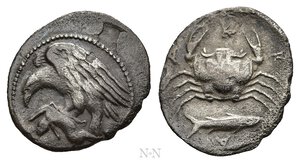
SICILY. Akragas. Hemidrachm (Circa 420-406 BC). Obv: Eagle standing left on hare.Rev: A K P A. Crab; below, fish right.Westermark 554 (O9/R9); SNG ANS 1005; HGC 2, 104. Condition: Very fine.Weight: 1.91 g. Diameter: 17 mm.Estimate: € 200.
Lotto n. 44
-
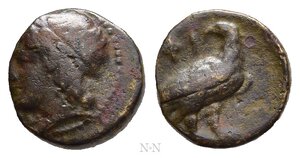
SICILY. Akragas. Phintias (Tyrant, 287-279 BC). Ae. Obv: AKPAΓANTI. Laureate head of Zeus Hellanios left.Rev: Eagle standing right, head left; ΦI above.CNS 119; HGC 2, 168. Condition: Near very fine.Weight: 50 g. Diameter: 13 mm.Estimate: € 50.
Exceptional Punic Tetradrachm
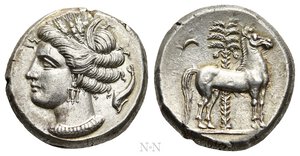
Lotto n. 45
-
SICILY. Entella. Punic Issues. Tetradrachm (Circa 345/38-320/15 BC). Obv: Wreathed head of Arethusa left, wearing triple-pendant earring and pendant necklace; to right, dolphin swimming downward.Rev: Horse standing right; palm tree in background, crescent to left.Jenkins, Punic, Series 2c, 121 (O41/R109); CNP 174; HGC 2, 278.The foundation of Entella is traced back to Acestes, son of the river god Krimisos and a Trojan woman or, according to other sources to Prince Elymus, son of Anchises and brother of Aeneas. The city stood on a summit overlooking the Belice valley. Records are scarce until the arrival of the Campanian mercenaries, recruited in 410 BC by the Carthaginians and discharged after the 405 BC treaty, then passed into the pay of Dionysius I of Syracuse. After liberating Dionysius on the island of Ortigia from the Punic siege, the were discharged with rich gifts and settled in various cities on the island. In 404 a group of these mercenaries seized Entella, exterminating the entire male population, and began to mint their own coinage. From then on they implemented a generally pro-Carthaginian policy and, in 398 B.C., were able to stop Syracusan siege attempts with the help of the Punic. The strategic location of the fortress of Entella was coveted for its control of the valley below, and this led to several siege attempts: in 345 it was attacked by the Carthaginians led by General Annon, then in 342 the city was taken by the Syracusans commanded by Timoleon, but in 338 it fell back under Punic influence. During the First Punic War the city was destroyed by the Carthaginians. The “Decrees of Entella,” which were requests for help engraved on bronze slabs, from the inhabitants to neighboring cities, date from this period. In 263 Entella was conquered by the Romans and enjoyed a new period of prosperity until the second century BC when it was abandoned. Condition: Near uncirculated .Weight: 17.09 g. Diameter: 24 mm.Estimate: € 12000.
Splendit Entella
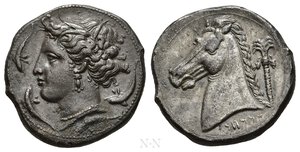
Lotto n. 46
-
SICILY. Entella. Punic Issues. Tetradrachm (Circa 320/15-300 BC). Obv: Head of Arethousa left, wearing grain-ear wreath, triple-pendant earring and pearl necklace; four dolphins around.Rev: Head of horse left; palm tree to right.Jenkins, Punic, 149 (O47/R134); CNP 267; HGC 2, 284.NGC 4934013-001 (with ticket)
The foundation of Entella is traced back to Acestes, son of the river god Krimisos and a Trojan woman or, according to other sources to Prince Elymus, son of Anchises and brother of Aeneas. The city stood on a summit overlooking the Belice valley. Records are scarce until the arrival of the Campanian mercenaries, recruited in 410 BC by the Carthaginians and discharged after the 405 BC treaty, then passed into the pay of Dionysius I of Syracuse. After liberating Dionysius on the island of Ortigia from the Punic siege, the were discharged with rich gifts and settled in various cities on the island. In 404 a group of these mercenaries seized Entella, exterminating the entire male population, and began to mint their own coinage. From then on they implemented a generally pro-Carthaginian policy and, in 398 B.C., were able to stop Syracusan siege attempts with the help of the Punic. The strategic location of the fortress of Entella was coveted for its control of the valley below, and this led to several siege attempts: in 345 it was attacked by the Carthaginians led by General Annon, then in 342 the city was taken by the Syracusans commanded by Timoleon, but in 338 it fell back under Punic influence. During the First Punic War the city was destroyed by the Carthaginians. The “Decrees of Entella,” which were requests for help engraved on bronze slabs, from the inhabitants to neighboring cities, date from this period. In 263 Entella was conquered by the Romans and enjoyed a new period of prosperity until the second century BC when it was abandoned. Condition: Good very fine.Weight: 17.15 g. Diameter: 27 mm.Estimate: € 2000.
Ex MMAG 1971 Hoard - Jenkins Plate Coin
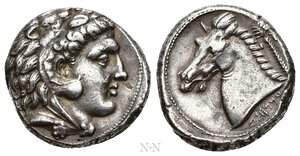
Lotto n. 47
-
SICILY. Entella. Punic issues. Tetradrachm (Circa 300-289 BC). Obv: Head of Herakles right, wearing lion skin.Rev: Head of horse left; palm tree to right; Punic legend below.Jenkins, Punic, Series 5b, 370 (O115/R293) and pl. 10, 370M (this coin) = MMAG 1971 hoard; CNP 271; HGC 2, 293.Ex Münzen & Medaillen AG Basel (1971).
The foundation of Entella is traced back to Acestes, son of the river god Krimisos and a Trojan woman or, according to other sources to Prince Elymus, son of Anchises and brother of Aeneas. The city stood on a summit overlooking the Belice valley. Records are scarce until the arrival of the Campanian mercenaries, recruited in 410 BC by the Carthaginians and discharged after the 405 BC treaty, then passed into the pay of Dionysius I of Syracuse. After liberating Dionysius on the island of Ortigia from the Punic siege, the were discharged with rich gifts and settled in various cities on the island. In 404 a group of these mercenaries seized Entella, exterminating the entire male population, and began to mint their own coinage. From then on they implemented a generally pro-Carthaginian policy and, in 398 B.C., were able to stop Syracusan siege attempts with the help of the Punic. The strategic location of the fortress of Entella was coveted for its control of the valley below, and this led to several siege attempts: in 345 it was attacked by the Carthaginians led by General Annon, then in 342 the city was taken by the Syracusans commanded by Timoleon, but in 338 it fell back under Punic influence. During the First Punic War the city was destroyed by the Carthaginians. The “Decrees of Entella,” which were requests for help engraved on bronze slabs, from the inhabitants to neighboring cities, date from this period. In 263 Entella was conquered by the Romans and enjoyed a new period of prosperity until the second century BC when it was abandoned. Condition: Good very fine.Weight: 16.40 g. Diameter: 24 mm.Estimate: € 1500.
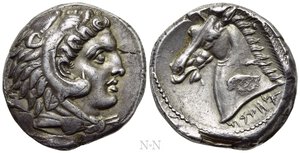
Lotto n. 48
-
SICILY. Entella. Punic issues. Tetradrachm (Circa 300-289 BC). Obv: Head of Herakles right, wearing lion skin.Rev: Head of horse left; palm tree to right; Punic legend below.CNP 272; HGC 2, 295.The foundation of Entella is traced back to Acestes, son of the river god Krimisos and a Trojan woman or, according to other sources to Prince Elymus, son of Anchises and brother of Aeneas. The city stood on a summit overlooking the Belice valley. Records are scarce until the arrival of the Campanian mercenaries, recruited in 410 BC by the Carthaginians and discharged after the 405 BC treaty, then passed into the pay of Dionysius I of Syracuse. After liberating Dionysius on the island of Ortigia from the Punic siege, the were discharged with rich gifts and settled in various cities on the island. In 404 a group of these mercenaries seized Entella, exterminating the entire male population, and began to mint their own coinage. From then on they implemented a generally pro-Carthaginian policy and, in 398 B.C., were able to stop Syracusan siege attempts with the help of the Punic. The strategic location of the fortress of Entella was coveted for its control of the valley below, and this led to several siege attempts: in 345 it was attacked by the Carthaginians led by General Annon, then in 342 the city was taken by the Syracusans commanded by Timoleon, but in 338 it fell back under Punic influence. During the First Punic War the city was destroyed by the Carthaginians. The “Decrees of Entella,” which were requests for help engraved on bronze slabs, from the inhabitants to neighboring cities, date from this period. In 263 Entella was conquered by the Romans and enjoyed a new period of prosperity until the second century BC when it was abandoned. Condition: Good very fine.Weight: 17,22 g. Diameter: 24 mm.Estimate: € 500.
Ex Busso 1994
Lotto n. 49
-
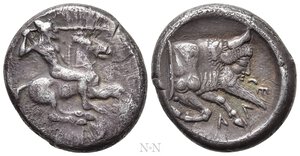
SICILY. Gela. Didrachm (485-475 BC). Obv: Horseman riding right, preparing to cast javelin.Rev: CΕΛΑΣ. Forepart of man-headed bull right within incuse circle.Jenkins, Gela 69A (O21/R32A); SNG ANS 13; HGC 2, 363.From the Nicholas V. Jamgochian Collection, ex Dr. Busso Peus Nachfolger 340 (1994), lot 107 Condition: Very fine.Weight: 8,57 g. Diameter: 20 mm.Estimate: € 500.
Lotto n. 50
-
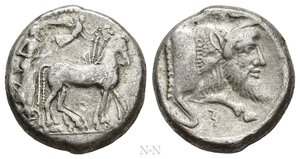
SICILY. Gela. Tetradrachm (Circa 480-470 BC). Obv: Charioteer driving slow biga right; above, Nike flying right, crowning horses.Rev: ΓΕΛΑΣ. Forepart of man-headed bull right.Jenkins, Gela, Group VII; HGC 2, 338. Condition: Near very fine.Weight: 14.67 g. Diameter: 23 mm.Estimate: € 500.
Ex CNG 2013
Lotto n. 51
-
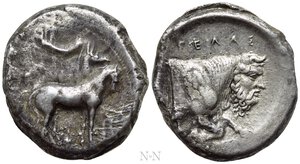
SICILY. Gela. Tetradrachm (Circa 420-415 BC). Obv: Charioteer driving slow quadriga right; above, Nike flying left, crowning charioteer; [in exergue, bird standing left].Rev: Forepart of man-headed bull right, within shallow incuse circle.Jenkins, Gela, Group VIII, 476 (O92/R186); SNG ANS 95 (same dies); HGC 2, 356.Ex Classical Numismatic Group E-294 (2013), lot 37 Condition: Very fine.Weight: 17,07 g. Diameter: 26 mm.Estimate: € 500.
Lotto n. 52
-
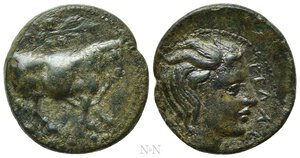
SICILY. Gela. Tetras (Circa 420-405 BC). Obv: Bull standing right; branch above; three pellets (mark of value) in exergue.Rev: ΓΕΛΑΣ. Head of river god Gelas right; grain kernel to left.CNS 49; HGC 2, 380. Condition: Very fine.Weight: 3,1 g. Diameter: 17 mm.Estimate: € 50.
Lotto n. 53
-
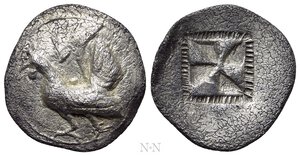
SICILY. Himera. Obol (Circa 530-520/15 BC). Obv: Hen standing left.Rev: Incuse square of windmill pattern within incuse dotted border.Kraay Group IV; SNG ANS 145; HGC 2, 427. Condition: Very fine.Weight: ,87 g. Diameter: 13 mm.Estimate: € 100.
Lotto n. 54
-
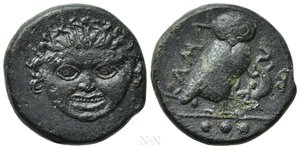
SICILY. Kamarina. Ae Tetras or Trionkion (Circa 420-405 BC). Obv: Facing gorgoneion.Rev: KAMA. Owl standing right, holding lizard; to right, retrograde B; in exergue three pellets (mark of value).CNS III, 9; HGC 2, 546.Rare Condition: Near very fine.Weight: 4,39 g. Diameter: 18 mm.Estimate: € 100.
Ex Leu 1992
Lotto n. 55
-
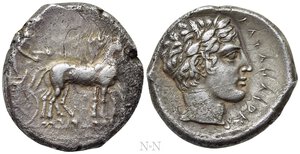
SICILY. Katane. Tetradrachm (Circa 435-412 BC). Obv: Charioteer, holding kentron and reins, driving slow quadriga of horses right; above, Nike flying left, crowning charioteer.Rev: KATANAION. Laureate head of Apollo right.Mirone 47; SNG ANS 1252 (same dies); SNG Lloyd 896 (same dies); Rizzo pl. XI, 2 (same dies); HGC 2, 568.Ex Leu fixed price list (1992), lot 132; ex Numismatica Ars Classica 88 (2015), lot 560 Condition: Very fine.Weight: 16,48 g. Diameter: 26 mm.Estimate: € 2000.
Ex Auktionen GM 1985 & Künker 2004
Lotto n. 56
-
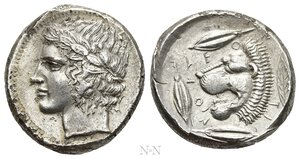
SICILY. Leontinoi. Tetradrachm (Circa 430-425 BC). Obv: Laureate head of Apollo left.Rev: LEONTINON. Lion head with open jaws; three barleycorns and laurel leaf around.Boehringer 55; SNG ANS 256-7; HGC 2, 671.From the Dr. Fritz Reiff Collection, ex Auktionen GM 31 (1985), lot 51; ex Fritz Rudolf Künker 94 (2004), lot 317.
The coinage of Leontinoi in the 5th century BC, especially the tetradrachms, represents one of the highest achievements of Sicilian engraving art. The city’s monetary series display a coherent and refined evolution in which two images dominate and define its visual identity: the head of Apollo and the lion’s protome.
The head of Apollo is the principal type on the obverse dies. The image is rendered with increasing elegance: at first more archaic and rigid, then progressively softer, more harmonious, and classically proportioned. Apollo is not merely an aesthetic motif; he embodies the Chalcidian cultural heritage, the Greek origins of the city, and an ideal of order, balance, and civic identity. The presence of several engravers, including the renowned “Master of Leontinoi”, contributes to an extraordinary stylistic variety, a sign of a lively and innovative mint.
The lion is the oldest and most deeply rooted symbol of Leontinoi, already linked to the city’s name and local tradition. On the coins it appears as a lion’s protome, often accompanied by barley grains, or as a running lion in earlier issues. It serves a dual purpose: it evokes the very name of the city and expresses strength, pride and autonomy, even in periods when the polis was politically subordinate to Syracuse.
This combination creates a powerful visual language that blends indigenous tradition, Greek culture, and artistic ambition. Leontinoi, though not one of Sicily’s great powers, thus succeeds in expressing a distinctive and original voice within the island’s numismatic landscape. Condition: Near extremely fine.Weight: 16.87 g. Diameter: 26 mm.Estimate: € 1000.
Ex Rauch 2004
Lotto n. 57
-
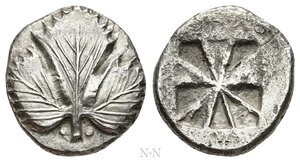
SICILY. Selinos. Didrachm (Circa 540-515 BC). Obv: Selinon leaf.Rev: Incuse square divided into ten sections.Arnold-Biucchi Group I, 4; SNG ANS 667; HGC 2, 1209.Ex Auktionshaus H. D. Rauch 73 (2004), lot 78 Condition: Extremely fine.Weight: 8.34 g. Diameter: 21 mm.Estimate: € 500.
Ex CNA 1990 & CNG 1995
Lotto n. 58
-
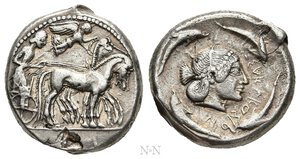
SICILY. Syracuse. Deinomenid Tyranny (485-466 BC). Tetradrachm. Obv: Charioteer driving quadriga right; above, crowning Nike flying right.Rev: ΣVRAKOΣION. Diademed head of Arethusa right; four dolphins around.Boehringer 163 (V72/R112); SNG ANS 48/50 (same dies); HGC 2, 1306.Ex Classical Numismatic Auctions XI (1990), lot 17; ex Classical Numismatic Group 34 (1995), lot 31 Condition: Very fine.Weight: 17.17 g. Diameter: 24 mm.Estimate: € 500.
Lotto n. 59
-
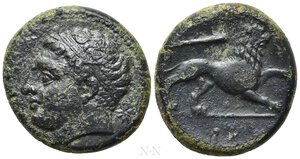
SICILY. Syracuse. Agathokles (317-289 BC). Ae. Obv: ΣΥΡΑΚΟΣΙΩΝ. Diademed and unbearded head of Herakles left; star to right.Rev: Nemean lion right; above; club right.CNS 150 Ds 14; HGC 2, 1464 (Fourth Democracy). Condition: Very fine.Weight: 8,86 g. Diameter: 22 mm.Estimate: € 50.
Lotto n. 60
-
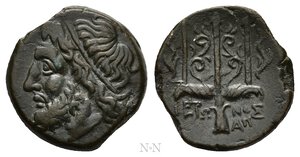
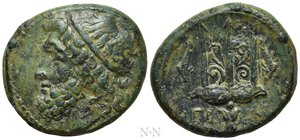
SICILY. Syracuse. Hieron II (275-215 BC). Ae. Obv: Head of Poseidon left, wearing tainia.Rev: ΙΕΡΩ - ΝΟΣ. Ornamented trident head flanked by two dolphins; AΠ to lower right.CNS 194 R1 2; HGC 2, 1550. Condition: Good very fine.Weight: 6.32 g. Diameter: 19 mm.Estimate: € 100.
Lotto n. 61
-
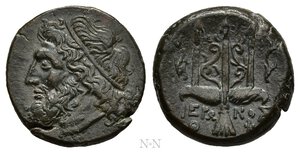
SICILY. Syracuse. Hieron II (275-215 BC). Ae. Obv: Head of Poseidon left, wearing tainia.Rev: ΙΕΡΩ - ΝΟΣ. Ornamented trident head flanked by two dolphins.CNS 197; HGC 2, 1550. Condition: Very fine.Weight: 8,68 g. Diameter: 23 mm.Estimate: € 100.
Lotto n. 62
-
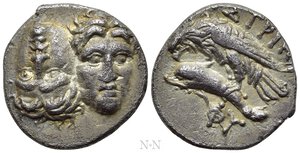
SICILY. Syracuse. Hieron II (275-215 BC). Ae. Obv: Head of Poseidon left, wearing tainia.Rev: ΙΕΡΩ - ΝΟΣ. Ornamented trident head flanked by two dolphins; Θ-Φ below.CNS 197 R1 14; SNG ANS 987-93; HGC 2, 1550. Condition: Good very fine.Weight: 6.62 g. Diameter: 19 mm.Estimate: € 50.
Lotto n. 63
-
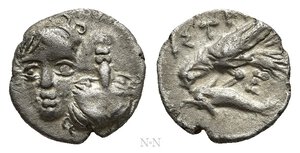
MOESIA. Istros. Drachm (4th century BC). Obv: Facing male heads, the left inverted.Rev: Sea eagle left, grasping dolphin with talons; ΦY below.SNG BM Black Sea 256 var. (right head inverted); AMNG I 425; HGC 3.2, 1803. Condition: Very fine.Weight: 5,13 g. Diameter: 18 mm.Estimate: € 200.
Lotto n. 64
-
MOESIA. Istros. Trihemiobol or 1/4 Drachm (4th century BC). Obv: Facing male heads, the right inverted.Rev: IΣTPIH. Sea-eagle left, grasping dolphin with talons; E below tail.SNG BM Black Sea 234 var. (control); SNG Stancomb 143 var. (same); HGC 3.2, 1807. Condition: Very fine.Weight: 1.31 g. Diameter: 11 mm.Estimate: € 50.
Lotto n. 65
-
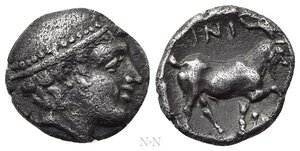
THRACE. Ainos. Diobol (Circa 408-406 BC). Obv: Head of Hermes right wearing petasos.Rev: AINI. Goat standing right.HGC 3.2, 1274. Condition: Very fine.Weight: 1,2 g. Diameter: 11 mm.Estimate: € 50.
Lotto n. 66
-
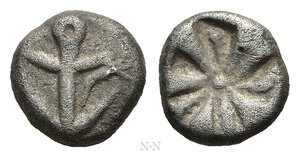
THRACE. Apollonia Pontika. Tetrobol (Circa 494-470 BC). Obv: Upright anchor; crayfish to left.Rev: Incuse swastika with pellet at centre; in segments, four dolphins swimming toward centre.SNG Bulgaria 65; Topalov 8; HGC 3.2, -.Very rare Condition: Very fine.Weight: 2.08 g. Diameter: 11 mm.Estimate: € 50.
Lotto n. 67
-
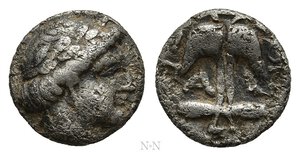
THRACE. Apollonia Pontika. Diobol (Circa 435-375 BC). Obv: Laureate head of Apollo right.Rev: Anchor; A to left, crayfish to right; uncertain letters around.SNG Bulgaria 288-9; SNG BM Black Sea 166.Very rare Condition: Near very fine.Weight: 1.17 g. Diameter: 10 mm.Estimate: € 50.
Attractive Natural Patina
Lotto n. 68
-
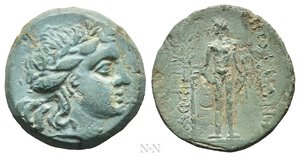
THRACE. Apollonia Pontika. Ae (Circa 2nd century BC). Obv: Laureate head of Apollo right.Rev: AΠOΛΛΩNOΣ / IATPOY. Apollo standing facing, head left, holding branch and bow.Topalov 92-3; HGC 3.2, 1350. Condition: Very fine.Weight: 6.71 g. Diameter: 23 mm.Estimate: € 200.
Lotto n. 69
-
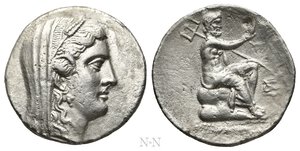
THRACE. Byzantion. Tetradrachm (Circa 240-220 BC). Meniskos(?), magistrate. Obv: Veiled and wreathed head of Demeter right.Rev: [EΠI ΜΕΝΙΣΚΟΥ]. Poseidon seated right on rocks, holding trident and aphlaston; two monograms to right.Cf. Schönert-Geiss, Byzantion 980-94; HGC 3.2, 1408.Rare Condition: Very fine.Weight: 12.53 g. Diameter: 27 mm.Estimate: € 200.
Lotto n. 70
-
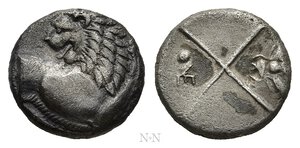
THRACE. Chersonesos. Hemidrachm (Circa 386-338 BC). Obv: Forepart of lion right, head left.Rev: Quadripartite incuse square with alternating raised and sunken quarters; pellet and monogram VE in one quarter, bee in opposite quarter.McClean 4114-6; SNG Copenhagen 830; HGC 3.2, 1437. Condition: Very fine.Weight: 2.18 g. Diameter: 13 mm.Estimate: € 100.
Lotto n. 71
-
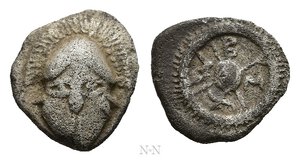
THRACE. Mesambria. Obol (Circa 5th century BC). Obv: Facing helmet.Rev: M - E - Σ. Four-spoked wheel, with tetraskeles or swastika in one angle.SNG BM Black Sea -; SNG Stancomb -; HGC 3.2, -; Numismatik Naumann 77, lot 43.Very rare Condition: Near very fine.Weight: 0.68 g. Diameter: 9 mm.Estimate: € 50.
Lotto n. 72
-
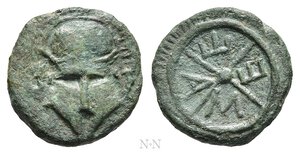
THRACE. Mesambria. Ae (Circa 175-100 BC). Obv: Facing helmet.Rev: M - E - Σ - A. Four-spoked wheel.SNG BM Black Sea 272-3; HGC 3.2, 1577. Condition: Very fine.Weight: 2.79 g. Diameter: 15 mm.Estimate: € 50.
Lotto n. 73
-
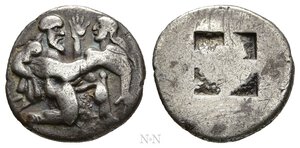
THRACE. Thasos. Stater (Circa 480-463 BC). Obv: Ithyphallic satyr advancing right, carrying off protesting nymph.Rev: Quadripartite incuse square.Le Rider, Thasiennes, 5; SNG Copenhagen 1010-2; HGC 6, 331. Condition: Good fine.Weight: 7.57 g. Diameter: 22 mm.Estimate: € 100.
Lotto n. 74
-
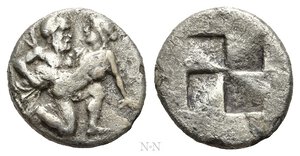
THRACE. Thasos. 1/3 Stater or Drachm (Circa 412-404 BC). Obv: Ithyphallic satyr advancing right, carrying off protesting nymph.Rev: Quadripartite incuse square.Le Rider, Thasiennes, 7; SNG Copenhagen 1018; HGC 6, 335. Condition: Good fine.Weight: 3.11 g. Diameter: 16 mm.Estimate: € 50.
Lotto n. 75
-
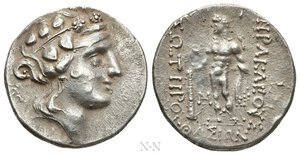
THRACE. Thasos. Tetradrachm (Circa 148-90/80 BC). Obv: Head of Dionysos right, wearing ivy wreath.Rev: HPAKΛEOYΣ / ΣΩTHPOΣ / ΘAΣIΩN. Herakles standing left, holding club and lion skin. Control: monogram to inner left.SNG Copenhagen 1040-5; HGC 6, 359. Condition: Very fine.Weight: 16.78 g. Diameter: 30 mm.Estimate: € 100.
Lotto n. 76
-
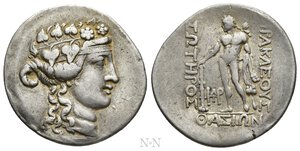
THRACE. Thasos. Tetradrachm (Circa 148-90/80 BC). Obv: Head of Dionysos right, wearing ivy wreath.Rev: HPAKΛEOYΣ / ΣΩTHPOΣ / ΘAΣIΩN. Herakles standing left, holding club and lion skin. Control: monogram to inner left.SNG Copenhagen 1046-8; HGC 6, 359. Condition: Near very fine.Weight: 16.37 g. Diameter: 34 mm.Estimate: € 100.
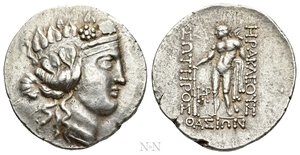
Lotto n. 77
-
THRACE. Thasos. Tetradrachm (Circa 148-90/80 BC). Imitative issue. Obv: Head of Dionysos right, wearing ivy wreath.Rev: HPAKΛEOYΣ / ΣΩTHPOΣ / ΘAΣIΩN. Herakles standing left, holding club and lion skin. Control: monogram to inner left.SNG Copenhagen 1046-8; HGC 6, 359. Condition: Very fine.Weight: 16.80 g. Diameter: 33 mm.Estimate: € 100.
Lotto n. 78
-
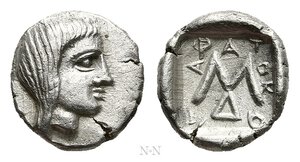
KINGS OF THRACE (Odrysian). Saratokos (Circa 410-380 BC). Obol. Uncertain mint, possibly Thasos. Obv: Male head (Saratokos?) right.Rev: ΣΑΡΑΤΟΚΟ. ΣΔ monogram within incuse square.Peykov B0380; HGC 3.2, 1681 (Diobol). Condition: Extremely fine.Weight: 1.00 g. Diameter: 10 mm.Estimate: € 100.
Lotto n. 79
-
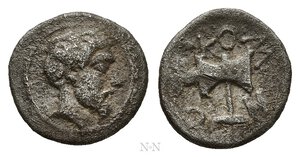
KINGS OF THRACE (Odrysian). Metokos (Circa 407-386 BC). Trihemiobol. Obv: Bare head right.Rev: MHTOKO. Labrys, with handle forming the T in the legend; grape bunch on vine to left.Peykov Type I, B0150; Topalov I 3; HGC 3.2, 1685 corr. (weight).Rare Condition: Near very fine.Weight: 1.04 g. Diameter: 11 mm.Estimate: € 50.
Lotto n. 80
-
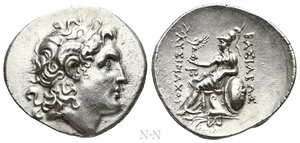
KINGS OF THRACE (Macedonian). Lysimachos (305-281 BC). Tetradrachm. Kalchedon. Obv: Diademed head of the deified Alexander right, wearing horn of Ammon.Rev: ΒΑΣΙΛΕΩΣ / ΛΥΣΙΜΑΧΟΥ. Athena seated left on throne, holding Nike and spear over shoulder. Controls: monogram to inner left; monogram and grain ear below throne.Marinescu Issue 25, 59-62; HGC 7, 524.Lysimachos was a Macedonian general and one of Alexander the Great's Diadochi. He was the son of Agathokles, from an important family in Pella. Took part in Alexander's expedition to Asia and distinguished himself during the campaign in India. As a reward for his valor, Alexander presented him with a golden crown in Susa. When Alexander died in 323, during the division of the empire's satrapies in Babylon, Lysimachos obtained Thrace and worked to expand its borders to the mouth of the Danube. He formed an alliance with Seleukos, Kassander, and Ptolemy against Antigonos, who had revived the idea, already supported by Perdikkas and Eumenes, of reconstituting the unity of Alexander's empire under his command. Antigonos sought to use the Greeks' desire for freedom to his advantage, proclaiming that all Hellenic states should be independent and free from garrisons and tributes. This also had an effect in Thrace, where a revolt broke out against Lysimachos, who managed to defeat the rebels and the troops sent by Antigonos. The general peace that ended in 311 consolidated his rule in Thrace, where he founded the new capital, Lysimachia, in 309/8. However, peace was brief and various Diadochi took the title of king, including Lysimachus (in 306-5), who once again allied himself with the previous league against Antigonos in Asia Minor. Antigonos was defeated at Ipsos in Phrygia, and in the resulting partition, Lysimachos gained control of Lydia and Caria. In honor of his first wife, who had died, he changed the name of the city of Antigoneia, founded by his rival, to Nicaea. To strengthen his alliance with Egypt, he remarried Arisonoe II, daughter of Ptolemy. Later, when Demetrios Poliorketes, Antigonos' son, resumed his father's plans and proclaimed himself king of Macedonia, he fought against him with mixed fortunes. When Demetrios attempted to occupy Thrace, Lysimachos allied with Ptolemy, Seleukos, and Pyrrhus, king of Epirus. In 288 BC, the coalition invaded Macedonia, forcing Demetrios to flee. In the ensuing partition, Lysimachos took western Macedonia and Pyrrhus took eastern Macedonia. The alliance with Pyrrhus soon broke down; defeated by Lysimachos, he was forced to retreat to Epirus, while in 285 Lysimachos became king of the all of Macedonia. His increased power aroused the suspicions of Seleukos and Ptolemy, intertwining with a family tragedy. His wife Arsinoe (perhaps with the intention of securing succession for her children) accused her stepson Agathokles of plotting against his father to seize the throne; Lysimachos had him imprisoned and poisoned (284 BC). His widow Lysandra (Arsinoe's half-sister), his brother Alexander, and other figures close to Agathokles fled and took refuge at the court of Seleukos, prompting him to wage war against Lysimachos. In the war that followed, Lysimachos was defeated, partly due to defections among his own forces, and died on the battlefield at Corupedium in Phrygia (282 BC). He was between 74 and 80 years old. The Asian territories of his kingdom came under the control of Seleukos, while Macedonia and Thrace, after various events, passed to Antigonos Gonatas, son of Demetrios. Condition: Extremely fine.Weight: 16.73 g. Diameter: 33 mm.Estimate: € 1000.
Lotto n. 81
-
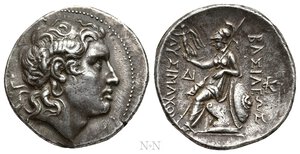
KINGS OF THRACE (Macedonian). Lysimachos (305-281 BC). Tetradrachm. Amphipolis. Obv: Diademed head of the deified Alexander right, wearing horn of Ammon.Rev: BAΣΙΛΕΩΣ / ΛYΣIMAXOY. Athena seated left on throne, holding Nike and spear over shoulder, and resting elbow on shield decorated with lion's head. Controls: ΔI monogram to inner left; monogram to outer right.Thompson 212; Müller 346.Lysimachos was a Macedonian general and one of Alexander the Great's Diadochi. He was the son of Agathokles, from an important family in Pella. Took part in Alexander's expedition to Asia and distinguished himself during the campaign in India. As a reward for his valor, Alexander presented him with a golden crown in Susa. When Alexander died in 323, during the division of the empire's satrapies in Babylon, Lysimachos obtained Thrace and worked to expand its borders to the mouth of the Danube. He formed an alliance with Seleukos, Kassander, and Ptolemy against Antigonos, who had revived the idea, already supported by Perdikkas and Eumenes, of reconstituting the unity of Alexander's empire under his command. Antigonos sought to use the Greeks' desire for freedom to his advantage, proclaiming that all Hellenic states should be independent and free from garrisons and tributes. This also had an effect in Thrace, where a revolt broke out against Lysimachos, who managed to defeat the rebels and the troops sent by Antigonos. The general peace that ended in 311 consolidated his rule in Thrace, where he founded the new capital, Lysimachia, in 309/8. However, peace was brief and various Diadochi took the title of king, including Lysimachus (in 306-5), who once again allied himself with the previous league against Antigonos in Asia Minor. Antigonos was defeated at Ipsos in Phrygia, and in the resulting partition, Lysimachos gained control of Lydia and Caria. In honor of his first wife, who had died, he changed the name of the city of Antigoneia, founded by his rival, to Nicaea. To strengthen his alliance with Egypt, he remarried Arisonoe II, daughter of Ptolemy. Later, when Demetrios Poliorketes, Antigonos' son, resumed his father's plans and proclaimed himself king of Macedonia, he fought against him with mixed fortunes. When Demetrios attempted to occupy Thrace, Lysimachos allied with Ptolemy, Seleukos, and Pyrrhus, king of Epirus. In 288 BC, the coalition invaded Macedonia, forcing Demetrios to flee. In the ensuing partition, Lysimachos took western Macedonia and Pyrrhus took eastern Macedonia. The alliance with Pyrrhus soon broke down; defeated by Lysimachos, he was forced to retreat to Epirus, while in 285 Lysimachos became king of the all of Macedonia. His increased power aroused the suspicions of Seleukos and Ptolemy, intertwining with a family tragedy. His wife Arsinoe (perhaps with the intention of securing succession for her children) accused her stepson Agathokles of plotting against his father to seize the throne; Lysimachos had him imprisoned and poisoned (284 BC). His widow Lysandra (Arsinoe's half-sister), his brother Alexander, and other figures close to Agathokles fled and took refuge at the court of Seleukos, prompting him to wage war against Lysimachos. In the war that followed, Lysimachos was defeated, partly due to defections among his own forces, and died on the battlefield at Corupedium in Phrygia (282 BC). He was between 74 and 80 years old. The Asian territories of his kingdom came under the control of Seleukos, while Macedonia and Thrace, after various events, passed to Antigonos Gonatas, son of Demetrios. Condition: Very fine.Weight: 16.91 g. Diameter: 29 mm.Estimate: € 500.
Lotto n. 82
-
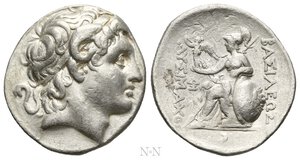
KINGS OF THRACE (Macedonian). Lysimachos (305-281 BC). Tetradrachm. Lampsakos. Obv: Diademed head of the deified Alexander right, wearing horn of Ammon.Rev: ΒΑΣΙΛΕΩΣ / ΛΥΣΙΜΑΧΟΥ. Athena seated left on throne, holding Nike and spear over shoulder, and resting elbow upon shield. Controls: monogram to inner left, crescent in exergue.Thompson 49; HGC 3.2, 1750b. Condition: Good fine.Weight: 16.80 g. Diameter: 31 mm.Estimate: € 200.
Lotto n. 83
-
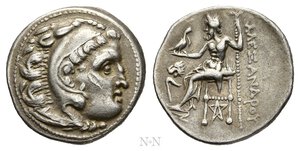
KINGS OF THRACE (Macedonian). Lysimachos (305-281 BC). Drachm. Kolophon. In the name of Alexander III of Macedon. Obv: Head of Herakles right, wearing lion skin.Rev: ΑΛΕΞΑΝΔΡΟΥ. Zeus seated left on throne, holding eagle and sceptre. Controls: in left field, head of lion left above torch; pentagram below throne.Price 1834. Condition: Very fine.Weight: 4.18 g. Diameter: 18 mm.Estimate: € 100.
Lotto n. 84
-
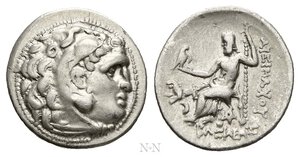
KINGS OF THRACE (Macedonian). Lysimachos (305-281 BC). Drachm. Kolophon. Obv: Head of Herakles right, wearing lion skin.Rev: ΛΥΣΙΜΑΧΟΥ / ΒΑΣΙΛΕΩΣ. Zeus seated left on throne, holding eagle and sceptre. Controls: in left field, forepart of lion left over crescent left; pentagram below throne.Thompson 123; Price L28; HGC 3, 1752e. Condition: Very fine.Weight: 4.14 g. Diameter: 19 mm.Estimate: € 50.
Lotto n. 85
-
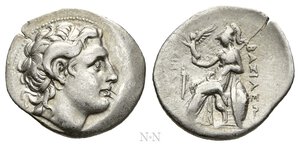
KINGS OF THRACE (Macedonian). Lysimachos (305-281 BC). Drachm. Ephesos. Obv: Head of the deified Alexander right, with horn of Ammon.Rev: BAΣIΛEΩΣ / ΛYΣIMAXOY. Athena seated left, holding Nike and spear over shoulder. Controls: bow and quiver to inner left.Thompson 171; HGC 3.2, 1753d. Condition: Near very fine.Weight: 4.10 g. Diameter: 20 mm.Estimate: € 50.
Caricamento altri risultati...