Info & contatti
Catalogo PDF
Le mie offerte
Lotti osservati
Condizioni di vendita
Prezzi di spedizione
Metodi di pagamento
Esito stampabile
Sessione Live 10/6/2025 14:30:00 CET
Greek (1-152)
Roman Republic (153-188)
The Staffieri Collection of Roman Alexandria (189-357)
Roman Empire (358-411)
Byzantine (412-421)
Greece - World Coins (422-422)
Haiti - World Coins (423-423)
Italy - World Coins (424-430)
Morocco - World Coins (431-431)
Russia - World Coins (432-439)
Medals (440-440)

Egypt, Alexandria. Philippus II as Caesar, 244-247. Tetradrachm (Billon, 23.00 mm, 13.33 g). Dated RY 4 (of Philippus I) = AD 246/7. M IOY ФIΛIΠΠOC K CЄ Bareheaded and cuirassed bust of Philippus II right, seen from the front; gorgoneion on cuirass. Rev. Philippus I, laureate, on horseback right, wearing chlamys, flowing from shoulder; right arm outstretched while holding in left hand a short sceptre resting on shoulder; L Δ (date) across fields. Geissen 2792. BMC 2052. Milne 3688. Dattari 5016 var. Dattari-Savio 12476. K&G 76.34. RPC VIII online 2820. Curtis 1394-1395. Emmett 3588 (5). Very rare. Brown patina, light roughness. Very Fine. From the Dr. Thomas Beniak Collection. Ex Empire Coins Sale 8, 07.12.1987, lot 758 and ex CNG, E-Auction 556, 21.02.2024, lot 404. Once again Philip II as Caesar (he would be made Augustus by his father in AD 247), with a fine tetradrachm struck using the typical technique and metal of the period. Here he is portrayed as a child—he was in fact 6 or 7 years old—in AD 246–247, on the eve of his elevation to Augustus by his father, who appears on the reverse, cuirassed and triumphant, riding a horse at a trot to the right. This coin clearly served as a piece of dynastic propaganda in anticipation of the millennium of Rome, which was celebrated only in AD 248.
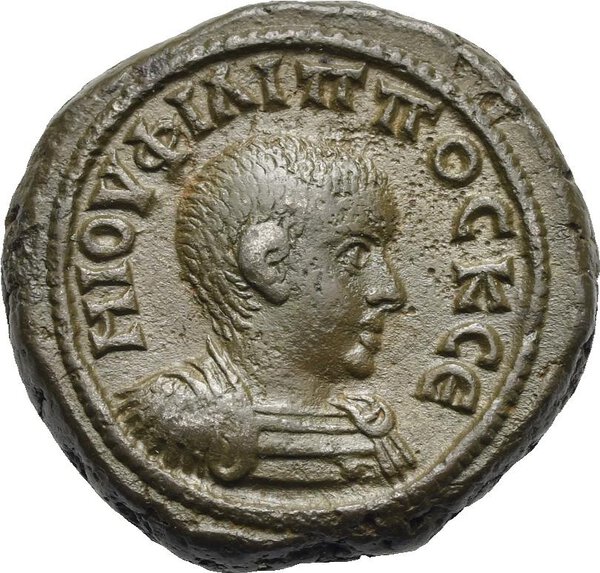
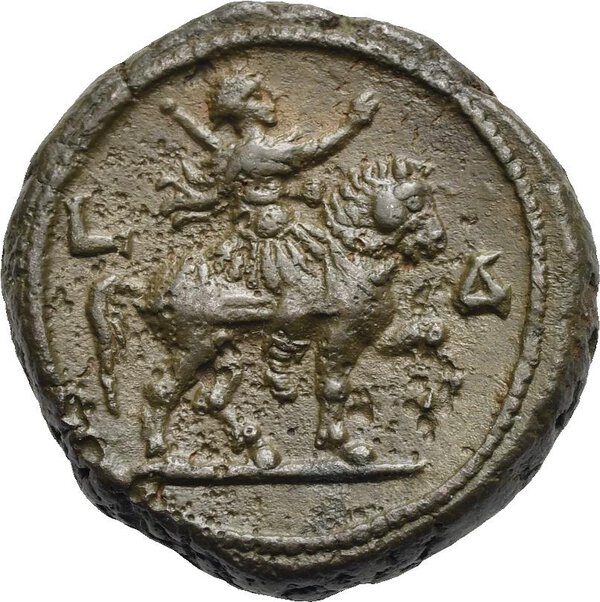
Egypt, Alexandria. Philippus II as Caesar, 244-247. Tetradrachm (Billon, 23.00 mm, 13.33 g). Dated RY 4 (of Philippus I) = AD 246/7. M IOY ФIΛIΠΠOC K CЄ Bareheaded and cuirassed bust of Philippus II right, seen from the front; gorgoneion on cuirass. Rev. Philippus I, laureate, on horseback right, wearing chlamys, flowing from shoulder; right arm outstretched while holding in left hand a short sceptre resting on shoulder; L Δ (date) across fields. Geissen 2792. BMC 2052. Milne 3688. Dattari 5016 var. Dattari-Savio 12476. K&G 76.34. RPC VIII online 2820. Curtis 1394-1395. Emmett 3588 (5). Very rare. Brown patina, light roughness. Very Fine.
From the Dr. Thomas Beniak Collection. Ex Empire Coins Sale 8, 07.12.1987, lot 758 and ex CNG, E-Auction 556, 21.02.2024, lot 404.
Once again Philip II as Caesar (he would be made Augustus by his father in AD 247), with a fine tetradrachm struck using the typical technique and metal of the period. Here he is portrayed as a child—he was in fact 6 or 7 years old—in AD 246–247, on the eve of his elevation to Augustus by his father, who appears on the reverse, cuirassed and triumphant, riding a horse at a trot to the right. This coin clearly served as a piece of dynastic propaganda in anticipation of the millennium of Rome, which was celebrated only in AD 248.