
Sicily. Panormos (as Ziz). Siculo-Punic Coinage, circa 405-380 BC. Tetradrachm (Silver, 25.82 mm, 16.40 g). 'SYS' (in Punic, small characters) Charioteer driving quadriga galloping right on double exergue line, holding kentron and reins; above, Nike flying left, crowning him; in exergue, hippocamp; border of dots. Rev. Female head of nymph (or Tanit-Arethusa) left, hair with ampyx, wearing triple pendant earring and pearl necklace; around, three dolphins; all within shallow circular incuse. Jenkins, SNR 50 (1971), pl. 10, 32 (O8/R27, same dies). BMC Sicily 247, 8 (same dies). McClean 2488 (same dies). De Luynes 1083 (same dies). De Hirsch 826 (same dies). Gulbenkian 237 (same dies). Rizzo pl. LXIV, 27 (same dies). Cf. SNG ANS 538. Cf. SNG Lloyd 1583. Cf. SNG Lockett 845 = SNG Ashmolean 2137. Cf. Viola CNP 297. Cf. Jameson 689. Cf. Buceti 33. Cf. HGC 2, 1010. Pleasant tone. Extremely Fine. Rare Variant, (all the horses' front hooves do not touch the double exergue line).Ex Nomisma 9, 17 May 1997, lot 143.The designs on Siculo-Punic coinages of the late 5th and early 4th centuries BC characteristically are drawn from Sicilian prototypes, principally from tetradrachms and dekadrachms of Syracuse. This issue of Panormos is of special interest in that regard. Jenkins considers the female head on the reverse to be “a free adaption from the type of Kimon’s decadrachms” with a result that, on this particular die, “admittedly seems remote from Kimon.” Considering that later reverse dies in this series closely approximate the work of Kimon, this connection seems beyond dispute. Jenkins’ views on the prototype for the obverse die, however, should be reconsidered. He suggests the chariot scene is directly copied from the Kimonian type, and that the hippocamp in the exergue may be indirectly inspired by the last issue of Himera or by the ketos of earlier Syracusan coinage. The prototype for this obverse, however, is not so remote: it is the work of the artist “Euth...”, whose masterful obverse die at Syracuse (cf. Tudeer obverse die 15, used with issues 46-48) seems to be the only one he signed. Every significant element of the Syracusan prototype is preserved on this Punic copy, including the vigorous style and inventive composition. Only details are changed: the charioteer is no longer winged; in the exergue the elaborate skylla, who holds a trident and captures a fish, is replaced with a hippocamp, and the three letters representing the first syllable of the artist’s signature are replaced with the Punic ethnic “sys” or “ziz”. Considering that both Syracusan prototypes date to the last decade of the 5th century BC, it makes sense that this Panormos issue (which is either contemporary, or at most a decade or so later) would find inspiration in the two important Syracusan issues.
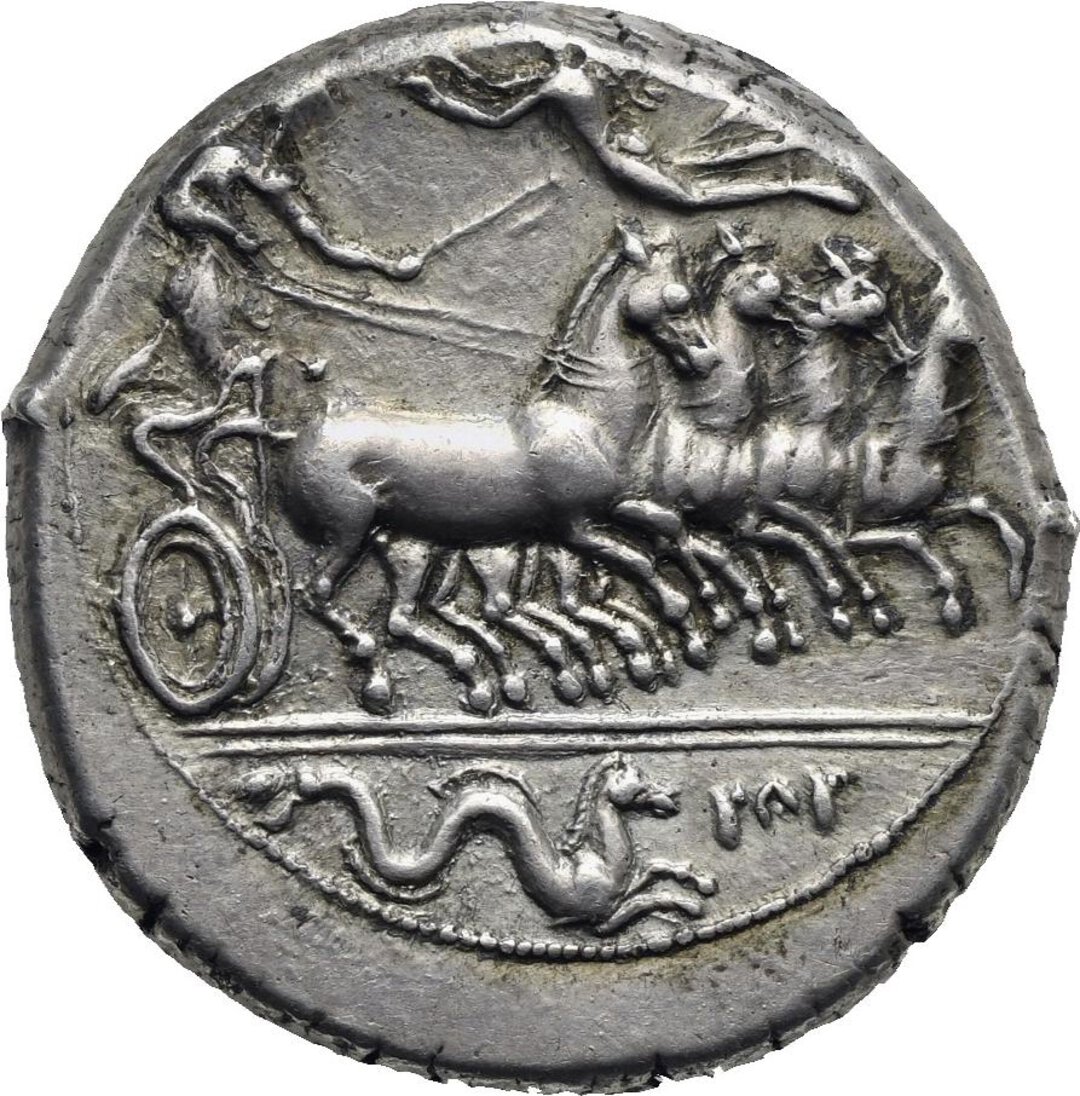
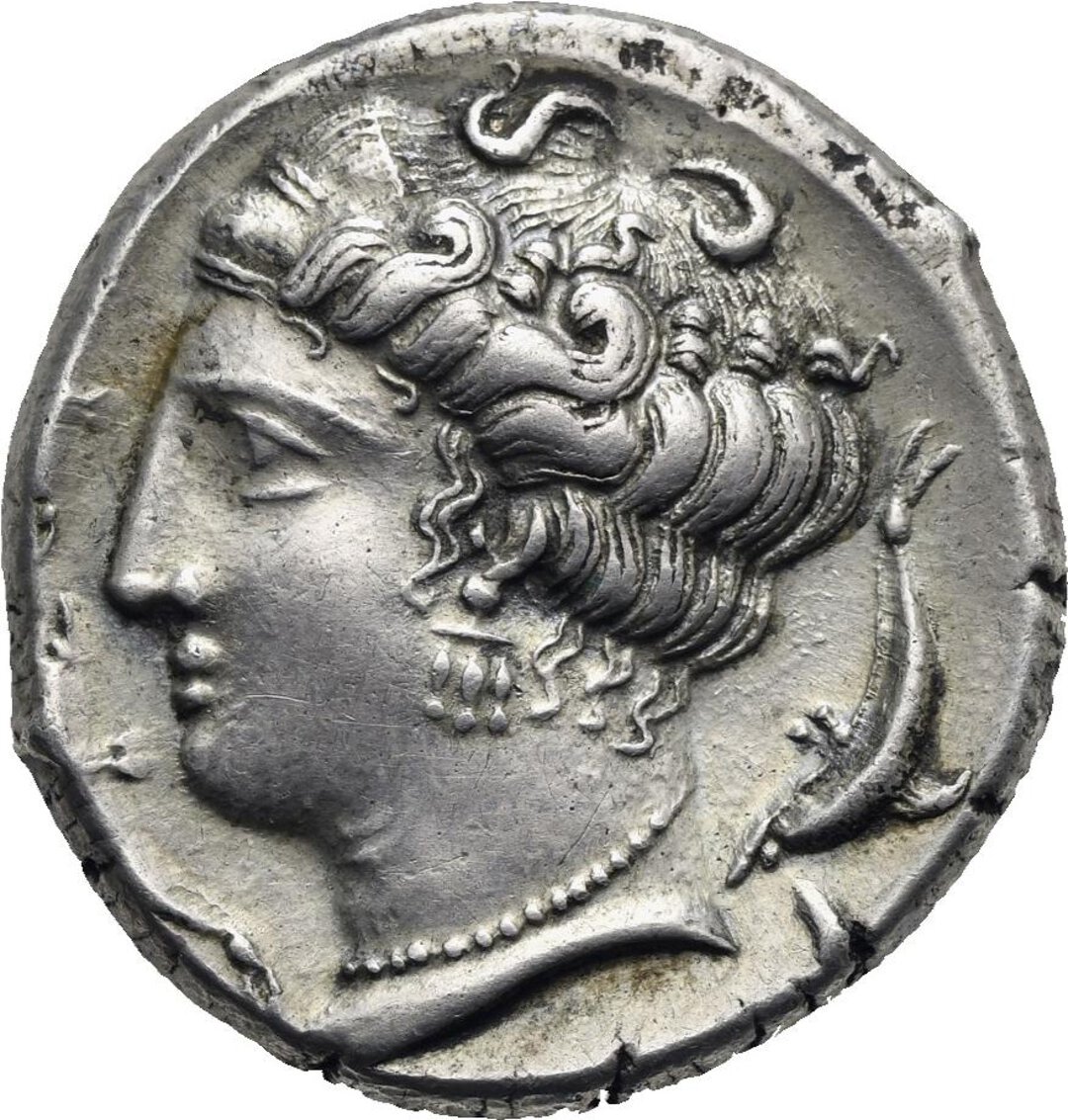
Sicily. Panormos (as Ziz). Siculo-Punic Coinage, circa 405-380 BC. Tetradrachm (Silver, 25.82 mm, 16.40 g). 'SYS' (in Punic, small characters) Charioteer driving quadriga galloping right on double exergue line, holding kentron and reins; above, Nike flying left, crowning him; in exergue, hippocamp; border of dots. Rev. Female head of nymph (or Tanit-Arethusa) left, hair with ampyx, wearing triple pendant earring and pearl necklace; around, three dolphins; all within shallow circular incuse. Jenkins, SNR 50 (1971), pl. 10, 32 (O8/R27, same dies). BMC Sicily 247, 8 (same dies). McClean 2488 (same dies). De Luynes 1083 (same dies). De Hirsch 826 (same dies). Gulbenkian 237 (same dies). Rizzo pl. LXIV, 27 (same dies). Cf. SNG ANS 538. Cf. SNG Lloyd 1583. Cf. SNG Lockett 845 = SNG Ashmolean 2137. Cf. Viola CNP 297. Cf. Jameson 689. Cf. Buceti 33. Cf. HGC 2, 1010. Pleasant tone. Extremely Fine. Rare Variant, (all the horses' front hooves do not touch the double exergue line).
Ex Nomisma 9, 17 May 1997, lot 143.
The designs on Siculo-Punic coinages of the late 5th and early 4th centuries BC characteristically are drawn from Sicilian prototypes, principally from tetradrachms and dekadrachms of Syracuse. This issue of Panormos is of special interest in that regard. Jenkins considers the female head on the reverse to be “a free adaption from the type of Kimon’s decadrachms” with a result that, on this particular die, “admittedly seems remote from Kimon.” Considering that later reverse dies in this series closely approximate the work of Kimon, this connection seems beyond dispute. Jenkins’ views on the prototype for the obverse die, however, should be reconsidered. He suggests the chariot scene is directly copied from the Kimonian type, and that the hippocamp in the exergue may be indirectly inspired by the last issue of Himera or by the ketos of earlier Syracusan coinage. The prototype for this obverse, however, is not so remote: it is the work of the artist “Euth...”, whose masterful obverse die at Syracuse (cf. Tudeer obverse die 15, used with issues 46-48) seems to be the only one he signed. Every significant element of the Syracusan prototype is preserved on this Punic copy, including the vigorous style and inventive composition. Only details are changed: the charioteer is no longer winged; in the exergue the elaborate skylla, who holds a trident and captures a fish, is replaced with a hippocamp, and the three letters representing the first syllable of the artist’s signature are replaced with the Punic ethnic “sys” or “ziz”. Considering that both Syracusan prototypes date to the last decade of the 5th century BC, it makes sense that this Panormos issue (which is either contemporary, or at most a decade or so later) would find inspiration in the two important Syracusan issues.