Info & contatti
Le mie offerte
Lotti osservati
Condizioni di vendita
Prezzi di spedizione
Metodi di pagamento
Esito stampabile
Sessione Live 5/7/2026 17:00:00 CET
Celtic Coins (1-25)
Greek Coins (26-218)
Roman Provincial Coins (219-296)
Roman Republican Coins (297-336)
Roman Imperial Coins (337-876)
Migration Period (877-880)
Byzantine Coins (881-904)
Medieval Coins (905-921)
World Coins (922-959)
Medals & Tokens (960-961)
Group Lots (962-1178)

M. PLAETORIUS M.F. CESTIANUS. Denarius (57 BC). Rome
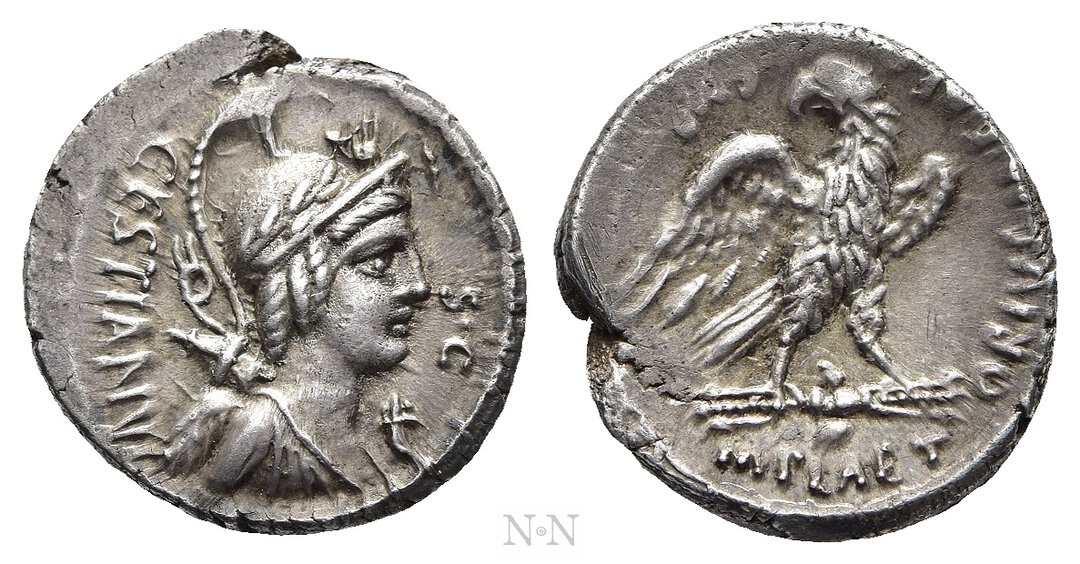

M. PLAETORIUS M.F. CESTIANUS. Denarius (57 BC). Rome.
Obv: CESTIANVS / S C.
Helmeted, laureate and draped bust of Vacuna right, with bow and quiver over shoulder; cornucopia to right.
Rev: M PLAETORIVS M F AED CVR.
Eagle standing right on winged thunderbolt, head left, with wings spread.
Crawford 409/1; RBW 1482.
Vacuna was an ancient goddess of Sabine origin who watched over the farmers' rest. Sacrifices were offered to her during the harvests and in December, once the farm work was completed. She is a enigmatic goddess, often associated with and confused with other deities of ancient Italy, such as Victoria, Diana, Ceres, and Minerva. Like other Sabine deities, her cult was practiced primarily outdoors, in the openings within the woods, though temples and sanctuaries were not excluded. There is little iconography depicting the goddess, and her symbolic traits are vague, as she is associated with the cycle of agricultural production. However, it has two specific connotations: the focus on the break that follows the fatigue of the last harvest, which places special emphasis on the dimension of rest after work, and the connection with water in all its forms, from rain to the sources of lakes, characterized by the oracular and thaumaturgical properties of the aquatic element. This denarius bears the most popular image, depicting the identification of Vacuna with Roman deities, particularly Victoria. The Romans celebrated Vacuna in early December with the Vacunalia, a festival about which little is known. It is possible that the cult in Rome retained elements of Sabine religious practices and perhaps even those of the Pelasgians, who inhabited the region before the Sabines.
Condition: Good very fine.
Weight: 4.18 g.
Diameter: 19 mm.
Estimate: € 250.
Obv: CESTIANVS / S C.
Helmeted, laureate and draped bust of Vacuna right, with bow and quiver over shoulder; cornucopia to right.
Rev: M PLAETORIVS M F AED CVR.
Eagle standing right on winged thunderbolt, head left, with wings spread.
Crawford 409/1; RBW 1482.
Vacuna was an ancient goddess of Sabine origin who watched over the farmers' rest. Sacrifices were offered to her during the harvests and in December, once the farm work was completed. She is a enigmatic goddess, often associated with and confused with other deities of ancient Italy, such as Victoria, Diana, Ceres, and Minerva. Like other Sabine deities, her cult was practiced primarily outdoors, in the openings within the woods, though temples and sanctuaries were not excluded. There is little iconography depicting the goddess, and her symbolic traits are vague, as she is associated with the cycle of agricultural production. However, it has two specific connotations: the focus on the break that follows the fatigue of the last harvest, which places special emphasis on the dimension of rest after work, and the connection with water in all its forms, from rain to the sources of lakes, characterized by the oracular and thaumaturgical properties of the aquatic element. This denarius bears the most popular image, depicting the identification of Vacuna with Roman deities, particularly Victoria. The Romans celebrated Vacuna in early December with the Vacunalia, a festival about which little is known. It is possible that the cult in Rome retained elements of Sabine religious practices and perhaps even those of the Pelasgians, who inhabited the region before the Sabines.
Condition: Good very fine.
Weight: 4.18 g.
Diameter: 19 mm.
Estimate: € 250.