Info & contatti
Le mie offerte
Lotti osservati
Condizioni di vendita
Prezzi di spedizione
Metodi di pagamento
Esito stampabile
Sessione Live 5/7/2026 17:00:00 CET
Celtic Coins (1-25)
Greek Coins (26-218)
Roman Provincial Coins (219-296)
Roman Republican Coins (297-336)
Roman Imperial Coins (337-876)
Migration Period (877-880)
Byzantine Coins (881-904)
Medieval Coins (905-921)
World Coins (922-959)
Medals & Tokens (960-961)
Group Lots (962-1178)

L. HOSTILIUS SASERNA. Denarius (48 BC). Rome
Personification of Gallia
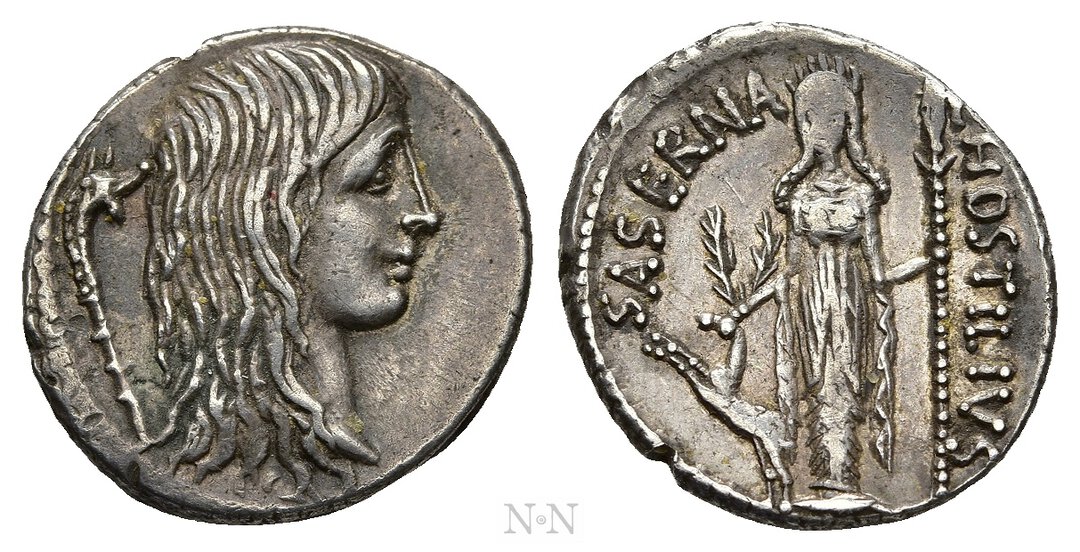

L. HOSTILIUS SASERNA. Denarius (48 BC). Rome.
Obv: Head of Gallia right; carnyx to left.
Rev: L HOSTILIVS / SASERNA.
Diana of Ephesus standing facing, holding spear and stag by the horns.
Crawford 448/3; CRI 19; RBW 1570.
Ex Naville Numismatics 32 (2017), lot 405; purchased from Muschietti in 1955. This denarius refers to the Roman expansion of the Empire with the annexation of the province of Gallia Comata, or the 'Tres Galliae', through its female personification characterized by long hair (“comata” = “hairy” or “leafy”) and by the presence of the Celtic carnyx in the field. This iconography also appears on the breastplate of the Augustus of Prima Porta. For the reverse to pair with the personification of Gallia Comata, the Ephesus Artemis was chosen, dressed in a long chiton, holding a spear in her left hand and restraining a doe by the antlers with her right. She is therefore a territorial deity, whose cult spread beyond the Alps thanks to the Greek colonists of Massalia, but also an expression of an ancient bond between the transalpine region and the city of Rome, where, in the archaic age, King Servius Tullius built on the Aventine Hill the temple of Diana–Artemis, marked by clear Ionian influences. This coin also offers one of the finest representations of the carnyx, the long Celtic war trumpet that was not merely a musical instrument: it became a powerful symbol of identity, strong enough to enter permanently into both Celtic and Roman monetary iconography. Ancient sources describe it as an object with a harsh and striking sound, used in battle and associated with the prestige of the warrior aristocracy. Archaeological depictions show that it also had a ritual and sacred role. On Celtic coins, the carnyx often appears together with the horse, the chariot, and other attributes of the military elite, a way to exalt the rank, courage and warrior tradition of the Gallic and British tribes. The Romans, on the other hand, adopted it as an emblem of the defeated enemy. In Republican and later Imperial denarii, the carnyx appears in trophies of barbarian arms, alongside oval shields and chariot wheels, or at the feet of prisoners in chains. There is, however, also a second use: in some issues, especially in Gallic colonies, the carnyx is represented not as a symbol of defeat but as a local identity marker integrated into the new Roman reality. It is the sign of a process of Romanization that did not entirely erase traditions but reused them to build a provincial identity loyal to Rome.
Condition: Near extremely fine.
Weight: 3.73 g.
Diameter: 19 mm.
Estimate: € 1000.
Obv: Head of Gallia right; carnyx to left.
Rev: L HOSTILIVS / SASERNA.
Diana of Ephesus standing facing, holding spear and stag by the horns.
Crawford 448/3; CRI 19; RBW 1570.
Ex Naville Numismatics 32 (2017), lot 405; purchased from Muschietti in 1955. This denarius refers to the Roman expansion of the Empire with the annexation of the province of Gallia Comata, or the 'Tres Galliae', through its female personification characterized by long hair (“comata” = “hairy” or “leafy”) and by the presence of the Celtic carnyx in the field. This iconography also appears on the breastplate of the Augustus of Prima Porta. For the reverse to pair with the personification of Gallia Comata, the Ephesus Artemis was chosen, dressed in a long chiton, holding a spear in her left hand and restraining a doe by the antlers with her right. She is therefore a territorial deity, whose cult spread beyond the Alps thanks to the Greek colonists of Massalia, but also an expression of an ancient bond between the transalpine region and the city of Rome, where, in the archaic age, King Servius Tullius built on the Aventine Hill the temple of Diana–Artemis, marked by clear Ionian influences. This coin also offers one of the finest representations of the carnyx, the long Celtic war trumpet that was not merely a musical instrument: it became a powerful symbol of identity, strong enough to enter permanently into both Celtic and Roman monetary iconography. Ancient sources describe it as an object with a harsh and striking sound, used in battle and associated with the prestige of the warrior aristocracy. Archaeological depictions show that it also had a ritual and sacred role. On Celtic coins, the carnyx often appears together with the horse, the chariot, and other attributes of the military elite, a way to exalt the rank, courage and warrior tradition of the Gallic and British tribes. The Romans, on the other hand, adopted it as an emblem of the defeated enemy. In Republican and later Imperial denarii, the carnyx appears in trophies of barbarian arms, alongside oval shields and chariot wheels, or at the feet of prisoners in chains. There is, however, also a second use: in some issues, especially in Gallic colonies, the carnyx is represented not as a symbol of defeat but as a local identity marker integrated into the new Roman reality. It is the sign of a process of Romanization that did not entirely erase traditions but reused them to build a provincial identity loyal to Rome.
Condition: Near extremely fine.
Weight: 3.73 g.
Diameter: 19 mm.
Estimate: € 1000.