Roman Republican Coins
Results from 2451 to 2500 of 10423
The Muse of Sacred Poetry, Hymn and Dance
Lot # 189
-
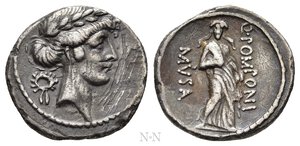
Q. POMPONIUS MUSA. Denarius (56 BC). Rome. Obv: Laureate head of Apollo right; wreath to left.Rev: Q POMPONI / MVSA. Polyhymnia standing slightly right, head facing.Crawford 410/10a; RBW -.Polyhymnia is one of the nine Muses, daughters of Zeus and Mnemosyne (goddess of memory). She is depicted as a young woman with a thoughtful gaze, often wrapped in a veil and a long cloak, with her head adorned with a crown of pearls, a symbol of purity and wisdom. Polyhymnia is traditionally considered the muse of the art of composing and performing complex stage actions that blend music, poetry, and dance. She is also the patroness of pantomime and dances associated with sacred and heroic songs, which celebrated the deeds of the gods and heroes of myth.
According to tradition, she is even credited with some important human inventions, such as the lyre, a musical instrument dear to Apollo, and agriculture, an activity fundamental to the development of civilization. Condition: Very fine.Weight: 3.23 g. Diameter: 18 mm.
Muse of Comedy and Idyllic Poetry
Lot # 188
-
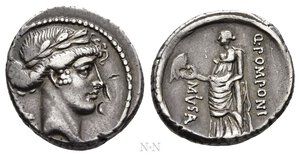
Q. POMPONIUS MUSA. Denarius (56 BC). Rome. Obv: Laureate head of Apollo right; sandal to left.Rev: Q POMPONI / MVSA. Thalia standing left, holding comic mask and resting elbow upon column to right.Crawford 410/9a; RBW -.Thalia is one of the nine Muses, daughters of Zeus and Mnemosyne (goddess of memory). Her name means “she who flourishes” or “the flourishing one” and she is the Muse of comedy and idyllic poetry, which appeal to the simplest, most ironic and lively side of humanity.
She is often depicted with a comic mask in her hand, symbolizing comic theater, and with an ivy crown, referring to the world of nature and wine. Sometimes she holds a shepherd's crook, representing bucolic poetry. Unlike other more solemn or dramatic Muses, Thalia calls for lightness and smiles. In classical times, those seeking inspiration to write satires or comedies invoked Thalia. Condition: Very fine.Weight: 3.85 g. Diameter: 18 mm.
The Muse of Astronomy and Stars
Lot # 187
-
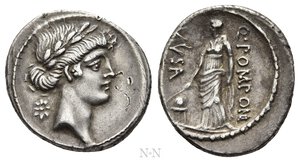
Q. POMPONIUS MUSA. Denarius (56 BC). Rome. Obv: Laureate head of Apollo right; star to left.Rev: Q POMPONI / MVSA. Urania standing left, holding wand and touching globe set upon base.Crawford 410/8; RBW 1488.Urania is one of the nine Muses, daughters of Zeus and Mnemosyne (goddess of memory). She was the muse of astronomy and geometry, as well as astronomy combined with astrology, disciplines that were inseparable for the Greeks. Urania lifts man's gaze from earthly things to eternal ones, granting him harmony and meditation.
Another tradition, of Eastern origin and linked to Herodotus, identifies her as the daughter of Heaven and Light and assimilates her to Aphrodite Urania (Venus Caelestis), daughter of Uranus. Condition: Good very fine.Weight: 4.04 g. Diameter: 19 mm.
The Muse of Dance
Lot # 186
-
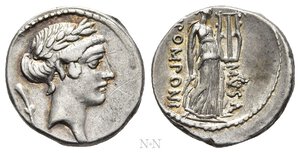
Q. POMPONIUS MUSA. Denarius (56 BC). Rome. Obv: Laureate head of Apollo right; flower to left.Rev: Q POMPONI / MVSA. Terpsichore, the Muse of Dance, standing right, holding plectrum and lyre.Crawford 410/7b; RBW -.Terpsichore, 'delight in dancing,' is one of the nine Muses, patroness of the song that accompanies dances. She is also mentioned as the mother of the sirens. Condition: Very fine.Weight: 3.93 g. Diameter: 18 mm.
The Muse of Music and Lyric Poetry
Lot # 185
-
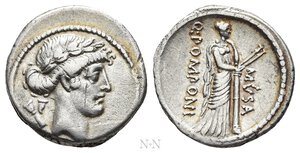
Q. POMPONIUS MUSA. Denarius (56 BC). Rome. Obv: Laureate head of Apollo right; two crossed tibiae (musical instruments) to left.Rev: MVSA / Q POMPONI. Euterpe (Muse of Music and Lyric Poetry) standing right, resting on column, holding two flutes.Crawford 410/5; RBW 1487.Euterpe is one of the nine Muses, daughters of Zeus and Mnemosyne (goddess of memory). She was the muse of music and protector of wind instruments. She is often depicted with the aulos, an ancient double-reed wind instrument which, according to myth, was invented by her.
Her name means “she who please” or “she who delights.” Euterpe inspires melodies and is the very essence of the joy that music can bring to the human soul. The aulos accompanied the most diverse moments of Greek life, during sporting events, sacred rites, and, of course, theatrical shows. Over time, Euterpe was also attributed with the protection of lyric poetry. Condition: Very fine.Weight: 3.63 g. Diameter: 19 mm.
The Muse of Tragedy
Lot # 184
-
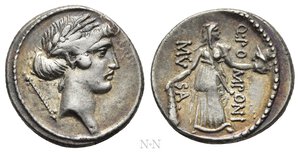
Q. POMPONIUS MUSA. Denarius (56 BC). Rome. Obv: Laureate head of Apollo right; sceptre to left.Rev: Q POMPONI MVSA. Melpomene standing left, wearing sword and holding club and mask.Crawford 410/4; RBW 1486.Melpomene is one of the nine Muses, daughters of Zeus and Mnemosyne (goddess of memory). She was initially the muse of song and musical harmony, but later became the muse of tragedy, perhaps because of her connection to Dionysus.
Melpomene is usually depicted with a severe, imposing appearance, wearing cothurni, the typical sandals worn by tragic actors. She holds a tragic mask in her hands and, sometimes, a scepter, a bloody dagger, or a club, symbols of drama and theatrical pathos. According to some traditions, the union between Melpomene and the river god Achelous gave birth to the Sirens, creatures with enchanting songs, with the head of a woman and the body of a bird. Condition: Good very fine.Weight: 4.02 g. Diameter: 18 mm.
Clio the Muse of History
Lot # 183
-
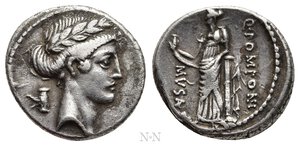
Q. POMPONIUS MUSA. Denarius (56 BC). Rome. Obv: Laureate head of Apollo right; tied volumen to left.Rev: Q POMPONI / MVSA. Clio standing left, holding scroll and leaning on column.Crawford 410/3; RBW 1485.Clio is the first of the nine Muses, daughter of Zeus and Mnemosyne (goddess of memory). From her mother, she inherited the gift of preserving and transmitting the memory of events and personalities, which makes her the Muse of History and “who can make famous.”
She is a wise, calm, and thoughtful figure with a sensitive heart. When the narrative is particularly moving, Clio can be moved to tears, and her tears, as rare as pearls, are a source of pride for poets, who see them as confirmation of the value of their work. Writers who wish to evoke distant times, reawaken buried memories, and give voice to forgotten heroes turn to her. Thanks to her, history becomes storytelling, and the past becomes living memory. Condition: Very fine.Weight: 4.44 g. Diameter: 18 mm.
The Muse of Eloquence and Epic Poetry
Lot # 182
-
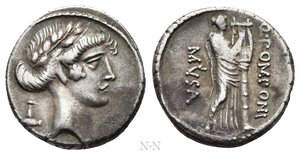
Q. POMPONIUS MUSA. Denarius (56 BC). Rome. Obv: Laureate head of Apollo right; lyre key to left.Rev: MVSA / Q POMPONI. Calliope standing right, playing lyre set on column.Crawford 410/2b; RBW -.Calliope is one of the nine Muses, daughters of Zeus and Mnemosyne (goddess of memory). She was the muse of epic poetry, considered Homer's favorite and believed to be the inspiration for the Iliad and the Odyssey.
Calliope was also known for being the mother of Orpheus and Linus, two highly talented musicians. The father of her children could have been the god Apollo or Oeagrus, king of Thrace, depending on the different versions of the myth. According to one tradition, she was loved by Zeus, with whom she generated the Corybantes, figures associated with ritual dance. Calliope is considered the oldest and wisest of the Muses, also famous for her confidence and authority. She played a significant role in the dispute between Aphrodite and Persephone over Adonis: acting as an impartial judge, she decreed that each of the two goddesses should spend the same amount of time with the young man.
She is usually depicted with a stylus and wax tablets, with scrolls of parchment or a book, or playing the lyre, as in the case of this denarius. Condition: Near very fine.Weight: 3.61 g. Diameter: 17 mm.
Lot # 181
-
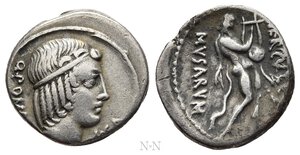
Q. POMPONIUS MUSA. Denarius (56 BC). Rome. Obv: Q POMPONI MVSA. Head of Apollo right, wearing taenia.Rev: HERCVLES / MVSARVM. Hercules standing right, playing lyre; club leaning on knee to right.Crawford 410/1; RBW -. Condition: Very fine.Weight: 3.83 g. Diameter: 18 mm.
Mint State
Lot # 180
-
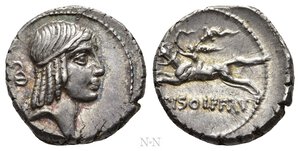
C. PISO L. F. FRUGI. Denarius (67 BC). Rome. Obv: Diademed head of Apollo right; symbol to left.Rev: C PISO L F FRV. Warrior riding horse left, holding whip; torch above.Crawford 408/1b (O92/R116); Hersh, Piso 345 (O274/R3001). Condition: Mint State.Weight: 4.08 g. Diameter: 17 mm.
Lot # 179
-
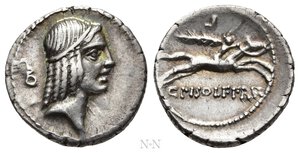
C. PISO L. F. FRUGI. Denarius (67 BC). Rome. Obv: Diademed head of Apollo right; symbol to left.Rev: C PISO L F FRV. Warrior riding horse right, holding palm frond; control-letter above.Crawford 408/1b (O120/R147); Hersh, Piso 391 (O295/R2117). Condition: Extremely fine; luster in field.Weight: 3.69 g. Diameter: 18 mm.
Lot # 178
-
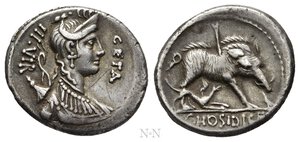
C. HOSIDIUS C.F. GETA. Denarius (64 BC). Rome. Obv: III VIR / GETA. Diademed and draped bust of Diana right, with bow and quiver over shoulder.Rev: C HOSIDI C F. Calydonian Boar standing right, pierced by spear and harried by hound below.Crawford 407/2; RBW 1456. Condition: Very fine.Weight: 3.89 g. Diameter: 20 mm.
Lot # 177
-
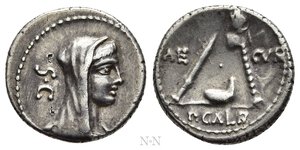
P. GALBA. Denarius (69 BC). Rome. Obv: Veiled and diademed head of Vesta right; S C to left.Rev: AE - CVR / P GALB. Secespita, simpulum and securis.Crawford 406/1; RBW 1454. Condition: Very fine.Weight: 3.74 g. Diameter: 17 mm.
Lot # 176
-
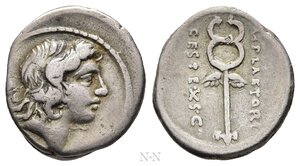
M. PLAETORIUS M.F. CESTIANUS. Denarius (69 BC). Rome. Obv: Male head right with flowing hair; symbol behind.Rev: M PLAETORI CEST EX S C. Winged caduceus.Crawford 405/5; RBW type as 1453. Condition: Good fine.Weight: 3.53 g. Diameter: 18 mm.
Lot # 175
-
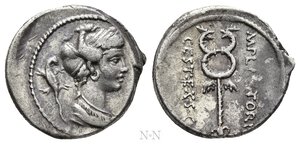
M. PLAETORIUS M.F. CESTIANUS. Denarius (57 BC). Rome. Obv: Draped female bust (Ceres?) right; lizard to left.Rev: M PLAETORI / CEST EX S C. Winged caduceus.Crawford 405/3b; RBW type as 1450. Condition: Very fine.Weight: 3.76 g. Diameter: 19 mm.
Lot # 174
-
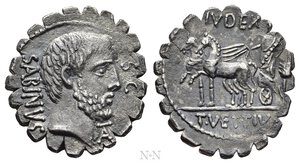
T. VETTIUS SABINUS. Serrate Denarius (70 BC). Rome. Obv: SABINVS / S C. Bare head of king Tatius right, TA monogram below chin.Rev: IVDEX / T VETTIVS. Togatus driving biga left; grain ear to right.Crawford 404/1; RBW 1446. Condition: Extremely fine.Weight: 3.67 g. Diameter: 20 mm.
Lot # 173
-
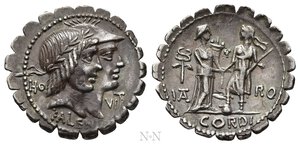
Q. FUFIUS CALENUS and MUCIUS CORDUS. Serrate Denarius (68 BC). Rome. Obv: HO - VIRT / KALENI. Jugate heads of Honos, laureate, and Virtus, helmeted, right.Rev: ITA - RO / CORDI. Italia standing right, holding cornucopia and clasping hands with Roma standing left, with foot upon globus and holding sceptre; winged caduceus to left.Crawford 403/1; RBW 1445. Condition: Good very fine.Weight: 3.93 g. Diameter: 22 mm.
Kneeling Sicily
Lot # 172
-
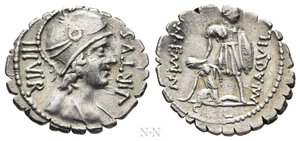
MN. AQUILIUS MN.F. MN.N. Serrate Denarius (65 BC). Rome. Obv: VIRTVS III VIR. Helmeted and draped bust of Virtus right.Rev: MN F MN N / MN AQVIL / SICIL. Mn. Aquillius standing left, head right, raising Sicilia kneeling left.Crawford 401/1; RBW 1443. Condition: Good very fine.Weight: 3.67 g. Diameter: 20 mm.
Lot # 171
-
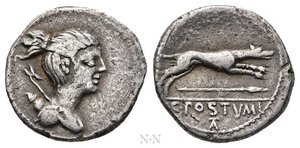
C. POSTUMIUS. Denarius (73 BC). Rome. Obv: Draped bust of Diana right, with bow and quiver over shoulder.Rev: C POSTVMI / TA. Hound springing right; below, spear right.Crawford 394/1a; RBW 1434. Condition: Good fine.Weight: 3.52 g. Diameter: 18 mm.
Mint State
Lot # 170
-
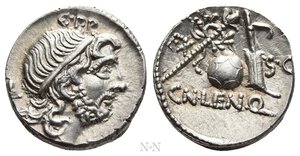
CN. LENTULUS. Denarius (76-75 BC). Spain. Obv: C P R. Diademed and draped bust of Genius Populi Romani right, with sceptre over shoulder.Rev: C N LEN Q. Sceptre with wreath, terrestrial globe and rudder.Crawford 393/1a; RBW 1432. Condition: Mint State.Weight: 3.81 g. Diameter: 18 mm.
Lot # 169
-
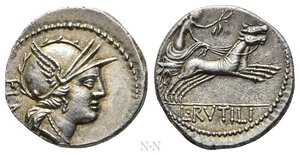
L. RUTILIUS FLACCUS. Denarius (77 BC). Rome. Obv: FLAC. Helmeted head of Roma right.Rev: L RVTILI. Victory, holding reins and wreath, driving biga right.Crawford 387/1; RBW 1420. Condition: Extremely fine; luster in field.Weight: 3.80 g. Diameter: 18 mm.
Lot # 168
-
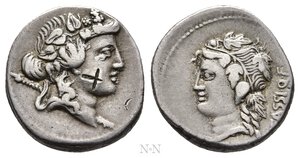
L. CASSIUS Q.F. LONGINUS. Denarius (75 BC). Rome. Obv: Head of Liber or young Bacchus right, wearing ivy wreath and with thyrsus over shoulder.Rev: L CASSI Q F. Head of Libera left, wearing ivy wreath.Crawford 386/1; RBW 1419. Condition: Very fine.Weight: 3.89 g. Diameter: 18 mm.
Lot # 167
-
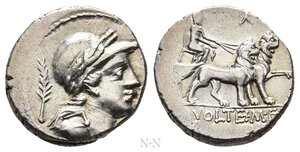
M. VOLTEIUS M.F. Denarius (78 BC). Rome. Obv: Helmeted, laureate and draped bust right; palm-branch to left.Rev: M VOLTEI M F. Cybele driving biga of lions right; control-mark Λ above.Crawford 385/4; RBW type as 1417. Condition: Very fine.Weight: 3.90 g. Diameter: 17 mm.
Lot # 166
-
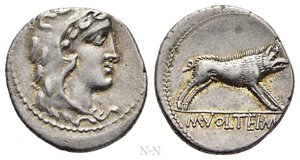
M. VOLTEIUS M.F. Denarius (75 BC). Rome. Obv: Head of Hercules right, wearing lion skin.Rev: M VOLTEI M F. Erymanthian Boar advancing right.Crawford 385/2; RBW 1415. Condition: Very fine.Weight: 3.84 g. Diameter: 19 mm.
Lot # 165
-
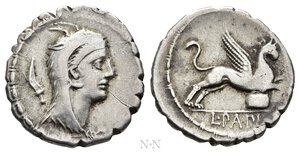
L. PAPIUS. Serrate Denarius (79 BC). Rome. Obv: Head of Juno Sospita right, wearing goat’s skin. Control: knife behind.Rev: L PAPI. Griffin leaping right. Control: block below.Crawford 384/1 (controls 67); RBW type as 1412-3. Condition: Near very fine.Weight: 3.99 g. Diameter: 19 mm.
Lot # 164
-
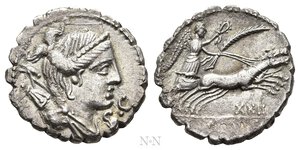
TI. CLAUDIUS NERO. Serrate Denarius (79 BC). Rome. Obv: S C. Draped bust of Diana right, with bow and quiver over shoulder.Rev: TI CLAVD TI F / AP N. Victory driving biga right, holding palm frond, wreath and reins; XXII below.Crawford 383/1; RBW type as 1411. Condition: Good very fine.Weight: 3.71 g. Diameter: 18 mm.

Lot # 163
-
C. NAEVIUS BALBUS. Serrate Denarius (79 BC). Rome. Obv: Diademed head of Venus right; S C to left; control-letter below chin.Rev: C NAE BALB. Victory driving triga right, holding reins.Crawford 382/1a; RBW type as 1409. Condition: Extremely fine; luster in field.Weight: 3.79 g. Diameter: 19 mm.
Lot # 162
-
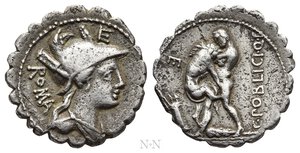
C. POBLICIUS Q.F. Serrate Denarius (80 BC). Rome. Obv: ROMA. Helmeted and draped bust of Roma right; E above.Rev: C POBLICI Q F. Hercules standing left, wrestling the Nemean Lion; club below, quiver with bow and arrows to left, E above.Crawford 380/1; RBW type as 1408. Condition: Very fine.Weight: 3.64 g. Diameter: 19 mm.
Lot # 161
-
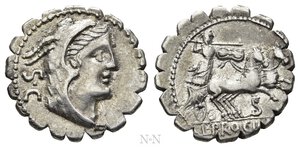
L. PROCILIUS. Serrate Denarius (80 BC). Rome. Obv: Head of Juno Sospita right, wearing goat skin; S C to left.Rev: L PROCILI F. Juno Sospita, holding spear, shield and reins, driving biga right; below, serpent coiled right.Crawford 379/2; RBW 1407. Condition: Very fine.Weight: 4.02 g. Diameter: 19 mm.
Lot # 160
-
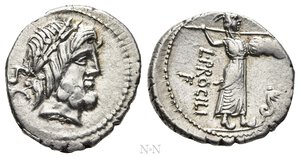
L. PROCILIUS. Denarius (80 BC). Rome. Obv: Laureate head of Jupiter right; S C to left.Rev: L PROCILI F. Juno Sospita advancing right, hurling spear and holding shield; to right, serpent coiled right.Crawford 379/1; RBW 1406. Condition: Extremely fine.Weight: 3.89 g. Diameter: 20 mm.
Lot # 159
-
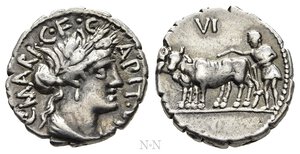
C. MARIUS C. F. CAPITO. Serrate Denarius (81 BC). Rome. Obv: C MARI C F CAPIT [...]. Draped bust of Ceres right, wearing wreath of grain ears.Rev: Priest plowing left with yoke of oxen; VI above.Crawford 378/1a; RBW type as 1401. Condition: Very fine.Weight: 3.90 g. Diameter: 18 mm.
Lot # 158
-
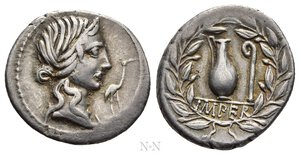
Q. CAECILIUS METELLUS PIUS. Denarius (81 BC). Uncertain mint in northern Italy. Obv: Diademed head of Pietas right; to right, stork standing right.Rev: IMPER. Jug and lituus within wreath.Crawford 374/2; RBW 1397. Condition: Very fine.Weight: 3.73 g. Diameter: 20 mm.
Lot # 157
-
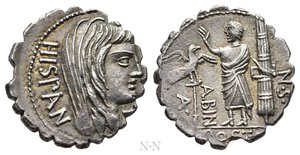
A. POSTUMIUS A.F. SP.N. ALBINUS. Serrate Denarius (81 BC). Rome. Obv: HISPAN. Veiled head of Hispania right.Rev: POST A F / S N / ALBIN / A. Togate figure standing left, raising hand; aquila to left, fasces to right.Crawford 372/2; RBW 1393. Condition: Extremely fine.Weight: 3.66 g. Diameter: 19 mm.
Lot # 156
-
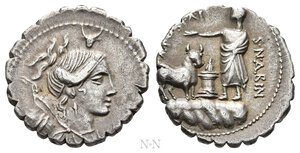
A. POSTUMIUS A. F. SP. N. ALBINUS. Serrate Denarius (81 BC). Rome. Obv: Draped bust of Diana right, with bow and quiver over shoulder; bucranium above.Rev: A POST A F / S N ALBIN. Togate figure right standing left on rock, holding aspergillum over bull; between them, lighted altar.Crawford 372/1; RBW 1392. Condition: Very fine.Weight: 3.70 g. Diameter: 18 mm.
Lot # 155
-
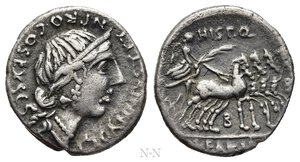
C. ANNIUS T.F. & C. TARQUITIUS P.F. Denarius (82-81 BC). Mint in northern Italy or Spain. Obv: C ANNIVS T F T N PRO COS EX S C. Diademed head of Anna Perenna right.Rev: HISP Q / L FABI L F. Victory, holding palm frond and reins, driving quadriga right; B below and to right.Crawford 366/3b; RBW type as 1381.According to legend, Anna was the sister of Dido of Carthage, who fled to Rome after Dido's death. Here she was received by Aeneas, Dido's lover. Lavinia, Aeneas' wife, became jealous and decided to kill her. Anna, having learned of the danger threatening her in a dream, hid in the river Numico and transformed herself into a nymph. According to other authors, Anna was an old woman who brought food to the plebeians barricaded on Monte Sacro and was therefore deified after her death.
She was probably an ancient Etruscan goddess who presided over the reproduction of humans and animals. She was celebrated on March 15 with rituals involving libations and sexual promiscuity. She bears a striking resemblance to the Indian goddess Anna Purna. Condition: Very fine.Weight: 3.80 g. Diameter: 19 mm.
Lot # 154
-
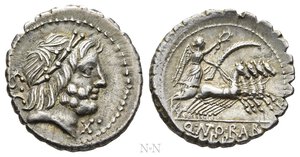
Q. ANTONIUS BALBUS. Serrate Denarius (83-82 BC). Rome. Obv: S•C. Laureate head of Jupiter right; control mark X• to lower right.Rev: Q ANTO BALB PR. Victory driving quadriga right, holding reins, wreath and palm frond.Crawford 364/1c; RBW -. Condition: Good very fine.Weight: 3.96 g. Diameter: 20 mm.
Lot # 153
-
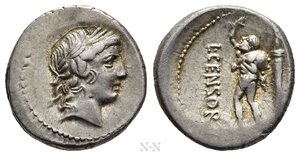
L. CENSORINUS. Denarius (82 BC). Rome. Obv: Laureate head of Apollo right.Rev: L CENSOR. Marsyas standing left, raising hand and holding wineskin over shoulder; to right, column bearing statue of Victory.Crawford 363/1d; RBW 1372. Condition: Very fine.Weight: 3.91 g. Diameter: 18 mm.
Ulysses Arriving in Ithaka
Lot # 152
-
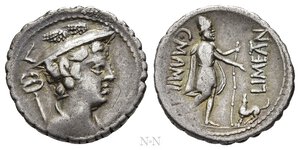
C. MAMILIUS LIMETANUS. Serrate Denarius (82 BC). Rome. Obv: Draped bust of Mercury right, wearing petasus; to left, control letter L above caduceus.Rev: C MAMIL / LIMETAN. Ulysses advancing right, holding staff and extending hand to his dog Argus.Crawford 362/1; RBW type as 1370.In book XVII of the Odyssey, Odysseus returns to Ithaka disguised as a beggar and is recognized only by his faithful dog Argos, now old. Once a superb hunting dog, Argos raises his head and wags his tail at the sight of Odysseus, but dies immediately after recognizing him, demonstrating his loyalty and love, preventing him from inadvertently revealing his master's identity and allowing Odysseus to plan his revenge. Condition: Very fine.Weight: 3.87 g. Diameter: 19 mm.
Lot # 151
-
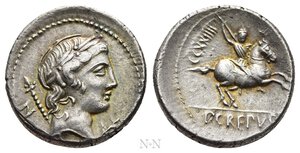
P. CREPUSIUS. Denarius (82 BC). Rome. Obv: Laureate head of Apollo right; behind, sceptre and N; lizard before.Rev: P CREPVSI. Horseman advancing right; behind, control-number CCXXIIII.Crawford 361/1c; RBW type as 1368-9. Condition: Good very fine.Weight: 3.76 g. Diameter: 18 mm.
Lot # 150
-
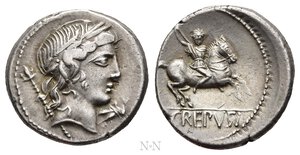
P. CREPUSIUS. Denarius (82 BC). Rome. Obv: Laureate head of Apollo right; behind, sceptre; below chin, control-mark.Rev: P CREPVSI. Horseman advancing right; behind, [control-numeral].Crawford 361/1b; RBW type as 1368. Condition: Good very fine.Weight: 3.96 g. Diameter: 17 mm.
Lot # 149
-
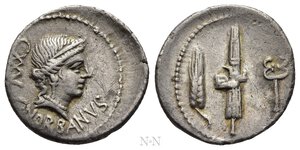
C. NORBANUS. Denarius (83 BC). Rome. Obv: C NORBANVS. Diademed head of Venus right; control-number CXXV to left.Rev: Fasces with axe; grain ear to left, caduceus to right.Crawford 357/1b; RBW type as 1363. Condition: Good very fine.Weight: 3.71 g. Diameter: 21 mm.
Lot # 148
-
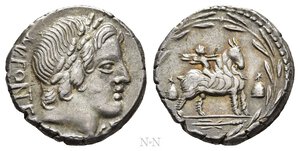
MN. FONTEIUS C. F. Denarius (85 BC). Rome. Obv: M FONTEI C F. Laureate head of Apollo right.Rev: Eros riding goat right; flanked by two pilei surmounted by stars; filleted thyrsos in exergue; all within laurel wreath.Crawford 353/1d; RBW 1352. Condition: Good very fine.Weight: 3.94 g. Diameter: 50 mm.
Lot # 147
-
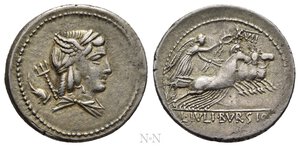
L. JULIUS BURSIO. Denarius (85 BC). Rome. Obv: Laureate, draped and winged bust of Apollo Vejovis right; to left, trident and rat.Rev: L IVLI BVRSIO. Victory, holding wreath and reins, driving quadriga right; control-mark XVII above.Crawford 352/1c; RBW type as 1349. Condition: Very fine.Weight: 3.74 g. Diameter: 22 mm.
Sharp Strike
Lot # 146
-
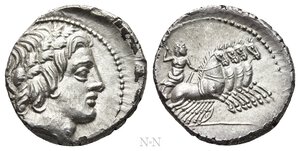
GARGILIUS, OGULNIUS and VERGILIUS. Denarius (86 BC). Rome. Obv: Laureate head of Apollo right; thunderbolt below.Rev: Jupiter driving quadriga right and hurling thunderbolt.Crawford 350A/2; RBW 1333. Condition: Extremely fine; luster.Weight: 3.84 g. Diameter: 19 mm.
Lot # 145
-
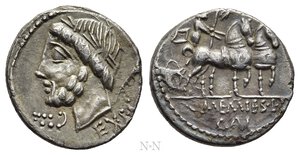
L. and C. MEMMIUS GALERIA. Denarius (87 BC). Rome. Obv: EX S C. Laureate head of Saturn left; harpa behind; control-mark to left.Rev: L C MEMIES L F / GAL. Venus in biga right; above, Cupid flying left to crown her.Crawford 349/1; RBW type as 1328. Condition: Near extremely fine.Weight: 3.64 g. Diameter: 18 mm.
Lot # 144
-
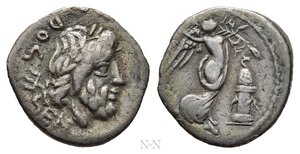
L. RUBRIUS DOSSENUS. Quinarius (87 BC). Rome. Obv: DOSSEN. Laureate head of Neptune right, with trident over shoulder.Rev: L RVBRI. Victory standing right, holding wreath and palm frond; to right, garlanded altar with serpent coiled around top.Crawford 348/4; King 48; RBW 1325. Condition: Near very fine.Weight: 1.84 g. Diameter: 14 mm.
Lot # 143
-
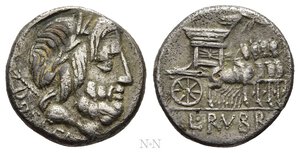
L. RUBRIUS DOSSENUS. Denarius (87 BC). Rome. Obv: DOSSEN. Laureate head of Jupiter right, with sceptre over shoulder.Rev: L RVBRI. Triumphal chariot with side panel decorated with thunderbolt; above, Victory flying right.Crawford 348/1; RBW 1322. Condition: Very fine.Weight: 3.34 g. Diameter: 17 mm.
Lot # 142
-
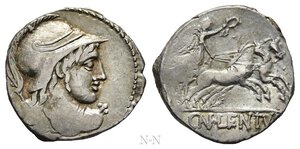
CN. LENTULUS CLODIANUS. Denarius (88 BC). Rome. Obv: Helmeted bust of Mars right.Rev: CN LENTVL. Victory driving biga right, holding wreath and reins.Crawford 345/1; RBW 1312. Condition: Very fine.Weight: 3.64 g. Diameter: 17 mm.
The Death of Tarpeia
Lot # 141
-
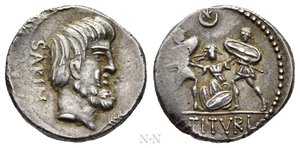
L. TITURIUS L.F. SABINUS. Denarius (89 BC). Rome. Obv: SABIN. Bareheaded and bearded head of King Tatius right; palm frond to lower right.Rev: L TITVRI. Tarpeia facing, buried to her waist in shields, with raised hands she tries to thrust of two soldiers who are about to cast their shields at her; star in crescent above.Crawford 344/2b; RBW 1301.After the abduction of their women, the Sabines, led by King Titus Tatius (depicted on the obverse), managed to take possession of the Capitoline Hill thanks to the betrayal of Tarpeia, who opened the gates of the citadel to them.
There are two versions of this myth, told by Propertius and Livy. The former presents the vestal virgin's betrayal as a consequence of her love for the king of the Sabines. According to Livy, however, Tarpeia was bribed by the enemy's gold: when she went outside the walls to draw water for the cult of Vesta, she was captured and punished for her behavior, ending up buried and crushed by the Sabine shields as illustrated on the reverse of the Denarius. Condition: Extremely fine.Weight: 3.79 g. Diameter: 18 mm.
The Rape of the Sabine Women
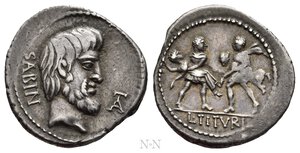
Lot # 140
-
L. TITURIUS L.F. SABINUS. Denarius (89 BC). Rome. Obv: SABIN. Bareheaded and bearded head of King Tatius right; monogram to right.Rev: L TITVRI. Two soldiers, facing each other, each carrying off a Sabine woman in his arms.Crawford 344/1a; RBW -.The episode of the Rape of the Sabine Women is recounted by Livy and Plutarch. According to legend, among the many problems faced by the Romans was a shortage of women. Therefore, in order to ensure the future of the Roman race, various alliances were formed with the aim of finding a way to bring women from neighboring populations to Rome.
One of the populations involved was that of the Sabines, who rejected the Roman proposal. Romulus and his companions then took advantage of the games in honor of the god Consus to invite the Sabines and kidnap the women, thus starting the war. But faced with the fact that their Sabine relatives and those who had meanwhile become their Roman husbands could be killed in battle, the women began to beg for an end to the massacre. As a result, what became known as the Rape of the Sabine Women led to a situation of peace and prosperity for the two peoples. Condition: Good very fine.Weight: 3.64 g. Diameter: 20 mm.
Results from 2451 to 2500 of 10423