Greek Coins
Results from 5651 to 5700 of 15719
Greek Poet Homer
Lot # 158
-
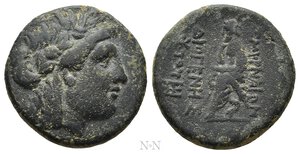
IONIA. Smyrna. Ae (Circa 145-125 BC). Diogenes Euryd-, magistrate. Obv: Laureate head of Apollo right.Rev: ΣΜΥΡΝΑΙΩΝ ΔIOΓENHΣ TOY. Homer, holding scroll and resting chin upon hand, seated left on plinth.Milne 183; cf. SNG Copenhagen 1140. Condition: Near very fine.Weight: 8.27 g. Diameter: 22 mm.
Ex Lanz 2011
Lot # 157
-
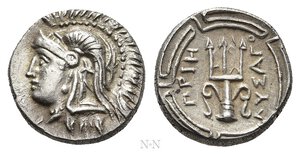
IONIA. Priene. Hemidrachm (Circa 290-250 BC). Lysago-, magistrate. Obv: Helmeted head of Athena left.Rev: ΠPIH / ΛYΣAΓO. Ornate trident head within circular maeander pattern.Regling 19; SNG Copenhagen 1082; Klein 459.Ex Numismatik Lanz 153 (2011), lot 274 Condition: Uncirculated .Weight: 1.71 g. Diameter: 12 mm.
Lot # 156
-
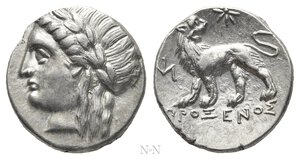
IONIA. Miletos. Drachm (Circa 340-325 BC). Proxenos, magistrate. Obv: Laureate head of Apollo left.Rev: ΠΡΟΞΕΝΟΣ. Lion standing left, head right; monogram to left, star above.Deppert-Lippitz 232-6. Condition: Extremely fine.Weight: 3.57 g. Diameter: 16 mm.
Lot # 155
-
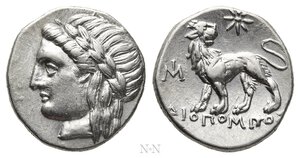
IONIA. Miletos. Drachm (Circa 353-323 BC). Diopompos, magistrate. Obv: Laureate head of Apollo left.Rev: ΔIOΠOMΠOΣ. Lion standing left, head right; star above, monogram in left field.Deppert-Lippitz 225-231. Condition: Extremely fine.Weight: 3.50 g. Diameter: 16 mm.
Lot # 154
-
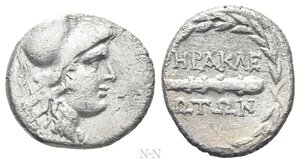
ΙΟΝIA. Herakleia ad Latmon. Octobol (Circa 150-142 BC). Obv: Head of Athena right, wearing Corinthian helmet.Rev: HPAKΛEΩTΩN. Club right within wreath.SNG München 431. Condition: Near very fine.Weight: 4.16 g. Diameter: 18 mm.
Lot # 153
-
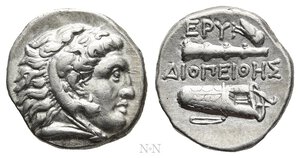
IONIA. Erythrai. Drachm (Circa 325-315 BC). Diopeithes, magistrate. Obv: Head of Herakles left, wearing lion skin.Rev: EPY / ΔIOΠEIΘHΣ. Club and bowcase; to upper left, owl standing right.SNG Copenhagen 586 var. (owl left). Condition: Good very fine.Weight: 3.63 g. Diameter: 16 mm.
Lot # 152
-
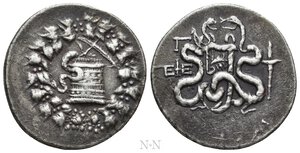
IONIA. Ephesos. Under Roman Rule (133-67 BC). Cistophor. Dated year 3 (of the formation of Provincia Asiae, 132/1 BC). Obv: Cista mystica with serpent; all within ivy wreath.Rev: Bowcase between two serpents; EΦΕ to left. Controls: Γ (date) to upper left, torch to right.Kleiner & Noe series 42b; SNG von Aulock 7845. Condition: Very fine.Weight: 12.50 g. Diameter: 29 mm.
Lot # 151
-
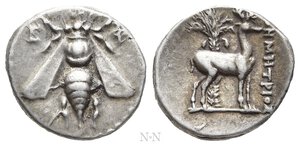
IONIA. Ephesos. Drachm (Circa 202-150 BC). Demetrios, magistrate. Obv: Ε - Φ. Bee.Rev: ΔΗΜΗΤΡΙΟΣ. Stag standing right; palm tree behind.SNG von Aulock 7825; SNG Copenhagen 289. Condition: Good very fine.Weight: 4.22 g. Diameter: 17 mm.
Lot # 150
-
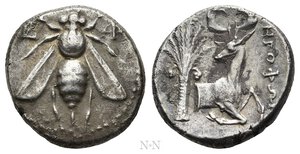
IONIA. Ephesos. Drachm (Circa 387-295 BC). Erophon, magistrate. Obv: Ε - Φ. Bee.Rev: HPOΦANΩN. Forepart of stag right, head left; palm tree to left.SNG Copehagen -; SNG von Aulock -.RareEx Gerhard Hirsch Nachfolger 355 (2020), lot 1778 Condition: Very fine.Weight: 5.53 g. Diameter: 18 mm.
Lot # 149
-
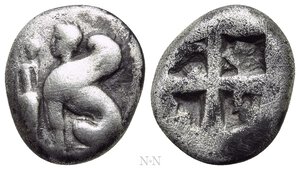
IONIA. Chios. Drachm (Circa 400-380 BC). Obv: Sphinx seated left; to left, grape bunch above amphora.Rev: Quadripartite granulated incuse square.Mavrogordato 33; HGC 6, 1124. Condition: Fine.Weight: 3.26 g. Diameter: 14 mm.
Lot # 148
-
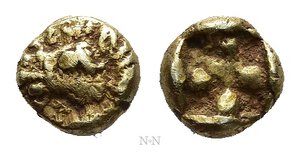
IONIA. Uncertain. EL 1/48 Stater (Circa 600-550 BC). Obv: Head of bridled horse left.Rev: Incuse punch with cross-like dots.Weidauer -, cf. 142 (Hemihekte); SNG Kayhan 718.Rare Condition: Near extremely fine.Weight: 0.30 g. Diameter: 5 mm.
Ex Gemini-Heritage 2011
Lot # 147
-
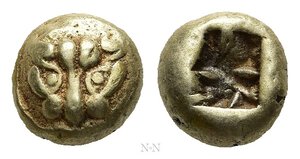
IONIA. Uncertain. EL 1/12 Stater (Circa 600-550 BC). Obv: Facing lion head.Rev: Incuse square.Weidauer 162-4; Traité I 32; Rosen 370; SNG Kayhan 712.RareEx Gemini-Heritage VIII (2011), lot 76; ex NAC Numismatica Ars Classica 116 (2019), lot 183 Condition: Good very fine.Weight: 1.22 g. Diameter: 7 mm.
Lot # 146
-
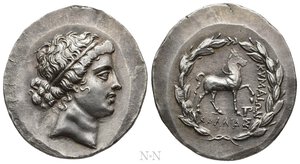
AEOLIS. Kyme. Tetradrachm (Circa 155-143 BC). Kallias, magistrate. Obv: Head of the Amazon Kyme right, wearing tainia.Rev: KYMAIΩN / KAΛΛIAΣ. Horse prancing right; one-handled cup below; all within wreath.SNG Copenhagen 103. Condition: Good very fine.Weight: 16.83 g. Diameter: 33 mm.
Lot # 145
-
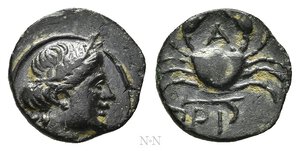
MYSIA. Priapos. Ae (Circa 300-200 BC). Obv: Laureate head of Apollo right.Rev: ΠPI / A. Crab; below, harpa right.SNG Arikantürk 1096-101; SNG BN -. Condition: Good very fine.Weight: 0.93 g. Diameter: 11 mm.
No Specimen on Acsearch
Lot # 144
-
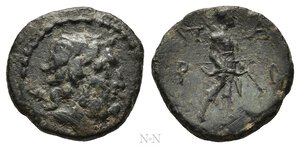
MYSIA. Parion. Ae (2nd-1st century BC). Obv: Head of Zeus right; sceptre behind.Rev: Π - A / P - I. Artemis standing right, holding bow and spear.BMC 62; Acsearch -.RareExtremely Rare Condition: Very fine.Weight: 2.30 g. Diameter: 15 mm.
Lot # 143
-
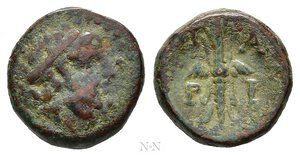
MYSIA. Parion. Ae (2nd-1st century BC). Obv: Laureate head of Zeus right.Rev: Π - Α / Ρ - Ι. Winged thunderbolt.SNG BN 1410.Very rare Condition: Very fine.Weight: 2.49 g. Diameter: 13 mm.
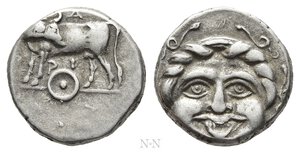
Lot # 142
-
MYSIA. Parion. Hemidrachm (4th century BC). Obv: ΠΑ / ΡΙ. Bull standing left, head reverted; Θ below.Rev: Facing gorgoneion.SNG BN 1385-6. Condition: Very fine.Weight: 2.45 g. Diameter: 13 mm.
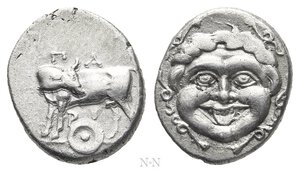
Lot # 141
-
MYSIA. Parion. Hemidrachm (4th century BC). Obv: ΠΑ / ΡΙ. Bull standing left, head reverted; Θ below.Rev: Facing gorgoneion.SNG BN 1385-6. Condition: Good very fine.Weight: 2.15 g. Diameter: 14 mm.
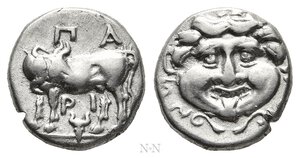
Lot # 140
-
MYSIA. Parion. Hemidrachm (4th century BC). Obv: ΠA / PI. Bull standing left, head reverted; boukranion below.Rev: Facing gorgoneion.SNG BN 1380; CN online 21203. Condition: Very fine.Weight: 2.35 g. Diameter: 13 mm.
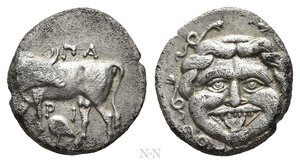
Lot # 139
-
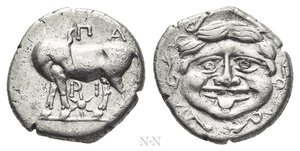
MYSIA. Parion. Hemidrachm (4th century BC). Obv: ΠΑ / ΡΙ. Cow standing left, head right; sickle below.Rev: Facing gorgoneion.SNG BN 1379. Condition: Very fine.Weight: 1.97 g. Diameter: 14 mm.
Lot # 138
-
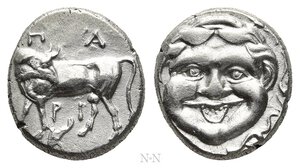
MYSIA. Parion. Hemidrachm (4th century BC). Obv: ΠΑ / ΡΙ. Cow standing left, head right; star below.Rev: Gorgoneion.SNG BN 1368; SNG Copenhagen 263. Condition: Very fine.Weight: 2.33 g. Diameter: 14 mm.
Lot # 137
-
MYSIA. Parion. Hemidrachm (4th century BC). Obv: ΠA / PI. Bull standing left, head right. Control: Dolphin below.Rev: Facing gorgoneion.SNG BN -; SNG von Aulock -; BMC 22 var. (dolphin above); Numismatik Naumann 127, lot 285. Condition: Extremely fine.Weight: 2.41 g. Diameter: 13 mm.
Lot # 136
-
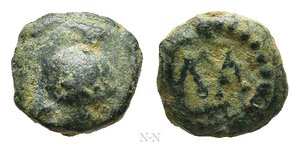
MYSIA. Lampsakos(?). Ae (4th-3rd centuries BC). Obv: Amphora(?).Rev: Large ΛA.SNG BN -; SNG Arikantürk -; SNG Copenhagen -; SNG von Aulock -; BMC -. Condition: Very fine.Weight: 0.59 g. Diameter: 8 mm.
Kerberos the Hound of Hades
Lot # 135
-
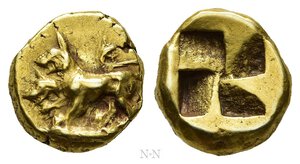
MYSIA. Kyzikos. EL Hekte - 1/6 Stater (Circa 450-330 BC).. Obv: Kerberos standing left on tunny left.Rev: Quadripartite incuse square.Von Fritze I 103; Greenwell 141; Boston MFA 1539; SNG BN 244; SNG von Aulock 7300; Rosen 484.Ex Fritz Rudolf Künker 94 (2004), lot 9845; ex The New York Sale XXV (2011), lot 69.
Guardian of the underworld, son of Echidna and Typhon, Cerberus had three heads (according to some versions fifty or a hundred), a mane of snakes, and a dragon's tail. His specific duty was to prevent the living from entering and the dead from leaving, but he failed in this task on very rare occasions: when he was enchanted by the music of Orpheus, who had come among the dead to retrieve his lost bride; when he was captured by Herakles in one of his twelve labors; and finally when he fell asleep after eating a honey loaf that Aeneas gave him on the advice of the Cumaean Sibyl. Condition: Near extremely fine.Weight: 2.67 g. Diameter: 12 mm.
Lot # 134
-
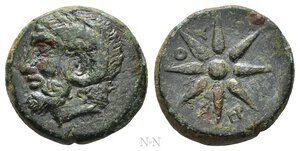
TROAS. Thymbria. Ae (4th century BC). Obv: Laureate head of Zeus Ammon left.Rev: Θ - Υ. Star of eight rays; HP monogram below; all within incuse circle.SNG Arikantürk 794; SNG von Aulock 1584; SNG Copenhagen -; BMC 4. Condition: Very fine.Weight: 5.50 g. Diameter: 18 mm.
Lot # 133
-
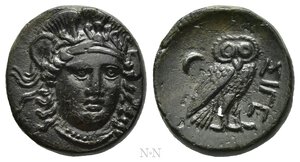
TROAS. Sigeion. Ae (355-334 BC). Obv: Helmeted head of Athena facing slightly right.Rev: ΣΙΓΕ. Owl standing right, head facing; crescent to left.SNG Arikantürk 761-3. Condition: Extremely fine.Weight: 6.86 g. Diameter: 18 mm.
Lot # 132
-
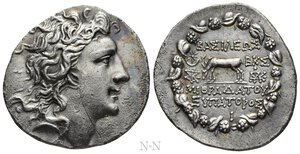
KINGS OF PONTOS. Mithradates VI Eupator (Circa 120-63 BC). Tetradrachm. Pergamon. Dated year 222, month 10 BE (July 75 BC). Obv: Diademed head right.Rev: ΒΑΣΙΛΕΩΣ / ΜΙΘΡΑΔΑΤΟΥ ΕΥΠΑΤΟΡΟΣ. Stag grazing left; to left, star-in-crescent above monogram; to right, BKΣ (year) above monogram; I (month) below; all within Dionysiac wreath of ivy and fruit.RG 16; DCA 692; HGC 7, 338. Condition: Good very fine.Weight: 15.55 g. Diameter: 35 mm.
Lot # 131
-
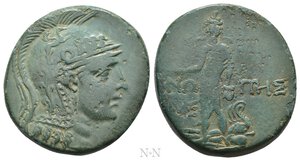
PAPHLAGONIA. Sinope. Struck under Mithradates VI Eupator (Circa 105-90 or 90-85 BC). Ae. Obv: Helmeted head of Athena right.Rev: ΣΙΝΩ - ΠΗΣ. Perseus standing left, holding harpa and head of Medusa, whose decapitated body lies at his feet; monogram to left.SNG BM Black Sea 1534-5; HGC 7, 416. Condition: Good fine.Weight: 17.91 g. Diameter: 29 mm.
Unpublished Type !?
Lot # 130
-
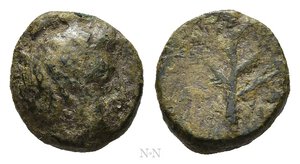
ASIA MINOR. Uncertain. Ae (Circa 4th century BC). Obv: Head right.Rev: [...M - YN]. Branch or tree.Unpublished in the standard references; Numismatik Naumann 44, lot 192. Condition: Very fine .Weight: 0.89 g. Diameter: 10 mm.
Lot # 129
-
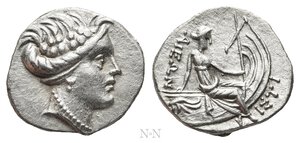
EUBOIA. Histiaia. Tetrobol (3rd-2nd centuries BC). Obv: Wreathed head of the nymph Histiaia right.Rev: IΣTIAIEΩN. Nymph seated right on stern of galley; wing on prow.BCD Euboia 387ff.; HGC 4, 1524. Condition: Extremely fine.Weight: 1.63 g. Diameter: 14 mm.
Lot # 128
-
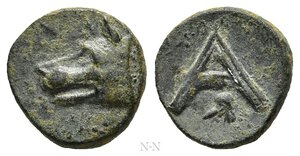
ARGOLIS. Argos. Ae (Circa 370-270 BC). Obv: Wolf’s head left.Rev: Large A; owl below.BCD Peloponnesos 1052-3 var. (symbol); HGC 5, 707. Condition: Near extremely fine.Weight: 2.13 g. Diameter: 14 mm.
Lot # 127
-
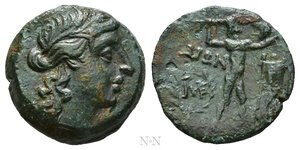
MESSENIA. Messene. Ae Hemiobol or Hexachalkon (Late 2nd-early 1st centuries BC). Dion, magistrate. Obv: Wreathed head of Demeter right.Rev: Zeus standing right, preparing to throw thunderbolt; eagle on left arm; to left, ΔIΩN above ethnic-in-wreath; tripod to right.BCD Peloponnesos 736; HGC 5, 578.RareEx Nomos Obolos 11 (2018), lot 216 Condition: Very fine.Weight: 7.05 g. Diameter: 21 mm.
Lot # 126
-
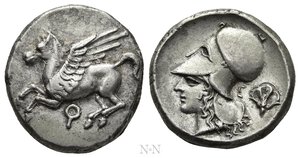
CORINTHIA. Corinth. Stater (Circa 375-300 BC). Obv: Pegasos flying left; Ϙ below.Rev: Helmeted head of Athena left; E and rose to right.Pegasi 374; BCD Corinth 97; HGC 4, 1848. Condition: Very fine.Weight: 8.44 g. Diameter: 21 mm.
Lot # 125
-
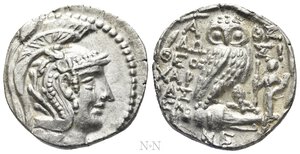
ATTICA. Athens. Tetradrachm (99/8 BC). New Style Coinage. Dositheos, Charias and Gl-, magistrates. Obv: Head of Athena Parthenos right, wearing triple crested Attic helmet decorated with Pegasos and floral pattern.Rev: A - ΘE / ΔΩ - ΣΙ / ΘΕΟΣ / ΧΑΡ / IΑΣ / ΓΛ. Owl standing right on amphora, head facing. Controls: I on amphora, ME below; to right, Tyche standing left, holding sceptre and cornucopia; all within wreath.Thompson 871a; HGC 4, 1602.Among the Greek poleis, Athens is undoubtedly the city that denotes the greatest monetary development. The earliest coinage followed the reforms attributed to Solon on the introduction of Attic weights to replace the Eginetic ones. These early coins, called "Wappenmünzen," were replaced by the "owls" at the end of the 6th century: tetradrachms marked with the head of Athena and the owl, next to which is now the ethnic of the Athenians. These types will last, with variations in style, until the end of silver production (c. mid-1st century). The most noticeable change occurs with the so-called "new style," established from the beginning of the 2nd century BC. In these issues the owl is surrounded by an olive wreath, which is why the tetradrachms are referred to in the inscriptions as "stephanephoroi" (= wreath bearers). Coins of new style also bear inscriptions with the names of magistrates. Condition: Good very fine.Weight: 16.47 g. Diameter: 29 mm.
Lot # 124
-
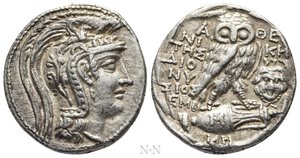
ATTICA. Athens. Tetradrachm (130/129 BC). New Style Coinage. Niketes, Dionysios and Embi-, magistrates. Obv: Head of Athena Parthenos right, wearing triple crested Attic helmet decorated with Pegasos and floral pattern.Rev: A-ΘΕ / NI - KH / THΣ / ΔΙΟ / NY / ΣΙΟΣ / EMBI. Owl standing right on amphora, head facing. Controls: M on amphora, MH below; gorgoneion in right field; all within wreath.Thompson 961; HGC 4, 1602.Among the Greek poleis, Athens is undoubtedly the city that denotes the greatest monetary development. The earliest coinage followed the reforms attributed to Solon on the introduction of Attic weights to replace the Eginetic ones. These early coins, called "Wappenmünzen," were replaced by the "owls" at the end of the 6th century: tetradrachms marked with the head of Athena and the owl, next to which is now the ethnic of the Athenians. These types will last, with variations in style, until the end of silver production (c. mid-1st century). The most noticeable change occurs with the so-called "new style," established from the beginning of the 2nd century BC. In these issues the owl is surrounded by an olive wreath, which is why the tetradrachms are referred to in the inscriptions as "stephanephoroi" (= wreath bearers). Coins of new style also bear inscriptions with the names of magistrates. Condition: Good very fine.Weight: 16.64 g. Diameter: 29 mm.
Lot # 123
-
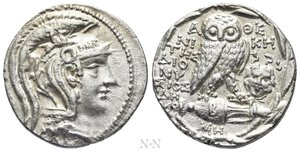
ATTICA. Athens. Tetradrachm (130/129 BC). New Style Coinage. Niketes, Dionysios and Demo-, magistrates. Obv: Head of Athena Parthenos right, wearing triple crested Attic helmet decorated with Pegasos and floral pattern.Rev: A-ΘΕ / NI - KH / THΣ / ΔΙΟ / NY / ΣΙΟΣ / ΔH / MO. Owl standing right on amphora, head facing. Controls: B on amphora, MH below; gorgoneion in right field; all within wreath.Thompson 932c; HGC 4, 1602.Among the Greek poleis, Athens is undoubtedly the city that denotes the greatest monetary development. The earliest coinage followed the reforms attributed to Solon on the introduction of Attic weights to replace the Eginetic ones. These early coins, called "Wappenmünzen," were replaced by the "owls" at the end of the 6th century: tetradrachms marked with the head of Athena and the owl, next to which is now the ethnic of the Athenians. These types will last, with variations in style, until the end of silver production (c. mid-1st century). The most noticeable change occurs with the so-called "new style," established from the beginning of the 2nd century BC. In these issues the owl is surrounded by an olive wreath, which is why the tetradrachms are referred to in the inscriptions as "stephanephoroi" (= wreath bearers). Coins of new style also bear inscriptions with the names of magistrates. Condition: Near extremely fine.Weight: 16.61 g. Diameter: 29 mm.
Lot # 122
-
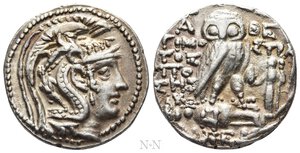
ATTICA. Athens. Tetradrachm (134/3 BC). New Style Coinage. Timostratos, Poses and Ley-(?), magistrates. Obv: Head of Athena Parthenos right, wearing triple crested Attic helmet decorated with Pegasos and floral pattern.Rev: A - ΘE / TIMO - ΣTPA / TOΣ / ΠO / ΣHΣ / [...]. Owl standing right on amphora, head facing. Controls: H on amphora, ΠE below; to right, Dionysos standing left, holding mask and sceptre; all within wreath.Thompson 830a; HGC 4, 1602.Among the Greek poleis, Athens is undoubtedly the city that denotes the greatest monetary development. The earliest coinage followed the reforms attributed to Solon on the introduction of Attic weights to replace the Eginetic ones. These early coins, called "Wappenmünzen," were replaced by the "owls" at the end of the 6th century: tetradrachms marked with the head of Athena and the owl, next to which is now the ethnic of the Athenians. These types will last, with variations in style, until the end of silver production (c. mid-1st century). The most noticeable change occurs with the so-called "new style," established from the beginning of the 2nd century BC. In these issues the owl is surrounded by an olive wreath, which is why the tetradrachms are referred to in the inscriptions as "stephanephoroi" (= wreath bearers). Coins of new style also bear inscriptions with the names of magistrates. Condition: Good very fine.Weight: 16.60 g. Diameter: 30 mm.
Lot # 121
-
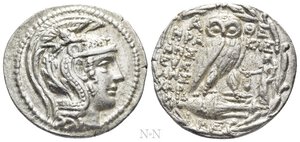
ATTICA. Athens. Tetradrachm (Circa 137/6 BC). New Style Coinage. Herakleides, Eukles and Charmid-, magistrates. Obv: Head of Athena Parthenos right, wearing triple crested Attic helmet decorated with Pegasos and floral pattern.Rev: A - ΘE / HPA - KΛEI / ΔHΣ / EYK / ΛHΣ / XAP / MIΔ. Owl, with head facing, standing right on amphora. Controls: Δ on amphora, ME below; to right, winged Tyche standing left, holding amphora; all within wreath.Thompson 783b; HGC 4, 1602.Among the Greek poleis, Athens is undoubtedly the city that denotes the greatest monetary development. The earliest coinage followed the reforms attributed to Solon on the introduction of Attic weights to replace the Eginetic ones. These early coins, called "Wappenmünzen," were replaced by the "owls" at the end of the 6th century: tetradrachms marked with the head of Athena and the owl, next to which is now the ethnic of the Athenians. These types will last, with variations in style, until the end of silver production (c. mid-1st century). The most noticeable change occurs with the so-called "new style," established from the beginning of the 2nd century BC. In these issues the owl is surrounded by an olive wreath, which is why the tetradrachms are referred to in the inscriptions as "stephanephoroi" (= wreath bearers). Coins of new style also bear inscriptions with the names of magistrates. Condition: Good very fine.Weight: 16.68 g. Diameter: 32 mm.
Lot # 120
-
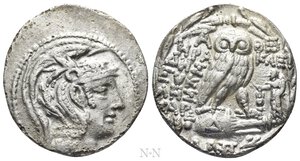
ATTICA. Athens. Tetradrachm (Circa 137/6 BC). New Style Coinage. Herakleides, Eukles and Charmid-, magistrates. Obv: Head of Athena Parthenos right, wearing triple crested Attic helmet decorated with Pegasos and floral pattern.Rev: A - ΘE / HPA - KΛEI / ΔHΣ / EYK / ΛHΣ / XAP / MIΔ. Owl, with head facing, standing right on amphora. Controls: Δ on amphora, AΠ below; to right, winged Tyche standing left, holding amphora; all within wreath.Thompson 782c-d; HGC 4, 1602.Among the Greek poleis, Athens is undoubtedly the city that denotes the greatest monetary development. The earliest coinage followed the reforms attributed to Solon on the introduction of Attic weights to replace the Eginetic ones. These early coins, called "Wappenmünzen," were replaced by the "owls" at the end of the 6th century: tetradrachms marked with the head of Athena and the owl, next to which is now the ethnic of the Athenians. These types will last, with variations in style, until the end of silver production (c. mid-1st century). The most noticeable change occurs with the so-called "new style," established from the beginning of the 2nd century BC. In these issues the owl is surrounded by an olive wreath, which is why the tetradrachms are referred to in the inscriptions as "stephanephoroi" (= wreath bearers). Coins of new style also bear inscriptions with the names of magistrates. Condition: Good very fine.Weight: 16.27 g. Diameter: 32 mm.
Lot # 119
-
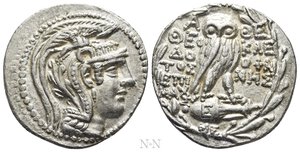
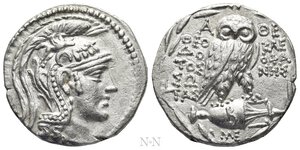
ATTICA. Athens. Tetradrachm (138/7 BC). New Style Coinage. Theodotos, Kleophanes and Epimachos, magistrates. Obv: Head of Athena Parthenos right, wearing triple crested Attic helmet decorated with Pegasos and floral pattern.Rev: A - ΘE / ΘEO / ΔO / TOΣ - KΛE / OΦA / NHΣ / EΠI / MAX / OΣ. Owl standing right on amphora, head facing. Controls: E on amphora, ME below; all within wreath.Thompson 768d-e; HGC 4, 1602.Among the Greek poleis, Athens is undoubtedly the city that denotes the greatest monetary development. The earliest coinage followed the reforms attributed to Solon on the introduction of Attic weights to replace the Eginetic ones. These early coins, called "Wappenmünzen," were replaced by the "owls" at the end of the 6th century: tetradrachms marked with the head of Athena and the owl, next to which is now the ethnic of the Athenians. These types will last, with variations in style, until the end of silver production (c. mid-1st century). The most noticeable change occurs with the so-called "new style," established from the beginning of the 2nd century BC. In these issues the owl is surrounded by an olive wreath, which is why the tetradrachms are referred to in the inscriptions as "stephanephoroi" (= wreath bearers). Coins of new style also bear inscriptions with the names of magistrates. Condition: Near extremely fine.Weight: 16.65 g. Diameter: 32 mm.
Lot # 118
-
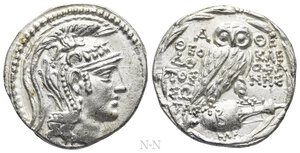
ATTICA. Athens. Tetradrachm (138/7 BC). New Style Coinage. Theodotos, Kleophanes and Sotas, magistrates. Obv: Head of Athena Parthenos right, wearing triple crested Attic helmet decorated with Pegasos and floral pattern.Rev: A - ΘE / ΘEO / ΔO / TOΣ - KΛE / OΦA / NHΣ / ΣΩ / TAΣ. Owl standing right on amphora, head facing. Controls: B on amphora, ME below; all within wreath.Thompson 764b; HGC 4, 1602.Among the Greek poleis, Athens is undoubtedly the city that denotes the greatest monetary development. The earliest coinage followed the reforms attributed to Solon on the introduction of Attic weights to replace the Eginetic ones. These early coins, called "Wappenmünzen," were replaced by the "owls" at the end of the 6th century: tetradrachms marked with the head of Athena and the owl, next to which is now the ethnic of the Athenians. These types will last, with variations in style, until the end of silver production (c. mid-1st century). The most noticeable change occurs with the so-called "new style," established from the beginning of the 2nd century BC. In these issues the owl is surrounded by an olive wreath, which is why the tetradrachms are referred to in the inscriptions as "stephanephoroi" (= wreath bearers). Coins of new style also bear inscriptions with the names of magistrates. Condition: Extremely fine.Weight: 17.26 g. Diameter: 29 mm.
Lot # 117
-
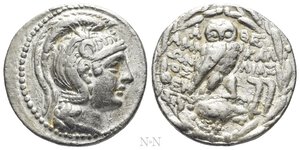
ATTICA. Athens. Tetradrachm (138/7 BC). New Style Coinage. Theodotos, Kleophanes and Sotas, magistrates. Obv: Head of Athena Parthenos right, wearing triple crested Attic helmet decorated with Pegasos and floral pattern.Rev: A - ΘE / ΘEO / ΔO / TOΣ - KΛE / OΦA / NHΣ / ΣΩ / TAΣ. Owl standing right on amphora, head facing. Controls: B on amphora, ME below; all within wreath.Thompson 764b; HGC 4, 1602.Among the Greek poleis, Athens is undoubtedly the city that denotes the greatest monetary development. The earliest coinage followed the reforms attributed to Solon on the introduction of Attic weights to replace the Eginetic ones. These early coins, called "Wappenmünzen," were replaced by the "owls" at the end of the 6th century: tetradrachms marked with the head of Athena and the owl, next to which is now the ethnic of the Athenians. These types will last, with variations in style, until the end of silver production (c. mid-1st century). The most noticeable change occurs with the so-called "new style," established from the beginning of the 2nd century BC. In these issues the owl is surrounded by an olive wreath, which is why the tetradrachms are referred to in the inscriptions as "stephanephoroi" (= wreath bearers). Coins of new style also bear inscriptions with the names of magistrates. Condition: Extremely fine.Weight: 17.06 g. Diameter: 30 mm.
Lot # 116
-
ATTICA. Athens. Tetradrachm (Circa 150/49 BC). New Style coinage. Ammonios, Kallias and Themisto-, magistrates. Obv: Head of Athena Parthenos right, wearing triple crested Attic helmet decorated with Pegasos and floral pattern.Rev: A - ΘE / AMM / ΩΝΙ / ΟΣ - KAΛ / ΛΙΑΣ / ΘEMI / ΣTO. Owl, with head facing, standing right on amphora. Controls: Z on amphora, ΣΦ below, two torches to right; all within wreath.Thompson 586d-e; HGC 4, 1602.Among the Greek poleis, Athens is undoubtedly the city that denotes the greatest monetary development. The earliest coinage followed the reforms attributed to Solon on the introduction of Attic weights to replace the Eginetic ones. These early coins, called "Wappenmünzen," were replaced by the "owls" at the end of the 6th century: tetradrachms marked with the head of Athena and the owl, next to which is now the ethnic of the Athenians. These types will last, with variations in style, until the end of silver production (c. mid-1st century). The most noticeable change occurs with the so-called "new style," established from the beginning of the 2nd century BC. In these issues the owl is surrounded by an olive wreath, which is why the tetradrachms are referred to in the inscriptions as "stephanephoroi" (= wreath bearers). Coins of new style also bear inscriptions with the names of magistrates. Condition: Very fine.Weight: 16.73 g. Diameter: 29 mm.
Lot # 115
-
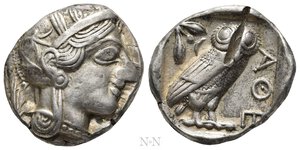
ATTICA. Athens. Tetradrachm (Circa 454-404 BC). Obv: Helmeted head of Athena right, with frontal eye.Rev: AΘE. Owl standing right, head facing; olive sprig and crescent to left; all within incuse square.Kroll 8; HGC 4, 1597. Condition: Very fine.Weight: 17.15 g. Diameter: 25 mm.
Lot # 114
-
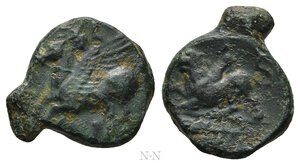
AKARNANIA. Leukas. Ae (Circa 350-300 BC). Obv: Bellerophon on Pegasos flying left.Rev: ΛEY. Chimaera standing left; rudder(?) in exergue.BCD Akarnania 259-60; HGC 5, 867. Condition: Very fine.Weight: 2.83 g. Diameter: 17 mm.
Lot # 113
-
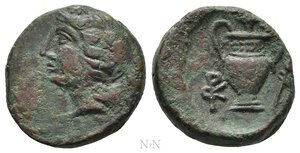
KORKYRA. Korkyra. Ae (Circa 229-48 BC). Obv: Wreathed head of Dionysos left.Rev: Kantharos surmounted by grapes; monogram to left, thyrsos to right.BMC 426 var. (head right); HGC 6, 82.Rare Condition: Very fine.Weight: 8.52 g. Diameter: 20 mm.
Ex Triton 2004
Lot # 112
-
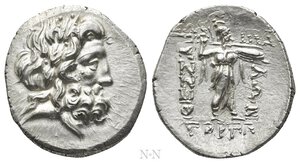
THESSALY. Thessalian League. Stater (Late 2nd-mid 1st centuries BC). Sosipatros and Gorgopas, magistrates. Obv: Laureate head of Zeus right.Rev: ΘΕΣΣΑ / ΛΩΝ / ΣΩΣΙΠΑ/ ΓΟΡΓΩ. Athena Itonia advancing right, holding shield and preparing to hurl spear.BCD Thessaly II 862.1; HGC 4, 209.Ex Triton VII (2004), lot 192 Condition: Mint State.Weight: 6.34 g. Diameter: 22 mm.
Lot # 111
-
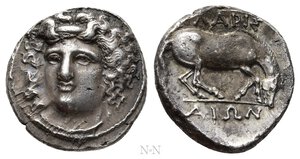
THESSALY. Larissa. Drachm (Circa 365-356 BC). Obv: Head of the nymph Larissa facing slightly left, with hair in ampyx.Rev: ΛΑΡΙΣ / ΑΙΩΝ. Horse standing right, preparing to lie down.BCD Thessaly II 320; HGC 4, 454. Condition: Good very fine.Weight: 5.88 g. Diameter: 20 mm.
Lot # 110
-
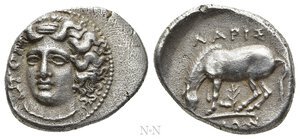
THESSALY. Larissa. Drachm (Circa 365-356 BC). Obv: Larissa facing slightly left, with hair in ampyx.Rev: ΛΑΡΙΣ / AIΩΝ. Horse grazing left; plant below.BCD Thessaly II 288; HGC 4, 452. Condition: Very fine.Weight: 5.90 g. Diameter: 22 mm.
Lot # 109
-
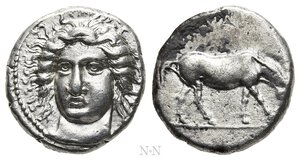
THESSALY. Larissa. Drachm (Circa 400-370 BC). Obv: Head of the nymph Larissa facing slightly left.Rev: ΛΑΡΙ. Horse grazing right.BCD Thessaly II 228; HGC 4, 431. Condition: Good very fine.Weight: 6.03 g. Diameter: 18 mm.
Results from 5651 to 5700 of 15719