Greek Coins
Results from 6201 to 6250 of 6251
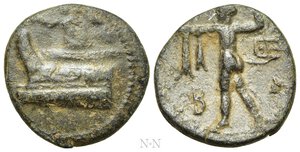
Lot # 140
-
KINGS OF MACEDON. Demetrios I Poliorketes (306-283 BC). Ae. Uncertain mint in Asia Minor. Obv: Nike on prow of galley left, blowing trumpet.Rev: B - A. Poseidon throwing trident left; monogram to right.Newell 62; HGC 3.1, 1031. Condition: Very fine.Weight: 1.13 g. Diameter: 13 mm.
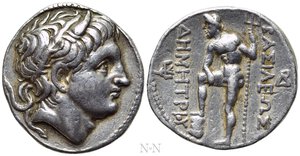
Lot # 139
-
KINGS OF MACEDON. Demetrios I Poliorketes (306-283 BC). Tetradrachm. Amphipolis. Obv: Diademed and horned head right.Rev: BAΣIΛEΩΣ / ΔHMHTPIOY. Poseidon, with foot upon rock, standing left, holding trident and resting arm upon leg; monograms to outer left and right.J.B. Vigne, 'La Vie des Monnaies Grecques', p. 104, n. 2 (this coin illustrated); Newell 124; HGC 3.1, 1014b. Condition: Very fine.Weight: 17.41 g. Diameter: 30 mm.
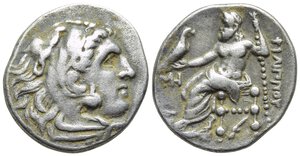
Lot # 138
-
KINGS OF MACEDON. Philip III Arrhidaios (323-317 BC). Drachm. Abydos. Obv: Head of Herakles right, wearing lion skin.Rev: ΦIΛIΠΠOY. Zeus seated left, holding eagle and sceptre. Controls: MH monogram in left field; below throne, animal-leg.Price P26. Condition: Good fine.Weight: 4.05 g. Diameter: 17 mm.
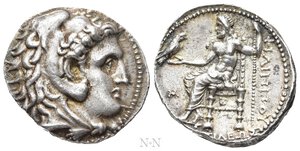
Lot # 137
-
KINGS OF MACEDON. Philip III Arrhidaios (323-317 BC). Tetradrachm. Babylon. Obv: Head of Herakles right, wearing lion skin.Rev: ΦΙΛΙΠΠΟΥ / ΒΑΣΙΛΕΩΣ. Zeus seated left on throne, holding eagle and sceptre. Controls: M in left field; below throne, B above strut.Price P182; HGC 3.1, 973f. Condition: Good very fine.Weight: 17.18 g. Diameter: 28 mm.
Attractive Memphis Tetradrachm
Lot # 136
-
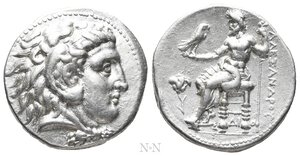
KINGS OF MACEDON. Alexander III 'the Great' (336-323 BC). Tetradrachm. Memphis. Struck under Ptolemy I Soter. Obv: Head of Herakles right, wearing lion skin.Rev: AΛΕΞΑΝΔΡΟΥ. Zeus seated left on throne, holding eagle and sceptre. Controls: Rose to left, ΔI-O below throne and to inner right.Price 3971; Lorber 19. Condition: Good very fine, with luster.Weight: 17.15 g. Diameter: 27 mm.
Lot # 135
-
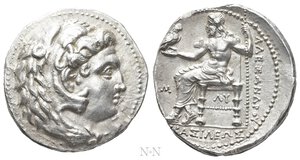
KINGS OF MACEDON. Alexander III 'the Great' (336-323 BC). Tetradrachm. Babylon. Obv: Head of Herakles right, wearing lion skin.Rev: AΛΕΞΑΝΔΡΟΥ / BAΣIΛEΩΣ. Zeus seated left on throne, holding eagle and sceptre. Controls: M to left, ΛY below throne.Price 3692. Condition: Near extremely fine.Weight: 17.19 g. Diameter: 28 mm.
Babylon Lifetime Issue
Lot # 134
-
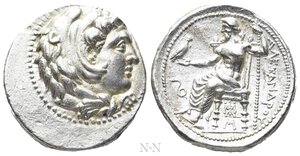
KINGS OF MACEDON. Alexander III 'the Great' (336-323 BC). Tetradrachm. Babylon. Lifetime issue. Obv: Head of Herakles right, wearing lion's skin.Rev: AΛEΞANΔPOY. Zeus seated left, holding eagle and sceptre. Controls: in left field, serpent coiled left; below throne, monogram above M.Price 3665. Condition: Good very fine.Weight: 17.23 g. Diameter: 28 mm.
Lot # 133
-
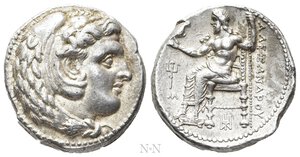
KINGS OF MACEDON. Alexander III 'the Great' (336-323 BC). Tetradrachm. Babylon. Obv: Head of Herakles right, wearing lion skin.Rev: AΛΕΞΑΝΔΡΟY. Zeus seated left on throne, holding eagle and sceptre. Controls: Trident and M in left field, monogram below throne.Price 3635. Condition: Good very fine.Weight: 17.21 g. Diameter: 25 mm.
Mint State
Lot # 132
-
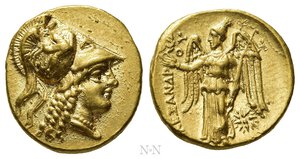
KINGS OF MACEDON. Alexander III 'the Great' (336-323 BC). GOLD Stater. Sidon. Obv: Head of Athena right, wearing Corinthian helmet decorated with griffin.Rev: AΛΕΞΑΝΔΡΟΥ. Nike standing left, holding wreath and stylis. Control: star to inner right.Price 3463.Already with Philip II the occupation of the Mount Pangaion region with its rich gold mines had made possible the abundant emission of gold coins, something that until then had been throughout Greece rather rare and linked to extraordinary circumstances or moments of crisis. Alexander, who imposed a single coinage throughout his vast empire, was able to issue States and their fractions in gold, using the Attic weight as the unit of measure. On the Staters the head of the goddess Athena with Corinthian helmet was depicted on the obverse, while a winged Nike was reproduced on the reverse. On silver tetradrachms, on the other hand, the head of Herakles with lion skin was depicted on the obverse and Zeus seated on a throne on the reverse (Phidian model). Toward the end of his reign there is an assimilation of the ruler with Herakles. The practice, derived from the Eastern world of reproducing the portrait of the ruler on the coin, represents a change with Alexander's coinage. But as if the human figure did not dare to suddenly replace that of the gods, the image is clothed with religious content, through its deification or identification with the deity. Even after his death for a long time Tetradrachms with the effigy of Alexander continued to be issued by his successors. The Macedonian king had the possibility to exploit for his coinage a large amount of precious metal from the vast empire he had conquered. The extremely rich mines scattered throughout this territory also made his successors self-sufficient.. The coin from that time became a symbol of the ruler's power and absolute authority; no longer protected by the image of deities, it became an instrument of propaganda and power. Condition: Mint State.Weight: 8.61 g. Diameter: 18 mm.
Lot # 131
-
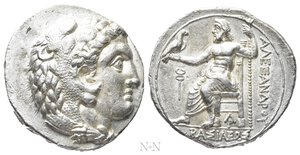
KINGS OF MACEDON. Alexander III 'the Great' (336-323 BC). Tetradrachm. Arados. Possible lifetime issue. Obv: Head of Herakles right, wearing lion skin.Rev: AΛΕΞΑΝΔΡΟΥ / BAΣIΛEΩΣ. Zeus seated left on throne, holding eagle and sceptre. Controls: Kerykeion in left field; below throne, AP monogram below struts.Price 3332. Condition: Extremely fine.Weight: 17.23 g. Diameter: 27 mm.
Lot # 130
-
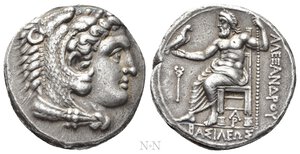
KINGS OF MACEDON. Alexander III 'the Great' (336-323 BC). Tetradrachm. Arados. Obv: Head of Herakles right, wearing lion skin.Rev: AΛΕΞΑΝΔΡΟY / ΒΑΣΙΛΕΩΣ. Zeus seated left on throne, holding eagle and sceptre. Controls: Kerykeion in left field; below throne, AP monogram below struts.Price 3332. Condition: Good very fine.Weight: 17.20 g. Diameter: 26 mm.
Lot # 129
-
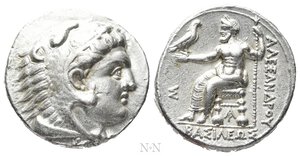
KINGS OF MACEDON. Alexander III 'the Great' (336-323 BC). Tetradrachm. Arados. Possible lifetime issue. Obv: Head of Herakles right, wearing lion skin.Rev: AΛEΞANΔPOY / ΒAΣIΛEΩΣ. Zeus seated left on throne, holding eagle and sceptre. Controls: Σ in left field, AP monogram below throne.Price 3316. Condition: Very fine.Weight: 17.13 g. Diameter: 25 mm.
Lot # 128
-
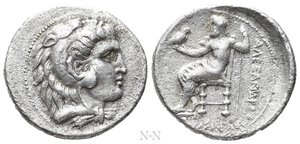
KINGS OF MACEDON. Alexander III 'the Great' (336-323 BC). Tetradrachm. Uncertain mint. Obv: Head of Herakles right, wearing lion skin.Rev: AΛΕΞΑΝΔΡΟΥ / BAΣIΛEΩΣ. Zeus seated left on throne, holding eagle and sceptre; no controls or symbols visible.Cf. Price 3303ff. Condition: Good fine.Weight: 15.84 g. Diameter: 28 mm.
Scorpion as Control
Lot # 127
-
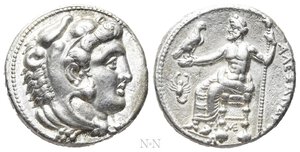
KINGS OF MACEDON. Alexander III 'the Great' (336-323 BC). Tetradrachm. Myriandros or Issos. Lifetime issue. Obv: Head of Herakles right, wearing lion skin.Rev: AΛΕΞΑΝΔΡΟΥ. Zeus seated left on throne, holding eagle and sceptre. Controls: Scorpion in left field, monogram below throne.Price 3218. Condition: Good very fine.Weight: 17.20 g. Diameter: 25 mm.
Lifetime Issue
Lot # 126
-
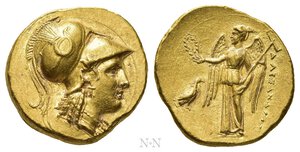
KINGS OF MACEDON. Alexander III 'the Great' (336-323 BC). GOLD Stater. Salamis. Lifetime issue. Obv: Head of Athena right, wearing Corinthian helmet decorated with coiled serpent.Rev: AΛΕΞΑΝΔΡΟΥ. Nike standing left, holding wreath and stylis. Control: To left, eagle standing right.Price 3128.Already with Philip II the occupation of the Mount Pangaion region with its rich gold mines had made possible the abundant emission of gold coins, something that until then had been throughout Greece rather rare and linked to extraordinary circumstances or moments of crisis. Alexander, who imposed a single coinage throughout his vast empire, was able to issue States and their fractions in gold, using the Attic weight as the unit of measure. On the Staters the head of the goddess Athena with Corinthian helmet was depicted on the obverse, while a winged Nike was reproduced on the reverse. On silver tetradrachms, on the other hand, the head of Herakles with lion skin was depicted on the obverse and Zeus seated on a throne on the reverse (Phidian model). Toward the end of his reign there is an assimilation of the ruler with Herakles. The practice, derived from the Eastern world of reproducing the portrait of the ruler on the coin, represents a change with Alexander's coinage. But as if the human figure did not dare to suddenly replace that of the gods, the image is clothed with religious content, through its deification or identification with the deity. Even after his death for a long time Tetradrachms with the effigy of Alexander continued to be issued by his successors. The Macedonian king had the possibility to exploit for his coinage a large amount of precious metal from the vast empire he had conquered. The extremely rich mines scattered throughout this territory also made his successors self-sufficient.. The coin from that time became a symbol of the ruler's power and absolute authority; no longer protected by the image of deities, it became an instrument of propaganda and power. Condition: Near mint state.Weight: 8.61 g. Diameter: 19 mm.
Lifetime Issue
Lot # 125
-
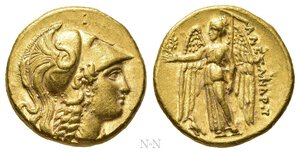
KINGS OF MACEDON. Alexander III 'the Great' (336-323 BC). GOLD Stater. Uncertain mint in western Asia Minor. Lifetime issue. Obv: Head of Athena right, wearing Corinthian helmet decorated with serpent.Rev: AΛΕΞΑΝΔΡΟΥ. Nike standing left, holding wreath and stylis Control: to lower left, eagle standing left with closed wings.Price 3125 (Salamis).Already with Philip II the occupation of the Mount Pangaion region with its rich gold mines had made possible the abundant emission of gold coins, something that until then had been throughout Greece rather rare and linked to extraordinary circumstances or moments of crisis. Alexander, who imposed a single coinage throughout his vast empire, was able to issue States and their fractions in gold, using the Attic weight as the unit of measure. On the Staters the head of the goddess Athena with Corinthian helmet was depicted on the obverse, while a winged Nike was reproduced on the reverse. On silver tetradrachms, on the other hand, the head of Herakles with lion skin was depicted on the obverse and Zeus seated on a throne on the reverse (Phidian model). Toward the end of his reign there is an assimilation of the ruler with Herakles. The practice, derived from the Eastern world of reproducing the portrait of the ruler on the coin, represents a change with Alexander's coinage. But as if the human figure did not dare to suddenly replace that of the gods, the image is clothed with religious content, through its deification or identification with the deity. Even after his death for a long time Tetradrachms with the effigy of Alexander continued to be issued by his successors. The Macedonian king had the possibility to exploit for his coinage a large amount of precious metal from the vast empire he had conquered. The extremely rich mines scattered throughout this territory also made his successors self-sufficient.. The coin from that time became a symbol of the ruler's power and absolute authority; no longer protected by the image of deities, it became an instrument of propaganda and power. Condition: Extremely fine.Weight: 8.63 g. Diameter: 18 mm.
Mint State
Lot # 124
-
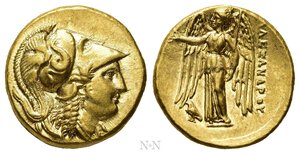
KINGS OF MACEDON. Alexander III 'the Great' (336-323 BC). GOLD Stater. Uncertain mint in western Asia Minor. Lifetime issue. Obv: Head of Athena right, wearing Corinthian helmet decorated with serpent.Rev: AΛΕΞΑΝΔΡΟΥ. Nike standing left, holding wreath and stylis Control: to lower left, eagle standing left with closed wings.Price 3125 (Salamis).Already with Philip II the occupation of the Mount Pangaion region with its rich gold mines had made possible the abundant emission of gold coins, something that until then had been throughout Greece rather rare and linked to extraordinary circumstances or moments of crisis. Alexander, who imposed a single coinage throughout his vast empire, was able to issue States and their fractions in gold, using the Attic weight as the unit of measure. On the Staters the head of the goddess Athena with Corinthian helmet was depicted on the obverse, while a winged Nike was reproduced on the reverse. On silver tetradrachms, on the other hand, the head of Herakles with lion skin was depicted on the obverse and Zeus seated on a throne on the reverse (Phidian model). Toward the end of his reign there is an assimilation of the ruler with Herakles. The practice, derived from the Eastern world of reproducing the portrait of the ruler on the coin, represents a change with Alexander's coinage. But as if the human figure did not dare to suddenly replace that of the gods, the image is clothed with religious content, through its deification or identification with the deity. Even after his death for a long time Tetradrachms with the effigy of Alexander continued to be issued by his successors. The Macedonian king had the possibility to exploit for his coinage a large amount of precious metal from the vast empire he had conquered. The extremely rich mines scattered throughout this territory also made his successors self-sufficient.. The coin from that time became a symbol of the ruler's power and absolute authority; no longer protected by the image of deities, it became an instrument of propaganda and power. Condition: Mint State.Weight: 8.60 g. Diameter: 19 mm.
Lot # 123
-
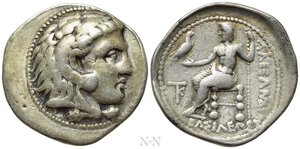
KINGS OF MACEDON. Alexander III 'the Great' (336-323 BC). Tetradrachm. Kition. Possible lifetime issue. Obv: Head of Herakles right, wearing lion skin.Rev: AΛΕΞΑΝΔΡΟΥ / BAΣIΛEΩΣ. Zeus seated left on throne, holding eagle and sceptre. Control: KT monogram in left field.Price 3108. Condition: Good fine.Weight: 16.99 g. Diameter: 31 mm.
Lot # 122
-
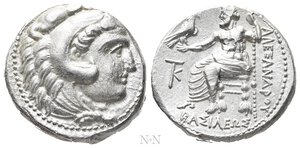
KINGS OF MACEDON. Alexander III 'the Great' (336-323 BC). Tetradrachm. Kition. Possible lifetime issue. Obv: Head of Herakles right, wearing lion skin.Rev: AΛΕΞΑΝΔΡΟΥ / BAΣIΛEΩΣ. Zeus seated left, holding sceptre and eagle. Control: KT monogram in left field.Price 3107. Condition: Good very fine.Weight: 17.20 g. Diameter: 25 mm.
Lot # 121
-
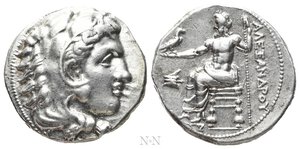
KINGS OF MACEDON. Alexander III 'the Great' (336-323 BC). Tetradrachm. Soloi (Cyprus). Obv: Head of Herakles right, wearing lion skin.Rev: AΛΕΞΑΝΔΡΟΥ. Zeus seated left on throne, holding eagle and sceptre. Controls: Prow in left field.Price 3097 (Amathos). Condition: Good very fine.Weight: 17.27 g. Diameter: 26 mm.
Lot # 120
-
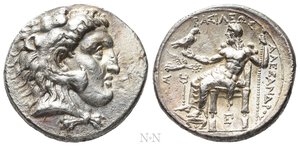
KINGS OF MACEDON. Alexander III 'the Great' (336-323 BC). Tetradrachm. Tarsos. Obv: Head of Herakles right, wearing lion skin.Rev: BAΣIΛEΩΣ AΛΕΞΑΝΔΡΟΥ. Zeus seated left on throne, holding eagle and sceptre. Controls: in left field, crowning Nike flying right above Σ and kerykeion; monogram below throne.Price 3053. Condition: Good very fine, with luster.Weight: 17.21 g. Diameter: 2927 mm.
Lot # 119
-
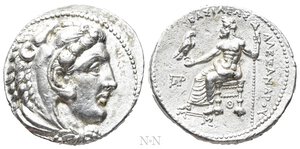
KINGS OF MACEDON. Alexander III 'the Great' (336-323 BC). Tetradrachm. Tarsos. Obv: Head of Herakles right, wearing lion skin.Rev: ΒΑΣΙΛΕΩΣ AΛΕΞΑΝΔΡΟΥ. Zeus seated left on throne, holding eagle and sceptre. Controls: Monogram in left field, Θ below throne.Price 3036. Condition: Very fine.Weight: 17.13 g. Diameter: 29 mm.
Lot # 118
-
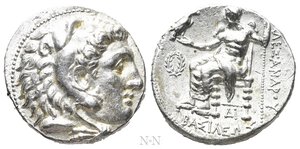
KINGS OF MACEDON. Alexander III 'the Great' (336-323 BC). Tetradrachm. Uncertain mint in Cilicia. Obv: Head of Herakles right, wearing lion skin.Rev: AΛEΞANΔPOY / ΒAΣIΛEΩΣ. Zeus seated left on throne, holding eagle and sceptre. Controls: Wreath in left field, ΔΙ below throne.Price 2949 (Side?). Condition: Good very fine.Weight: 17.22 g. Diameter: 26 mm.
Lot # 117
-
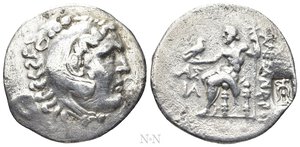
KINGS OF MACEDON. Alexander III 'the Great' (336-323 BC). Tetradrachm. Aspendos. Dated CY 11 (202/1 BC). Obv: Head of Herakles right, wearing lion skin.Rev: AΛEΞANΔPOY. Zeus seated left on throne, holding eagle and sceptre. Controls: In left field, ΑΣ above IA (date); c/m: anchor within rectangular incuse.Price 2891. Condition: Good fine.Weight: 15.83 g. Diameter: 33 mm.
Mint State - Artistic Athena
Lot # 116
-
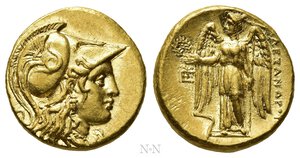
KINGS OF MACEDON. Alexander III 'the Great' (336-323 BC). GOLD Stater. Sardeis. Obv: Head of Athena right, wearing helmet decorated with serpent.Rev: AΛΕΞΑΝΔΡΟΥ. Nike standing left, holding wreath and stylis. Controls: In left field, monogram; akrostolion below left wing.Price 2592.Already with Philip II the occupation of the Mount Pangaion region with its rich gold mines had made possible the abundant emission of gold coins, something that until then had been throughout Greece rather rare and linked to extraordinary circumstances or moments of crisis. Alexander, who imposed a single coinage throughout his vast empire, was able to issue States and their fractions in gold, using the Attic weight as the unit of measure. On the Staters the head of the goddess Athena with Corinthian helmet was depicted on the obverse, while a winged Nike was reproduced on the reverse. On silver tetradrachms, on the other hand, the head of Herakles with lion skin was depicted on the obverse and Zeus seated on a throne on the reverse (Phidian model). Toward the end of his reign there is an assimilation of the ruler with Herakles. The practice, derived from the Eastern world of reproducing the portrait of the ruler on the coin, represents a change with Alexander's coinage. But as if the human figure did not dare to suddenly replace that of the gods, the image is clothed with religious content, through its deification or identification with the deity. Even after his death for a long time Tetradrachms with the effigy of Alexander continued to be issued by his successors. The Macedonian king had the possibility to exploit for his coinage a large amount of precious metal from the vast empire he had conquered. The extremely rich mines scattered throughout this territory also made his successors self-sufficient.. The coin from that time became a symbol of the ruler's power and absolute authority; no longer protected by the image of deities, it became an instrument of propaganda and power. Condition: Mint State.Weight: 8.58 g. Diameter: 18 mm.
Mint State
Lot # 115
-
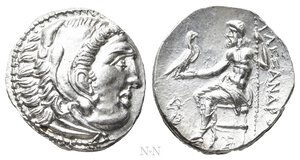
KINGS OF MACEDON. Alexander III 'the Great' (336-323 BC). Drachm. Teos. Obv: Head of Herakles right, wearing lion skin.Rev: AΛEΞANΔPOY. Zeus seated left, holding eagle and sceptre. Controls: monogram in field left and below throne.Price 2295. Condition: Mint State.Weight: 4.23 g. Diameter: 18 mm.
Lot # 114
-
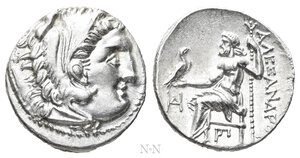
KINGS OF MACEDON. Alexander III 'the Great' (336-323 BC). Drachm. Teos. Obv: Head of Herakles right, wearing lion skin.Rev: AΛEΞANΔPOY. Zeus seated left, holding eagle and sceptre. Controls: monogram in field left and below throne.Price 2290. Condition: Near mint state.Weight: 4.42 g. Diameter: 18 mm.
Lot # 113
-
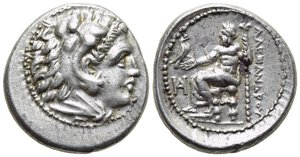
KINGS OF MACEDON. Alexander III 'the Great' (336-323 BC). Drachm. Miletos. Obv: Head of Herakles right, wearing lion skin.Rev: ΑΛΕΞΑΝΔΡΟΥ. Zeus seated left on throne, holding eagle and sceptre. Control: Monogram in left field.Price 2090. Condition: Good very fine.Weight: 4.30 g. Diameter: 16 mm.
Lot # 112
-
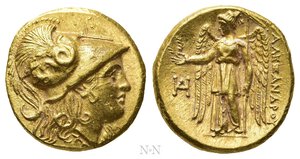
KINGS OF MACEDON. Alexander III 'the Great' (336-323 BC). GOLD Stater. Miletos. Lifetime issue. Obv: Head of Athena right, wearing Corinthian helmet decorated with serpent; thunderbolt below neck.Rev: AΛΕΞΑΝΔΡΟΥ. Nike standing left, with laurel wreath in her right hand and stylis in her left. Control: Monogram in left field.Price 2077.Already with Philip II the occupation of the Mount Pangaion region with its rich gold mines had made possible the abundant emission of gold coins, something that until then had been throughout Greece rather rare and linked to extraordinary circumstances or moments of crisis. Alexander, who imposed a single coinage throughout his vast empire, was able to issue States and their fractions in gold, using the Attic weight as the unit of measure. On the Staters the head of the goddess Athena with Corinthian helmet was depicted on the obverse, while a winged Nike was reproduced on the reverse. On silver tetradrachms, on the other hand, the head of Herakles with lion skin was depicted on the obverse and Zeus seated on a throne on the reverse (Phidian model). Toward the end of his reign there is an assimilation of the ruler with Herakles. The practice, derived from the Eastern world of reproducing the portrait of the ruler on the coin, represents a change with Alexander's coinage. But as if the human figure did not dare to suddenly replace that of the gods, the image is clothed with religious content, through its deification or identification with the deity. Even after his death for a long time Tetradrachms with the effigy of Alexander continued to be issued by his successors. The Macedonian king had the possibility to exploit for his coinage a large amount of precious metal from the vast empire he had conquered. The extremely rich mines scattered throughout this territory also made his successors self-sufficient.. The coin from that time became a symbol of the ruler's power and absolute authority; no longer protected by the image of deities, it became an instrument of propaganda and power. Condition: Extremely fine; luster in field.Weight: 8.64 g. Diameter: 17 mm.
Lot # 111
-
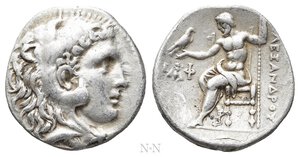
KINGS OF MACEDON. Alexander III 'the Great' (336-323 BC). Drachm. Ephesos. Obv: Head of Herakles right, wearing lion skin.Rev: AΛΕΞΑΝΔΡΟΥ. Zeus seated left on throne, holding eagle and sceptre. Controls: Bee between E-Φ.Price 1877. Condition: Near very fine.Weight: 4.16 g. Diameter: 19 mm.
Lot # 110
-
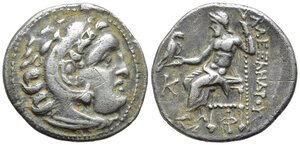
KINGS OF MACEDON. Alexander III 'the Great' (336-323 BC). Drachm. Kolophon. Obv: Head of Herakles right, wearing lion skin.Rev: AΛΕΞΑΝΔΡΟΥ. Zeus seated left on throne, holding eagle and sceptre. Controls: Monogram in left field; below throne, Φ below strut.Price 1823. Condition: Near very fine.Weight: 4.22 g. Diameter: 19 mm.
Lot # 109
-
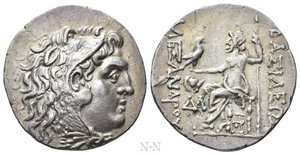
KINGS OF MACEDON. Alexander III 'the Great' (336-323 BC). Tetradrachm. Mesambria. Obv: Head of Herakles right, wearing lion skin.Rev: ΒΑΣΙΛΕΩΣ / AΛΕΞΑΝΔΡOY. Zeus seated left on throne, holding eagle and sceptre. Controls: In left field, crested helmet right above ΔA; monogram below throne.Price 1062. Condition: Good very fine.Weight: 16.35 g. Diameter: 30 mm.
Lot # 108
-
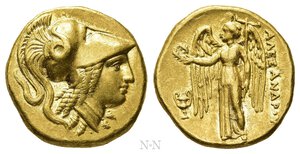
KINGS OF MACEDON. Alexander III 'the Great' (336-323 BC). GOLD Stater. Amphipolis. Possibly lifetime issue. Obv: Head of Athena right, wearing Corinthian helmet decorated with serpent.Rev: AΛΕΞΑΝΔΡΟΥ. Nike standing left, holding wreath and stylis. Control: Kantharos in left field.Price 168.Already with Philip II the occupation of the Mount Pangaion region with its rich gold mines had made possible the abundant emission of gold coins, something that until then had been throughout Greece rather rare and linked to extraordinary circumstances or moments of crisis. Alexander, who imposed a single coinage throughout his vast empire, was able to issue States and their fractions in gold, using the Attic weight as the unit of measure. On the Staters the head of the goddess Athena with Corinthian helmet was depicted on the obverse, while a winged Nike was reproduced on the reverse. On silver tetradrachms, on the other hand, the head of Herakles with lion skin was depicted on the obverse and Zeus seated on a throne on the reverse (Phidian model). Toward the end of his reign there is an assimilation of the ruler with Herakles. The practice, derived from the Eastern world of reproducing the portrait of the ruler on the coin, represents a change with Alexander's coinage. But as if the human figure did not dare to suddenly replace that of the gods, the image is clothed with religious content, through its deification or identification with the deity. Even after his death for a long time Tetradrachms with the effigy of Alexander continued to be issued by his successors. The Macedonian king had the possibility to exploit for his coinage a large amount of precious metal from the vast empire he had conquered. The extremely rich mines scattered throughout this territory also made his successors self-sufficient.. The coin from that time became a symbol of the ruler's power and absolute authority; no longer protected by the image of deities, it became an instrument of propaganda and power. Condition: Near extremely fine.Weight: 8.59 g. Diameter: 18 mm.
Near Mint State
Lot # 107
-
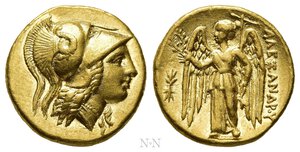
KINGS OF MACEDON. Alexander III 'the Great' (336-323 BC). GOLD Stater. 'Amphipolis'. Obv: Head of Athena right, wearing Corinthian helmet decorated with coiled serpent.Rev: AΛΕΞΑΝΔΡΟΥ. Nike standing left, holding wreath and stylis. Control: thunderbolt in left field.Price 164.Already with Philip II the occupation of the Mount Pangaion region with its rich gold mines had made possible the abundant emission of gold coins, something that until then had been throughout Greece rather rare and linked to extraordinary circumstances or moments of crisis. Alexander, who imposed a single coinage throughout his vast empire, was able to issue States and their fractions in gold, using the Attic weight as the unit of measure. On the Staters the head of the goddess Athena with Corinthian helmet was depicted on the obverse, while a winged Nike was reproduced on the reverse. On silver tetradrachms, on the other hand, the head of Herakles with lion skin was depicted on the obverse and Zeus seated on a throne on the reverse (Phidian model). Toward the end of his reign there is an assimilation of the ruler with Herakles. The practice, derived from the Eastern world of reproducing the portrait of the ruler on the coin, represents a change with Alexander's coinage. But as if the human figure did not dare to suddenly replace that of the gods, the image is clothed with religious content, through its deification or identification with the deity. Even after his death for a long time Tetradrachms with the effigy of Alexander continued to be issued by his successors. The Macedonian king had the possibility to exploit for his coinage a large amount of precious metal from the vast empire he had conquered. The extremely rich mines scattered throughout this territory also made his successors self-sufficient.. The coin from that time became a symbol of the ruler's power and absolute authority; no longer protected by the image of deities, it became an instrument of propaganda and power. Condition: Near mint state.Weight: 8.61 g. Diameter: 18 mm.
Lifetime Issue
Lot # 106
-
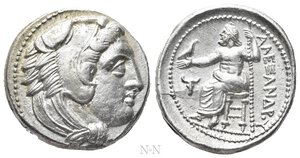
KINGS OF MACEDON. Alexander III 'the Great' (336-323 BC). Tetradrachm. Amphipolis. Lifetime issue. Obv: Head of Herakles right, wearing lion skin.Rev: AΛEΞANΔPOY. Zeus seated left on throne, holding eagle and sceptre. Control: Boukranion in left field.Price 93. Condition: Very fine.Weight: 17.18 g. Diameter: 27 mm.
Lot # 105
-
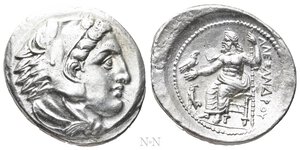
KINGS OF MACEDON. Alexander III 'the Great' (336-323 BC). Tetradrachm. Amphipolis. Lifetime issue. Obv: Head of Herakles right, wearing lion skin.Rev: AΛΕΞΑΝΔΡΟΥ. Zeus seated left on throne, holding sceptre and eagle. Control: In left field, roster standing left.Price 79. Condition: Near extremely fine; luster in field.Weight: 17.17 g. Diameter: 29 mm.
Lot # 104
-
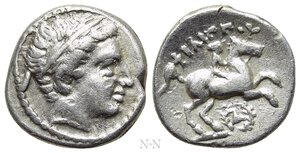
KINGS OF MACEDON. Philip II (359-336 BC). 1/5 Tetradrachm. Amphipolis. Obv: Diademed head of Apollo right.Rev: ΦΙΛΙΠΠΟΥ. Youth on horse rearing right; below, A within wreath.Le Rider pl. 45, 30. Condition: Very fine.Weight: 2.60 g. Diameter: 14 mm.
Lot # 103
-
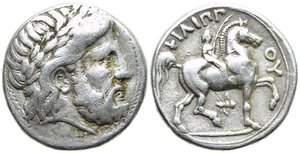
KINGS OF MACEDON. Philip II (359-336 BC). Tetradrachm. Pella. Obv: Laureate head of Zeus right.Rev: ΦΙΛΙΠΠOΥ. Nude youth on horseback right, holding palm in right hand and reins in left. Control: below, bee flying right.Le Rider 508 (D270/R419). Condition: Very fine.Weight: 14.23 g. Diameter: 25 mm.
Lot # 102
-
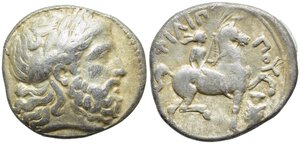
KINGS OF MACEDON. Philip II (359-336 BC). Tetradrachm. Amphipolis. Obv: Laureate head of Zeus right.Rev: ΦΙΛΙΠΠΟΥ. Youth, holding palm frond, riding horse right. Control: Janiform head below raised foreleg.Le Rider 263ff.; SNG ANS 510-20. Condition: Fine.Weight: 14.10 g. Diameter: 25 mm.
Lot # 101
-
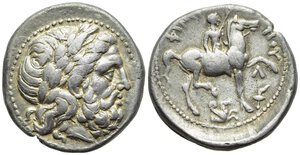
KINGS OF MACEDON. Philip II (359-336 BC). Tetradrachm. Amphipolis. Obv: Laureate head of Zeus right.Rev: ΦΙΛΙΠΠΟΥ. Youth riding horse right, holding palm frond. Controls: below, forepart of Pegasos right; below raised foreleg, Λ above torch.Le Rider pl. 47, 15; SNG ANS 778. Condition: Near very fine.Weight: 13.75 g. Diameter: 25 mm.
Lot # 100
-
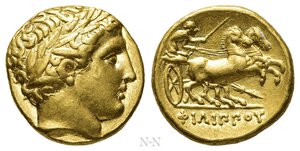
KINGS OF MACEDON. Philip II (359-336 BC). GOLD Stater. Pella. Obv: Laureate head of Apollo right.Rev: ΦΙΛΙΠΠΟΥ. Charioteer driving biga right. Control: Thunderbolt below.Le Rider 60-132; SNG ANS 130-7; HGC 3.1, 847.In the Classical period throughout Greece silver coinage predominated, while gold was minted by a few cities. In Asia Minor electrum coins were still struck in three mints (Kyzikos, Mytilene and Phokaia) until the Athenian hegemony that followed the victory over the Persians. In 405 BC the issue of Lampsakos gold staters based on the Persian weight system began. Athens produced the first and only precious metal issues toward the end of the Peloponnesian War, in 407-6 BC, at a time of severe crisis when silver mining in Laurion began to fail and it was forced to melt down the Parthenon's gold statues. Aside from these cases, the first important and massive gold coinage in the Greek context was that of Philip II of Macedon. He minted abundant series of coins in several mints. Having conquered the city of Krenides, where the Thasians had already exploited gold mines, Philip renamed the city Philippi and started the production of philippéioi, gold staters weighing two Attic drachms. Apollo's youthful head appears on the obverse, a galloping chariot on the reverse, types glorifying the Macedonian ruler who had triumphed at the Olympian Games in 356 BC. The series also includes fractions. Condition: Good very fine; some luster in field.Weight: 8.60 g. Diameter: 17 mm.
Lot # 99
-
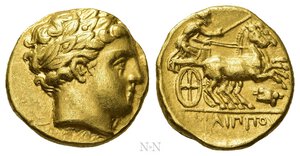
KINGS OF MACEDON. Philip II (359-336 BC). GOLD Stater. Amphipolis. Obv: Laureate head of Apollo right.Rev: ΦΙΛΙΠΠΟΥ. Charioteer driving biga right. Control: astragalos below.Le Rider 28 (D12/R22); SNG ANS 245 (same dies).RareEx Roma Numismatics E-28 (2016), lot 66.
In the Classical period throughout Greece silver coinage predominated, while gold was minted by a few cities. In Asia Minor electrum coins were still struck in three mints (Kyzikos, Mytilene and Phokaia) until the Athenian hegemony that followed the victory over the Persians. In 405 BC the issue of Lampsakos gold staters based on the Persian weight system began. Athens produced the first and only precious metal issues toward the end of the Peloponnesian War, in 407-6 BC, at a time of severe crisis when silver mining in Laurion began to fail and it was forced to melt down the Parthenon's gold statues. Aside from these cases, the first important and massive gold coinage in the Greek context was that of Philip II of Macedon. He minted abundant series of coins in several mints. Having conquered the city of Krenides, where the Thasians had already exploited gold mines, Philip renamed the city Philippi and started the production of philippéioi, gold staters weighing two Attic drachms. Apollo's youthful head appears on the obverse, a galloping chariot on the reverse, types glorifying the Macedonian ruler who had triumphed at the Olympian Games in 356 BC. The series also includes fractions. Condition: Very fine.Weight: 8.58 g. Diameter: 17 mm.Rare
Lot # 98
-
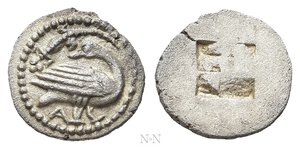
MACEDON. Eion. Trihemiobol (Circa 460-400 BC). Obv: Goose standing right, head left; above, lizard left; A to lower left.Rev: Quadripartite incuse square.SNG ANS 285-6; HGC 3.1, 521. Condition: Extremely fine.Weight: 0.89 g. Diameter: 12 mm.
Lot # 97
-
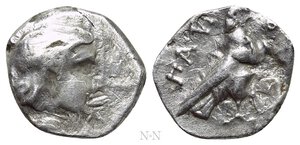
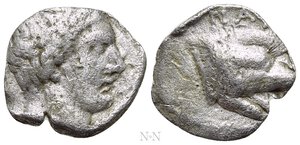
KINGS OF PAEONIA. Patraos (Circa 335-315 BC). Tetrobol. Obv: Laureate head of Apollo right.Rev: ΠΑΤΡΑΟΥ. Eagle standing right; symbol(?) to right.Cf. HGC 3.1, 150.Very rare Condition: Good fine.Weight: 2.24 g. Diameter: 13 mm.Very rare
Lot # 96
-
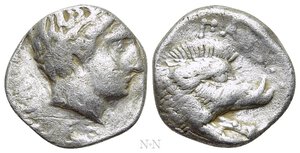
KINGS OF PAEONIA. Patraos (Circa 335-315 BC). Drachm. Astibos or Damastion. Obv: Diademed head of Apollo right.Rev: ΠΑΤΡΑΟΥ. Forepart of boar right.HGC 3.1, 149. Condition: Good fine.Weight: 2.37 g. Diameter: 16 mm.
Lot # 95
-
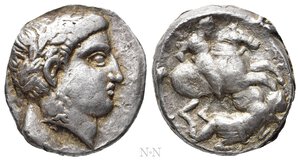
KINGS OF PAEONIA. Patraos (Circa 335-315 BC). Drachm. Astibos or Damastion. Obv: Diademed head of Apollo right.Rev: ΠATPAOY. Forepart of boar right.Peykov E2270; HGC 3.1, 149.Rare Condition: Good fine.Weight: 3.10 g. Diameter: 15 mm.Rare
Ex Stacks 1997
Lot # 94
-
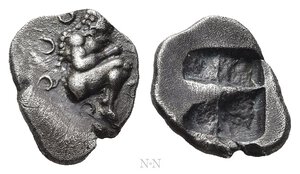
KINGS OF PAEONIA. Patraos (Circa 335-315 BC). Tetradrachm. Astibos or Damastion mint. Obv: Laureate head of Apollo right.Rev: ΠΑΤΡΑΟΥ. Warrior on horse rearing right, thrusting spear at enemy below who defends with shield.Paeonian Hoard 454; Peykov E2160; HGC 3.1, 148.Ex Stack's 5.11.97 Condition: Very fine.Weight: 12.67 g. Diameter: 23 mm.
Lot # 93
-
THRACO-MACEDONIAN REGION. Siris or Berge. 1/8 Stater – Trihemiobol (Circa 525-480 BC). Obv: Satyr crouching right; annulets around.Rev: Quadripartite incuse square.Psoma, Lete Reconsidered, 9 var. (pellets instead of annulets); SNG ANS 974-6 var. (same); Nomos Obolos 35, lot 1169.Rare Condition: Near extremely fine.Weight: 0.97 g. Diameter: 11 mm.Rare
Lot # 92
-
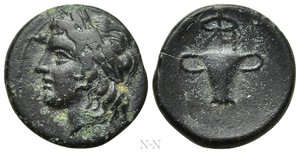
KINGS OF THRACE. Odrysian regal coinage (4th-3rd centuries BC). Ae. Obv: Laureate head of Apollo left.Rev: Two-handled cup; monogram above.Topalov 111. Condition: Very fine.Weight: 1.30 g. Diameter: 12 mm.
Lot # 91
-
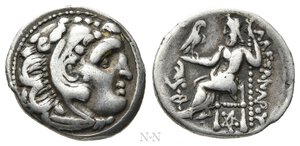
KINGS OF THRACE (Macedonian). Lysimachos (305-281 BC). Drachm. Kolophon. In the name of Alexander III of Macedon. Obv: Head of Herakles right, wearing lion skin.Rev: AΛEΞANΔPOY. Zeus seated left with eagle and sceptre Controls: forepart of lion above Φ in left field, pentagram below throne.Thompson 120; Price 1840; HGC 3, 1751d. Condition: Fine.Weight: 4.12 g. Diameter: 18 mm.
Results from 6201 to 6250 of 6251