Greek Coins
Results from 10451 to 10500 of 10501
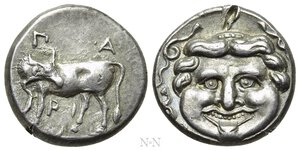
Lot # 172
-
MYSIA. Parion. Hemidrachm (4th century BC). Obv: ΠΑ / ΡΙ. Bull, with head right, standing left on ground line; branch(?) below.Rev: Facing gorgoneion.SNG BN 1364. Condition: Good very fine.Weight: 2.40 g. Diameter: 13 mm.
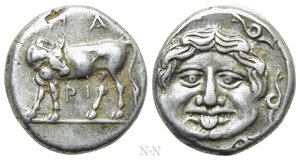
Lot # 171
-
MYSIA. Parion. Hemidrachm (4th century BC). Obv: ΠΑ / ΡΙ. Bull, with head right, standing left on ground line.Rev: Facing gorgoneion within incuse circle.SNG BN 1356-7. Condition: Good very fine.Weight: 2.45 g. Diameter: 13 mm.
Fantastic Hekte
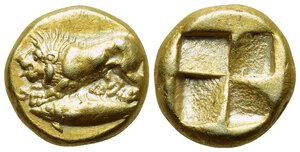
Lot # 170
-
MYSIA. Kyzikos. EL Hekte (Circa 550-470 BC). Obv: Lion at bay left on tunny left.Rev: Quadripartite incuse square.Cf. von Fritze 84 (Stater); cf. SNG BN 182 (same); Rosen 461. Condition: Extremely fine.Weight: 2.65 g. Diameter: 11 mm.
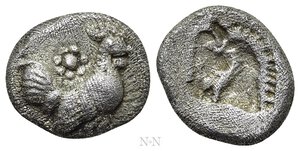
Lot # 169
-
TROAS. Dardanos. Trihemiobol (5th century BC). Obv: Cock standing right; rosette or star above.Rev: Incuse horse head left.Unpublished in the standard references; CNG E-227, lot 155.Extremely rare Condition: Very fine.Weight: 0.97 g. Diameter: 10 mm.
Ex Auctiones 1978
Lot # 168
-
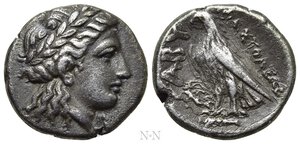
TROAS. Abydos. Hemidrachm or Half Siglos (Circa 350-325 BC). Ephaistoleos, magistrate. Obv: Laureate head of Apollo right.Rev: ABY / ΗΦΑΙΣΤΟΛΕΩΣ. Eagle standing left; to left, Nike flying left with wreath.SNG Copenhagen 9; BMC 17.Ex Auctiones AG 8 (1978), lot 231 Condition: Very fine.Weight: 2.40 g. Diameter: 14 mm.
Lot # 167
-
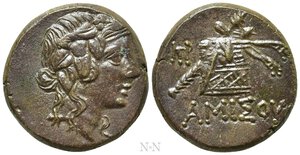
PONTOS. Amisos. Time of Mithradates VI Eupator (Circa 105-90 or 90-85 BC). Ae. Obv: Head of Dionysos right, wearing ivy wreath.Rev: AMIΣOY. Thyrsos leaning against cista mystica and draped with panther skin; monogram to left.SNG BM Black Sea 1202-4; HGC 7, 243. Condition: Extremely fine.Weight: 8.32 g. Diameter: 21 mm.
Lot # 166
-
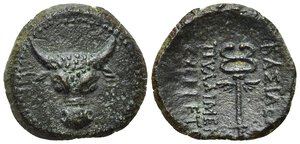
KINGS OF PAPHLAGONIA. Pylaimenes II/III Euergetes (Circa 133-103 BC). Ae. Obv: Head of bull facing.Rev: ΒΑΣΙΛΕΩΣ / ΠΥΛΑΙΜΕΝΟΥ ΕΥΕΡΓΕΤΟΥ. Winged kerykeion.SNG BM Black Sea 1555-6; HGC 7, 441. Condition: Extremely fine.Weight: 3.07 g. Diameter: 17 mm.
Lot # 165
-
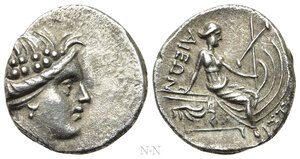
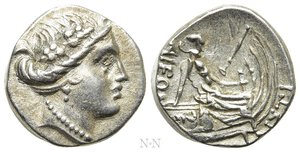
EUBOIA. Histiaia. Tetrobol (3rd-2nd centuries BC). Obv: Wreathed head of the nymph Histiaia right.Rev: IΣTIAIEΩN. Nymph seated right on stern of galley; wing on prow.BCD Euboia 387ff.; HGC 4, 1524. Condition: Extremely fine.Weight: 1.53 g. Diameter: 13 mm.
Lot # 164
-
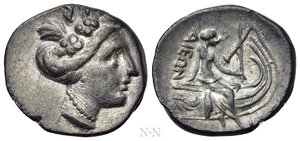
EUBOIA. Histiaia. Tetrobol (3rd-2nd centuries BC). Obv: Wreathed head of the nymph Histiaia right.Rev: IΣTIAIEΩN. Nymph seated right on stern of galley; wing on prow.BCD Euboia 387ff.; HGC 4, 1524. Condition: Good very fine.Weight: 1.54 g. Diameter: 13 mm.
Lot # 163
-
EUBOIA. Histiaia. Tetrobol (3rd-2nd centuries BC). Obv: Wreathed head of the nymph Histiaia right.Rev: IΣTIAIEΩN. Nymph seated right on stern of galley; wing on prow.BCD Euboia 387ff.; HGC 4, 1524. Condition: Good very fine.Weight: 1.88 g. Diameter: 15 mm.
Lot # 162
-
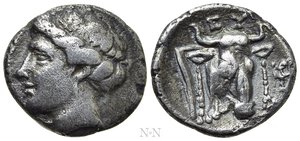
EUBOIA. Euboian League. Drachm (304-290 BC). Obv: Head of the nymph Euboia left.Rev: EY. Filleted head and neck of cow facing slightly right; kantharos to right.BCD Euboia 22; HGC 4, 1421. Condition: Very fine.Weight: 3.36 g. Diameter: 17 mm.
Lot # 161
-
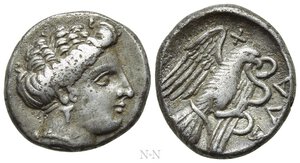
EUBOIA. Chalkis. Drachm (Circa 338-308 BC). Obv: Head of the nymph Chalkis right.Rev: XAΛ. Eagle flying right, carrying serpent in talons; kantharos below.BCD Euboia 127; HGC 4, 1463. Condition: Very fine.Weight: 3.69 g. Diameter: 16 mm.
Lot # 160
-
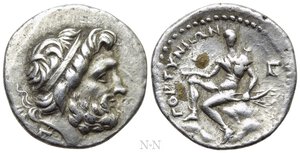
CRETE. Gortyna. Drachm (Circa 2nd-1st century BC). Obv: Diademed head of Minos right; Γ below.Rev: ΓOPTINIΩN. Apollo seated left on rock, holding bow and arrow; Γ to right.Svoronos, Crète 181.Ex Münzen & Medaillen AG 321 (1971), lot 15 Condition: Good very fine.Weight: 3.40 g. Diameter: 18 mm.
Lot # 159
-
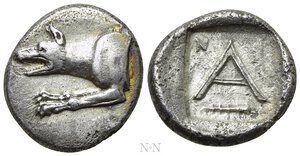
ARGOLIS. Argos. Triobol (Circa 330-270 BC). Obv: Forepart of wolf at bay left.Rev: Large A; N-I above; below, club right; all within incuse square.BCD Peloponnesos 1075.6; SNG Copenhagen 33. Condition: Good very fine.Weight: 2.62 g. Diameter: 15 mm.
Lot # 158
-
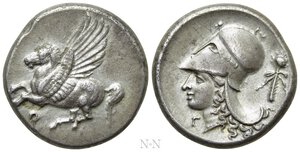
CORINTHIA. Corinth. Stater (Circa 375-300 BC). Obv: Pegasos flying left; koppa below.Rev: Head of Athena left, wearing Corinthian helmet; thyrsos behind, Γ in front.Pegasi 417; BCD Corinth 109; HGC 4, 1848."API" graffito in reverse field.
Ex Münzen & Medaillen AG 513 (1988), lot 20 Condition: Very fine.Weight: 8.50 g. Diameter: 21 mm.
Lot # 157
-
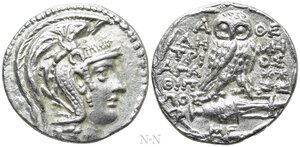
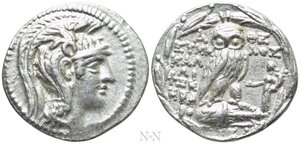
ATTICA. Athens. Tetradrachm (74/3 BC). New Style Coinage. Demetrios and Agatippos, magistrates. Obv: Head of Athena Parthenos right, wearing triple crested Attic helmet decorated with Pegasos and floral pattern.Rev: A - ΘE / ΔH - MH / TPI - OΣ / AΓA / ΘIΠ / ΠOΣ. Owl, with head facing, standing right on amphora. Controls: ΦI to left, B on amphora, ME below; to right, caps of Dioscuri; all within wreath.Thompson 890; HGC 4, 1602.Among the Greek poleis, Athens is undoubtedly the city that denotes the greatest monetary development. The earliest coinage followed the reforms attributed to Solon on the introduction of Attic weights to replace the Eginetic ones. These early coins, called "Wappenmünzen," were replaced by the "owls" at the end of the 6th century: tetradrachms marked with the head of Athena and the owl, next to which is now the ethnic of the Athenians. These types will last, with variations in style, until the end of silver production (c. mid-1st century). The most noticeable change occurs with the so-called "new style," established from the beginning of the 2nd century BC. In these issues the owl is surrounded by an olive wreath, which is why the tetradrachms are referred to in the inscriptions as "stephanephoroi" (= wreath bearers). Coins of new style also bear inscriptions with the names of magistrates. Condition: Good very fine.Weight: 16.43 g. Diameter: 30 mm.
Lot # 156
-
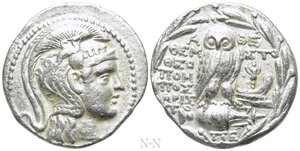
ATTICA. Athens. Tetradrachm (108/7 BC). New Style Coinage. Eumelos, Kalliphon and Hera-, magistrates. Obv: Head of Athena Parthenos right, wearing triple crested Attic helmet decorated with Pegasos and floral pattern.Rev: A - ΘE / EYMH - ΛOΣ / KAΛ / ΛI / ΦΩN / HPA. Owl, with head facing, standing right on overturned amphora; in right field, Tyche standing left, extending right hand and holding cornucopia; Z on amphora, ME below.Thompson 740c var. (control below amphora); HGC 4, 1602.Among the Greek poleis, Athens is undoubtedly the city that denotes the greatest monetary development. The earliest coinage followed the reforms attributed to Solon on the introduction of Attic weights to replace the Eginetic ones. These early coins, called "Wappenmünzen," were replaced by the "owls" at the end of the 6th century: tetradrachms marked with the head of Athena and the owl, next to which is now the ethnic of the Athenians. These types will last, with variations in style, until the end of silver production (c. mid-1st century). The most noticeable change occurs with the so-called "new style," established from the beginning of the 2nd century BC. In these issues the owl is surrounded by an olive wreath, which is why the tetradrachms are referred to in the inscriptions as "stephanephoroi" (= wreath bearers). Coins of new style also bear inscriptions with the names of magistrates. Condition: Good very fine.Weight: 16.56 g. Diameter: 32 mm.
Lot # 155
-
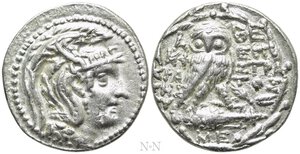
ATTICA. Athens. Tetradrachm (117/6 BC). New Style Coinage. Themisto-, Theopompos and Aristo-, magistrates. Obv: Head of Athena Parthenos right, wearing triple crested Attic helmet decorated with Pegasos and floral pattern.Rev: A - ΘEM - IΣT / ΘEO / ΠOM / ΠOΣ / APIΣ / TO. Owl, with head facing, standing right on overturned amphora; Λ on amphora, ΠE below; to right, trophy on prow right; all within wreath.Thompson 605e; HGC 4, 1602.Among the Greek poleis, Athens is undoubtedly the city that denotes the greatest monetary development. The earliest coinage followed the reforms attributed to Solon on the introduction of Attic weights to replace the Eginetic ones. These early coins, called "Wappenmünzen," were replaced by the "owls" at the end of the 6th century: tetradrachms marked with the head of Athena and the owl, next to which is now the ethnic of the Athenians. These types will last, with variations in style, until the end of silver production (c. mid-1st century). The most noticeable change occurs with the so-called "new style," established from the beginning of the 2nd century BC. In these issues the owl is surrounded by an olive wreath, which is why the tetradrachms are referred to in the inscriptions as "stephanephoroi" (= wreath bearers). Coins of new style also bear inscriptions with the names of magistrates. Condition: Good very fine.Weight: 16.76 g. Diameter: 29 mm.
Lot # 154
-
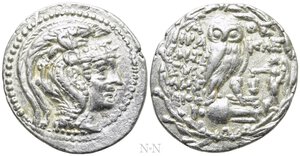
ATTICA. Athens. Tetradrachm (133/2 BC). New Style Coinage. Amphikrates, Epispatos and Eudi-(?), magistrates. Obv: Head of Athena Parthenos right, wearing triple crested Attic helmet decorated with Pegasos and floral pattern.Rev: A - ΘE / AMΦ / IKPA / THΣ - EΠI / ΣΠA / TOΣ - [...]. Owl, with head facing, standing right on amphora. Controls: uncertain control on amphora, ME below; to right, grain ears; all within wreath.Cf. Thompson 842ff.; HGC 4, 1602.Among the Greek poleis, Athens is undoubtedly the city that denotes the greatest monetary development. The earliest coinage followed the reforms attributed to Solon on the introduction of Attic weights to replace the Eginetic ones. These early coins, called "Wappenmünzen," were replaced by the "owls" at the end of the 6th century: tetradrachms marked with the head of Athena and the owl, next to which is now the ethnic of the Athenians. These types will last, with variations in style, until the end of silver production (c. mid-1st century). The most noticeable change occurs with the so-called "new style," established from the beginning of the 2nd century BC. In these issues the owl is surrounded by an olive wreath, which is why the tetradrachms are referred to in the inscriptions as "stephanephoroi" (= wreath bearers). Coins of new style also bear inscriptions with the names of magistrates. Condition: Good very fine.Weight: 16.71 g. Diameter: 31 mm.
Lot # 153
-
ATTICA. Athens. Tetradrachm (Circa 137/6 BC). Herakleides, Eukles and Diok-, magistrates. Obv: Head of Athena Parthenos right, wearing triple crested Attic helmet decorated with Pegasos and floral pattern.Rev: A - ΘE / HPA - KΛEI / ΔHΣ / EYK / ΛHΣ / ΔIOK. Owl, with head facing, standing right on amphora. Controls: uncertain control on amphora; to right, winged Tyche standing left, holding amphora; all within wreath.Cf. Thompson 775-6; HGC 4, 1602.Among the Greek poleis, Athens is undoubtedly the city that denotes the greatest monetary development. The earliest coinage followed the reforms attributed to Solon on the introduction of Attic weights to replace the Eginetic ones. These early coins, called "Wappenmünzen," were replaced by the "owls" at the end of the 6th century: tetradrachms marked with the head of Athena and the owl, next to which is now the ethnic of the Athenians. These types will last, with variations in style, until the end of silver production (c. mid-1st century). The most noticeable change occurs with the so-called "new style," established from the beginning of the 2nd century BC. In these issues the owl is surrounded by an olive wreath, which is why the tetradrachms are referred to in the inscriptions as "stephanephoroi" (= wreath bearers). Coins of new style also bear inscriptions with the names of magistrates. Condition: Good very fine.Weight: 16.67 g. Diameter: 32 mm.
Lot # 152
-
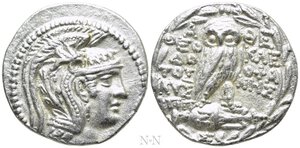
ATTICA. Athens. Tetradrachm (138/7 BC). New Style Coinage. Theodotos, Kleophanes and Lisipp-, magistrates. Obv: Head of Athena Parthenos right, wearing triple crested Attic helmet decorated with Pegasos and floral pattern.Rev: A - ΘE / ΘEO / ΔO / TOΣ - KΛE / OΦA / NHΣ / ΛYΣ / IΠΠ. Owl standing right on amphora, head facing. Controls: Z on amphora, ΣO below; all within wreath.Thompson 771c; HGC 4, 1602.Among the Greek poleis, Athens is undoubtedly the city that denotes the greatest monetary development. The earliest coinage followed the reforms attributed to Solon on the introduction of Attic weights to replace the Eginetic ones. These early coins, called "Wappenmünzen," were replaced by the "owls" at the end of the 6th century: tetradrachms marked with the head of Athena and the owl, next to which is now the ethnic of the Athenians. These types will last, with variations in style, until the end of silver production (c. mid-1st century). The most noticeable change occurs with the so-called "new style," established from the beginning of the 2nd century BC. In these issues the owl is surrounded by an olive wreath, which is why the tetradrachms are referred to in the inscriptions as "stephanephoroi" (= wreath bearers). Coins of new style also bear inscriptions with the names of magistrates. Condition: Good very fine.Weight: 16.80 g. Diameter: 31 mm.
Lot # 151
-
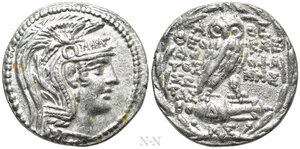
ATTICA. Athens. Tetradrachm (138/7 BC). New Style Coinage. Theodotos, Kleophanes and Sotas, magistrates. Obv: Head of Athena Parthenos right, wearing triple crested Attic helmet decorated with Pegasos and floral pattern.Rev: A - ΘE / ΘEO / ΔO / TOΣ - KΛE / OΦA / NHΣ / ΣΩ / TAΣ. Owl standing right on amphora, head facing. Controls: Δ on amphora, ME below; all within wreath.Thompson 768; HGC 4, 1602.Among the Greek poleis, Athens is undoubtedly the city that denotes the greatest monetary development. The earliest coinage followed the reforms attributed to Solon on the introduction of Attic weights to replace the Eginetic ones. These early coins, called "Wappenmünzen," were replaced by the "owls" at the end of the 6th century: tetradrachms marked with the head of Athena and the owl, next to which is now the ethnic of the Athenians. These types will last, with variations in style, until the end of silver production (c. mid-1st century). The most noticeable change occurs with the so-called "new style," established from the beginning of the 2nd century BC. In these issues the owl is surrounded by an olive wreath, which is why the tetradrachms are referred to in the inscriptions as "stephanephoroi" (= wreath bearers). Coins of new style also bear inscriptions with the names of magistrates. Condition: Good very fine.Weight: 16.69 g. Diameter: 31 mm.
Lot # 150
-
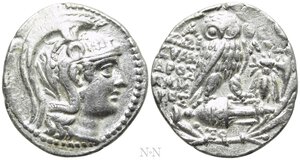
ATTICA. Athens. Tetradrachm (Circa 142/1 BC). Zoilos, Euandros and Lamios, magistrates. Obv: Head of Athena Parthenos right, wearing triple crested Attic helmet decorated with Pegasos and floral pattern.Rev: A - ΘE / ZΩI - ΛOΣ / EYAN / ΔPOΣ / ΛAM / IOΣ. Owl, with head facing, standing right on amphora. Controls: K on amphora, ΣO below; to right, bee; all within wreath.Thompson 717d var. (control on amphora); HGC 4, 1602.Among the Greek poleis, Athens is undoubtedly the city that denotes the greatest monetary development. The earliest coinage followed the reforms attributed to Solon on the introduction of Attic weights to replace the Eginetic ones. These early coins, called "Wappenmünzen," were replaced by the "owls" at the end of the 6th century: tetradrachms marked with the head of Athena and the owl, next to which is now the ethnic of the Athenians. These types will last, with variations in style, until the end of silver production (c. mid-1st century). The most noticeable change occurs with the so-called "new style," established from the beginning of the 2nd century BC. In these issues the owl is surrounded by an olive wreath, which is why the tetradrachms are referred to in the inscriptions as "stephanephoroi" (= wreath bearers). Coins of new style also bear inscriptions with the names of magistrates. Condition: Good very fine.Weight: 16.79 g. Diameter: 31 mm.
Lot # 149
-
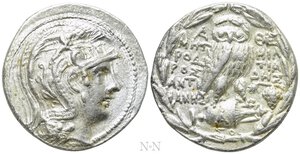
ATTICA. Athens. Tetradrachm (147/6 BC). New Style Coinage. Metrodoros, Miltiades and Antiphanes, magistrates. Obv: Head of Athena Parthenos right, wearing triple crested Attic helmet decorated with Pegasos and floral pattern.Rev: A - ΘE / MHT / POΔΩ / POΣ - MIΛ / TIA / ΔHΣ - ANTI / ΦANHΣ. Owl standing right on amphora, head facing. Controls: A on amphora, ΣO below; grapes to right; all within wreath.Thompson 630a-b; HGC 4, 1602.Among the Greek poleis, Athens is undoubtedly the city that denotes the greatest monetary development. The earliest coinage followed the reforms attributed to Solon on the introduction of Attic weights to replace the Eginetic ones. These early coins, called "Wappenmünzen," were replaced by the "owls" at the end of the 6th century: tetradrachms marked with the head of Athena and the owl, next to which is now the ethnic of the Athenians. These types will last, with variations in style, until the end of silver production (c. mid-1st century). The most noticeable change occurs with the so-called "new style," established from the beginning of the 2nd century BC. In these issues the owl is surrounded by an olive wreath, which is why the tetradrachms are referred to in the inscriptions as "stephanephoroi" (= wreath bearers). Coins of new style also bear inscriptions with the names of magistrates. Condition: Good very fine.Weight: 16.68 g. Diameter: 30 mm.
Lot # 148
-
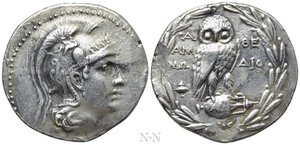
ATTICA. Athens. Tetradrachm (148/7 BC). New Style Coinage. Ammonios and Dio-, magistrates. Obv: Head of Athena Parthenos right, wearing triple crested Attic helmet decorated with Pegasos and floral pattern.Rev: A - ΘE / AM / MΩ - ΔIO. Owl standing right on amphora, head facing. Controls: kerchnos to lower left; AP on amphora; all within wreath.Thompson 101c; HGC 4, 1602.Among the Greek poleis, Athens is undoubtedly the city that denotes the greatest monetary development. The earliest coinage followed the reforms attributed to Solon on the introduction of Attic weights to replace the Eginetic ones. These early coins, called "Wappenmünzen," were replaced by the "owls" at the end of the 6th century: tetradrachms marked with the head of Athena and the owl, next to which is now the ethnic of the Athenians. These types will last, with variations in style, until the end of silver production (c. mid-1st century). The most noticeable change occurs with the so-called "new style," established from the beginning of the 2nd century BC. In these issues the owl is surrounded by an olive wreath, which is why the tetradrachms are referred to in the inscriptions as "stephanephoroi" (= wreath bearers). Coins of new style also bear inscriptions with the names of magistrates. Condition: Very fine.Weight: 16.80 g. Diameter: 32 mm.
Lot # 147
-
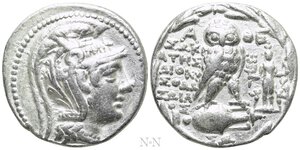
ATTICA. Athens. Tetradrachm (148/7 BC). New Style Coinage. Sokrates, Dionysodo and Zoilos, magistrates. Obv: Head of Athena Parthenos right, wearing triple crested Attic helmet decorated with Pegasos and floral pattern.Rev: Α - ΘΕ / ΣΩKΡ / ATHΣ / ΔIONY / ΣOΔΩ / ZΩIΛ / OΣ. Owl standing right on amphora, head facing. Controls: To right, Apollo Delios standing left, holding Three Graces and bow; uncertain control on amphora, ΣΩ below; all within wreath.Cf. Thompson 613c-d; HGC 4, 1602.Among the Greek poleis, Athens is undoubtedly the city that denotes the greatest monetary development. The earliest coinage followed the reforms attributed to Solon on the introduction of Attic weights to replace the Eginetic ones. These early coins, called "Wappenmünzen," were replaced by the "owls" at the end of the 6th century: tetradrachms marked with the head of Athena and the owl, next to which is now the ethnic of the Athenians. These types will last, with variations in style, until the end of silver production (c. mid-1st century). The most noticeable change occurs with the so-called "new style," established from the beginning of the 2nd century BC. In these issues the owl is surrounded by an olive wreath, which is why the tetradrachms are referred to in the inscriptions as "stephanephoroi" (= wreath bearers). Coins of new style also bear inscriptions with the names of magistrates. Condition: Very fine.Weight: 16.63 g. Diameter: 28 mm.
Lot # 146
-
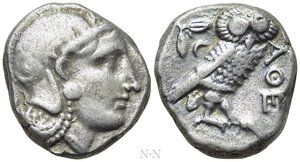
ATTICA. Athens. Tetradrachm (Circa 353-294 BC). Obv: Helmeted head of Athena right, with profile eye.Rev: AΘE. Owl standing right, head facing; olive sprig and crescent to left.SNG Copenhagen 63; HGC 4, 1599. Condition: Near very fine.Weight: 17.15 g. Diameter: 24 mm.
Lot # 145
-
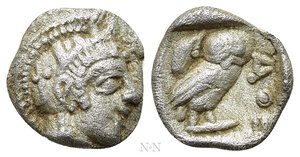
ATTICA. Athens. Hemiobol (Circa 454-404 BC). Obv: Helmeted head of Athena right.Rev: AΘΕ. Owl standing right, head facing; olive sprig to left; all within incuse square.Kroll 14; SNG Copenhagen 27-9; HGC 4, 1681. Condition: Very fine.Weight: 0.33 g. Diameter: 7 mm.
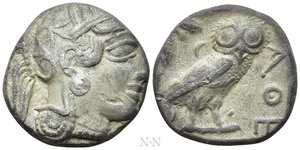
Lot # 144
-
ATTICA. Athens. Tetradrachm (Circa 454-404 BC). Obv: Helmeted head of Athena right, with frontal eye.Rev: AΘE. Owl standing right, head facing; olive sprig and crescent to left; all within incuse square.Kroll 8; HGC 4, 1597. Condition: Good fine.Weight: 16.77 g. Diameter: 23 mm.
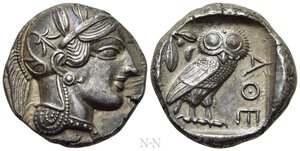
Lot # 143
-
ATTICA. Athens. Tetradrachm (Circa 454-404 BC). Obv: Helmeted head of Athena right, with frontal eye.Rev: AΘE. Owl standing right, head facing; olive sprig and crescent to left; all within incuse square.Kroll 8; HGC 4, 1597. Condition: Near extremely fine.Weight: 17.22 g. Diameter: 24 mm.
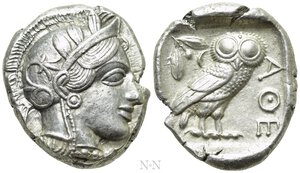
Lot # 142
-
ATTICA. Athens. Tetradrachm (Circa 454-404 BC). Obv: Helmeted head of Athena right, with frontal eye.Rev: AΘE. Owl standing right, head facing; olive sprig and crescent to left; all within incuse square.Kroll 8; HGC 4, 1597. Condition: Extremely fine.Weight: 17.21 g. Diameter: 26 mm.
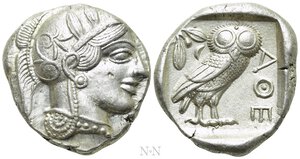
Lot # 141
-
ATTICA. Athens. Tetradrachm (Circa 454-404 BC). Obv: Helmeted head of Athena right, with frontal eye.Rev: AΘE. Owl standing right, head facing; olive sprig and crescent to left; all within incuse square.Kroll 8; HGC 4, 1597. Condition: Extremely fine; some luster in field.Weight: 17.21 g. Diameter: 25 mm.
Lot # 140
-
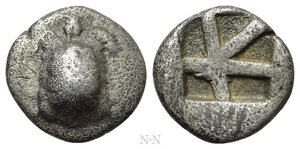
ATTICA. Aegina. Obol (Circa 370 BC). Obv: Land tortoise with segmented shell.Rev: Square incuse with large skew pattern.Meadows Group IIIb; HGC 6, 451. Condition: Near very fine.Weight: 0.71 g. Diameter: 10 mm.
Lot # 139
-
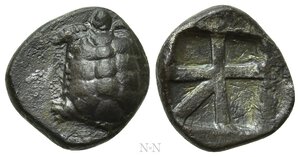
ATTICA. Aegina. Obol (Circa 370 BC). Obv: Land tortoise with segmented shell.Rev: Square incuse with large skew pattern.Meadows Group IIIb; HGC 6, 451.Ex Münzen & Medaillen AG 406 (1978), lot 68 Condition: Good very fine.Weight: 0.93 g. Diameter: 10 mm.
Lot # 138
-
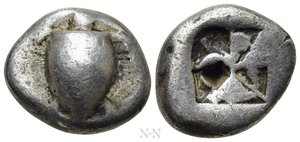
ATTICA. Aegina. Triobol or Hemidrachm (Circa 525-475 BC). Obv: Sea tortoise.Rev: Square incuse with large skew pattern.Meadows Group IIb; HGC 6, 447. Condition: Very fine.Weight: 2.89 g. Diameter: 13 mm.
Lot # 137
-
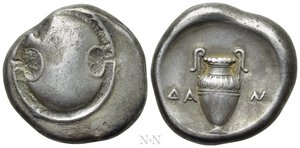
BOEOTIA. Thebes. Stater (Circa 379-368 BC). Dam-, magistrate. Obv: Boeotian shield.Rev: ΔA - M. Amphora within incuse concave circle.Cf. BCD Boiotia 523; HGC 4, 1331.Ex Münzen & Medaillen AG 344 (1973), lot 11 Condition: Very fine.Weight: 12.25 g. Diameter: 23 mm.
Lot # 136
-
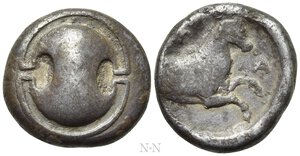
BOEOTIA. Tanagra. Stater (Circa 350 BC). Obv: Boeotian shield.Rev: T-A. Forepart of horse right.BCD Boiotia 265; HGC 4, 1280.Ex Münzen & Medaillen AG 397 (1978), lot 178 Condition: Very fine.Weight: 11.75 g. Diameter: 22 mm.
Lot # 135
-
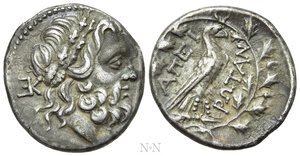
EPEIROS. Federal Coinage. Drachm (Circa 148-50 BC). Obv: Head of Zeus right, wearing oak wreath; monogram to left.Rev: ΑΠΕΙ / ΡΩΤΑΝ. Eagle standing right on thunderbolt; all within wreath.Franke V15/R26; HGC 3.1, 171. Condition: Good very fine.Weight: 4.71 g. Diameter: 20 mm.
Lot # 134
-
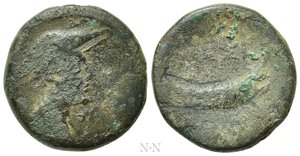
KINGS OF ILLYRIA. Genthios (181-168 BC). Ae. Skodra. Obv: Draped bust of Redon right, wearing petasos.Rev: BAΣIΛEOΣ / ΓENΘIOY. Prow of galley.HGC 3.1, 77.The bust on obverse sometimes identified as Genthios portrait, could instead be interpreted as Redon, an Illyrian god of the sea after which the Cape of Rodon is named. A similar iconography can be found on a civic coin of Lissos (HGC 3.1 56), bearing the legend PEΔΩN. Redon, patron of sailors, is usually portrayed as a bearded figure with trident, like Poseidon. He is also patron of travelers, like Hermes, as suggested by the broad hat kausia they wore. Condition: Fine.Weight: 5.95 g. Diameter: 18 mm.
Lot # 133
-
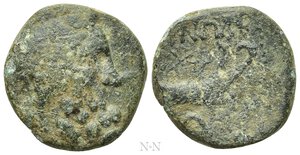
ILLYRIA. Skodra. Ae (Circa 181-168 BC). Obv: Diademed head of Poseidon right.Rev: ΣΚΟΔΡΙEΝΩΝ / ΣKAΛNOΣ. Galley left.HGC 3.1, 62.Extremely rare Condition: Fine.Weight: 3.79 g. Diameter: 17 mm.
Lot # 132
-
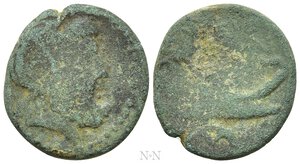
ILLYRIA. Skodra. Ae (Circa 181-168 BC). Obv: Diademed head of Poseidon right.Rev: ΣΚΟΔΡΙEΝΩΝ / ΣKAΛNOΣ. Galley left.HGC 3.1, 62.Extremely rare Condition: Fine.Weight: 4.03 g. Diameter: 18 mm.
Lot # 131
-
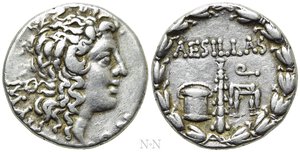
MACEDON AS ROMAN PROVINCE. Aesillas (Quaestor, circa 93-87 BC). Tetradrachm. Thessalonika. Obv: MAKEΔONΩN. Head of the deified Alexander the Great right, with horn of Ammon; Θ to left.Rev: AESILLAS. Fiscus (money chest), club and sella curulis; Q to upper right.SNG Copenhagen 1330; HGC 3.1, 1110. Condition: Very fine.Weight: 15.71 g. Diameter: 26 mm.
Lot # 130
-
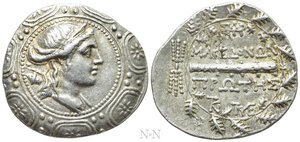
MACEDON UNDER ROMAN PROTECTORATE. First Meris. Tetradrachm (Circa 167-148 BC). Amphipolis. Obv: Diademed and draped bust of Artemis right, with bow and quiver over shoulder; all in centre of Macedonian shield.Rev: MAKEΔONΩN / ΠPΩTHΣ. Club; monogram above, two monograms below; all within oak wreath; thunderbolt to left.SNG Copenhagen 1314; HGC 3.1, 1103. Condition: Good very fine.Weight: 16.80 g. Diameter: 32 mm.
Lot # 129
-
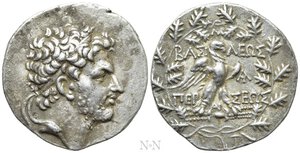
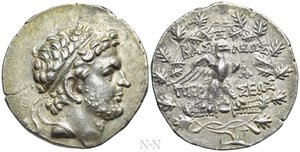
KINGS OF MACEDON. Perseus (179-168 BC). Tetradrachm. Pella or Amphipolis. Au-, mintmaster. Obv: Diademed head right.Rev: ΒΑΣΙΛΕΩΣ / ΠΕPΣΕΩΣ. Eagle standing right on thunderbolt. Controls: monogram above, to right and between legs; all within wreath; plow below.Mamroth, Perseus 21b-22 var. (control mark between legs); HGC 3.1, 1094. Condition: Good very fine.Weight: 15.29 g. Diameter: 30 mm.
Lot # 128
-
KINGS OF MACEDON. Perseus (179-168 BC). Tetradrachm. Pella or Amphipolis. Au-, mintmaster. Obv: Diademed head right.Rev: ΒΑΣΙΛΕΩΣ / ΠΕPΣΕΩΣ. Eagle standing right on thunderbolt Controls: Ξ above, monogram to right and between legs; all within wreath; plow below.Mamroth 23; HGC 3.1, 1091. Condition: Very fine.Weight: 15.25 g. Diameter: 31 mm.
Lot # 127
-
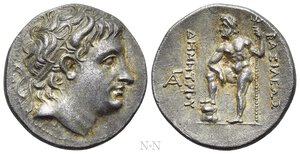
KINGS OF MACEDON. Demetrios I Poliorketes (306-283 BC). Drachm. Euboeia. Obv: Diademed and horned head right.Rev: BAΣIΛEΩΣ / ΔHMHTPIOY. Poseidon Pelagaios standing left, right foot on rock, holding trident; monogram to outer left.Newell 154a; HGC 3.1, 1017.Very rare Condition: Near extremely fine.Weight: 4.17 g. Diameter: 18 mm.
Lot # 126
-
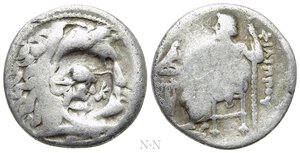
KINGS OF MACEDON. Philip III Arrhidaios (323-317 BC). Countermarked Kolophon Drachm. Obv: Head of Herakles right, wearing lion skin; c/m: head of Apollo right and K in incuse circle.Rev: ΦΙΛΙΠΠΟΥ. Zeus seated left on throne, holding eagle and sceptre. Controls: Lyre in left field, A below throne.Price P44 (for undertype). Condition: C/m very fine.Weight: 3.98 g. Diameter: 18 mm.
Lot # 125
-
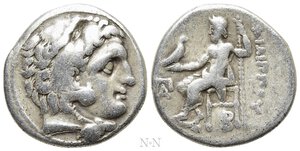
KINGS OF MACEDON. Philip III Arrhidaios (323-317 BC). Drachm. Kolophon. Obv: Head of Herakles right, wearing lion skin.Rev: ΦΙΛΙΠΠΟΥ. Zeus seated left on throne, holding eagle and sceptre. Controls: Monogram in left field; below throne, B below strut.Price P48. Condition: Fine.Weight: 3.93 g. Diameter: 17 mm.
Lot # 124
-
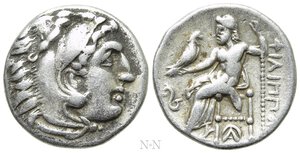
KINGS OF MACEDON. Philip III Arrhidaios (323-317 BC). Drachm. Lampsakos. Obv: Head of Herakles right, wearing lion skin.Rev: ΦIΛIΠΠOY. Zeus seated left, holding eagle and sceptre. Controls: In left field, buckle; below throne, crescent above A.Price P15. Condition: Near very fine.Weight: 4.14 g. Diameter: 18 mm.
Lot # 123
-
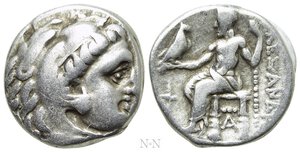
KINGS OF MACEDON. Alexander III 'the Great' (336-323 BC). Drachm. Sardeis. Obv: Head of Herakles right, wearing lion skin.Rev: AΛΕΞΑΝΔΡΟΥ. Zeus seated left on throne, holding eagle and sceptre. Controls: Torch in left field, A below throne.Price 2637. Condition: Good fine.Weight: 4.15 g. Diameter: 16 mm.
Results from 10451 to 10500 of 10501