Greek Coins
Results from 11351 to 11400 of 15719
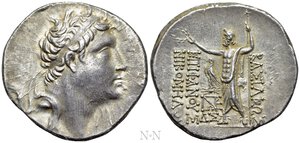
Lot # 254
-
KINGS OF BITHYNIA. Nikomedes IV Philopator (94-74 BC). Tetradrachm. Dated BE 204 (74/3 BC). Obv: Diademed head of Nikomedes right.Rev: ΒΑΣΙΛΕΩΣ / ΕΠΙΦΑΝΟΥΣ ΝΙΚΟΜΗΔΟΥ. Zeus standing left, holding wreath and sceptre. Controls: To inner left, eagle standing left on thunderbolt, monogram and ΔΣ (date).De Callataÿ p. 59; RG 40; HGC 7, 646. Condition: Extremely fine.Weight: 15.69 g. Diameter: 33 mm.
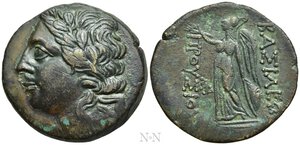
Lot # 253
-
KINGS OF BITHYNIA. Prusias I (238-183 BC). Ae. Obv: Laureate head of Apollo left.Rev: BAΣIΛEΩΣ ΠΡΟYΣIOY. Helmeted Athena-Nike standing left, holding wreath and shield; Control: monogram to inner left.RG 16; SNG von Aulock 248; HGC 7, 615. Condition: Very fine.Weight: 9.23 g. Diameter: 27 mm.

Lot # 252
-
BITHYNIA. Kios. Ae (3rd century BC). Obv: Head of Mithras right, wearing peaked cap.Rev: KIANΩN. Club; monogram and ΛY below.RG 6; SNG Copenhagen 380 var. (controls); HGC 7, 557. Condition: Near very fine.Weight: 5.12 g. Diameter: 19 mm.
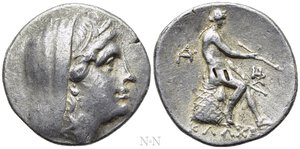
Lot # 251
-
BITHYNIA. Kalchedon. Tetradrachm (Circa 240-220 BC). Obv: Veiled head of Demeter right, wearing grain wreath.Rev: KAΛX. Apollo seated right on omphalos, holding bow and arrow. Controls: Monogram to left and right.SNG BM Black Sea 134; SNG Stancomb 15; HGC 7, 533.Rare Condition: Good fine.Weight: 13.64 g. Diameter: 28 mm.
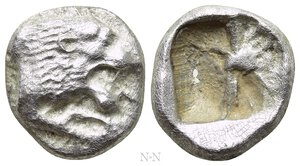
Lot # 250
-
ASIA MINOR. Uncertain. 1/12 Stater - Obol (5th century BC). Obv: Forepart of roaring lion right.Rev: Rough incuse square.Unpublished in the standard references; Cf. Numismatik Naumann 138, lot 161 (1/6 Stater). Condition: Very fine.Weight: 0.81 g. Diameter: 9 mm.
Lot # 249
-
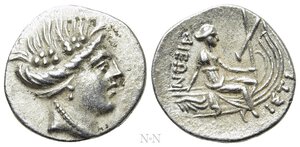
EUBOIA. Histiaia. Tetrobol (3rd-2nd centuries BC). Obv: Wreathed head of the nymph Histiaia right.Rev: IΣTIAIEΩN. Nymph seated right on stern of galley; wing on prow.BCD Euboia 387ff.; HGC 4, 1524. Condition: Extremely fine.Weight: 1.44 g. Diameter: 14 mm.
Lot # 248
-
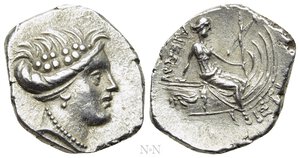
EUBOIA. Histiaia. Tetrobol (3rd-2nd centuries BC). Obv: Wreathed head of the nymph Histiaia right.Rev: IΣTIAIEΩN. Nymph seated right on stern of galley; wing on prow.BCD Euboia 387ff.; HGC 4, 1524. Condition: Extremely fine.Weight: 1.73 g. Diameter: 16 mm.
Lot # 247
-
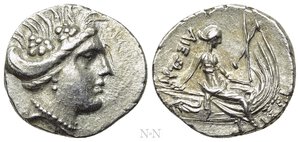
EUBOIA. Histiaia. Tetrobol (3rd-2nd centuries BC). Obv: Wreathed head of the nymph Histiaia right.Rev: IΣTIAIEΩN. Nymph seated right on stern of galley; wing on prow.BCD Euboia 387ff.; HGC 4, 1524. Condition: Extremely fine.Weight: 1.91 g. Diameter: 14 mm.
Lot # 246
-
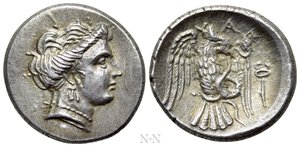
EUBOIA. Chalkis. Drachm (Circa 290-273/1 BC). Obv: Head of the nymph Chalkis right.Rev: XAΛ. Eagle flying right, grappling with serpent; below, kerykeion to right.BCD Euboia 178-80; SNG Copenhagen 438; HGC 4, 1464. Condition: Extremely fine.Weight: 3.67 g. Diameter: 18 mm.
Lot # 245
-
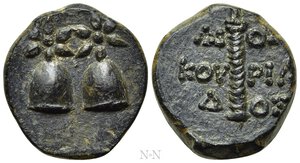
KOLCHIS. Dioskourias. Ae (Circa 2nd-1st century BC). Obv: Two piloi surmounted by stars.Rev: ΔΙΟΣΚΟΥΡΙΑΔΟΥ. Thyrsos.SNG BM Black Sea 1021-3; SNG Stancomb 638; HGC 7, 205. Condition: Extremely fine.Weight: 5.04 g. Diameter: 17 mm.
Lot # 244
-
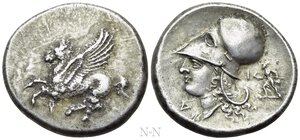
CORINTHIA. Corinth. Stater (Circa 350/45-285 BC). Obv: Pegasos flying left; koppa below.Rev: Helmeted head of Athena left; Δ to left; to right, I and Artemis advancing left, holding torches.Pegasi 453; BCD Corinth -; HGC 4, 1848. Condition: Very fine.Weight: 8.55 g. Diameter: 23 mm.
Lot # 243
-
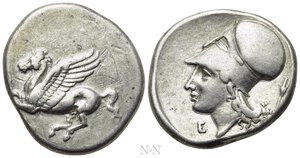
CORINTHIA. Corinth. Stater (Circa 350/45-285 BC). Obv: Pegasos flying left; koppa below.Rev: Helmeted head of Athena left; amphora to right, E to left.Pegasi 375; BCD Corinth -; HGC 4, 1848. Condition: Very fine.Weight: 8.40 g. Diameter: 23 mm.
Lot # 242
-
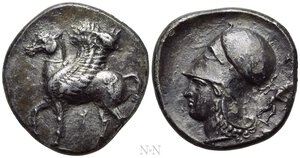
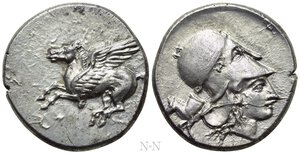
CORINTHIA. Corinth. Stater (Circa 400-375 BC). Obv: Pegasos walking left; koppa below.Rev: Helmeted head of Athena left; to right, Herakles advancing right, drawing bow.Pegasi 290; BCD Corinth -; HGC 4, 1838.Rare Condition: Very fine.Weight: 8.02 g. Diameter: 22 mm.
Lot # 241
-
CORINTHIA. Corinth. Stater (Circa 400-375 BC). Obv: Pegasos flying left; koppa below.Rev: Head of Athena right, wearing Corinthian helmet; to left, forepart of horse left.Pegasi 143; BCD Corinth 55; HGC 4, 1833. Condition: Near extremely fine.Weight: 8.38 g. Diameter: 22 mm.
Lot # 240
-
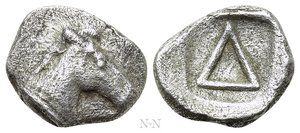
CORINTHIA. Corinth. Diobol (Circa 500-450 BC). Obv: Head of horse right.Rev: Large Δ (denomination mark) within incuse square.BCD Corinth 35-6; HGC 4, 1880. Condition: Very fine.Weight: 0.69 g. Diameter: 9 mm.
Lot # 239
-
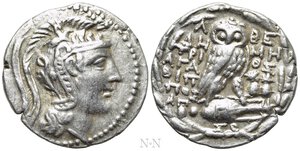
ATTICA. Athens. Tetradrachm (74/3 BC). New Style Coinage. Demetrios, Agatippos, magistrates. Obv: Head of Athena Parthenos right, wearing triple crested Attic helmet decorated with Pegasos and floral pattern.Rev: A - ΘE / ΔH - MH / TPI - OΣ / AΓA / ΘIΠ / ΠOΣ / [AΠ?]. Owl, with head facing, standing right on amphora. Controls: uncertain letter on amphora, ΠA(?) below; to right, caps of Dioscuri; all within wreath.Thompson 879ff.; HGC 4, 1602. Condition: Near very fine.Weight: 15.44 g. Diameter: 30 mm.
Lot # 238
-
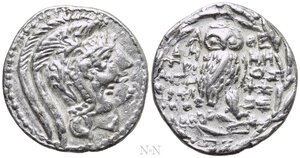
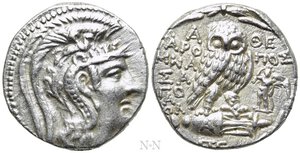
ATTICA. Athens. Tetradrachm (74/3 BC). New Style Coinage. Demetrios, Agatippos and Ap-, magistrates. Obv: Head of Athena Parthenos right, wearing triple crested Attic helmet decorated with Pegasos and floral pattern.Rev: A - ΘE / ΔH - MH / TPI - OΣ / AΓA / ΘIΠ / ΠOΣ / AΠ. Owl, with head facing, standing right on amphora. Controls: Γ on amphora, ΣO below; to right, caps of Dioscuri; all within wreath.Thompson 891c; HGC 4, 1602.Among the Greek poleis, Athens is undoubtedly the city that denotes the greatest monetary development. The earliest coinage followed the reforms attributed to Solon on the introduction of Attic weights to replace the Eginetic ones. These early coins, called "Wappenmünzen," were replaced by the "owls" at the end of the 6th century: tetradrachms marked with the head of Athena and the owl, next to which is now the ethnic of the Athenians. These types will last, with variations in style, until the end of silver production (c. mid-1st century). The most noticeable change occurs with the so-called "new style," established from the beginning of the 2nd century BC. In these issues the owl is surrounded by an olive wreath, which is why the tetradrachms are referred to in the inscriptions as "stephanephoroi" (= wreath bearers). Coins of new style also bear inscriptions with the names of magistrates Condition: Good very fine.Weight: 16.47 g. Diameter: 30 mm.
Lot # 237
-
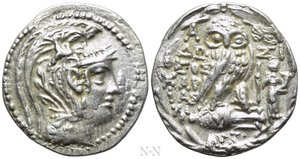
ATTICA. Athens. Tetradrachm (95/4 BC). New Style Coinage. Aropos-, Mnasogo- and Apol-, magistrates. Obv: Head of Athena Parthenos right, wearing triple crested Attic helmet decorated with Pegasos and floral pattern.Rev: A - ΘE / APO - ΠOΣ / MNA / ΣA / ΓO / A/ΠOΛ. Owl, with head facing, standing right on amphora; in right field, winged Agon standing facing, holding palm frond; A on amphora; ΠE below; all within wreath.Thompson 990c; HGC 4, 1602.Among the Greek poleis, Athens is undoubtedly the city that denotes the greatest monetary development. The earliest coinage followed the reforms attributed to Solon on the introduction of Attic weights to replace the Eginetic ones. These early coins, called "Wappenmünzen," were replaced by the "owls" at the end of the 6th century: tetradrachms marked with the head of Athena and the owl, next to which is now the ethnic of the Athenians. These types will last, with variations in style, until the end of silver production (c. mid-1st century). The most noticeable change occurs with the so-called "new style," established from the beginning of the 2nd century BC. In these issues the owl is surrounded by an olive wreath, which is why the tetradrachms are referred to in the inscriptions as "stephanephoroi" (= wreath bearers). Coins of new style also bear inscriptions with the names of magistrates Condition: Very fine.Weight: 16.47 g. Diameter: 27 mm.
Lot # 236
-
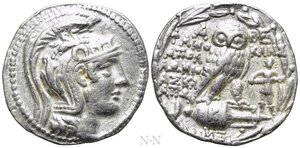
ATTICA. Athens. Tetradrachm (99/8 BC). New Style Coinage. Dositheos, Charias and Chair-, magistrates. Obv: Head of Athena Parthenos right, wearing triple crested Attic helmet decorated with Pegasos and floral pattern.Rev: A - ΘE / ΔΩ - ΣΙ / ΘΕΟΣ / ΧΑΡΙ / ΑΣ / XA / I. Owl standing right on amphora, head facing. Controls: Λ on amphora, AΠ below; to right, Tyche standing left, holding sceptre and cornucopia; all within wreath.Thompson 874; HGC 4, 1602.Among the Greek poleis, Athens is undoubtedly the city that denotes the greatest monetary development. The earliest coinage followed the reforms attributed to Solon on the introduction of Attic weights to replace the Eginetic ones. These early coins, called "Wappenmünzen," were replaced by the "owls" at the end of the 6th century: tetradrachms marked with the head of Athena and the owl, next to which is now the ethnic of the Athenians. These types will last, with variations in style, until the end of silver production (c. mid-1st century). The most noticeable change occurs with the so-called "new style," established from the beginning of the 2nd century BC. In these issues the owl is surrounded by an olive wreath, which is why the tetradrachms are referred to in the inscriptions as "stephanephoroi" (= wreath bearers). Coins of new style also bear inscriptions with the names of magistrates Condition: Good very fine.Weight: 16.57 g. Diameter: 32 mm.
Lot # 235
-
ATTICA. Athens. Tetradrachm (111/0 BC). New Style Coinage. Phanokles, Apollonios and Asklapon, magistrates. Obv: Head of Athena Parthenos right, wearing triple crested Attic helmet decorated with Pegasos and floral pattern.Rev: A - ΘE / ΦANO - KΛHΣ / AΠOΛ / ΛONIOΣ / AΣKΛ / AΠΩN. Owl standing right on amphora, head facing. Controls: K on amphora and ME below; to right, Artemis Phosphoros standing facing, holding torch with both hands; all within wreath.Thompson 706b; HGC 4, 1602.Among the Greek poleis, Athens is undoubtedly the city that denotes the greatest monetary development. The earliest coinage followed the reforms attributed to Solon on the introduction of Attic weights to replace the Eginetic ones. These early coins, called "Wappenmünzen," were replaced by the "owls" at the end of the 6th century: tetradrachms marked with the head of Athena and the owl, next to which is now the ethnic of the Athenians. These types will last, with variations in style, until the end of silver production (c. mid-1st century). The most noticeable change occurs with the so-called "new style," established from the beginning of the 2nd century BC. In these issues the owl is surrounded by an olive wreath, which is why the tetradrachms are referred to in the inscriptions as "stephanephoroi" (= wreath bearers). Coins of new style also bear inscriptions with the names of magistrates Condition: Very fine.Weight: 16.63 g. Diameter: 32 mm.

Lot # 234
-
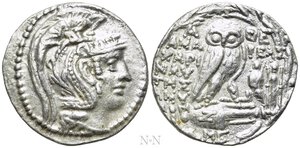
ATTICA. Athens. Tetradrachm (Circa 129/8 BC). Aristion, Philon and Hegi-, magistrates. Obv: Head of Athena Parthenos right, wearing triple crested Attic helmet decorated with Pegasos and floral pattern.Rev: A - ΘE / API - ΣTI / ΩN / ΦI / ΛΩN / HΓI. Owl, with head facing, standing right on amphora. Controls: I on amphora, ΠE below; to right, Pegasos grazing left; all within wreath.Thompson 976b; HGC 4, 1602.Among the Greek poleis, Athens is undoubtedly the city that denotes the greatest monetary development. The earliest coinage followed the reforms attributed to Solon on the introduction of Attic weights to replace the Eginetic ones. These early coins, called "Wappenmünzen," were replaced by the "owls" at the end of the 6th century: tetradrachms marked with the head of Athena and the owl, next to which is now the ethnic of the Athenians. These types will last, with variations in style, until the end of silver production (c. mid-1st century). The most noticeable change occurs with the so-called "new style," established from the beginning of the 2nd century BC. In these issues the owl is surrounded by an olive wreath, which is why the tetradrachms are referred to in the inscriptions as "stephanephoroi" (= wreath bearers). Coins of new style also bear inscriptions with the names of magistrates Condition: Very fine.Weight: 16.60 g. Diameter: 31 mm.
Lot # 233
-
ATTICA. Athens. Tetradrachm (136/5 BC). New Style Coinage. Andreas, Charinautes and Amynom-, magistrates. Obv: Head of Athena Parthenos right, wearing triple crested Attic helmet decorated with Pegasos and floral pattern.Rev: A - ΘE / ANΔ - PEAΣ / XAPI / NAY / THΣ / AMY / NOM. Owl, with head facing, standing right on amphora. Controls: Z on amphora, ME below; to right, Dionysos and Demeter standing facing; all within wreath.Thompson 804c-e; HGC 4, 1602.Among the Greek poleis, Athens is undoubtedly the city that denotes the greatest monetary development. The earliest coinage followed the reforms attributed to Solon on the introduction of Attic weights to replace the Eginetic ones. These early coins, called "Wappenmünzen," were replaced by the "owls" at the end of the 6th century: tetradrachms marked with the head of Athena and the owl, next to which is now the ethnic of the Athenians. These types will last, with variations in style, until the end of silver production (c. mid-1st century). The most noticeable change occurs with the so-called "new style," established from the beginning of the 2nd century BC. In these issues the owl is surrounded by an olive wreath, which is why the tetradrachms are referred to in the inscriptions as "stephanephoroi" (= wreath bearers). Coins of new style also bear inscriptions with the names of magistrates Condition: Very fine.Weight: 16.55 g. Diameter: 31 mm.
Lot # 232
-
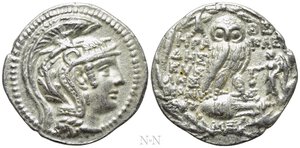
ATTICA. Athens. Tetradrachm (Circa 137/6 BC). Herakleides, Eukles and Dionysog-, magistrates. Obv: Head of Athena Parthenos right, wearing triple crested Attic helmet decorated with Pegasos and floral pattern.Rev: A - ΘE / HPA - KΛEI / ΔHΣ / EYK / ΛHΣ / ΔIONY / ΣOΓ. Owl, with head facing, standing right on amphora. Controls: B on amphora, ME below; to right, winged Tyche standing left, holding amphora; all within wreath.Thompson 780b-c; HGC 4, 1602.Among the Greek poleis, Athens is undoubtedly the city that denotes the greatest monetary development. The earliest coinage followed the reforms attributed to Solon on the introduction of Attic weights to replace the Eginetic ones. These early coins, called "Wappenmünzen," were replaced by the "owls" at the end of the 6th century: tetradrachms marked with the head of Athena and the owl, next to which is now the ethnic of the Athenians. These types will last, with variations in style, until the end of silver production (c. mid-1st century). The most noticeable change occurs with the so-called "new style," established from the beginning of the 2nd century BC. In these issues the owl is surrounded by an olive wreath, which is why the tetradrachms are referred to in the inscriptions as "stephanephoroi" (= wreath bearers). Coins of new style also bear inscriptions with the names of magistrates Condition: Good very fine.Weight: 16.72 g. Diameter: 32 mm.
Lot # 231
-
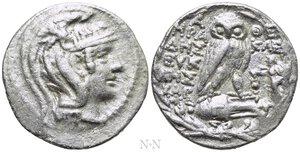
ATTICA. Athens. Tetradrachm (Circa 137/6 BC). Herakleides, Eukles and Charmid-, magistrates. Obv: Head of Athena Parthenos right, wearing triple crested Attic helmet decorated with Pegasos and floral pattern.Rev: A - ΘE / HPA - KΛEI / ΔHΣ / EYK / ΛHΣ / XAP / MIΔ. Owl, with head facing, standing right on amphora. Controls: Γ on amphora, ΣO below; to right, winged Tyche standing left, holding amphora; all within wreath.Thompson 779f; HGC 4, 1602. Condition: Very fine.Weight: 16.59 g. Diameter: 31 mm.
Lot # 230
-
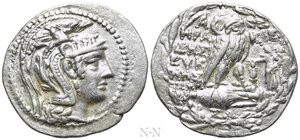
ATTICA. Athens. Tetradrachm (Circa 137/6 BC). Herakleides, Eukles and Timar-, magistrates. Obv: Head of Athena Parthenos right, wearing triple crested Attic helmet decorated with Pegasos and floral pattern.Rev: A - ΘE / HPA - KΛEI / ΔHΣ / EYK / ΛHΣ / TIMA/P. Owl, with head facing, standing right on amphora. Controls: A on amphora, ΣΩ below; to right, winged Tyche standing left, holding amphora; all within wreath.Thompson 779a; HGC 4, 1602.Among the Greek poleis, Athens is undoubtedly the city that denotes the greatest monetary development. The earliest coinage followed the reforms attributed to Solon on the introduction of Attic weights to replace the Eginetic ones. These early coins, called "Wappenmünzen," were replaced by the "owls" at the end of the 6th century: tetradrachms marked with the head of Athena and the owl, next to which is now the ethnic of the Athenians. These types will last, with variations in style, until the end of silver production (c. mid-1st century). The most noticeable change occurs with the so-called "new style," established from the beginning of the 2nd century BC. In these issues the owl is surrounded by an olive wreath, which is why the tetradrachms are referred to in the inscriptions as "stephanephoroi" (= wreath bearers). Coins of new style also bear inscriptions with the names of magistrates Condition: Very fine.Weight: 16.52 g. Diameter: 34 mm.
Lot # 229
-
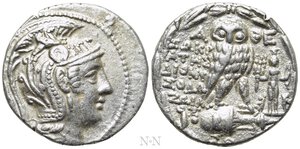
ATTICA. Athens. Tetradrachm (148/7 BC). New Style Coinage. Sokrates, Dionisodo- and Zoilos, magistrates. Obv: Head of Athena Parthenos right, wearing triple crested Attic helmet decorated with Pegasos and floral pattern.Rev: Α - ΘΕ / ΣΩKΡ / ATHΣ / ΔIONY / ΣOΔΩ / ZΩIΛ / OΣ. Owl standing right on amphora, head facing. Controls: To right, Apollo Delios standing left, holding Three Graces and bow; B on amphora, ΣΩ below; all within wreath.Thompson 613c-d; HGC 4, 1602.Among the Greek poleis, Athens is undoubtedly the city that denotes the greatest monetary development. The earliest coinage followed the reforms attributed to Solon on the introduction of Attic weights to replace the Eginetic ones. These early coins, called "Wappenmünzen," were replaced by the "owls" at the end of the 6th century: tetradrachms marked with the head of Athena and the owl, next to which is now the ethnic of the Athenians. These types will last, with variations in style, until the end of silver production (c. mid-1st century). The most noticeable change occurs with the so-called "new style," established from the beginning of the 2nd century BC. In these issues the owl is surrounded by an olive wreath, which is why the tetradrachms are referred to in the inscriptions as "stephanephoroi" (= wreath bearers). Coins of new style also bear inscriptions with the names of magistrates Condition: Good very fine.Weight: 16.82 g. Diameter: 29 mm.
Lot # 228
-
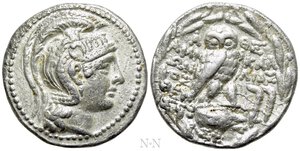
ATTICA. Athens. Tetradrachm (Circa 150/49 BC). New Style coinage. Ammonios, Kallias and Themisto-, magistrates. Obv: Head of Athena Parthenos right, wearing triple crested Attic helmet decorated with Pegasos and floral pattern.Rev: A - ΘE / AMM / ΩΝΙ / ΟΣ - KAΛ / ΛΙΑΣ / ΘEMI / ΣTO. Owl, with head facing, standing right on amphora. Controls: Z on amphora, ΣΦ below, two torches to right; all within wreath.Thompson 586d-e; HGC 4, 1602.Among the Greek poleis, Athens is undoubtedly the city that denotes the greatest monetary development. The earliest coinage followed the reforms attributed to Solon on the introduction of Attic weights to replace the Eginetic ones. These early coins, called "Wappenmünzen," were replaced by the "owls" at the end of the 6th century: tetradrachms marked with the head of Athena and the owl, next to which is now the ethnic of the Athenians. These types will last, with variations in style, until the end of silver production (c. mid-1st century). The most noticeable change occurs with the so-called "new style," established from the beginning of the 2nd century BC. In these issues the owl is surrounded by an olive wreath, which is why the tetradrachms are referred to in the inscriptions as "stephanephoroi" (= wreath bearers). Coins of new style also bear inscriptions with the names of magistrates Condition: Very fine.Weight: 16.70 g. Diameter: 29 mm.
Lot # 227
-
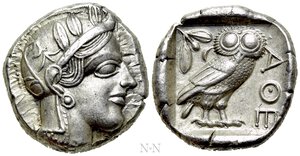
ATTICA. Athens. Tetradrachm (Circa 454-404 BC). Obv: Helmeted head of Athena right, with frontal eye.Rev: AΘE. Owl standing right, head facing; olive sprig and crescent to left; all within incuse square.Kroll 8; HGC 4, 1597. Condition: Near extremely fine.Weight: 17.18 g. Diameter: 25 mm.
Lot # 226
-
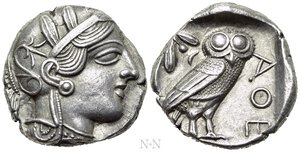
ATTICA. Athens. Tetradrachm (Circa 454-404 BC). Obv: Helmeted head of Athena right, with frontal eye.Rev: AΘE. Owl standing right, head facing; olive sprig and crescent to left; all within incuse square.Kroll 8; HGC 4, 1597. Condition: Extremely fine.Weight: 17.17 g. Diameter: 25 mm.
Lot # 225
-
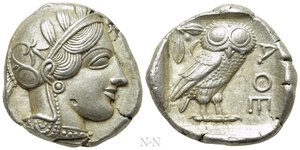
ATTICA. Athens. Tetradrachm (Circa 454-404 BC). Obv: Helmeted head of Athena right, with frontal eye.Rev: AΘE. Owl standing right, head facing; olive sprig and crescent to left; all within incuse square.Kroll 8; HGC 4, 1597. Condition: Near extremely fine.Weight: 17.20 g. Diameter: 25 mm.
Outstanding Grade
Lot # 224
-
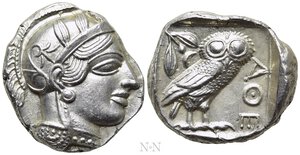
ATTICA. Athens. Tetradrachm (Circa 454-404 BC). Obv: Helmeted head of Athena right, with frontal eye.Rev: AΘE. Owl standing right, head facing; olive sprig and crescent to left; all within incuse square.Kroll 8; HGC 4, 1597. Condition: Extremely fine; luster in field.Weight: 17.18 g. Diameter: 26 mm.
Lot # 223
-
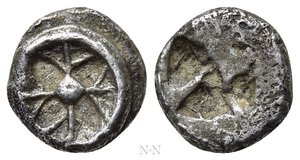
ATTICA. Athens. Obol (Circa 515-510 BC). "Wappenmünzen" type. Obv: Wheel with four spokes.Rev: Quadripartite incuse square, divided diagonally.Seltman pl. IV, ρ; HGC 4, 1654. Condition: Very fine.Weight: 0.53 g. Diameter: 8 mm.
Lot # 222
-
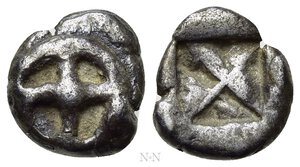
ATTICA. Athens. Obol (Circa 515-510 BC). "Wappenmünzen" type. Obv: Wheel with four spokes.Rev: Quadripartite incuse square, divided diagonally.Seltman pl. IV, ρ; HGC 4, 1654. Condition: Very fine.Weight: 0.61 g. Diameter: 8 mm.
Ex Nelson Bunker Hunt Collection
Lot # 221
-
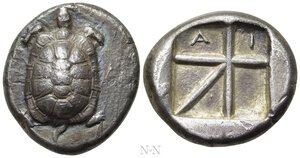
ATTICA. Aegina. Stater (Circa 350). Obv: Land turtle with segmented shell.Rev: Skew incuse pattern; A-I in upper incuses.Milbank -; BMC -; HGC 6, 439 var. (letters); Stack's Bowers Galleries, 14 January 2022, lot 4273.Extremely rare varietyEx Sothebys New York (1990), lot 432, from the Nelson Bunker Hunt collection Condition: Good very fine.Weight: 11.94 g. Diameter: 23 mm.
Lot # 220
-
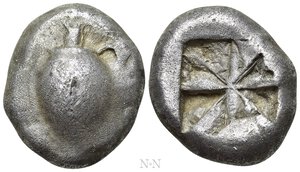
ATTICA. Aegina. Stater (Circa 550-530/25 BC). Obv: Sea turtle, head turned to left in profile.Rev: Deep incuse square of proto-“Union Jack” pattern with eight segments.Meadows, Aegina, Group Ib; HGC 6, 425. Condition: Very fine.Weight: 12.02 g. Diameter: 20 mm.
Lot # 219
-
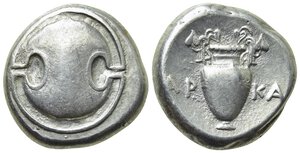
BOEOTIA. Thebes. Stater (Circa 368-364 BC) Arka-, magistrate. Obv: Boeotian shield.Rev: AP - KA. Amphora, two ivy leaves on each handle; all within incuse circle.Hepworth 14; BCD Boiotia 537; HGC 4, 1332. Condition: Very fine.Weight: 12.04 g. Diameter: 21 mm.
Lot # 218
-
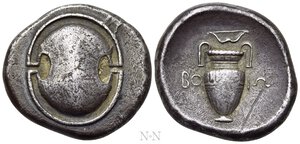
BOEOTIA. Federal Coinage. Stater (Circa 395-387 BC). Obv: Boeotian shield.Rev: BO - IΩ. Amphora; above, bow with string upward; all within incuse concave circle.BCD Boiotia 8; HGC 4, 1163. Condition: Near very fine.Weight: 11.85 g. Diameter: 24 mm.
Lot # 217
-
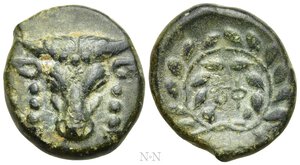
PHOKIS. Phokian League. Ae (Circa 347-346 BC). Obv: Facing head of filleted bull.Rev: ΦΩ within wreath.BCD Lokris 350-1; HGC 4, 1112. Condition: Good very fine.Weight: 2.27 g. Diameter: 15 mm.
Ex Hirsch 1971
Lot # 216
-
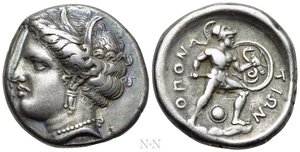
LOKRIS. Lokri Opuntii. Stater (Circa 370-360 BC). Obv: Head of Persephone left, wearing wreath of grain ears, earring and pearl necklace.Rev: OΠONTIΩN. Ajax advancing right on rocks, holding shield decorated with coiled serpent; round shield below.BCD Lokris 15; HGC 4, 989.Ex Gerhard Hirsch Nachfolger 71 (1971), lot 129 Condition: Good very fine.Weight: 12.00 g. Diameter: 23 mm.
Lot # 215
-
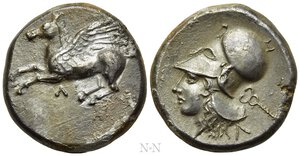
AKARNANIA. Leukas. Stater (Circa 350-320 BC). Obv: Pegasos flying left; Λ below.Rev: Helmeted head of Athena left; kerykeion behind, Λ below.Pegasi 58; BCD Akarnania -; HGC 4, 822. Condition: Good very fine.Weight: 8.14 g. Diameter: 20 mm.
Lot # 214
-
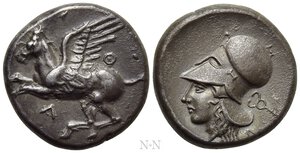
AKARNANIA. Leukas. Stater (Circa 350-320 BC). Obv: Pegasos flying left; Θ above, A below.Rev: Helmeted head of Athena left; kerykeion behind, Λ below.Pegasi 58; BCD Akarnania -; HGC 4, 822.Ex Gorny & Mosch Giessener 233 (2015), lot 1390 Condition: Good very fine.Weight: 8.43 g. Diameter: 20 mm.
Lot # 213
-
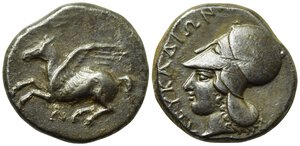
AKARNANIA. Leukas. Stater (Circa 375-350 BC). Obv: Pegasos flying left; Λ below.Rev: ΛΕΥΚΑΔΙΩΝ. Helmeted head of Athena left.Pegasi 49; BCD Akarnania -; HGC 4, 822. Condition: Good very fine.Weight: 7.85 g. Diameter: 21 mm.
Lot # 212
-
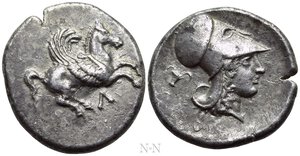
AKARNANIA. Leukas. Stater (Circa 400-375 BC). Obv: Pegasos flying right; Λ below.Rev: Helmeted head of Athena right; kantharos to left.Pegasi 29; BCD Akarnania 187; HGC 4, 817. Condition: Very fine.Weight: 8.02 g. Diameter: 22 mm.
Lot # 211
-
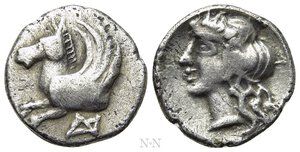
AKARNANIA. Anaktorion. Triobol or Hemidrachm (Circa 330-300 BC). Obv: Forepart of Pegasos left; AN monogram below.Rev: Laureate head of Apollo left.BCD Akarnania 100; HGC 4, 774. Condition: Near very fine.Weight: 1.15 g. Diameter: 12 mm.
Lot # 210
-
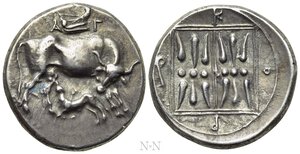
KORKYRA. Korkyra. Stater (Circa 350/30-290/70 BC). Obv: Cow standing right suckling calf; above, prow between A-Γ.Rev: K - O - P. Double stellate pattern within dual linear border; lituus to left.Fried Group IV; HGC 6, 37. Condition: Extremely fine.Weight: 10.49 g. Diameter: 22 mm.
Lot # 209
-
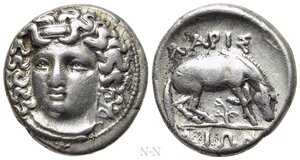
THESSALY. Larissa. Drachm (Circa 356-342 BC). Obv: Head of the nymph Larissa facing slightly left, with hair in ampyx.Rev: ΛΑΡΙΣ / ΑΙΩΝ. Horse standing right, preparing to lie down; branch below.BCD Thessaly II 320; HGC 4, 454. Condition: Very fine.Weight: 6.02 g. Diameter: 19 mm.
Lot # 208
-
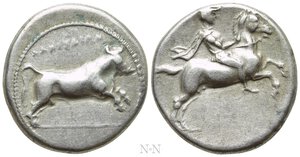
THESSALY. Larissa. Drachm (Circa 370-360 BC). Obv: ΛAPIΣAIΩN. Bull leaping right.Rev: Thessalian horseman riding right, holding goad.BCD Thessaly II 186; HGC 4, 449. Condition: Very fine.Weight: 6.21 g. Diameter: 20 mm.
Lot # 207
-
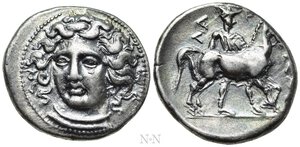
THESSALY. Larissa. Drachm (Circa 380-365 BC). Obv: Head of the nymph Larissa facing slightly left, wearing ampyx, earring and necklace.Rev: ΛΑΡΙΣAIΩΝ. Thessalos, wearing petasos, preparing to vault onto back of bridled horse right.BCD Thessaly I 1151; BCD Thessaly II 290-1 var. (arrangement of ethnic); HGC 4, 443. Condition: Good very fine.Weight: 6.01 g. Diameter: 21 mm.
Lot # 206
-
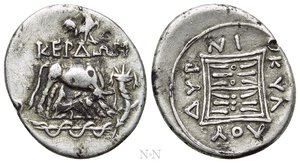
ILLYRIA. Dyrrhachion. Fourrèe Drachm (Circa 229-100 BC). Kerdon and Nikyllos, magistrates. Obv: KEPΔΩΝ. Cow standing right, suckling calf; above, cockerel right; cornucopia in right field, serpent-entwined staff below.Rev: ΔYP / NI / KYΛ / ΛOY. Double stellate pattern within linear borders.Cf. Maier 325 & HGC 3.1, 40 (for prototypes). Condition: Very fine.Weight: 2.87 g. Diameter: 19 mm.
With 19th Century Ticket
Lot # 205
-
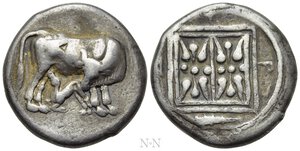
ILLYRIA. Dyrrhachion. Stater (Circa 375-280 BC). Obv: Cow standing right, looking back at suckling calf standing left below.Rev: Δ-Y-P. Double stellate pattern within dual linear border; below, club left.BMC 1; BMFA 939; HGC 3.1, 33.With 19th century ticket Condition: Very fine.Weight: 10.81 g. Diameter: 21 mm.
Results from 11351 to 11400 of 15719