Greek Coins
Results from 4201 to 4250 of 15716
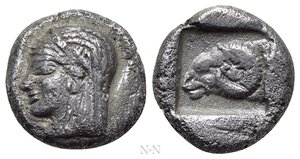
Lot # 179
-
TROAS. Kebren. Diobol (5th century BC). Obv: Archaic head (Apollo?) left.Rev: Head of ram left within incuse square.SNG Arikantürk 372-5; SNG Ashmolean 1086. Condition: Near very fine.Weight: 1.20 g. Diameter: 10 mm.
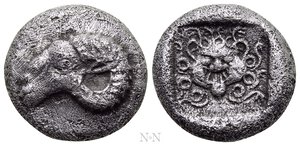
Lot # 178
-
TROAS. Kebren. Hemidrachm (Circa 460 BC). Obv: Head of ram left.Rev: Gorgoneion within incuse square.SNG Arikantürk -; SNG von Aulock 7619. Condition: Very fine.Weight: 1.94 g g. Diameter: 10 mm.
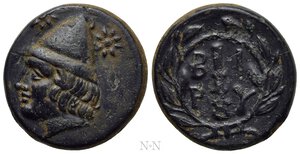
Lot # 177
-
TROAS. Birytis. Ae (4th-3rd centuries BC). Obv: Head of Kabeiros left, wearing pilos; star to left and right.Rev: B - I / P - Y in two lines around downward club; all within wreath.SNG Arikantürk 342-5; SNG Copenhagen 247-8. Condition: Very fine.Weight: 5.73 g g. Diameter: 18 mm.
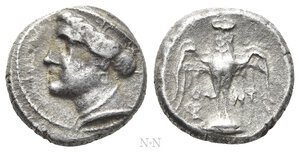
Lot # 176
-
PONTOS. Amisos (as Peiraieos). Siglos (Circa 435-370 BC). Obv: Head of Hera left, wearing ornamented stephanos.Rev: OΛ(?) - NY / Φ. Owl, with wings spread, standing facing on shield.Cf. SNG BM Black Sea 1053ff.; HGC 7, 229. Condition: Very fine.Weight: 5.50 g. Diameter: 16 mm.
Lot # 175
-
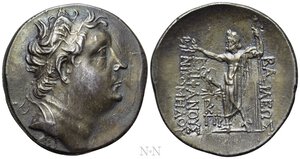
KINGS OF BITHYNIA. Nikomedes III Euergetes (127-94 BC). Tetradrachm. Dated BE 180 (118/7 BC). Obv: Diademed head right.Rev: ΒΑΣΙΛΕΩΣ / ΕΠΙΦΑΝΟΥΣ ΝΙΚΟΜΗΔΟΥ. Zeus standing left, holding wreath and sceptre. Controls: To inner left, eagle standing left on thunderbolt, monogram and ΠP (date).RG 40; HGC 6, 645; DCA 444. Condition: Good very fine.Weight: 16.49 g. Diameter: 34 mm.
Lot # 174
-
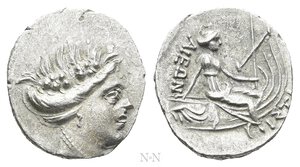
EUBOIA. Histiaia. Tetrobol (3rd-2nd centuries BC). Obv: Wreathed head of the nymph Histiaia right.Rev: IΣTIAIEΩN. Nymph seated right on stern of galley; wing on prow.BCD Euboia 387ff.; HGC 4, 1524. Condition: Near extremely fine.Weight: 1.30 g. Diameter: 14 mm.
Lot # 173
-
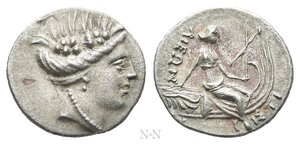
EUBOIA. Histiaia. Tetrobol (3rd-2nd centuries BC). Obv: Wreathed head of the nymph Histiaia right.Rev: IΣTIAIEΩN. Nymph seated right on stern of galley; wing on prow.BCD Euboia 387ff.; HGC 4, 1524. Condition: Good very fine.Weight: 1.67 g. Diameter: 14 mm.
Lot # 172
-
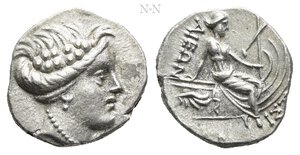
EUBOIA. Histiaia. Tetrobol (3rd-2nd centuries BC). Obv: Wreathed head of the nymph Histiaia right.Rev: IΣTIAIEΩN. Nymph seated right on stern of galley; wing on prow.BCD Euboia 387ff.; HGC 4, 1524. Condition: Extremely fine.Weight: 1.63 g. Diameter: 13 mm.
Lot # 171
-
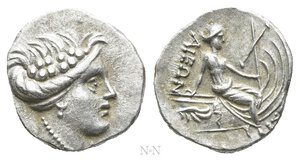
EUBOIA. Histiaia. Tetrobol (3rd-2nd centuries BC). Obv: Wreathed head of the nymph Histiaia right.Rev: IΣTIAIEΩN. Nymph seated right on stern of galley; wing on prow.BCD Euboia 387ff.; HGC 4, 1524. Condition: Extremely fine.Weight: 1.79 g. Diameter: 14 mm.
Sparta
Lot # 170
-
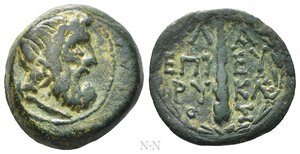
LAKONIA. Lakedaimon (Sparta). Ae (Circa 31-7 BC). C. Julius Eurycles, magistrate. Obv: Head of Zeus right.Rev: Λ - A / EΠI EY-PY-KΛE/O-Σ. Upright club within wreath.BCD Peloponnesos 921-2; RPC I 1103; HGC 5, 625. Condition: Very fine.Weight: 8.91 g. Diameter: 23 mm.
Lot # 169
-
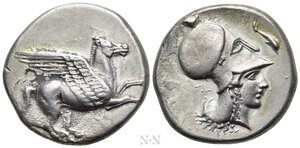
CORINTHIA. Corinth. Stater (Circa 400-375 BC). Obv: Pegasos flying right; koppa below.Rev: Head of Athena right, wearing Corinthian helmet; above, dolphin swimming right.Pegasi 344; BCD Corinth 89; HGC 4, 1834. Condition: Good very fine.Weight: 8.34 g. Diameter: 22 mm.
Lot # 168
-
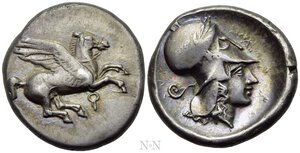
CORINTHIA. Corinth. Stater (Circa 400-375 BC). Obv: Pegasos flying right, koppa below.Rev: Head of Athena right, wearing laureate Corinthian helmet; coiled serpent to left.Pegasi 222 var. (no laurel-wreath); BCD Corinth 63 var. (same); HGC 4, 1834. Condition: Very fine.Weight: 8.54 g g. Diameter: 22 mm.
Lot # 167
-
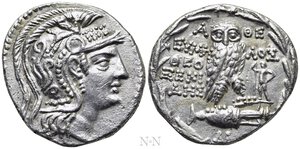
ATTICA. Athens. Tetradrachm (75/4 BC). New Style Coinage. Eumelos and Theoxenides, magistrates. Obv: Head of Athena Parthenos right, wearing triple crested Attic helmet decorated with Pegasos and floral pattern.Rev: A - ΘE / EYMH - ΛOΣ / ΘΕΟ / ΞENI / ΔΗΣ. Owl, with head facing, standing right on overturned amphora; in right field, Ares(?) standing facing, holding spear and resting hand on his hip; A on amphora, ΔΙ below; all within wreath.Thompson 1196a var. (no letters below amphora).Among the Greek poleis, Athens is undoubtedly the city that denotes the greatest monetary development. The earliest coinage followed the reforms attributed to Solon on the introduction of Attic weights to replace the Eginetic ones. These early coins, called "Wappenmünzen," were replaced by the "owls" at the end of the 6th century: tetradrachms marked with the head of Athena and the owl, next to which is now the ethnic of the Athenians. These types will last, with variations in style, until the end of silver production (c. mid-1st century). The most noticeable change occurs with the so-called "new style," established from the beginning of the 2nd century BC. In these issues the owl is surrounded by an olive wreath, which is why the tetradrachms are referred to in the inscriptions as "stephanephoroi" (= wreath bearers). Coins of new style also bear inscriptions with the names of magistrates. Condition: Near extremely fine.Weight: 15.72 g. Diameter: 29 mm.
Lot # 166
-
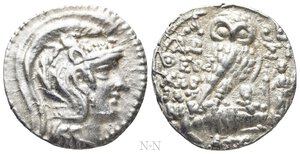
ATTICA. Athens. Tetradrachm (99/8 BC). New Style Coinage. Dositheos, Charias and Nik-, magistrates. Obv: Head of Athena Parthenos right, wearing triple crested Attic helmet decorated with Pegasos and floral pattern.Rev: A - ΘE / ΔΩ - ΣΙ / ΘΕΟΣ / ΧΑΡ / IΑΣ / NIK. Owl standing right on amphora, head facing. Controls: B(?) on amphora, AΠ below; to right, Tyche standing left, holding sceptre and cornucopia; all within wreath.Cf. Thompson 857-8; HGC 4, 1602.Among the Greek poleis, Athens is undoubtedly the city that denotes the greatest monetary development. The earliest coinage followed the reforms attributed to Solon on the introduction of Attic weights to replace the Eginetic ones. These early coins, called "Wappenmünzen," were replaced by the "owls" at the end of the 6th century: tetradrachms marked with the head of Athena and the owl, next to which is now the ethnic of the Athenians. These types will last, with variations in style, until the end of silver production (c. mid-1st century). The most noticeable change occurs with the so-called "new style," established from the beginning of the 2nd century BC. In these issues the owl is surrounded by an olive wreath, which is why the tetradrachms are referred to in the inscriptions as "stephanephoroi" (= wreath bearers). Coins of new style also bear inscriptions with the names of magistrates. Condition: Good very fine.Weight: 16.52 g. Diameter: 28 mm.
Lot # 165
-
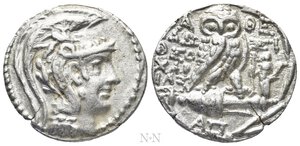
ATTICA. Athens. Tetradrachm (99/8 BC). New Style Coinage. Dositheos and Charias, magistrates. Obv: Head of Athena Parthenos right, wearing triple crested Attic helmet decorated with Pegasos and floral pattern.Rev: A - ΘE / ΔΩ - ΣΙ / ΘΕΟΣ / ΧΑΡ / IΑΣ / [...]. Owl standing right on amphora, head facing. Controls: letter on amphora, AΠ below; to right, Tyche standing left, holding sceptre and cornucopia; all within wreath.Cf. Thompson 847ff.; HGC 4, 1602.Among the Greek poleis, Athens is undoubtedly the city that denotes the greatest monetary development. The earliest coinage followed the reforms attributed to Solon on the introduction of Attic weights to replace the Eginetic ones. These early coins, called "Wappenmünzen," were replaced by the "owls" at the end of the 6th century: tetradrachms marked with the head of Athena and the owl, next to which is now the ethnic of the Athenians. These types will last, with variations in style, until the end of silver production (c. mid-1st century). The most noticeable change occurs with the so-called "new style," established from the beginning of the 2nd century BC. In these issues the owl is surrounded by an olive wreath, which is why the tetradrachms are referred to in the inscriptions as "stephanephoroi" (= wreath bearers). Coins of new style also bear inscriptions with the names of magistrates. Condition: Good very fine.Weight: 16.45 g. Diameter: 30 mm.
Lot # 164
-
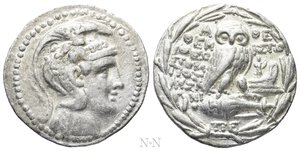
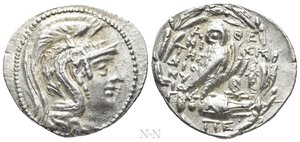
ATTICA. Athens. Tetradrachm (117/6 BC). New Style Coinage. Themisto-, Theopompos and Lysani-, magistrates. Obv: Head of Athena Parthenos right, wearing triple crested Attic helmet decorated with Pegasos and floral pattern.Rev: A - ΘEM - IΣT / ΘEO / ΠOM / ΠOΣ / ΛYΣA / NI. Owl, with head facing, standing right on overturned amphora; H on amphora, ΠE below; to right, trophy on prow right; all within wreath.Thompson 603b; HGC 4, 1602.Among the Greek poleis, Athens is undoubtedly the city that denotes the greatest monetary development. The earliest coinage followed the reforms attributed to Solon on the introduction of Attic weights to replace the Eginetic ones. These early coins, called "Wappenmünzen," were replaced by the "owls" at the end of the 6th century: tetradrachms marked with the head of Athena and the owl, next to which is now the ethnic of the Athenians. These types will last, with variations in style, until the end of silver production (c. mid-1st century). The most noticeable change occurs with the so-called "new style," established from the beginning of the 2nd century BC. In these issues the owl is surrounded by an olive wreath, which is why the tetradrachms are referred to in the inscriptions as "stephanephoroi" (= wreath bearers). Coins of new style also bear inscriptions with the names of magistrates. Condition: Good very fine.Weight: 16.48 g. Diameter: 31 mm.
Lot # 163
-
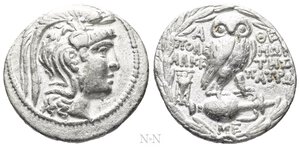
ATTICA. Athens. Tetradrachm (125/4 BC). New Style Coinage. Polemon, Alketes and Patro-, magistrates. Obv: Head of Athena Parthenos right, wearing triple crested Attic helmet decorated with Pegasos and floral pattern.Rev: A - ΘE / ΠΟΛΕ - ΜΩΝ / ΑΛΚE - ΤΗΣ / ΠATPΩ. Owl, with head facing, standing right on amphora; tripod in left field, uncertain letter on amphora, ME below; all within wreath.Cf. Thompson 466b-f; HGC 4, 1602.Among the Greek poleis, Athens is undoubtedly the city that denotes the greatest monetary development. The earliest coinage followed the reforms attributed to Solon on the introduction of Attic weights to replace the Eginetic ones. These early coins, called "Wappenmünzen," were replaced by the "owls" at the end of the 6th century: tetradrachms marked with the head of Athena and the owl, next to which is now the ethnic of the Athenians. These types will last, with variations in style, until the end of silver production (c. mid-1st century). The most noticeable change occurs with the so-called "new style," established from the beginning of the 2nd century BC. In these issues the owl is surrounded by an olive wreath, which is why the tetradrachms are referred to in the inscriptions as "stephanephoroi" (= wreath bearers). Coins of new style also bear inscriptions with the names of magistrates. Condition: Good very fine.Weight: 16.61 g. Diameter: 30 mm.
Lot # 162
-
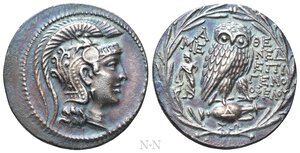
ATTICA. Athens. Tetradrachm (130/129 BC). New Style Coinage. Niketes, Dionysios and Glau-, magistrates. Obv: Head of Athena Parthenos right, wearing triple crested Attic helmet decorated with Pegasos and floral pattern.Rev: A-ΘΕ / NI - KH / THΣ / ΔΙΟ / NY / ΣΙΟΣ / ΓΛAY. Owl standing right on amphora, head facing. Controls: Δ on amphora, ΠE below; gorgoneion in right field; all within wreath.Thompson 939a-c; HGC 4, 1602.Among the Greek poleis, Athens is undoubtedly the city that denotes the greatest monetary development. The earliest coinage followed the reforms attributed to Solon on the introduction of Attic weights to replace the Eginetic ones. These early coins, called "Wappenmünzen," were replaced by the "owls" at the end of the 6th century: tetradrachms marked with the head of Athena and the owl, next to which is now the ethnic of the Athenians. These types will last, with variations in style, until the end of silver production (c. mid-1st century). The most noticeable change occurs with the so-called "new style," established from the beginning of the 2nd century BC. In these issues the owl is surrounded by an olive wreath, which is why the tetradrachms are referred to in the inscriptions as "stephanephoroi" (= wreath bearers). Coins of new style also bear inscriptions with the names of magistrates. Condition: Good very fine.Weight: 16.23 g. Diameter: 32 mm.
Attractive Bluish Toning
Lot # 161
-
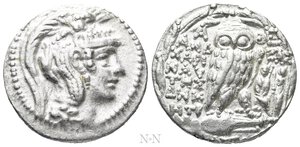
ATTICA. Athens. Tetradrachm (Circa 135/4 BC). New Style coinage. Mened-, Epigeno and Ophelos, magistrates. Obv: Head of Athena Parthenos right, wearing triple crested Attic helmet decorated with Pegasos and floral pattern.Rev: A - ΘE / ME - NEΔ / EΠI / ΓENO / OΦEΛOY. Owl, with head facing, standing right on amphora. Controls: Δ on amphora, ΣΩ below; ; to left, Asklepios standing left, holding serpent-entwined sceptre; all within wreath.Thompson 350f-g; HGC 4, 1602.Among the Greek poleis, Athens is undoubtedly the city that denotes the greatest monetary development. The earliest coinage followed the reforms attributed to Solon on the introduction of Attic weights to replace the Eginetic ones. These early coins, called "Wappenmünzen," were replaced by the "owls" at the end of the 6th century: tetradrachms marked with the head of Athena and the owl, next to which is now the ethnic of the Athenians. These types will last, with variations in style, until the end of silver production (c. mid-1st century). The most noticeable change occurs with the so-called "new style," established from the beginning of the 2nd century BC. In these issues the owl is surrounded by an olive wreath, which is why the tetradrachms are referred to in the inscriptions as "stephanephoroi" (= wreath bearers). Coins of new style also bear inscriptions with the names of magistrates. Condition: Good very fine.Weight: 16.52 g. Diameter: 31 mm.
Lot # 160
-
ATTICA. Athens. Tetradrachm (136/5 BC). New Style Coinage. Andreas, Charinautes and Demetr-, magistrates. Obv: Head of Athena Parthenos right, wearing triple crested Attic helmet decorated with Pegasos and floral pattern.Rev: A - ΘE / ANΔ - PEAΣ / XAPI / NAY / THΣ / ΔHM / HTP. Owl standing right on amphora, head facing. Controls: uncertain letter on amphora, AΠ(?) below; to right, Dionysos and Demeter standing facing; all within wreath.Cf. Thompson 802h-i; HGC 4, 1602.Among the Greek poleis, Athens is undoubtedly the city that denotes the greatest monetary development. The earliest coinage followed the reforms attributed to Solon on the introduction of Attic weights to replace the Eginetic ones. These early coins, called "Wappenmünzen," were replaced by the "owls" at the end of the 6th century: tetradrachms marked with the head of Athena and the owl, next to which is now the ethnic of the Athenians. These types will last, with variations in style, until the end of silver production (c. mid-1st century). The most noticeable change occurs with the so-called "new style," established from the beginning of the 2nd century BC. In these issues the owl is surrounded by an olive wreath, which is why the tetradrachms are referred to in the inscriptions as "stephanephoroi" (= wreath bearers). Coins of new style also bear inscriptions with the names of magistrates. Condition: Good very fine.Weight: 16.65 g. Diameter: 30 mm.
Lot # 159
-
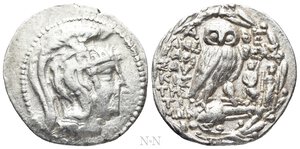
ATTICA. Athens. Tetradrachm (136/5 BC). New Style Coinage. Andreas and Charinautes, magistrates. Obv: Head of Athena Parthenos right, wearing triple crested Attic helmet decorated with Pegasos and floral pattern.Rev: A - ΘE / ANΔ - PEAΣ / XAPI / ΣAY / KIΣ / THΣ / TI / MΩN. Owl standing right on amphora, head facing. Controls: uncertain letter on amphora, ΣO below; to right, Dionysos and Demeter standing facing; all within wreath.Cf. Thompson 795ff.; HGC 4, 1602.Possibly overstruck.
Among the Greek poleis, Athens is undoubtedly the city that denotes the greatest monetary development. The earliest coinage followed the reforms attributed to Solon on the introduction of Attic weights to replace the Eginetic ones. These early coins, called "Wappenmünzen," were replaced by the "owls" at the end of the 6th century: tetradrachms marked with the head of Athena and the owl, next to which is now the ethnic of the Athenians. These types will last, with variations in style, until the end of silver production (c. mid-1st century). The most noticeable change occurs with the so-called "new style," established from the beginning of the 2nd century BC. In these issues the owl is surrounded by an olive wreath, which is why the tetradrachms are referred to in the inscriptions as "stephanephoroi" (= wreath bearers). Coins of new style also bear inscriptions with the names of magistrates. Condition: Good very fine.Weight: 16.60 g. Diameter: 33 mm.
Lot # 158
-
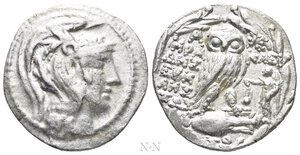
ATTICA. Athens. Tetradrachm (Circa 137/6 BC). New Style Coinage. Herakleides, Eukles and Sosikrates, magistrates. Obv: Head of Athena Parthenos right, wearing triple crested Attic helmet decorated with Pegasos and floral pattern.Rev: A - ΘE / HPA - KΛEI / ΔHΣ / EYK / ΛHΣ / ΣΩΣ / IKP. Owl, with head facing, standing right on amphora. Controls: uncertain control on amphora, ΣOΛ below; to right, winged Tyche standing left, holding uncertain object over amphora; all within wreath.Thompson 792a-b; HGC 4, 1602.Among the Greek poleis, Athens is undoubtedly the city that denotes the greatest monetary development. The earliest coinage followed the reforms attributed to Solon on the introduction of Attic weights to replace the Eginetic ones. These early coins, called "Wappenmünzen," were replaced by the "owls" at the end of the 6th century: tetradrachms marked with the head of Athena and the owl, next to which is now the ethnic of the Athenians. These types will last, with variations in style, until the end of silver production (c. mid-1st century). The most noticeable change occurs with the so-called "new style," established from the beginning of the 2nd century BC. In these issues the owl is surrounded by an olive wreath, which is why the tetradrachms are referred to in the inscriptions as "stephanephoroi" (= wreath bearers). Coins of new style also bear inscriptions with the names of magistrates. Condition: Good very fine.Weight: 16.72 g. Diameter: 31 mm.
Lot # 157
-
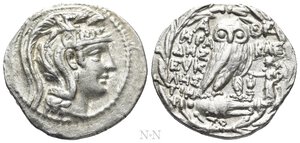
ATTICA. Athens. Tetradrachm (Circa 137/6 BC). New Style Coinage. Herakleides, Eukles and Timar-, magistrates. Obv: Head of Athena Parthenos right, wearing triple crested Attic helmet decorated with Pegasos and floral pattern.Rev: A - ΘE / HPA - KΛEI / ΔHΣ / EYK / ΛHΣ / TIMA/P. Owl, with head facing, standing right on amphora. Controls: A on amphora, ΣΩ below; to right, winged Tyche standing left, holding amphora; all within wreath.Thompson 779a; HGC 4, 1602.Among the Greek poleis, Athens is undoubtedly the city that denotes the greatest monetary development. The earliest coinage followed the reforms attributed to Solon on the introduction of Attic weights to replace the Eginetic ones. These early coins, called "Wappenmünzen," were replaced by the "owls" at the end of the 6th century: tetradrachms marked with the head of Athena and the owl, next to which is now the ethnic of the Athenians. These types will last, with variations in style, until the end of silver production (c. mid-1st century). The most noticeable change occurs with the so-called "new style," established from the beginning of the 2nd century BC. In these issues the owl is surrounded by an olive wreath, which is why the tetradrachms are referred to in the inscriptions as "stephanephoroi" (= wreath bearers). Coins of new style also bear inscriptions with the names of magistrates. Condition: Good very fine.Weight: 16.69 g. Diameter: 32 mm.
Lot # 156
-
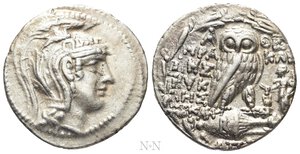
ATTICA. Athens. Tetradrachm (Circa 137/6 BC). New Style Coinage. Herakleides, Eukles and [...]kle-, magistrates. Obv: Head of Athena Parthenos right, wearing triple crested Attic helmet decorated with Pegasos and floral pattern.Rev: A - ΘE / HPA - KΛEI / ΔHΣ / EYK / ΛHΣ / [...]KΛH(?). Owl, with head facing, standing right on amphora. Controls: B on amphora, AΠ below; to right, winged Tyche standing left, holding amphora; all within wreath.Cf. Thompson 777ff.; HGC 4, 1602.Among the Greek poleis, Athens is undoubtedly the city that denotes the greatest monetary development. The earliest coinage followed the reforms attributed to Solon on the introduction of Attic weights to replace the Eginetic ones. These early coins, called "Wappenmünzen," were replaced by the "owls" at the end of the 6th century: tetradrachms marked with the head of Athena and the owl, next to which is now the ethnic of the Athenians. These types will last, with variations in style, until the end of silver production (c. mid-1st century). The most noticeable change occurs with the so-called "new style," established from the beginning of the 2nd century BC. In these issues the owl is surrounded by an olive wreath, which is why the tetradrachms are referred to in the inscriptions as "stephanephoroi" (= wreath bearers). Coins of new style also bear inscriptions with the names of magistrates. Condition: Good very fine.Weight: 16.55 g. Diameter: 30 mm.
Lot # 155
-
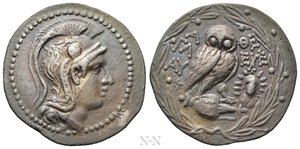
ATTICA. Athens. Tetradrachm (138/7 BC). New Style Coinage. Glau- and Eche-, magistrates. Obv: Head of Athena Parthenos right, wearing triple crested Attic helmet decorated with Pegasos and floral pattern.Rev: A - ΘE / ΓΛ / AY - EXE / KT. Owl standing right on amphora, head facing. Controls: E (or Ξ) on amphora, radiate and draped facing bust of Helios to right.Cf. Thompson 295c; HGC 4, 1602. Condition: Very fine.Weight: 16.21 g. Diameter: 36 mm.
Lot # 154
-
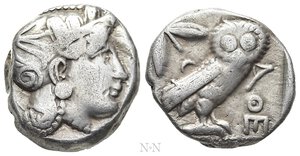
ATTICA. Athens. Tetradrachm (Circa 286/5-280/67 BC). Obv: Helmeted head of Athena right, with profile eye.Rev: AΘE. Owl standing right, head facing; olive sprig and crescent to left.SNG Copenhagen 64; HGC 4, 1600. Condition: Good fine.Weight: 16.80 g. Diameter: 24 mm.
Lot # 153
-
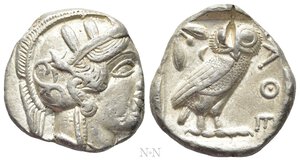
ATTICA. Athens. Tetradrachm (Circa 454-404 BC). Obv: Helmeted head of Athena right, with frontal eye.Rev: AΘE. Owl standing right, head facing; olive sprig and crescent to left; all within incuse square.Kroll 8; HGC 4, 1597. Condition: Very fine.Weight: 17.16 g. Diameter: 24 mm.
Lot # 152
-
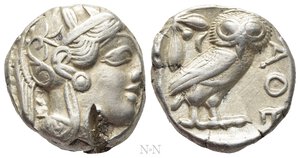
ATTICA. Athens. Tetradrachm (Circa 454-404 BC). Obv: Helmeted head of Athena right, with frontal eye.Rev: AΘE. Owl standing right, head facing; olive sprig and crescent to left; all within incuse square.Kroll 8; HGC 4, 1597. Condition: Very fine.Weight: 17.02 g. Diameter: 24 mm.
Lot # 151
-
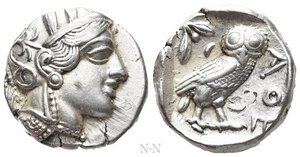
ATTICA. Athens. Tetradrachm (Circa 454-404 BC). Obv: Helmeted head of Athena right, with frontal eye.Rev: AΘE. Owl standing right, head facing; olive sprig and crescent to left; all within incuse square.Kroll 8; HGC 4, 1597. Condition: Very fine.Weight: 17.08 g. Diameter: 25 mm.
Lot # 150
-
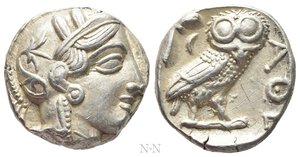
ATTICA. Athens. Tetradrachm (Circa 454-404 BC). Obv: Helmeted head of Athena right, with frontal eye.Rev: AΘE. Owl standing right, head facing; olive sprig and crescent to left; all within incuse square.Kroll 8; HGC 4, 1597. Condition: Good very fine.Weight: 17.19 g. Diameter: 23 mm.
Lot # 149
-
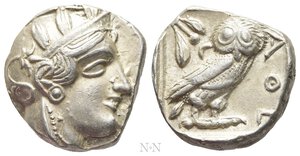
ATTICA. Athens. Tetradrachm (Circa 454-404 BC). Obv: Helmeted head of Athena right, with frontal eye.Rev: AΘE. Owl standing right, head facing; olive sprig and crescent to left; all within incuse square.Kroll 8; HGC 4, 1597. Condition: Good very fine.Weight: 17.21 g. Diameter: 23 mm.
Attractive Transitional Owl
Lot # 148
-
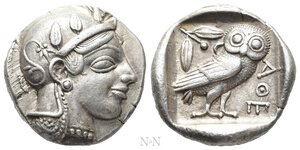
ATTICA. Athens. Tetradrachm (Circa 465-460 BC). Transitional issue. Obv: Helmeted head of Athena right, with frontal eye.Rev: AΘE. Owl standing right, head facing; olive sprig and crescent to left; all within incuse square.Starr Group V.B, 207; HGC 4, 1596.Ex Gorny & Mosch 265 (2019), lot 314; ex Numismatik Naumann 85 (2020), lot 89 Condition: Good very fine.Weight: 17.16 g. Diameter: 25 mm.
Lot # 147
-
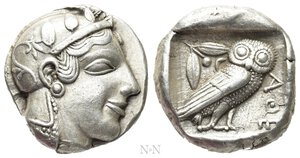
ATTICA. Athens. Tetradrachm (Circa 470-465 BC). Transitional issue. Obv: Helmeted head of Athena right, with frontal eye.Rev: AΘE. Owl standing right, head facing; olive sprig and crescent to left; all within incuse square.Starr Group IV; HGC 4, 1595.Ex Numismatik Naumann 85 (2020), lot 88 Condition: Good very fine.Weight: 17.14 g. Diameter: 24 mm.
Lot # 146
-
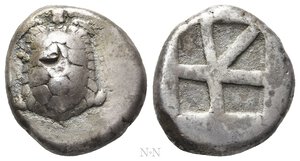
ATTICA. Aegina. Stater (Circa 456-431 BC). Obv: Land turtle with segmented shell.Rev: Large square incuse with skew pattern.SNG Delepierre 1775ff.; SNG Copenhagen 516; HGC 6, 437.Aegina's coinage was very important in the Greek world. According to Ephorus, historian from Cyme, it was the first city to mint silver coinage to facilitate the mercantile practices of its inhabitants, who engaged in trade to make up for the poverty of the agricultural soil. Aegina's coinage is certainly among the oldest and played a leading role among the Aegean islands, which adopted its weight for their own coinage. Very widespread is the diffusion of early Staters from the mid-6th century BC, with the sea turtle type remaining a constant throughout production. The only variation is the change to land tortoise that occurred after the defeat suffered against the Athenians in 431, at the beginning of the Peloponnesian War. Condition: Very fine.Weight: 12.16 g. Diameter: 21 mm.
Lot # 145
-
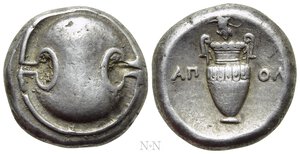
BOEOTIA. Thebes. Stater (Circa 363-338 BC). Apol-, magistrate. Obv: Boeotian shield.Rev: AΠ-OΛ. Amphora; grape bunch on vine above; all within incuse concave circle.BCD Boiotia 565; HGC 4, 1334.Ex Emporium Hamburg 73 (2015), lot 44 Condition: Very fine.Weight: 12.19 g g. Diameter: 20 mm.
Lot # 144
-
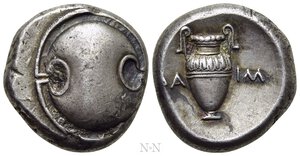
BOEOTIA. Thebes. Stater (Circa 379-368 BC). Daim-, magistrate. Obv: Boeotian shield.Rev: ΔA - IM. Amphora within incuse concave circle.BCD Boiotia 523; Hepworth 18; HGC 4, 1331. Condition: Good very fine.Weight: 12.24 g. Diameter: 20 mm.
Lot # 143
-
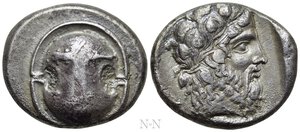
BOEOTIA. Thebes. Stater (425-395 BC). Obv: Boeotian shield; club across upper half.Rev: Θ - E. Bearded head of Dionysos right, wearing ivy wreath within incuse square.BCD Boiotia 436; Myron Hoard pl. A, 35; HGC 4, 1326. Condition: Good very fine.Weight: 11.97 g. Diameter: 23 mm.
Lot # 142
-
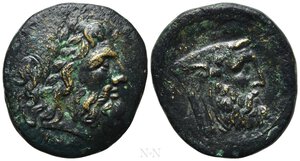
AKARNANIA. The Oiniadai. Ae (Circa 219-211 BC). Obv: Laureate head of Zeus right; star to left, monogram below.Rev: OINIAΔAN. Head of Acheloös right; monogram to left.BCD Akarnania 351.7; SNG Copenhagen 402; HGC 4, 899. Condition: Very fine.Weight: 6.85 g. Diameter: 23 mm.
Lot # 141
-
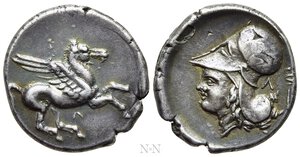
AKARNANIA. Leukas. Stater (Circa 350-320 BC). Obv: Pegasos flying right; Λ below.Rev: Helmeted head of Athena left; to right, Λ and kerykeion.Pegasi 86; BCD Akarnania -; HGC 4, 828. Condition: Good very fine.Weight: 8.38 g g. Diameter: 21 mm.
Lot # 140
-
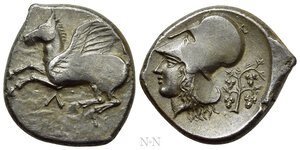
AKARNANIA. Leukas. Stater (Circa 375-350 BC). Obv: Pegasos flying left; Λ below.Rev: ΛEY. Helmeted head of Athena left; four grape bunches on vine to right.Pegasi 51; BCD Akarnania 202; HGC 4, 822. Condition: Very fine.Weight: 8.43 g g. Diameter: 22 mm.
Lot # 139
-
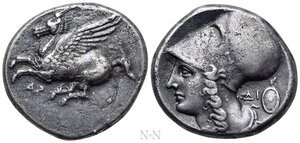
AKARNANIA. Argos Amphilochikon. Stater (Circa 330-280 BC). Obv: Pegasos flying left; AP below.Rev: Helmeted head of Athena left; to right, ΔΙ and shield.Pegasi 16; BCD Akarnania -; HGC 4, 786. Condition: Very fine.Weight: 8.16 g. Diameter: 21 mm.
Lot # 138
-
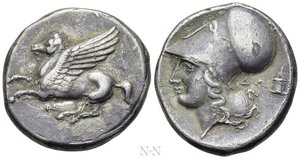
AKARNANIA. Anaktorion. Stater (Circa 320-280 BC). Obv: Pegasos flying left; monogram below.Rev: Helmeted head of Athena left; API above, ΔΩ and lighted altar to right.Pegasi 58; BCD Akarnania 108; HGC 4, 763. Condition: Very fine.Weight: 8.39 g. Diameter: 21 mm.
Lot # 137
-
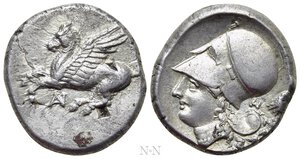
AKARNANIA. Anaktorion. Stater (Circa 320-280 BC). Obv: Pegasos flying left; AN monogram below.Rev: Helmeted head of Athena left; AN monogram and omphalos to right.Pegasi 36; BCD Akarnania 105; HGC 4, 755. Condition: Good very fine.Weight: 8.49 g g. Diameter: 20 mm.
Lot # 136
-
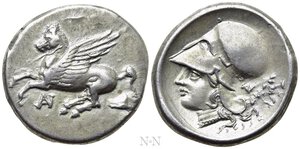
AKARNANIA. Anaktorion. Stater (Circa 350-300 BC). Obv: Pegasos flying left; monogram below.Rev: Helmeted head of Athena left; behind, monogram and tripod within wreath.Pegasi 29.1; BCD Akarnania 83; HGC 4, 755. Condition: Very fine.Weight: 8.54 g g. Diameter: 22 mm.
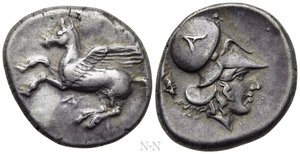
Lot # 135
-
EPEIROS. Ambrakia. Stater (Circa 404-360 BC). Obv: Pegasos flying left; A below.Rev: Helmeted head of Athena right; A on bowl, grasshopper to left.Pegasi 57; HGC 3.1, 205.Rare Condition: Very fine.Weight: 8.57 g. Diameter: 22 mm.
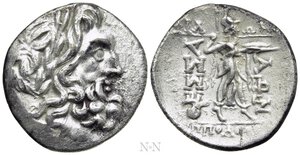
Lot # 134
-
THESSALY. Thessalian League. Stater (Late 2nd-mid 1st centuries BC). Philon and Hippolochos, magistrates. Obv: Laureate head of Zeus right.Rev: ΘΕΣΣΑ/ΛΩΝ / ΦIΛ-ΩN / IΠΠOΛOXOΣ. Athena Itonia advancing right, holding shield and preparing to hurl spear.BCD Thessaly II 869.2; HGC 4, 209. Condition: Very fine.Weight: 5.69 g. Diameter: 21 mm.
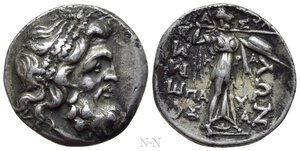
Lot # 133
-
THESSALY. Thessalian League. Stater (Late 2nd-mid 1st century BC). Thrasylo(s), Hera-, and Pausa(nias), magistrates. Obv: Laureate head of Zeus right.Rev: ΘPA-ΣΥΛO / ΘEΣΣA/ΛΩN / H-P-A / ΠA-Y/Σ-A. Athena Itonia striding right, hurling spear, shield on left arm.BCD Thessaly II 858.2; HGC 4, 209. Condition: Very fine.Weight: 5.97 g g. Diameter: 20 mm.
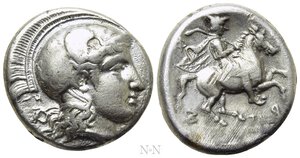
Lot # 132
-
THESSALY. Pharsalos. Drachm (Circa 400-370 BC). Obv: Head of Athena right, wearing crested Attic helmet decorated with wing; TH to left.Rev: ΦAPΣ. Thessalian cavalryman on horse prancing to right, wearing petasos, chlamys and short chiton, holding a lagobolon over his right shoulder; TH below.Lavva 99d; BCD Thessaly I -; BCD Thessaly II -; HGC 4, 624. Condition: Very fine.Weight: 5.93 g. Diameter: 18 mm.
Lot # 131
-
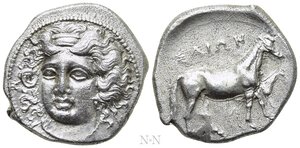
THESSALY. Larissa. Drachm (Circa 380-365 BC). Obv: Head of the nymph Larissa facing slightly left, with hair in ampyx.Rev: ΛAPI / ΣAIΩN. Mare standing right with foal right in background.BCD Thessaly I 1153; HGC 4, 444. Condition: Good very fine.Weight: 5.98 g. Diameter: 20 mm.
No Example on Acsearch
Lot # 130
-
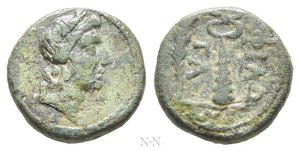
ILLYRIA. Dyrrhachion. Ae (42-38 BC). Philota, magistrate. Obv: Laureate head of Apollo right.Rev: ΦΙΛΩ - TA. Club surmounted by kerykeion; palm-branch to left.SNG Copenhagen 523; HGC 3.1, 47.Rare Condition: Very fine.Weight: 2.94 g. Diameter: 14 mm.
Results from 4201 to 4250 of 15716