Roman Imperial Coins
Results from 13251 to 13300 of 32902
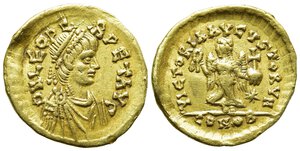
Lot # 1235
-
LEO I (457-474). GOLD Tremissis. Constantinople. Obv: D N LEO PERPET AVG. Diademed, draped and cuirassed bust right.Rev: VICTORIA AVGVSTORVM / CONOB. Victory advancing right, head left, holding wreath and globus cruciger; star to right.RIC 611. Condition: Very fine.Weight: 1.46 g. Diameter: 15 mm.
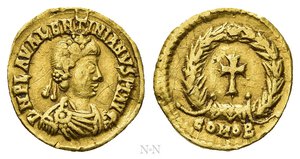
Lot # 1234
-
VALENTINIAN III (425-455). GOLD Tremissis. Rome or Ravenna. Obv: D N PLA VALENTINIANVS P F AVG. Rosette-diademed, draped and cuirassed bust right.Rev: COMOB. Latin cross within wreath with central jewel.RIC 2060; Depeyrot 47/7. Condition: Very fine.Weight: 1.35 g. Diameter: 13 mm.
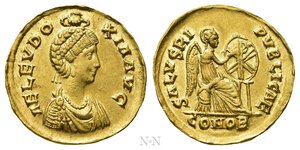
Lot # 1233
-
AELIA EUDOXIA (Augusta, 400-404). GOLD Solidus. Constantinople. Obv: AEL EVDOXIA AVG. Diademed and draped bust right; manus Dei above, crowning her.Rev: SALVS REI PVBLICAE / CONOB. Victory seated right on throne, inscribing Christogram on shield set upon a column.RIC 12; Depeyrot 55/4. Condition: Good very fine; ex jewelry.Weight: 4.08 g. Diameter: 19 mm.
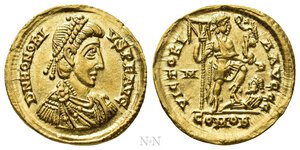
Lot # 1232
-
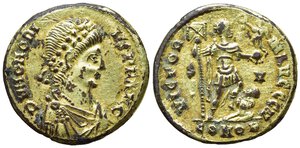
HONORIUS (393-423). GOLD Solidus. Mediolanum. Obv: D N HONORIVS P F AVG. Pearl-diademed, draped and cuirassed bust right.Rev: VICTORIA AVGGG / M - D / COMOB. Honorius standing right, with foot set on captive, holding vexillum and victoriola.RIC 1206; Depeyrot 16/2.Honorius became Augustus of the West at the age of ten at the behest of his father Theodosius I, who was intent on establishing the succession before his death. Given his young age, however, he was assisted by the valiant general Stilicho, who was half Vandal in origin and unlikely to have been aiming for the throne. The East, on the other hand, was entrusted to Honorius's brother Arcadius, and this was home to unrest because the two brothers did not like each other and were both assisted by cunning and manipulative advisers. By now there was no longer talk of a western and eastern part of the empire, but of two separate empires. Theodosius' project of a united empire in solidarity with the barbarian peoples, integrated into the Roman army, had failed. According to some historians Arcadius was the first Byzantine emperor. Stilicho faced great difficulties on the eastern front, mainly due to Alaric's Goths and other tribes crossing into Gaul. The situation precipitated and the Senate refused to pay a large sum of money to Alaric, further accusing Stilicho of conspiring with the enemy and condemning him to death in 408. It was the beginning of the end for the West, because the most valuable politician and general was lost. Honorius resided in Ravenna, where he treacherously attempted to murder Alaric, who was there to renew the 'foedus' with the emperor. This caused him to break off all negotiations and led to the famous 'sack of Rome' in 410, which marked the end of the city as capital. The news of Rome's fall represented a trauma for the empire and the collapse of the certainty of its invincibility. Honorius also did not recognize the marriage between his half-sister Galla Placidia and Ataulf, Alaric's successor. This marriage was strongly desired by the Goths and may have been a response to the crisis in the empire, as Ataulf intended to settle permanently in Roman territories by offering protection to the emperor instead of fighting him. In 413 General Flavius Constantius defeated four usurpers in the western provinces, succeeded in signing a peace treaty with Ataulf, and became associate emperor under the name Constantius III (421) but, unrecognized by the eastern empire, died shortly thereafter. In 423 Honorius also died, marking the final surrender, the birth of the Romano-Barbarian kingdoms and the first steps of medieval history. Condition: Near mint state; luster in field.Weight: 4.39 g. Diameter: 21 mm.
Lot # 1231
-
HONORIUS (393-423). Fourrèe Solidus. Contemporary imitation of Sirmium. Obv: D N HONORIVS P F AVG. Diademed, draped and cuirassed bust right.Rev: VICTORIA AVGGG A / S - M / COMOB. Honorius standing right, with foot upon captive, holding labarum and victoriola.Cf. RIC 15d (for prototype). Condition: Very fine.Weight: 2.86 g. Diameter: 20 mm.
Lot # 1230
-
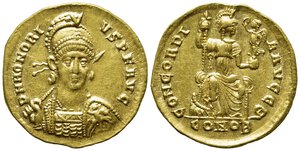
HONORIUS (393-423). GOLD Solidus. Constantinople. Obv: D N HONORIVS P F AVG. Diademed, helmeted and cuirassed bust facing slightly right, holding spear and shield decorated with horseman motif.Rev: CONCORDIA AVGG Θ / CONOB. Constantinopolis seated facing on throne, head right, with foot set upon prow, holding sceptre and victoriola.RIC 8; Depeyrot 55/2.Honorius became Augustus of the West at the age of ten at the behest of his father Theodosius I, who was intent on establishing the succession before his death. Given his young age, however, he was assisted by the valiant general Stilicho, who was half Vandal in origin and unlikely to have been aiming for the throne. The East, on the other hand, was entrusted to Honorius's brother Arcadius, and this was home to unrest because the two brothers did not like each other and were both assisted by cunning and manipulative advisers. By now there was no longer talk of a western and eastern part of the empire, but of two separate empires. Theodosius' project of a united empire in solidarity with the barbarian peoples, integrated into the Roman army, had failed. According to some historians Arcadius was the first Byzantine emperor. Stilicho faced great difficulties on the eastern front, mainly due to Alaric's Goths and other tribes crossing into Gaul. The situation precipitated and the Senate refused to pay a large sum of money to Alaric, further accusing Stilicho of conspiring with the enemy and condemning him to death in 408. It was the beginning of the end for the West, because the most valuable politician and general was lost. Honorius resided in Ravenna, where he treacherously attempted to murder Alaric, who was there to renew the 'foedus' with the emperor. This caused him to break off all negotiations and led to the famous 'sack of Rome' in 410, which marked the end of the city as capital. The news of Rome's fall represented a trauma for the empire and the collapse of the certainty of its invincibility. Honorius also did not recognize the marriage between his half-sister Galla Placidia and Ataulf, Alaric's successor. This marriage was strongly desired by the Goths and may have been a response to the crisis in the empire, as Ataulf intended to settle permanently in Roman territories by offering protection to the emperor instead of fighting him. In 413 General Flavius Constantius defeated four usurpers in the western provinces, succeeded in signing a peace treaty with Ataulf, and became associate emperor under the name Constantius III (421) but, unrecognized by the eastern empire, died shortly thereafter. In 423 Honorius also died, marking the final surrender, the birth of the Romano-Barbarian kingdoms and the first steps of medieval history. Condition: Near extremely fine.Weight: 4.38 g. Diameter: 20 mm.
Lot # 1229
-
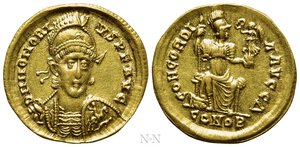
HONORIUS (393-423). GOLD Solidus. Constantinople. Obv: D N HONORIVS P F AVG. Diademed, helmeted and cuirassed bust facing slightly right, holding spear and shield decorated with horseman motif.Rev: CONCORDIA AVGG Δ / CONOB. Constantinopolis seated facing on throne, head right, with foot set upon prow, holding sceptre and victoriola.RIC 8; Depeyrot 55/2.Honorius became Augustus of the West at the age of ten at the behest of his father Theodosius I, who was intent on establishing the succession before his death. Given his young age, however, he was assisted by the valiant general Stilicho, who was half Vandal in origin and unlikely to have been aiming for the throne. The East, on the other hand, was entrusted to Honorius's brother Arcadius, and this was home to unrest because the two brothers did not like each other and were both assisted by cunning and manipulative advisers. By now there was no longer talk of a western and eastern part of the empire, but of two separate empires. Theodosius' project of a united empire in solidarity with the barbarian peoples, integrated into the Roman army, had failed. According to some historians Arcadius was the first Byzantine emperor. Stilicho faced great difficulties on the eastern front, mainly due to Alaric's Goths and other tribes crossing into Gaul. The situation precipitated and the Senate refused to pay a large sum of money to Alaric, further accusing Stilicho of conspiring with the enemy and condemning him to death in 408. It was the beginning of the end for the West, because the most valuable politician and general was lost. Honorius resided in Ravenna, where he treacherously attempted to murder Alaric, who was there to renew the 'foedus' with the emperor. This caused him to break off all negotiations and led to the famous 'sack of Rome' in 410, which marked the end of the city as capital. The news of Rome's fall represented a trauma for the empire and the collapse of the certainty of its invincibility. Honorius also did not recognize the marriage between his half-sister Galla Placidia and Ataulf, Alaric's successor. This marriage was strongly desired by the Goths and may have been a response to the crisis in the empire, as Ataulf intended to settle permanently in Roman territories by offering protection to the emperor instead of fighting him. In 413 General Flavius Constantius defeated four usurpers in the western provinces, succeeded in signing a peace treaty with Ataulf, and became associate emperor under the name Constantius III (421) but, unrecognized by the eastern empire, died shortly thereafter. In 423 Honorius also died, marking the final surrender, the birth of the Romano-Barbarian kingdoms and the first steps of medieval history. Condition: Extremely fine.Weight: 4.48 g. Diameter: 20 mm.
Lot # 1228
-
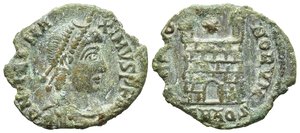
MAGNUS MAXIMUS (383-388). Ae. Aquileia. Obv: D N MAG MAXIMVS P F AVG. Diademed, draped and cuirassed bust right.Rev: SPES ROMANORVM / SMAQS. Camp gate, with open door and two towers; star above.RIC 55a.2. Condition: Good very fine.Weight: 0.95 g. Diameter: 14 mm.
Lot # 1227
-
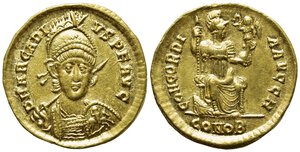
ARCADIUS (383-408). GOLD Solidus. Constantinople. Obv: D N ARCADIVS P F AVG. Diademed, helmeted and cuirassed bust facing slightly right, holding spear and shield decorated with horseman motif.Rev: CONCORDIA AVGG H / CONOB. Constantinopolis seated facing on throne, head right, with foot set upon prow, holding sceptre and victoriola.RIC 7; Depeyrot 55/1.The eldest son of Theodosius I from Spain, Arcadius became augustus at the age of six. When his father left to end the usurpation of Eugenius and did not return, Arcadius remained in Constantinople in his stead and became augustus of the East at eighteen, while his brother Honorius got the West. The empire was now divided, Theodosius I was first seen as the unifier and then as the one who divided it forever. From this time on, the two empires had independent lives and slowly became more and more distinct from each other, and Arcadius was recognized as the first Byzantine emperor. Initially Arcadius reigned under his patron Rufinus, an ambitious politician from Aquitaine who frowned upon his equivalent in the West, Stilicho. The latter made a secret agreement with the Visigoth leader Gainas, who had been welcomed to Constantinople by Arcadius, and killed Rufinus. Stilicho thus prevailed in this dispute but was sentenced to death in 408, accused among other things of the murder of Rufinus himself. His place was then taken by the eunuch Eutropius, remembered in the sources as a cruel and vicious man. Eutropius tried to forge an alliance with Alaric, who now hold the balance of power between East and West. By putting his opponents to death and confiscating their wealth, he succeeded in getting Stilicho declared a public enemy and bring Africa under the control of the East in order to secure its grain, bringing the West to its knees and starving it. In any case, Arcadius was persuaded by the court to get Eutropius, who was in fact acting as the real emperor, out of the way and hit with damnatio memoriae as well. In his place was chosen Gainas himself, the Visigoth leader, who, however, was short-lived. The anti-barbarian mood that was fueled by influential figures, such as Patriarch John Chrysostom, resulted in a revolt in Constantinople against the Goths and, therefore, also against Gainas, and led to a massacre of the barbarians and the escape of their leader. At this point the reins of the empire were taken over by the emperor's wife, Aelia Eudoxia, as Arcadius proved incapable of governing. Aelia pushed Alaric to invade the West, receiving in turn fierce criticism from the patriarch and the hatred of much of the people. However, she died in 404 from an abortion, while Arcadius died of illness four years later. Condition: Extremely fine.Weight: 4.36 g. Diameter: 19 mm.
Lot # 1226
-
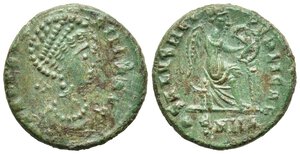
AELIA FLACCILLA (Augusta, 379-386/8). Ae. Heraclea. Obv: AEL FLACCILLA AVG. Diademed and draped bust right.Rev: SALVS REIPVBLICAE / •SMHA. Victory seated right on chair, inscribing Christogram upon shield set upon short column to right.RIC 17.2. Condition: Extremely fine.Weight: 1.62 g. Diameter: 13 mm.
Lot # 1225
-
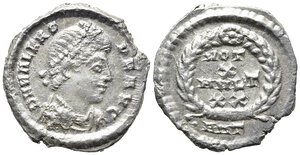
VALENS (364-378). Siliqua. Antioch. Obv: D N VALENS P F AVG. Pearl-diademed, draped and cuirassed bust right.Rev: VOT / X / MVLT / XX / •ANT. Legend in four lines within wreath.RIC 34b.2. Condition: Very fine.Weight: 2.69 g. Diameter: 19 mm.
Lot # 1224
-
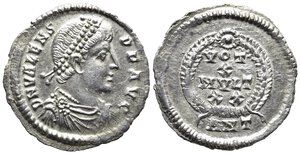
VALENS (364-378). Siliqua. Antioch. Obv: D N VALENS P F AVG. Pearl-diademed, draped and cuirassed bust right.Rev: VOT / X / MVLT / XX / ANT. Legend in four lines within wreath.RIC 34b.1. Condition: Extremely fine.Weight: 1.45 g. Diameter: 19 mm.
Lot # 1223
-
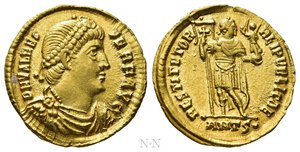
VALENS (364-378). GOLD Solidus. Antioch. Obv: D N VALENS PER F AVG. Pearl-diademed, draped and cuirassed bust right.Rev: RESTITVTOR REIPVBLICAE / •/ANTS•. Valens standing facing, head right, holding labarum with cross and victoriola.RIC 2d.xxv.2; Depeyrot 20/2.Flavius Julius Valens was the younger brother of Valentinian I. After serving as protector domesticus (personal guard) of Julian II and Jovian, he immediately became emperor of the East in 364 thanks to his brother who was already Augustus of the West, although the two differed in faith. Valens in fact was an Arian, while Valentinian was a Nicene Christian. The first problem was presented by the usurper Procopius, comes of Antioch, who proclaimed himself Augustus of the East in 365. Valens defeated him, sentenced him to death and struck with damnatio memoriae. He later faced the Visigoths and a second conspiracy, hatched by Theodore of Antioch. In 374 Valens celebrated the decennalia and became Maximus Augustus in 375 on the death of his brother, after which he organized an expedition against the Persians that proved unsuccessful, forcing him to sign an unfavorable peace. Another problem was the confluence of Ostrogoths and Visigoths into Roman territory across the Danube because of the advance of the Huns. The Romans were forced to accept them, but this integration was not easy; the Visigoths felt oppressed and exploited as a labor-power, resulting in an insurrection. Valens, considered a general of little ability by his contemporaries, was thus induced to recruit Goth mercenaries, with the risk that they would end up allied with his enemies. In fact, a large contingent of Visigoths, Ostrogoths, Huns, and Alamanni joined forces to fight the Romans and achieved a decisive victory at Hadrianopolis (Thrace) in 378. The tremendous defeat was caused by Gratian, who was meanwhile on the Western throne and did not arrive in time with his troops. Valens died in the battle but the Goths failed to conquer Constantinople. According to Ambrose, bishop of Mediolanum, the defeat at Hadrianopolis heralded the fall of the empire and the end of the world. Condition: Extremely fine.Weight: 4.47 g. Diameter: 21 mm.
Lot # 1222
-
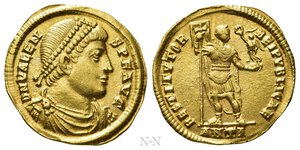
VALENS (364-378). GOLD Solidus. Antioch. Obv: D N VALENS P F AVG. Pearl-diademed, draped and cuirassed bust right.Rev: RESTITVTOR REI PVBLICAE / ANTI. Emperor standing facing, head right, holding labarum with cross on banner and Victory on globe.RIC 2c.i.5; Depeyrot 30/2.Flavius Julius Valens was the younger brother of Valentinian I. After serving as protector domesticus (personal guard) of Julian II and Jovian, he immediately became emperor of the East in 364 thanks to his brother who was already Augustus of the West, although the two differed in faith. Valens in fact was an Arian, while Valentinian was a Nicene Christian. The first problem was presented by the usurper Procopius, comes of Antioch, who proclaimed himself Augustus of the East in 365. Valens defeated him, sentenced him to death and struck with damnatio memoriae. He later faced the Visigoths and a second conspiracy, hatched by Theodore of Antioch. In 374 Valens celebrated the decennalia and became Maximus Augustus in 375 on the death of his brother, after which he organized an expedition against the Persians that proved unsuccessful, forcing him to sign an unfavorable peace. Another problem was the confluence of Ostrogoths and Visigoths into Roman territory across the Danube because of the advance of the Huns. The Romans were forced to accept them, but this integration was not easy; the Visigoths felt oppressed and exploited as a labor-power, resulting in an insurrection. Valens, considered a general of little ability by his contemporaries, was thus induced to recruit Goth mercenaries, with the risk that they would end up allied with his enemies. In fact, a large contingent of Visigoths, Ostrogoths, Huns, and Alamanni joined forces to fight the Romans and achieved a decisive victory at Hadrianopolis (Thrace) in 378. The tremendous defeat was caused by Gratian, who was meanwhile on the Western throne and did not arrive in time with his troops. Valens died in the battle but the Goths failed to conquer Constantinople. According to Ambrose, bishop of Mediolanum, the defeat at Hadrianopolis heralded the fall of the empire and the end of the world. Condition: Near extremely fine.Weight: 4.44 g. Diameter: 22 mm.
Lot # 1221
-
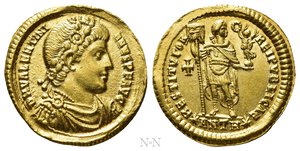
VALENTINIAN I (364-375). GOLD Solidus. Antioch. Obv: D N VALENTINIANVS P F AVG. Rosette-diademed, draped and cuirassed bust right.Rev: RESTITVTOR REIPVBLICAE / (star) ANTH (star). Valentinian standing facing, head right, holding labarum with cross on banner and victoriola; cross to left.RIC 2b.xxxviii.8; Depeyrot 20/1. Condition: Extremely fine.Weight: 4.48 g. Diameter: 22 mm.
Lot # 1220
-
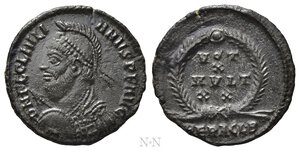
JULIAN II APOSTATA (360-363). Ae. Heraclea. Obv: D N FL CL IVLIANVS P F AVG. Diademed, helmeted and cuirassed bust left, holding spear and shield.Rev: VOT / X / MVLT / XX / HERACL•B. Legend in four lines within wreath.RIC 106. Condition: Extremely fine.Weight: 2.78 g. Diameter: 21 mm.
Lot # 1219
-
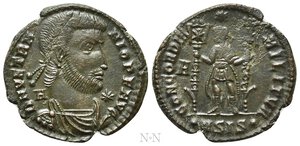
VETRANIO (350). Ae. Siscia. Obv: D N VETRANIO P F AVG. Laureate, draped and cuirassed bust right; A to left, star to right.Rev: CONCORDIA MILITVM / A / •ASIS•. Vetranio standing facing, head left, holding labarum decorated with phalerae in each hand; star above.RIC 285. Condition: Near extremely fine.Weight: 4.30 g. Diameter: 23 mm.
Lot # 1218
-
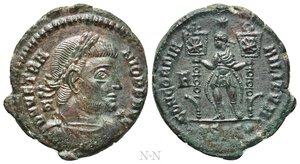
VETRANIO (350). Ae. Siscia. Obv: D N VETRANIO P F AVG. Laureate, draped and cuirassed bust right; A to left, star to right.Rev: CONCORDIA MILITVM / A / •BSIS•. Vetranio standing facing, head left, holding labarum decorated with phalerae in each hand; star above.RIC 285. Condition: Extremely fine.Weight: 4.60 g. Diameter: 24 mm.
Lot # 1217
-
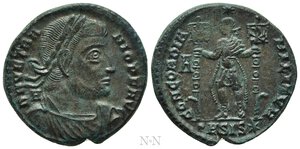
VETRANIO (350). Ae. Siscia. Obv: D N VETRANIO P F AVG. Laureate, draped and cuirassed bust right; A to left.Rev: CONCORDIA MILITVM / A / •ASIS (star). Vetranio standing facing, head left, holding labarum in each hand; star above.RIC 281. Condition: Near extremely fine.Weight: 6.20 g. Diameter: 23 mm.
Lot # 1216
-
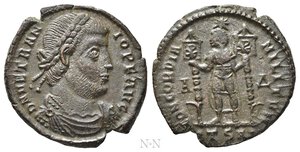
VETRANIO (350). Ae. Thessalonica. Obv: D N VETRANIO P F AVG. Diademed, draped and cuirassed bust right.Rev: CONCORDIA MILITVM / A - Δ / •TSA•. Vetranio standing facing, head left, holding labarum decorated with christogram in each hand; star above.RIC 135. Condition: Very fine.Weight: 5.78 g. Diameter: 25 mm.
Lot # 1215
-
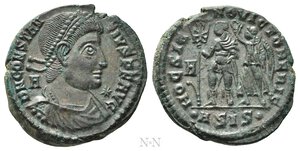
CONSTANTIUS II (337-361). Ae. Siscia. Obv: D N CONSTANTIVS P F AVG. Pearl-diademed, draped and cuirassed bust right; A to left, star to right.Rev: HOC SIGNO VICTOR ERIS / A / •ASIS•. Constantius standing left, holding labarum and spear; to right, crowning Victory standing left.RIC 286. Condition: Extremely fine.Weight: 7.30 g. Diameter: 23 mm.
Lot # 1214
-
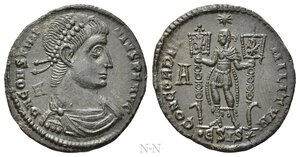
CONSTANTIUS II (337-361). Ae. Siscia. Obv: D N CONSTANTIVS P F AVG. Pearl-diademed, draped and cuirassed bust right; A to left.Rev: CONCORDIA MILITVM / A / •ЄSIS (star). Constantius standing left, holding labarum in each hand; star above.RIC 280. Condition: Extremely fine.Weight: 3.55 g. Diameter: 23 mm.
Lot # 1213
-
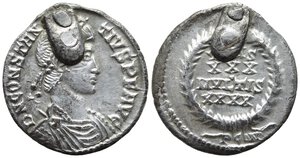
CONSTANTIUS II (337-361). Siliqua. Arelate. Obv: D N CONSTANTIVS P F AVG. Diademed, draped and cuirassed bust right.Rev: VOTIS / XXX / MVLTIS / XXXX / PCON. Legend in four lines within wreath.RIC 207 & 253. Condition: Very fine.Weight: 2.61 g. Diameter: 19 mm.
Lot # 1212
-
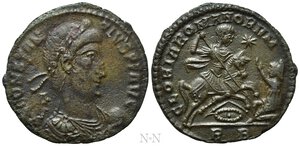
CONSTANTIUS II (337-361). Ae. Rome. Obv: D N CONSTANTIVS P F AVG. Rosette-diademed, draped and cuirassed bust right, holding globe; A behind.Rev: GLORIA ROMANORVM / R P. Emperor galloping right, spearing enemy beneath horse; star above.RIC 196. Condition: Good very fine.Weight: 4.59 g. Diameter: 24 mm.
Lot # 1211
-
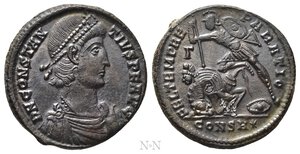
CONSTANTIUS II (337-361). Follis. Constantinople. Obv: D N CONSTANTIVS P F AVG. Diademed, draped and cuirassed bust right.Rev: FEL TEMP REPARATIO / Γ / CONSH (star). Soldier advancing left, spearing fallen horseman.RIC 81. Condition: Near extremely fine.Weight: 6.54 g. Diameter: 23 mm.
Lot # 1210
-
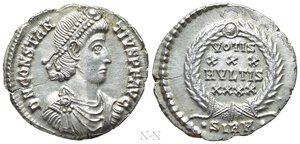
CONSTANTIUS II (337-361). Siliqua. Sirmium. Obv: D N CONSTANTIVS P F AVG. Diademed, draped and cuirassed bust right.Rev: VOTIS / XXX / MVLTIS / XXXX / •SIRM•. Legend in four lines within wreath.RIC 66. Condition: Near mint state.Weight: 3.11 g. Diameter: 21 mm.
Lot # 1209
-
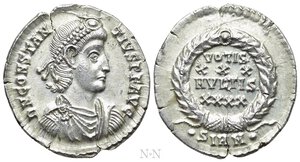
CONSTANTIUS II (337-361). Siliqua. Sirmium. Obv: D N CONSTANTIVS P F AVG. Diademed, draped and cuirassed bust right.Rev: VOTIS / XXX / MVLTIS / XXXX / •SIRM•. Legend in four lines within wreath.RIC 66. Condition: Extremely fine; luster in field.Weight: 3.12 g. Diameter: 21 mm.
Lot # 1208
-
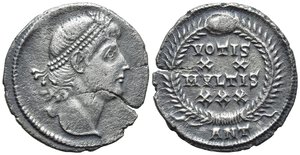
CONSTANTIUS II (337-361). Siliqua. Antioch. Obv: Diademed bust right, with eyes raised to heaven.Rev: VOTIS / XX / MVLTIS / XXX / ANT. Legend in four lines within wreath.RIC 36. Condition: Very fine.Weight: 2.81 g. Diameter: 21 mm.
Lot # 1207
-
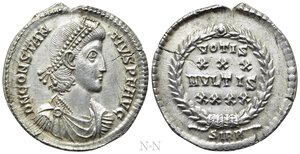
CONSTANTIUS II (337-361). Siliqua. Sirmium. Obv: D N CONSTANTIVS P F AVG. Pearl-diademed, draped and cuirassed bust right.Rev: VOTIS / XXX / MVLTIS / XXXX / SIRM. Legend in four lines within wreath.RIC 15. Condition: Extremely fine.Weight: 3.12 g. Diameter: 21 mm.
Lot # 1206
-
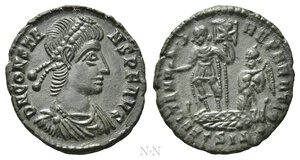
CONSTANS (337-350). Follis. Siscia. Obv: D N CONSTANS P F AVG. Pearl-diademed, draped and cuirassed bust right.Rev: FEL TEMP REPARATIO / ΓSIS (symbol). Constans standing left in galley left, holding crowning Phoenix and labarum; to right, rowing Victory seated left.RIC 199. Condition: Extremely fine.Weight: 2.44 g. Diameter: 19 mm.
Lot # 1205
-
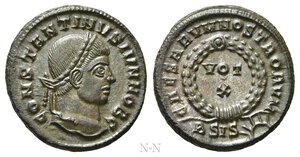
CONSTANTINE II (Caesar, 316-337). Follis. Siscia. Obv: CONSTANTINVS IVN NOB C. Laureate head right.Rev: CAESARVM NOSTRORVM / BSIS (sun). VOT / X in two lines within wreath.RIC 182. Condition: Extremely fine.Weight: 3.61 g. Diameter: 19 mm.
Lot # 1204
-
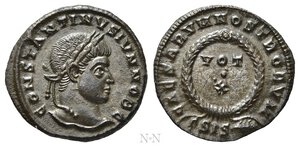
CONSTANTINE II (Caesar, 316-337). Follis. Siscia. Obv: CONSTANTINVS IVN NOB C. Laureate head right.Rev: CAESARVM NOSTRORVM / ΓSIS (palm). VOT / X in two lines within wreath.RIC 176. Condition: Extremely fine.Weight: 2.95 g. Diameter: 19 mm.
Lot # 1203
-
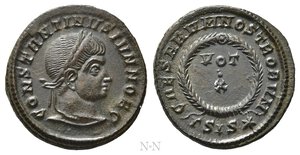
CONSTANTINE II (Caesar, 316-337). Follis. Siscia. Obv: CONSTANTINVS IVN NOB C. Laureate head right.Rev: CAESARVM NOSTRORVM / ΓSIS (star). VOT / X in two lines within wreath.RIC 166. Condition: Extremely fine.Weight: 3.39 g. Diameter: 19 mm.
Lot # 1202
-
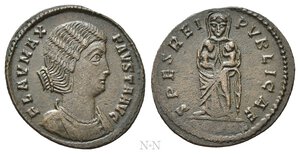
FAUSTA (Augusta, 324-326). Follis. Arelate. Obv: FLAV MAX FAVSTA AVG. Draped bust right.Rev: SPES REIPVBLICAE / QA (crescent) RL. Spes standing left, cradling two infants in her arms.RIC 300 (R4).Very rare Condition: Near extremely fine.Weight: 2.63 g. Diameter: 20 mm.Very rare
Lot # 1201
-
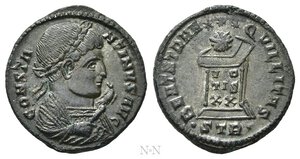
CONSTANTINE I 'THE GREAT' (307/10-337). Follis. Treveri. Obv: CONSTANTINVS AVG. Laureate and mantled bust right, holding eagle-tipped sceptre.Rev: BEATA TRANQVILLITAS / •STR•. Globe set on altar inscribed VO / TIS / XX; three stars above.RIC 369. Condition: Extremely fine.Weight: 3.48 g. Diameter: 20 mm.
Lot # 1200
-
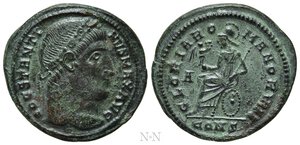
CONSTANTINE I 'THE GREAT' (307/10-337). Follis. Constantinople. Obv: CONSTANTINVS MAX AVG. Rosette-diademed head right.Rev: GLORIA ROMANORVM / A / CONS. Roma seated left on shield, holding sceptre and Victory on globe.RIC 23. Condition: Extremely fine.Weight: 3.55 g. Diameter: 21 mm.
Lot # 1199
-
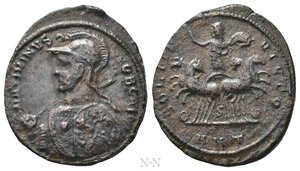
MAXIMINUS II (Caesar, 305-309). Follis. Antioch. Obv: MAXIMINVS NOB CAES. Helmeted and cuirassed bust left, holding spear over shoulder and shield decorated with two horsemen and four infantrymen in a battle scene.Rev: SOLI INVICTO / S / ANT. Sol, head left and raising hand, driving facing spread quadriga.RIC 145b (R3; unlisted officina).Rare Condition: Very fine, cleaning marks.Weight: 5.83 g. Diameter: 26 mm.Rare
Lot # 1198
-
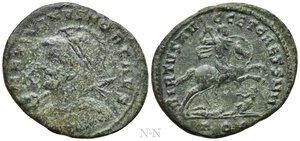
MAXIMINUS II (Caesar, 305-309). Follis. Aquileia. Obv: MAXIMINVS NOB CAES. Laureate, helmeted and cuirassed bust left, holding shield and sceptre over shoulder.Rev: VIRTVS AVGG ET CAESS NN / AQ[...]. Severus on horse rearing right, preparing to hurl spear at two fallen enemies below.RIC 68b.Rare Condition: Very fine.Weight: 7.67 g. Diameter: 30 mm.Rare
Lot # 1197
-
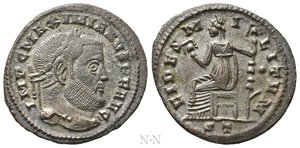
GALERIUS MAXIMIANUS (305-311). Follis. Ticinum. Obv: IMP C MAXIMIANVS P F AVG. Laureate head right.Rev: FIDES MILITVM / • / ST. Fides seated left with two standards.RIC 55b. Condition: Good very fine.Weight: 9.32 g. Diameter: 29 mm.
Lot # 1196
-
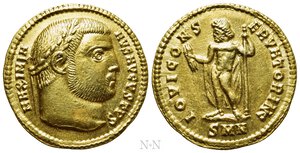
GALERIUS MAXIMIANUS (305-311). GOLD Aureus. Nicomedia. Obv: MAXIMIANVS AVGVSTVS. Laureate head right.Rev: IOVI CONSERVATORI (NK) / SMN. Jupiter standing left, holding thunderbolt and sceptre.RIC 33; Calicó 4926.Galerius was born near Serdica in Dacia. He distinguished himself in war under Aurelian and Probus, served as praetorian prefect to Diocletian, and took the name Maximianus 'Jovius' in 293, when he became caesar in the East and was adopted by Diocletian before marrying his daughter.
In 296 he was engaged in a military campaign in Egypt against the Persian king Narseh. Galerius suffered a heavy defeat that went down in history, as it caused the loss of Mesopotamia. However, he did not give up and was later able to defeat Narsehand recover the province in 298.
Through this success he regained the emperor's trust and, following the abdication of Diocletian and Maximian, became augustus in the East in 305. He moved the capital from Thessalonica to Nicomedia and appointed Severus as caesar in the West and Constantine (son of Constantius Chlorus) in the East. When Severus lost his life to the revolt of Maxentius, son of Maximianus, Galerius's dream of reunifying the empire was threatened. In 308 at Carnuntum he succeeded in getting Licinius the throne of the West so as to keep the civil wars and the lust for power of many figures in check.
After that Galerius became seriously ill and, fearing divine punishment, proclaimed an important measure in favor of Christians. According to historians he conducted prolonged persecutions and had influenced even the decisions of Diocletian. Therefore, before he died, he revoked Diocletian's edict, granting Christians peace and freedom of worship within the empire.
With his death the Tetrarchy also died. Condition: Extremely fine; some restorations.Weight: 5.36 g. Diameter: 20 mm.
Lot # 1195
-
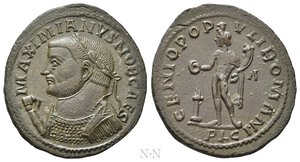
GALERIUS MAXIMIANUS (Caesar, 293-305). Follis. Lugdunum. Obv: MAXIMIANVS NOB CAES. Laureate and cuirassed bust left, holding sceptre over shoulder.Rev: GENIO POPVLI ROMANI / A / PLG. Genius standing facing, head left, holding patera and cornucopia; altar to left.RIC 144b. Condition: Good very fine.Weight: 9.06 g. Diameter: 30 mm.
Lot # 1194
-
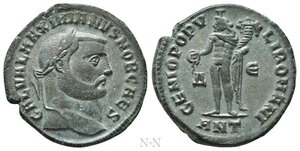
GALERIUS MAXIMIANUS (Caesar, 293-305). Follis. Antioch. Obv: GAL VAL MAXIMIANVS NOB CAES. Laureate head right.Rev: GENIO POPVLI ROMANI / Δ - Є / ANT. Genius standing left, holding cornucopia and sacrificing with patera.RIC 53b. Condition: Extremely fine.Weight: 9.70 g. Diameter: 27 mm.
Lot # 1193
-
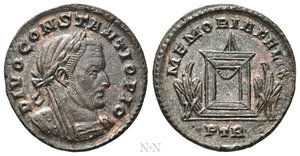
DIVUS CONSTANTIUS I (Died 306). Follis. Treveri. Obv: DIVO CONSTANTIO PIO. Laureate, veiled and draped bust right.Rev: MEMORIA FELIX / PTR. Lighted and garlanded altar flanked by eagles.RIC 789. Condition: Extremely fine.Weight: 6.30 g. Diameter: 26 mm.
Lot # 1192
-
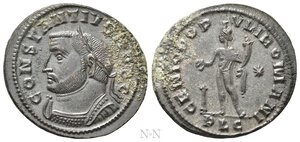
CONSTANTIUS I (Caesar, 293-305). Follis. Lugdunum. Obv: CONSTANTIVS NOB C. Laureate and cuirassed bust left.Rev: GENIO POPVLI ROMANI / (star) / PLG. Genius standing left, holding cornucopia and patera over altar.RIC 180a. Condition: Extremely fine.Weight: 10.10 g. Diameter: 30 mm.
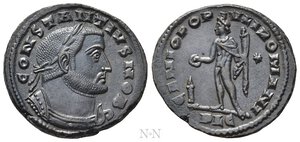
Lot # 1191
-
CONSTANTIUS I (Caesar, 293-305). Follis. Lugdunum. Obv: CONSTANTIVS NOB C. Laureate and cuirassed bust right.Rev: GENIO POPVLI ROMANI / (star) / PLG. Genius standing left, holding cornucopia, sacrificing from patera over altar.RIC 178a. Condition: Extremely fine.Weight: 11.79 g. Diameter: 28 mm.
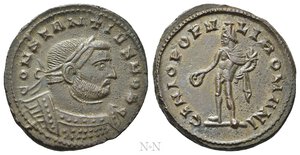
Lot # 1190
-
CONSTANTIUS I (Caesar, 293-305). Follis. Londinium. Obv: CONSTANTIVS NOB C. Laureate and cuirassed bust right.Rev: GENIO POPVLI ROMANI. Genius standing left, holding patera and cornucopia.RIC 22. Condition: Near extremely fine.Weight: 9.16 g. Diameter: 27 mm.
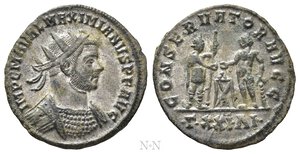
Lot # 1189
-
MAXIMIANUS HERCULIUS (First reign, 286-305). Antoninianus. Siscia. Obv: IMP C M A VAL MAXIMIANVS P F AVG. Radiate and cuirassed bust right.Rev: CONSERVATOR AVGG / •Γ•XXI•ΛI•. Maximianus standing right, holding sceptre, and Hercules, resting hand upon club, standing facing one another, each holding patera and sacrificing over lighted altar between them.RIC 580. Condition: Good very fine.Weight: 3.16 g. Diameter: 22 mm.
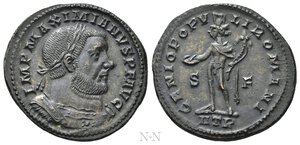
Lot # 1188
-
MAXIMIANUS HERCULIUS (First reign, 286-305). Follis. Treveri. Obv: IMP MAXIMIANVS P F AVG. Laureate and cuirassed bust right.Rev: GENIO POPVLI ROMANI / S - F / IITR. Genius standing left, holding patera and cornucopia.RIC 504. Condition: Extremely fine.Weight: 9.50 g. Diameter: 29 mm.
NGC Grading MS*
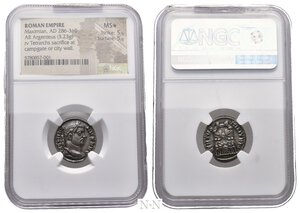
Lot # 1187
-
MAXIMIANUS HERCULIUS (Forst reign, 286-305). Argenteus. Treveri. Obv: MAXIMIANVS AVG. Laureate head right.Rev: VIRTVS MILITVM. The tetrarchs sacrificing over tripod before city enclosure with six turrets.RIC 102b.Certified by NGC 5780857-001 (as MS*) Condition: Extremely fine; luster in field.Weight: g. Diameter: mm.
Lot # 1186
-
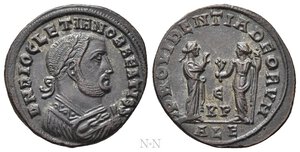
DIOCLETIAN (Senior Augustus, 305-311/2). Follis. Alexandria. Obv: D N DIOCLETIANO BAEATISS. Laureate bust right, wearing trabea and holding olive branch and mappa.Rev: PROVIDENTIA DEORVM / Є KP / ALE. Providentia standing right, extending hand to Quies standing left, holding branch and sceptre.RIC 109. Condition: Near extremely fine.Weight: 6.15 g. Diameter: 25 mm.
Results from 13251 to 13300 of 32902