Roman Imperial Coins
Results from 23101 to 23150 of 32905
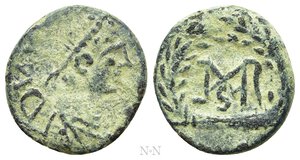
Lot # 1138
-
MARCIAN (450-457). Nummus. Constantinople. Obv: D N MARCIANVS P F AVG. Diademed, draped and cuirassed bust right.Rev: Monogram within wreath; CON.RIC 541. Condition: Very fine.Weight: 1.23 g. Diameter: 11 mm.
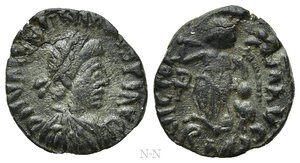
Lot # 1137
-
VALENTINIAN III (425-455). Nummus. Rome. Obv: D N VALENTINIANVS P F AVG. Diademed, draped and cuirassed bust right.Rev: VICTORIA AVGG / (staurogram) / RM. Victory advancing left, holding wreath and palm frond.RIC 2138. Condition: Good very fine.Weight: 0.98 g. Diameter: 12 mm.
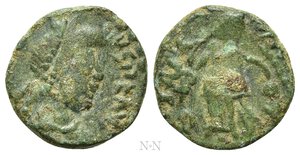
Lot # 1136
-
THEODOSIUS II ? (402-450). Ae. Rome. Obv: [...]VS P F AVG. Pearl-diademed, draped and cuirassed bust right.Rev: SALVS REI PVBLICAE / [...]. Victory advancing left, head right, holding trophy and dragging captive; staurogram to elft.Cf. RIC 1914. Condition: Very fine.Weight: 1.20 g. Diameter: 12 mm.
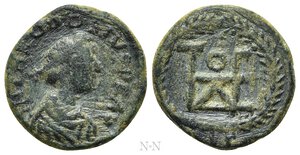
Lot # 1135
-
THEODOSIUS II (402-450). Nummus. Nicomedia. Obv: D N THEODOSIVS P F AVG. Diademed, draped and cuirassed bust right.Rev: Monogram of Theodosius within wreath; NIC below.RIC 465. Condition: Very fine.Weight: 1.51 g. Diameter: 13 mm.
Lot # 1134
-
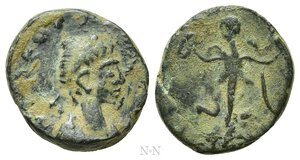
THEODOSIUS II ? (402-450). Ae. Uncertain mint. Possibly imitative. Obv: [...]EO[...]. Pearl-diademed, draped and cuirassed bust right.Rev: Victory standing facing, holding wreath in each hand.Cf. RIC 437 (Cyzicus). Condition: Near very fine.Weight: 1.03 g. Diameter: 11 mm.
Lot # 1133
-
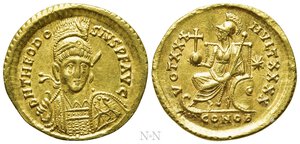
THEODOSIUS II (402-450). GOLD Solidus. Constantinople. Obv: D N THEODOSIVS P F AVG. Helmeted and cuirassed bust facing slightly right, holding spear and shield decorated with horseman motif.Rev: VOT XXX MVLT XXXX / CONOB. Constantinopolis seated left on throne, with foot upon prow, holding globus cruciger and sceptre, and resting elbow upon shield; star to right.RIC 257 var. (officina). Condition: Extremely fine.Weight: 4.40 g. Diameter: 21 mm.
Lot # 1132
-
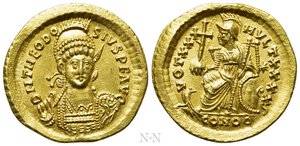
THEODOSIUS II (402-450). GOLD Solidus. Constantinople. Obv: D N THEODOSIVS P F AVG. Helmeted and cuirassed bust facing slightly right, holding spear and shield decorated with horseman motif.Rev: VOT XXX MVLT XXXX S / CONOB. Constantinopolis seated left on throne, with foot upon prow, holding globus cruciger and sceptre, and resting elbow upon shield; star to right.RIC 257; Depeyrot 81/1. Condition: Extremely fine.Weight: 4.47 g. Diameter: 21 mm.
Lot # 1131
-
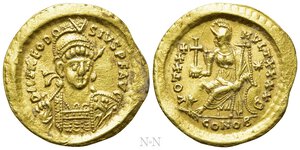
THEODOSIUS II (402-450). GOLD Solidus. Constantinople. Obv: D N THEODOSIVS P F AVG. Helmeted and cuirassed bust facing slightly right, holding spear and shield decorated with horseman motif.Rev: VOT XXX MVLT XXXX B / CONOB. Constantinopolis seated left on throne, with foot upon prow, holding globus cruciger and sceptre, and resting elbow upon shield; star to right.RIC 257; Depeyrot 81/1. Condition: Good very fine.Weight: 4.38 g. Diameter: 21 mm.
Lot # 1130
-
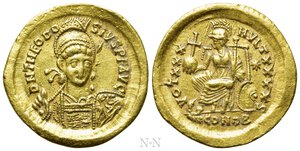
THEODOSIUS II (402-450). GOLD Solidus. Constantinople. Obv: D N THEODOSIVS P F AVG. Helmeted and cuirassed bust facing slightly right, holding spear and shield decorated with horseman motif.Rev: VOT XXX MVLT XXXX S / CONOB. Constantinopolis seated left on throne, with foot upon prow, holding globus cruciger and sceptre, and resting elbow upon shield; star to right.RIC 257; Depeyrot 81/1. Condition: Good very fine.Weight: 4.45 g. Diameter: 21 mm.
Lot # 1129
-
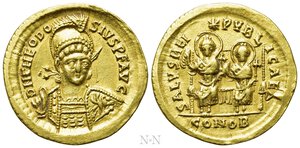
THEODOSIUS II (402-450). GOLD Solidus. Constantinople. Obv: D N THEODOSIVS P F AVG. Helmeted and cuirassed bust facing slightly right, holding spear and shield decorated with horseman motif.Rev: SALVS REI PVBLICAE Δ / CONOB. Theodosius II seated facing on the left and Valentinian III standing facing on the right, both wearing consular robes, holding mappa and cross; star above.RIC 237; Depeyrot 79/1. Condition: Good very fine.Weight: 4.38 g. Diameter: 21 mm.
Highlight
Lot # 1128
-
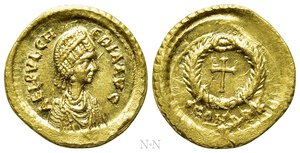
AELIA PULCHERIA (Augusta, 414-453). GOLD Tremissis. Constantinople. Obv: AEL PVLCHERIA AVG. Diademed, draped and cuirassed bust right.Rev: CONOB (star). Cross within wreath.RIC 280 (wreath ties 8); Depeyrot 72/4.Aelia Pulcheria was empress of the Eastern Roman Empire from 414, when she was only 16 years old, as regent for her younger brother, emperor Theodosius II, and then as wife of Marcian after Theodosius' childless death. This was a fervently Christian family: her father Theodosius I had been a disciple of St. Ambrose, and Pulcheria took a vow of virginity, convincing her sisters to do the same. She undertook to find a wife for her brother herself and convinced the pagan Athenais to convert to Christianity. The latter agreed and became empress under the name Eudocia. Pulcheria also convinced Theodosius to have the Jews driven out of Constantinople, depriving them of all their property, and to declare war on the Persians because they did not follow the Christian religion. He prohibited pagans from entering public offices and expelled the patriarch Nestorius, considered a heretic, from Constantinople. Upon the death of Theodosius II, who died without an heir, Pulcheria married Marcian, after rejecting all marriage proposals she had had up to that point. Marcian thus became emperor, provided, however, that the marriage was never consummated. As empress she sponsored the building of many churches and shrines, and engaged in intense correspondence with Pope Leo the Great, who especially begged her to help him suppress the Monophysite heresy of Eutyches, later condemned in 451 at the Council of Chalcedon. Pulcheria died in 453. In her will, drafted by Marcianus, she left all her property to the poor. Condition: Mint State.Weight: 1.51 g. Diameter: 14 mm.
Lot # 1127
-
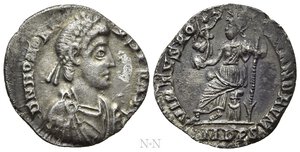
HONORIUS (393-423). Siliqua. Mediolanum. Obv: D N HONORIVS P F AVG. Diademed, draped and cuirassed bust right.Rev: VIRTVS ROMANORVM / MDPS. Roma seated left on cuirass, holding spear and victoriola.RIC 1228. Condition: Very fine.Weight: 1.28 g. Diameter: 16 mm.
Lot # 1126
-
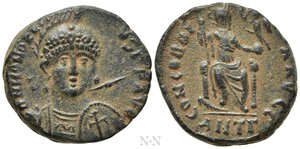
HONORIUS (393-423). Ae. Antioch. Obv: D N HONORIVS P F AVG. Helmeted and cuirassed bust facing slightly right, holding spear and shield decorated with cross.Rev: CONCORDIA AVGG / ANTΓ. Constantinopolis seated facing on throne, head right, holding sceptre and victoriola.RIC 99. Condition: Good very fine.Weight: 2.94 g. Diameter: 17 mm.
Lot # 1125
-
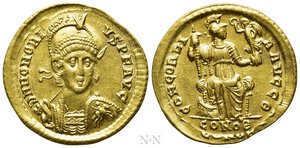
HONORIUS (393-423). GOLD Solidus. Constantinople. Obv: D N HONORIVS P F AVG. Diademed, helmeted and cuirassed bust facing slightly right, holding spear and shield decorated with horseman motif.Rev: CONCORDIA AVGG Θ / CONOB. Constantinopolis seated facing on throne, head right, with foot set upon prow, holding sceptre and victoriola.RIC 8; Depeyrot 55/2.Honorius became Augustus of the West at the age of ten at the behest of his father Theodosius I, who was intent on establishing the succession before his death. Given his young age, however, he was assisted by the valiant general Stilicho, who was half Vandal in origin and unlikely to have been aiming for the throne. The East, on the other hand, was entrusted to Honorius's brother Arcadius, and this was home to unrest because the two brothers did not like each other and were both assisted by cunning and manipulative advisers. By now there was no longer talk of a western and eastern part of the empire, but of two separate empires. Theodosius' project of a united empire in solidarity with the barbarian peoples, integrated into the Roman army, had failed. According to some historians Arcadius was the first Byzantine emperor. Stilicho faced great difficulties on the eastern front, mainly due to Alaric's Goths and other tribes crossing into Gaul. The situation precipitated and the Senate refused to pay a large sum of money to Alaric, further accusing Stilicho of conspiring with the enemy and condemning him to death in 408. It was the beginning of the end for the West, because the most valuable politician and general was lost. Honorius resided in Ravenna, where he treacherously attempted to murder Alaric, who was there to renew the 'foedus' with the emperor. This caused him to break off all negotiations and led to the famous 'sack of Rome' in 410, which marked the end of the city as capital. The news of Rome's fall represented a trauma for the empire and the collapse of the certainty of its invincibility. Honorius also did not recognize the marriage between his half-sister Galla Placidia and Ataulf, Alaric's successor. This marriage was strongly desired by the Goths and may have been a response to the crisis in the empire, as Ataulf intended to settle permanently in Roman territories by offering protection to the emperor instead of fighting him. In 413 General Flavius Constantius defeated four usurpers in the western provinces, succeeded in signing a peace treaty with Ataulf, and became associate emperor under the name Constantius III (421) but, unrecognized by the eastern empire, died shortly thereafter. In 423 Honorius also died, marking the final surrender, the birth of the Romano-Barbarian kingdoms and the first steps of medieval history Condition: Good very fine.Weight: 4.46 g. Diameter: 20 mm.
Lot # 1124
-
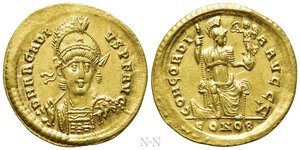
ARCADIUS (383-408). GOLD Solidus. Constantinople. Obv: D N ARCADIVS P F AVG. Helmeted and cuirassed bust facing slightly right, holding spear and shield decorated with horseman motif.Rev: CONCORDIA AVGG Z / CONOB. Constantinopolis seated facing on throne, head right, with foot set upon prow, holding sceptre and victoriola.RIC 7; Depeyrot 55/1.The eldest son of Theodosius I from Spain, Arcadius became augustus at the age of six. When his father left to end the usurpation of Eugenius and did not return, Arcadius remained in Constantinople in his stead and became augustus of the East at eighteen, while his brother Honorius got the West. The empire was now divided, Theodosius I was first seen as the unifier and then as the one who divided it forever. From this time on, the two empires had independent lives and slowly became more and more distinct from each other, and Arcadius was recognized as the first Byzantine emperor. Initially Arcadius reigned under his patron Rufinus, an ambitious politician from Aquitaine who frowned upon his equivalent in the West, Stilicho. The latter made a secret agreement with the Visigoth leader Gainas, who had been welcomed to Constantinople by Arcadius, and killed Rufinus. Stilicho thus prevailed in this dispute but was sentenced to death in 408, accused among other things of the murder of Rufinus himself. His place was then taken by the eunuch Eutropius, remembered in the sources as a cruel and vicious man. Eutropius tried to forge an alliance with Alaric, who now hold the balance of power between East and West. By putting his opponents to death and confiscating their wealth, he succeeded in getting Stilicho declared a public enemy and bring Africa under the control of the East in order to secure its grain, bringing the West to its knees and starving it. In any case, Arcadius was persuaded by the court to get Eutropius, who was in fact acting as the real emperor, out of the way and hit with damnatio memoriae as well. In his place was chosen Gainas himself, the Visigoth leader, who, however, was short-lived. The anti-barbarian mood that was fueled by influential figures, such as Patriarch John Chrysostom, resulted in a revolt in Constantinople against the Goths and, therefore, also against Gainas, and led to a massacre of the barbarians and the escape of their leader. At this point the reins of the empire were taken over by the emperor's wife, Aelia Eudoxia, as Arcadius proved incapable of governing. Aelia pushed Alaric to invade the West, receiving in turn fierce criticism from the patriarch and the hatred of much of the people. However, she died in 404 from an abortion, while Arcadius died of illness four years later. Condition: Near extremely fine.Weight: 4.45 g. Diameter: 20 mm.
Lot # 1123
-
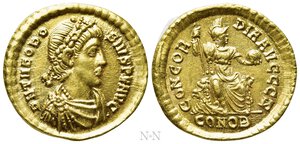
THEODOSIUS I (379-395). GOLD Solidus. Constantinople. Obv: D N THEODOSIVS P F AVG. Rosette-diademed, draped and cuirassed bust right.Rev: CONCORDIA AVGGG Z / CONOB. Concordia, with foot set upon eagle-headed prow, seated facing on throne, head right, holding sceptre and globus.RIC 45d.6; Depeyrot 33/3.Theodosius I, called "the Great" by Christian writers, was of Spanish origin. His father was a magister equitum who fell into disgrace under Valentinian I and was later executed by Gratian. However, Theodosius' military exploits in Britain against the Alamanni and Sarmati, and in Africa against the usurper Firmus, induced Gratian to elevate him to the rank of Augustus of the East in 379, to give him control of Thrace, Dacia and Macedonia. Theodosius managed to prevent another war against the Huns and Visigoths by signing an agreement in 382, allowing them to settle in Thrace on condition that they fight for him. The need to pay these mercenaries caused a considerable tax increase for the Romans, but it proved to be a successful move. Upon Gratian's death, the usurper of Britain, Magnus Maximus, marched into Italy and threatened the throne of Valentinian II. Theodosius married Valentinian II's sister, Galla, and succeeded in defeating Magnus Maximus in 388 with troops from the Visigoths and Huns. Another threat, however, was posed by Arbogaste, a Frankish general, who was able to put Eugenius on the Western throne instead of Valentinian II. Theodosius refused to recognize his position and appointed his son, Honorius, as Augustus of the West, inducing Eugenius to invade Italy and start a war. Eugenius and Arbogaste were defeated at the Frigidus River in 394, and Theodosius became sole Augustus of the entire empire, but he died shortly thereafter in Mediolanum. His funeral was celebrated by Bishop Ambrose, and the body was transported to Constantinople, where the consecratio took place. Theodosius is remembered as a fervent believer in the Nicene faith and for issuing the Edict of Thessalonica, by which he attempted to end theological disputes. He also made Christianity the sole state religion in 380, declaring Arians and devotees of other movements heretics. In 392 he banned the pagan religion. Condition: Extremely fine.Weight: 4.43 g. Diameter: 20 mm.
Lot # 1122
-
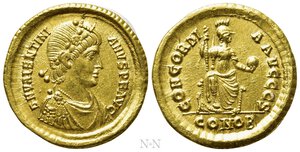
VALENTINIAN II (375-392). GOLD Solidus. Constantinople. Obv: D N VALENTINIANVS P F AVG. Rosette-diademed, draped and cuirassed bust right.Rev: CONCORDIA AVGGG S / CONOB. Constantinopolis seated facing on throne ornamented with lion heads, head right, with foot set upon prow, holding sceptre and globus.RIC 45b.2; Depeyrot 33/2.Flavius Valentinianus, of Augusta Treverorum (Treveri), son of Justina, ascended the throne when he was only four years old. He was elected augustus in 375 by the soldiers, because they refused to let the sole legions of Germania, who had nominated Valentinian's elder half-brother Gratian, choose the emperor. However young, Valentinian faced complicated situations with his mother and Gratian, such as the usurpation of Magnus Maximus in Britain, which was remedied by Theodosius I, who managed to prevent Valentinian from being attacked by the insurgent's legions. More complicated was the matter of the removal of the Altar of Victory from the Senate of Rome, which represented the city's glorious pagan tradition. Its removal was supported by Gratian, on the advice of charismatic figures such as Mediolanum bishop Ambrose, which led him to confront a group headed by senator Quintus Aurelius Simmachus. As much as Justina and her son were of the Arian faith and close to Simmachus, the altar was nevertheless removed to the great scandal of the court of Rome. When his mother and brother faced such situations, because of his young age Valentinian often remained in the background; moreover, he fell under the spell of a dangerous character: the Frank leader and able warrior Arbogastes, his magister equitum. Soon, however, their relationship became conflictual, partly because of the Altar of Victory, which Arbogaste wanted to see restored. Valentinian was found hanged from a tree in 392 at Vienne in Gaul. Sources disagree on the cause of death, some mentioning suicide, others leaning toward murder by Arbogaste. The emperor was probably the victim of a palace conspiracy, as Arbogaste had led to the elevation of Flavius Eugenius to augustus. The damnatio memoriae documented by some eroded inscriptions may support this hypothesis. His funeral was held in Mediolanum, at the behest of Theodosius I, by Bishop Ambrose, who also wrote a consolatory piece on the young emperor's death for the occasion. Condition: Extremely fine.Weight: 4.46 g. Diameter: 20 mm.
Lot # 1121
-
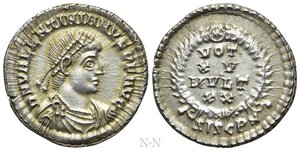
VALENTINIAN II (375-392). Siliqua. Siscia. Obv: D N VALENTINIANVS P F AVG. Diademed, draped and cuirassed bust right.Rev: VOT/XV/MVLT/XX in four lines within wreath; SISCPS.RIC 19c.2. Condition: Extremely fine.Weight: 2.30 g. Diameter: 19 mm.
Lot # 1120
-
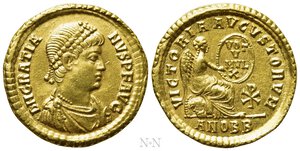
GRATIAN (367-383). GOLD Solidus. Antioch. Obv: D N GRATIANVS P F AVG. Pearl-diademed, draped and cuirassed bust right.Rev: VICTORIA AVGVSTORVM / ANOBB. Victory seated right on cuirass, holding shield inscribed with VOT V MVL X, christogram in right field.RIC 21a.1. Condition: Near extremely fine.Weight: 4.46 g. Diameter: 21 mm.
Lot # 1119
-
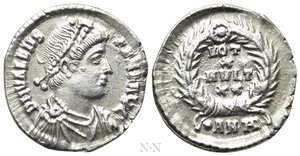
VALENS (364-378). Siliqua. Antioch. Obv: D N VALENS PER F AVG. Pearl-diademed, draped and cuirassed bust right.Rev: VOT / X / MVLT / XX / •AN(TA). Legend in four lines within wreath.RIC 34d. Condition: Good very fine.Weight: 2.14 g. Diameter: 17 mm.
Lot # 1118
-
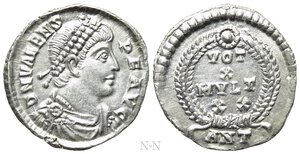
VALENS (364-378). Siliqua. Antioch. Obv: D N VALENS P F AVG. Pearl-diademed, draped and cuirassed bust right.Rev: VOT / X / MVLT / XX / ANT. Legend in four lines within wreath.RIC 34b.1. Condition: Extremely fine.Weight: 1.69 g. Diameter: 17 mm.
Lot # 1117
-
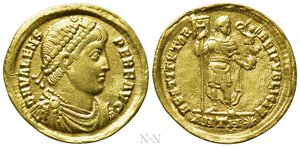
VALENS (364-378). GOLD Solidus. Antioch. Obv: D N VALENS PER F AVG. Pearl-diademed, draped and cuirassed bust right.Rev: RESTITVTOR REIPVBLICAE / ANTH (star). Valens standing facing, head right, holding labarum with cross and victoriola.RIC 2c.xxix.Flavius Julius Valens was the younger brother of Valentinian I. After serving as protector domesticus (personal guard) of Julian II and Jovian, he immediately became emperor of the East in 364 thanks to his brother who was already Augustus of the West, although the two differed in faith. Valens in fact was an Arian, while Valentinian was a Nicene Christian. The first problem was presented by the usurper Procopius, comes of Antioch, who proclaimed himself Augustus of the East in 365. Valens defeated him, sentenced him to death and struck with damnatio memoriae. He later faced the Visigoths and a second conspiracy, hatched by Theodore of Antioch. In 374 Valens celebrated the decennalia and became Maximus Augustus in 375 on the death of his brother, after which he organized an expedition against the Persians that proved unsuccessful, forcing him to sign an unfavorable peace. Another problem was the confluence of Ostrogoths and Visigoths into Roman territory across the Danube because of the advance of the Huns. The Romans were forced to accept them, but this integration was not easy; the Visigoths felt oppressed and exploited as a labor-power, resulting in an insurrection. Valens, considered a general of little ability by his contemporaries, was thus induced to recruit Goth mercenaries, with the risk that they would end up allied with his enemies. In fact, a large contingent of Visigoths, Ostrogoths, Huns, and Alamanni joined forces to fight the Romans and achieved a decisive victory at Hadrianopolis (Thrace) in 378. The tremendous defeat was caused by Gratian, who was meanwhile on the Western throne and did not arrive in time with his troops. Valens died in the battle but the Goths failed to conquer Constantinople. According to Ambrose, bishop of Mediolanum, the defeat at Hadrianopolis heralded the fall of the empire and the end of the world. Condition: Good very fine.Weight: 4.39 g. Diameter: 22 mm.
Lot # 1116
-
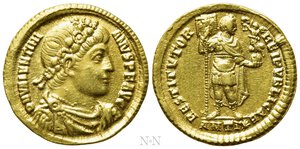
VALENTINIAN I (364-375). GOLD Solidus. Antioch. Obv: D N VALENTINIANVS P F AVG. Rosette-diademed, draped and cuirassed bust right.Rev: RESTITVTOR REIPVBLICAE / ANTI (star). Valentinian standing facing, head right, holding labarum with cross on banner and victoriola.RIC 2b.xxx.6. Condition: Good very fine.Weight: 4.45 g. Diameter: 21 mm.
Highlight
Lot # 1115
-
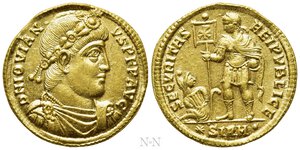
JOVIAN (363-364). GOLD Solidus. Sirmium. Obv: D N IOVIANVS P F AVG. Rosette-diademed, draped and cuirassed bust right.Rev: SECVRITAS REIPVBLICE / (star) SIRM•. Jovian standing left, wearing military attire, holding globe and vexillum with christogram; Persian captive seated on ground to left, looking right.RIC 112; Depeyrot 23/3.Very rare Condition: Near extremely fine.Weight: 4.46 g. Diameter: 21 mm.
Lot # 1114
-
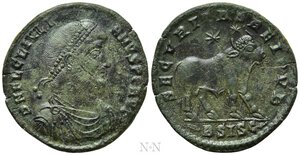
JULIAN II APOSTATA (360-363). Ae. Siscia. Obv: D N FL CL IVLIANVS P F AVG. Diademed, draped and cuirassed bust right.Rev: SECVRITAS REI PVB / (palm) BSISC (palm). Bull standing right; two stars above.RIC 418. Condition: Near mint state.Weight: 8.54 g. Diameter: 29 mm.
Lot # 1113
-
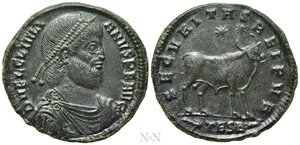
JULIAN II APOSTATA (360-363). Ae. Thessalonica. Obv: D N FL CL IVLIANVS P F AVG. Diademed, draped and cuirassed bust right.Rev: SECVRITAS REIPVB / (palm)TESB(palm). Bull standing right; two stars above.RIC 225. Condition: Extremely fine.Weight: 8.67 g. Diameter: mm.
Lot # 1112
-
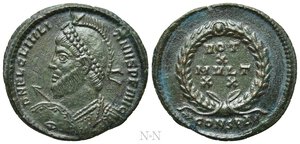
JULIAN II APOSTATA (360-363). Ae. Constantinople. Obv: D N FL CL IVLIANVS P F AVG. Helmeted, diademed and cuirassed bust left, holding shield and spear.Rev: VOT / X / MVLT / XX / (palm) CONSPΔ (palm). Legend in four lines within wreath.RIC 166. Condition: Extremely fine.Weight: 2.32 g. Diameter: 21 mm.
Lot # 1111
-
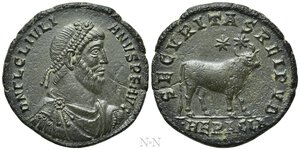
JULIAN II APOSTATA (360-363). Ae. Heraclea. Obv: D N FL CL IVLIANVS P F AVG. Diademed, draped and cuirassed bust right.Rev: SECVRITAS REIPVB / •HERACL•A/•. Bull, with head facing, standing right; two stars above.RIC 104. Condition: Good very fine.Weight: 8.56 g. Diameter: 27 mm.
Lot # 1110
-
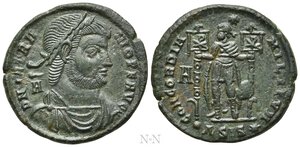
VETRANIO (350). Ae. Siscia. Obv: D N VETRANIO P F AVG. Laureate, draped and cuirassed bust right; A to left.Rev: CONCORDIA MILITVM / A / •ASIS (star). Vetranio standing facing, head left, holding labarum in each hand; star above.RIC 281. Condition: Near extremely fine.Weight: 5.09 g. Diameter: 24 mm.
Lot # 1109
-
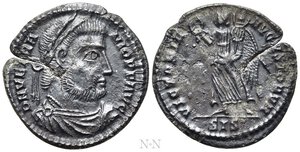
VETRANIO (350). Siliqua. Siscia. Obv: D N VETRANIO P F AVG. Laureate, draped and cuirassed bust right.Rev: VICTORIA AVGVSTORVM / SIS. Victory advancing left, holding wreath and trophy.RIC 267.Vetranio was a valiant soldier of humble origins who served under Constantine I and became magister militum under Constans I, proving himself an experienced officer. When the usurper Magnentius killed Constantus in 350, Constantina, sister of Constantius II and Constantus I, asked Vetranio to proclaim himself augustus to protect his family, as the Danubian troops would be more loyal to him than to an emperor in the far East. He was proclaimed augustus at Sirmium in March 350. Constantius, who was involved against the Sasanids, accepted him as a colleague, sending him a diadem and money and putting him in command of Danubian troops to fight Magnentius. Vetranio was initially loyal to Constantius, but then their relationship broke down and he decided to ally himself with Magnentius. The two sent a peace proposal, demanding the marriages of Magnentius to Constantina and Constantius to Magnentius' daughter, but Constantius refused. Vetranio then met with the latter first at Serdica, then at Naissus, where he was deposed on December 25, 350. Constantius managed to get the troops to acclaim him emperor and stripped Vetranio of his purple, but rewarded him with an estate at Prusa in Bithynia, where, however, he committed suicide in 356. Condition: Very fine.Weight: 2.94 g. Diameter: 20 mm.
Lot # 1108
-
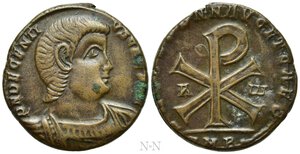
DECENTIUS (Caesar, 350/1-353). Ae. Ambianum. Obv: D N DECENTIVS CAESAR. Bareheaded and cuirassed bust right.Rev: SALVS DD NN AVG ET CAES / AMB. Large Chi-Rho; A - ω across field.RIC 40. Condition: Good very fine.Weight: 7.48 g. Diameter: 24 mm.
Lot # 1107
-
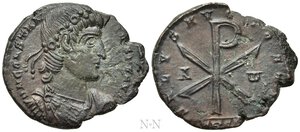
CONSTANTIUS II (337-361). Ae. Treveri. Obv: D N CONSTANTIVS P F AVG. Rosette-diademed, draped and cuirassed bust right.Rev: SALVS AVG NOSTRI / TRS (star). Large Christogram; A - ω across field.RIC 333.RareThis coin belongs to the period of Poemenius' revolt against Magnentius and Decentius, whenTreveri mint began minting hybrid coins in the name of Constantius II and with Magnentius' typical christogram. Condition: Good very fine.Weight: 7.15 g. Diameter: 36 mm.
Lot # 1106
-
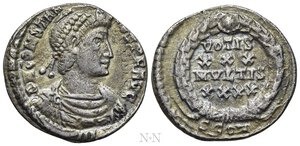
CONSTANTIUS II (337-361). Siliqua. Arelate. Obv: D N CONSTANTIVS P F AVG. Diademed, draped and cuirassed bust right.Rev: VOTIS / XXX / MVLTIS / XXXX / SCON. Legend in four lines within wreath.RIC 207. Condition: Near very fine.Weight: 1.91 g. Diameter: 17 mm.
Lot # 1105
-
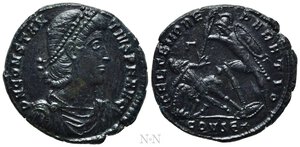
CONSTANTIUS II (337-361). Ae. Constantinople. Obv: D N CONSTANTIVS P F AVG. Diademed, draped and cuirassed bust right.Rev: FEL TEMP REPARATIO / Γ / CONSЄ (star). Helmeted soldier with shield to left, spearing falling horseman.RIC 81. Condition: Extremely fine.Weight: 6.20 g. Diameter: 23 mm.
Lot # 1104
-
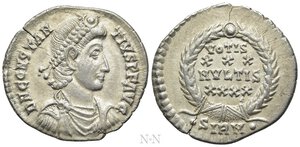
CONSTANTIUS II (337-361). Siliqua. Sirmium. Obv: D N CONSTANTIVS P F AVG. Diademed, draped and cuirassed bust right.Rev: VOTIS / XXX / MVLTIS / XXXX / •SIRM•. Legend in four lines within wreath.RIC 66. Condition: Very fine.Weight: 3.21 g. Diameter: 20 mm.
Lot # 1103
-
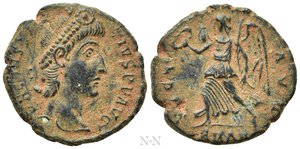
CONSTANTIUS II (337-361). Ae. Antioch. Obv: D N CONSTANTIVS P F AVG. Diademed head right.Rev: VICT AVG / SMAN[...]. Victory advancing left, holding palm branch and wreath.RIC 65.Rare Condition: Good very fine.Weight: 1.62 g. Diameter: 14 mm.
Lot # 1102
-
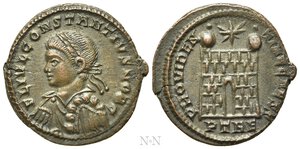
CONSTANTIUS II (Caesar, 324-337). Follis. Treveri. Obv: FL IVL CONSTANTIVS NOB C. Laureate, draped and cuirassed bust left.Rev: PROVIDENTIAE CAESS / PTRE. Camp gate with open door and two towers; star above.RIC 506. Condition: Extremely fine.Weight: 2.98 g. Diameter: 19 mm.
Lot # 1101
-
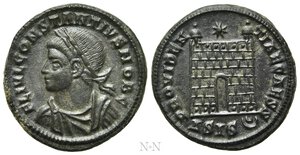
CONSTANTIUS II (Caesar, 324-337). Follis. Siscia. Obv: FL IVL CONSTANTIVS NOB C. Laureate, draped and cuirassed bust left.Rev: PROVIDENTIAE CAESS / ΔSIS (double crescent). Camp gate, with two turrets and open doorway; star above, pellets in top and bottom stone layers.RIC 217. Condition: Extremely fine.Weight: 3.41 g. Diameter: 19 mm.
Lot # 1100
-
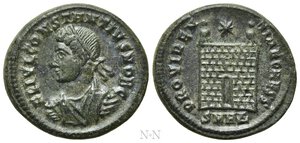
CONSTANTIUS II (Caesar, 324-337). Follis. Heraclea. Obv: FL IVL CONSTANTIVS NOB C. Laureate, draped and cuirassed bust left.Rev: PROVIDENTIAE CAESS / SMHΔ. Camp gate with two turrets and no doors; star above.RIC 78. Condition: Extremely fine.Weight: 3.59 g. Diameter: 19 mm.
Lot # 1099
-
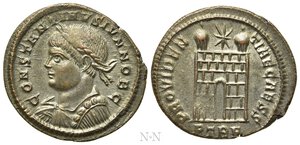
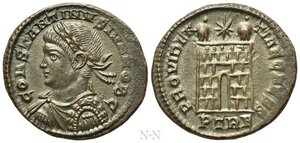
CONSTANTINE II (Caesar, 316-337). Follis. Treveri. Obv: CONSTANTINVS IVN NOB C. Laureate, draped and cuirassed bust left.Rev: PROVIDENTIAE CAESS / PTRE. Camp gate with two towers and open door; star above.RIC 505. Condition: Extremely fine.Weight: 2.76 g. Diameter: 20 mm.
Lot # 1098
-
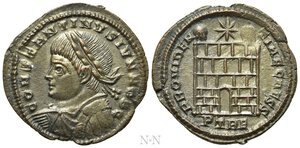
CONSTANTINE II (Caesar, 316-337). Follis. Treveri. Obv: CONSTANTINVS IVN NOB C. Laureate, draped and cuirassed bust left.Rev: PROVIDENTIAE CAESS / PTRE. Camp gate with two towers and no door; star above.RIC 505. Condition: Extremely fine.Weight: 3.03 g. Diameter: 19 mm.
Lot # 1097
-
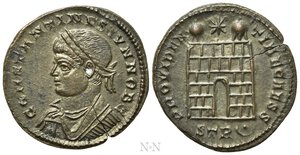
CONSTANTINE II (Caesar, 316-337). Follis. Treveri. Obv: CONSTANTINVS IVN NOB C. Laureate, draped and cuirassed bust left.Rev: PROVIDENTIAE CAESS / PTRE. Camp gate with two towers and no door; star above.RIC 505. Condition: Extremely fine.Weight: 2.26 g. Diameter: 20 mm.
Lot # 1096
-
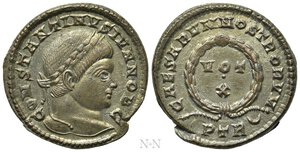
CONSTANTINE II (Caesar, 316-337). Follis. Treveri. Obv: CONSTANTINVS IVN NOB C. Laureate, draped and cuirassed bust left.Rev: PROVIDENTIAE CAESS / STR (pellet-in-crescent). Camp gate, with open door and two towers; star above.RIC 479. Condition: Extremely fine.Weight: 3.02 g. Diameter: 19 mm.
Lot # 1095
-
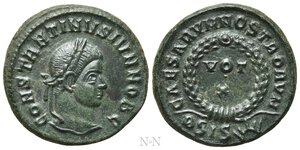
CONSTANTINE II (Caesar, 316-337). Follis. Treveri. Obv: CONSTANTINVS IVN NOB C. Laureate head right.Rev: CAESARVM NOSTRORVM / PTR (crescent). VOT / X in two lines within wreath.RIC 433. Condition: Extremely fine.Weight: 3.59 g. Diameter: 19 mm.
Lot # 1094
-
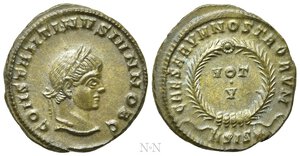
CONSTANTINE II (Caesar, 316-337). Follis. Siscia. Obv: CONSTANTINVS IVN NOB C. Laureate head right.Rev: CAESARVM NOSTRORVM / BSIS (sun). VOT / X in two lines within wreath.RIC 182. Condition: Extremely fine.Weight: 3.11 g. Diameter: 19 mm.
Lot # 1093
-
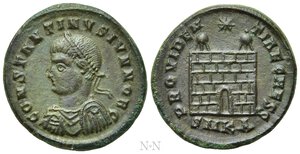
CONSTANTINE II (Caesar, 316-337). Follis. Siscia. Obv: CONSTANTINVS IVN NOB C. Laureate head right.Rev: CAESARVM NOSTRORVM / ASIS (star). VOT / V in two lines within wreath.RIC 163. Condition: Extremely fine.Weight: 3.27 g. Diameter: 19 mm.
Lot # 1092
-
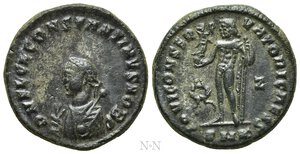
CONSTANTINE II (Caesar, 316-337). Follis. Follis. Cyzicus. Obv: CONSTANTINVS IVN NOB C. Laureate, draped and cuirassed bust left.Rev: PROVIDENTIAE CAESS / SMKA. Camp gate, with two turrets and no door; star above.RIC 26. Condition: Extremely fine.Weight: 3.45 g. Diameter: mm.
Lot # 1091
-
CONSTANTINE II (Caesar, 316-337). Follis. Cyzicus. Obv: D N FL CL CONSTANTINVS NOB C. Laureate and draped bust left, holding globus, sceptre and mappa.Rev: IOVI CONSERVATORI CAESS / Z / SMK. Jupiter standing left, holding crowning Victory on globe and sceptre; wreath to left.RIC 12. Condition: Good very fine.Weight: 2.87 g. Diameter: 19 mm.
Lot # 1090
-
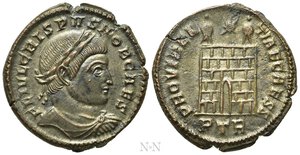
CRISPUS (Caesar, 316-326). Follis. Treveri. Obv: FL IVL CRISPVS NOB CAES. Laureate, draped and cuirassed bust right, seen from behind.Rev: PROVIDENTIAE CAESS / PTR. Campgate with two turrets; above, star.RIC 450. Condition: Good very fine.Weight: 3.61 g. Diameter: 20 mm.
Lot # 1089
-
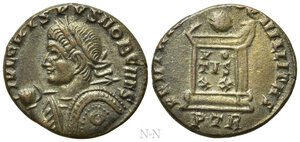
CRISPUS (Caesar, 316-326). Follis. Treveri. Obv: IVL CRISPVS NOB CAES. Laureate and cuirassed bust left, holding spear over shoulder and decorated shield.Rev: BEATA TRANQVILLITAS / PTR. Globus set upon altar inscribed VO / TIS / XX in three lines; three stars above.RIC 307. Condition: Good very fine.Weight: 2.56 g. Diameter: 18 mm.
Results from 23101 to 23150 of 32905